More on Qatzrin

August 20, 2010

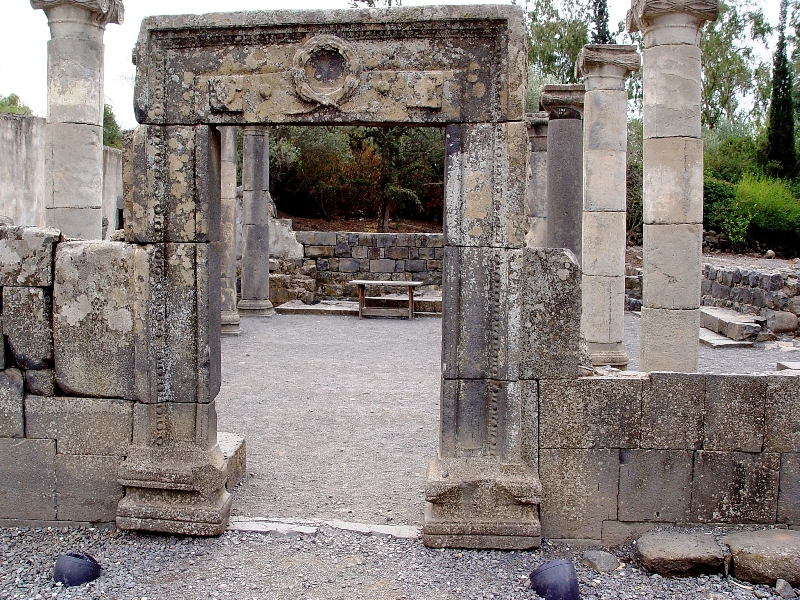
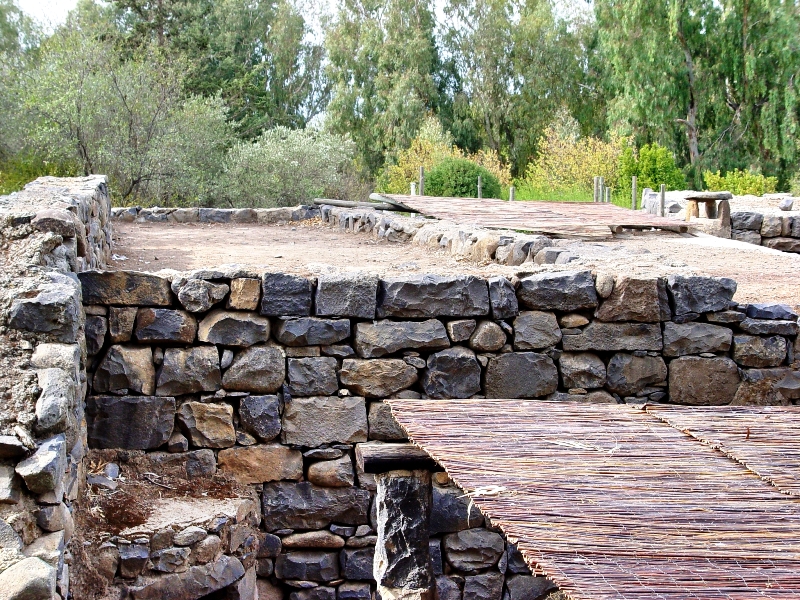
Qatzrin is located in the central Golan, 13 km northeast of the Sea of Galilee.  A settlement was here during the Iron Age, as well as the Hellenistic period, but it was during the Roman-Byzantine period that the village grew and became prosperous.  Our photo here features the synagogue.

Qatzrin Synagogue. Photo ©Leon Mauldin.

The synagogue, along with most of the village, was destroyed by an earthquake in AD 749.  The synagogue was excavated by D. Urman, M. Ben-Ari and S. Barlev, and later by Z. Maoz, R. Hachlili and A. Killebrew, on behalf of the Israel Department of Antiquities.

The Qatzrin houses were two-story structures.  As you look on the rooftop in our photo, think of that day in Joppa described in Acts 10:9: “On the next day, as they were on their way and approaching the city, Peter went up on the housetop about the sixth hour to pray.”

Housetop at Qatzrin. Photo ©Leon Mauldin.

The ancient housetop would have been much like today’s patio.  That was the setting when God showed Peter that the gospel message of salvation was for Gentiles, and not for Jews only (Acts 10-11).

Remember to click on image for higher resolution.


Home Life at Qatzrin, Golan

August 19, 2010

Paul wrote the evangelist Titus in the New Testament letter that bears his name, instructing him to “speak the things that are proper for sound doctrine” (Titus 2:1).  That included teaching God’s will for men and women, young and old. Older women were to teach (train, encourage) the younger women “to be self-controlled, pure, working at home, kind, and submissive to their own husbands, that the word of God may not be reviled” (2:5, ESV).

I want to notice the word kind. Older Christian women are to teach the younger women to be kind.  The Greek word is agathos, often elsewhere rendered “good” (and here in KJV, NKJV), but here is translated “kind” by most (NASB, NIV, NET, NRSV, etc.).

Why would kindness be specified as an essential trait for younger women to acquire?  There may be many reasons, but perhaps at least one factor was simply the labor intensive lifestyle that characterized home responsibilities.

In the Golan, the restoration of Qatzrin gives us a glimpse of daily life in the time of Jesus and the centuries immediately to follow.

Qatzrin at Golan. Map by holylandphotos.org.

There are variant spellings for Qatzrin, such as Katzrin on this map; also Qasrin. The site is northeast of the Sea of Galilee.  This Talmudic Village was occupied during AD 4th-8th centuries.  Qatzrin was excavated by Z. Ma’oz and A. Killebrew.  The villiage has been reconstructed and furnished with artifacts from the period.

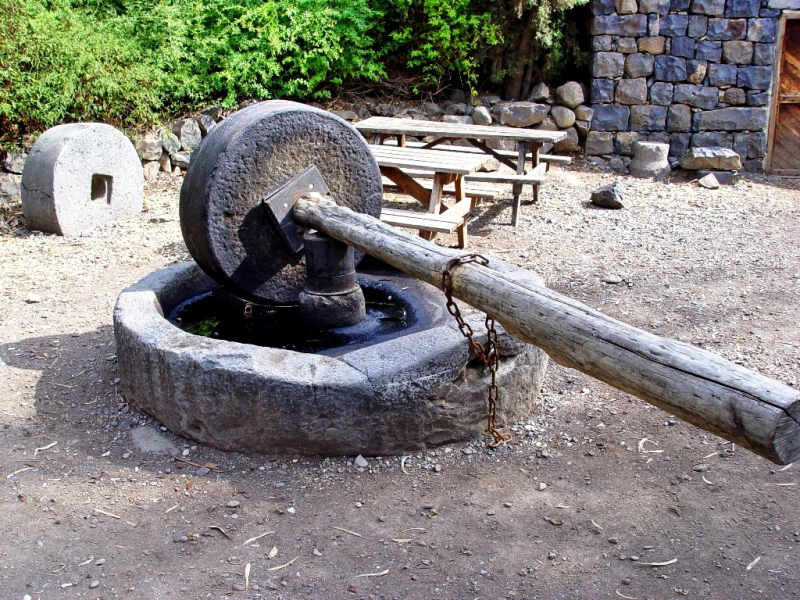
Our photo below shows a basalt olive-crushing mill. A different situation than simply going to the local supermarket and picking up a bottle of olive oil!

Basalt olive-crushing mill at Qatzrin. Photo ©Leon Mauldin.

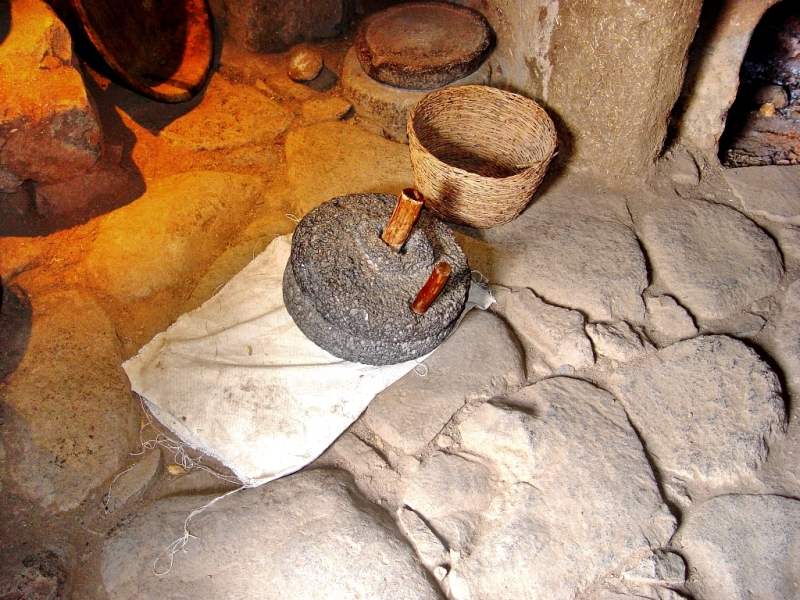
Grinding grain for bread had to be done regularly.  Some millstones had two handles, and were designed for two women (cf. Matt. 24:41).

Millstone for two women. Qatzrin. Photo ©Leon Mauldin.

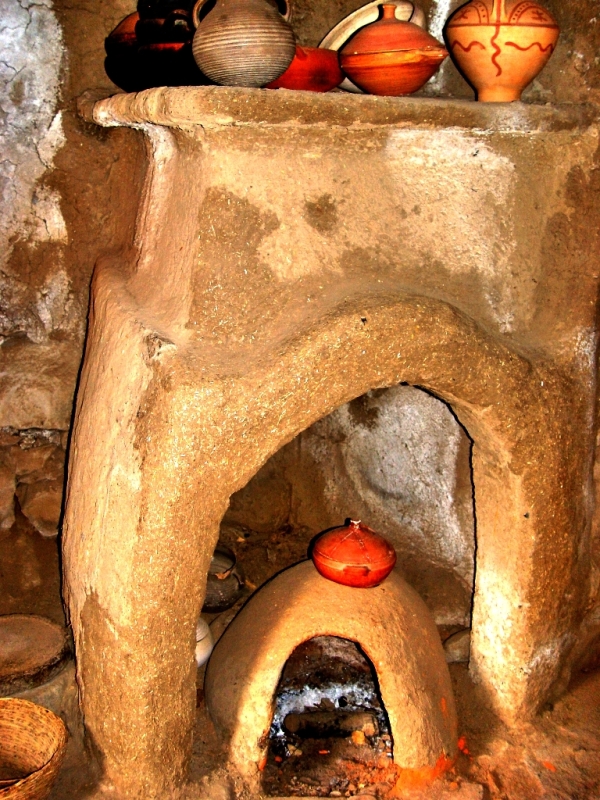
Qatzrin features a fully-restored house with all its furnishings.

Inside house at Qatzrin. Oven. Photo ©Leon Mauldin.

This isn’t exactly what we would call “fast food.”  The daily domestic duties would include a lot of hard work!  It would be quite conceivable that the cumulative effect would be to make a young mother/wife bitter and resentful.

What do you think?  I believe the nature of daily life with its responsibilities furnish at least one important reason for Paul’s injunction that older women teach the younger women to be kind. I’m thankful for the kind of work that has been done at Qatzrin which helps take us back to life during biblical times.


The Manger, a Bassinet for Jesus

August 17, 2010

The Gospel writer Luke tells of the night Jesus was born in Bethlehem:

8 Now there were in the same country shepherds living out in the fields, keeping watch over their flock by night. 9 And behold, an angel of the Lord stood before them, and the glory of the Lord shone around them, and they were greatly afraid. 10 Then the angel said to them, “Do not be afraid, for behold, I bring you good tidings of great joy which will be to all people. 11 “For there is born to you this day in the city of David a Savior, who is Christ the Lord. 12 “And this will be the sign to you: You will find a Babe wrapped in swaddling cloths, lying in a manger.” 13 And suddenly there was with the angel a multitude of the heavenly host praising God and saying: 14 “Glory to God in the highest, And on earth peace, goodwill toward men!” (2:8-14).

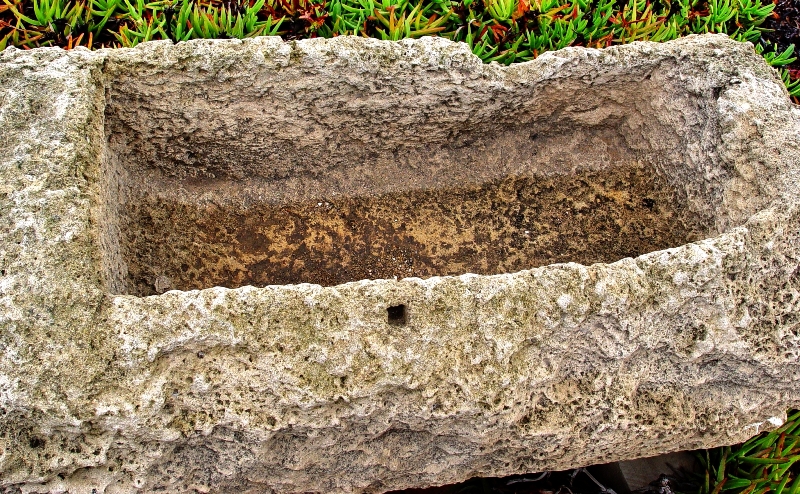
What comes to your mind when you read of Jesus’ lying in a manger? Our photo shows a manger (located in Caesarea Maritima) which illustrates that which served as a bassinet for Jesus as an infant.

Manger (Caesarea Maritima). Photo ©Leon Mauldin.

I never cease to be amazed at the thought! Eternal Deity, Eternal God, the Word became flesh (John 1:14).  The One who created all things (John 1:1-3) came to earth, and a feeding trough was His bassinet!  Jesus always was and always is divine, but He became human, He became flesh, that He might die for our sins (Heb. 2:14-15; 1 Pet. 2:24).

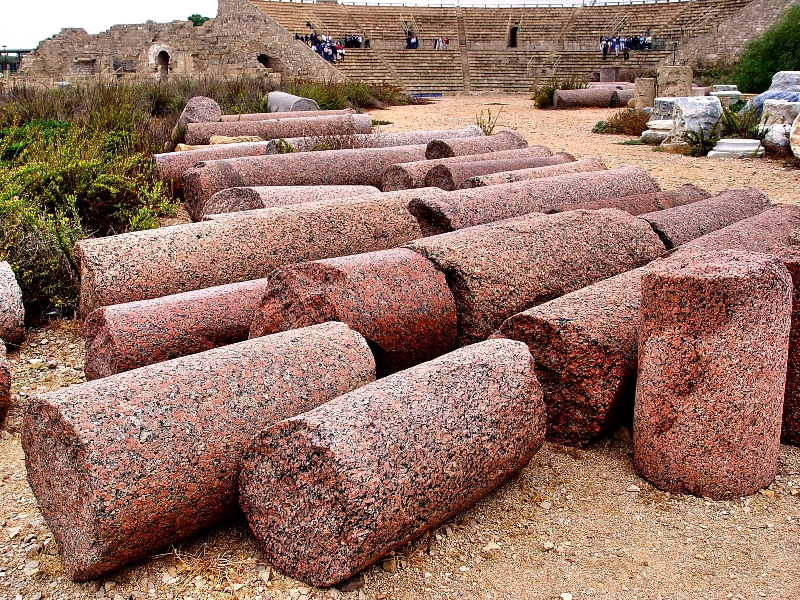
On another note, while one is visiting Caesarea on the coast, you can see the ruins of Roman columns.

Roman Columns at Caesarea. Imported from Aswan Egypt. Photo ©Leon Mauldin.

Those in our photo are pink granite.  These were not quarried locally, but were imported from Aswan Egypt.  This reflects that because Caesarea was the Roman capital of Israel, there was sufficient wealth and resources to acquires such materials.  In the background of photo you can see the theater. Remember to click on images for higher resolution.

Other Matters.

Obituary. Our friend bro. Dave Bradford passed away this past Thursday. He had served as evangelist for the church of Christ at Auburn 27 years (during part of which time he also served as elder), but for the past 6+ years had been located in Cullman AL.  On numerous occasions we did radio programs together.  I always enjoyed the association.  He had been plagued with failing health for the past several years.  Funeral services were conducted Saturday at Hoover, AL, with Bill Simmons, as well as Tom Holley, Perry Hurst and John Christian speaking.  Singing was led by Doyle Bullard.

Schedule. I’m looking forward to being at Salem, IL., beginning this Sunday, for a 6-day series which will include my “Steps of Paul” series plus other lessons.  Such speaking opportunities provide occasions for usage of Bible lands photos, and reinforce the historicity of the biblical record.


Alexandria, Egypt and Ptolemy II

August 14, 2010

Greetings from Atlanta, where we are in a 2 day/4 lesson series on the Life of Christ, surveying the Gospel records, and making use of photos of the locations of the events of Jesus’ ministry.  It is rewarding to see folks’ understanding of scripture enhanced and illuminated by seeing where the biblical events occurred.  It is good for my wife and me to be in the home of Sewell and Canita Hall, and to be with the Embry Hills church for this effort.

The discovery of a gold coin at Kadesh (northern city of refuge, see Josh. 20:7) was reported by the Israeli Antiquities Authority:

An extremely rare 2200-year old gold coin was uncovered recently in the excavations of the University of Michigan and University of Minnesota at Tell Kedesh in Israel near its Lebanese border. The coin was minted in Alexandria by Ptolemy V in 191 BCE and bears the name of the wife of Ptolemy II, Arsinoë Philadephus (II).

Ferrell Jenkins reported on this in his blog: http://ferrelljenkins.wordpress.com/2010/08/12/ptolemaic-gold-coin-found-at-tel-kedesh/

See also Todd Bolen’s informative post athttp://blog.bibleplaces.com/2010/08/hellenistic-gold-coin-found-at-kedesh.html

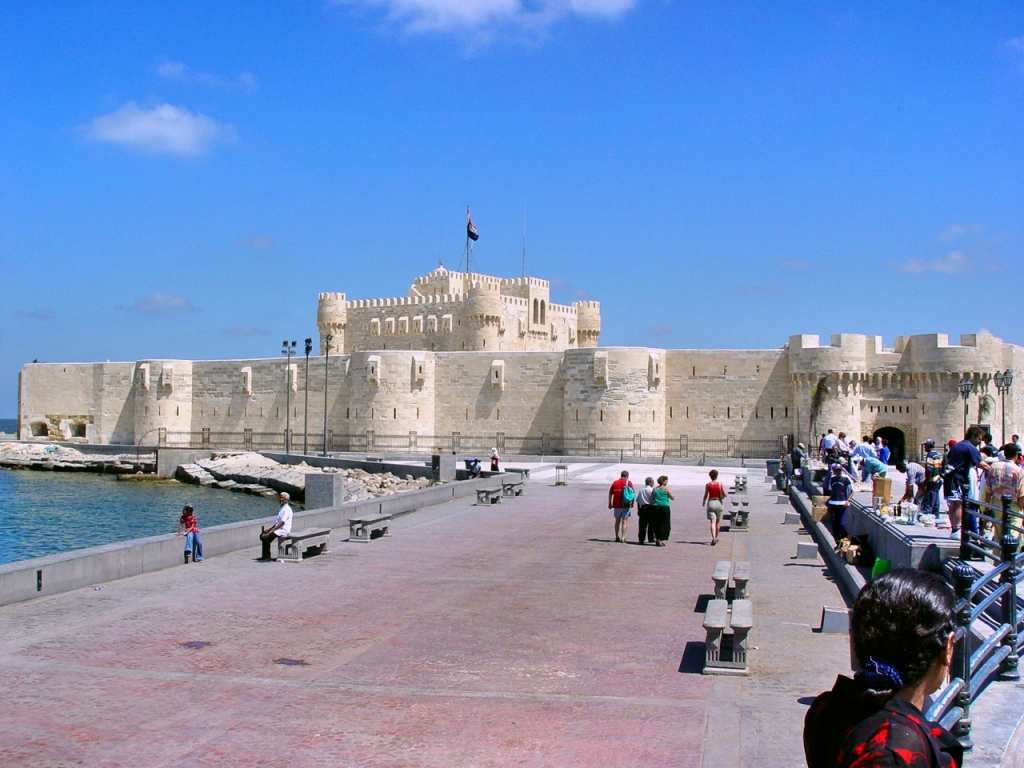
Reading of this fascinating find reminded me of a couple of photos I thought I’d share.  As stated above, the coin was minted at Alexandria.

Alexandria, Egypt. Photo ©Leon Mauldin.

This photo shows the location of the famous lighthouse, one of the Seven Wonders of the Ancient World.

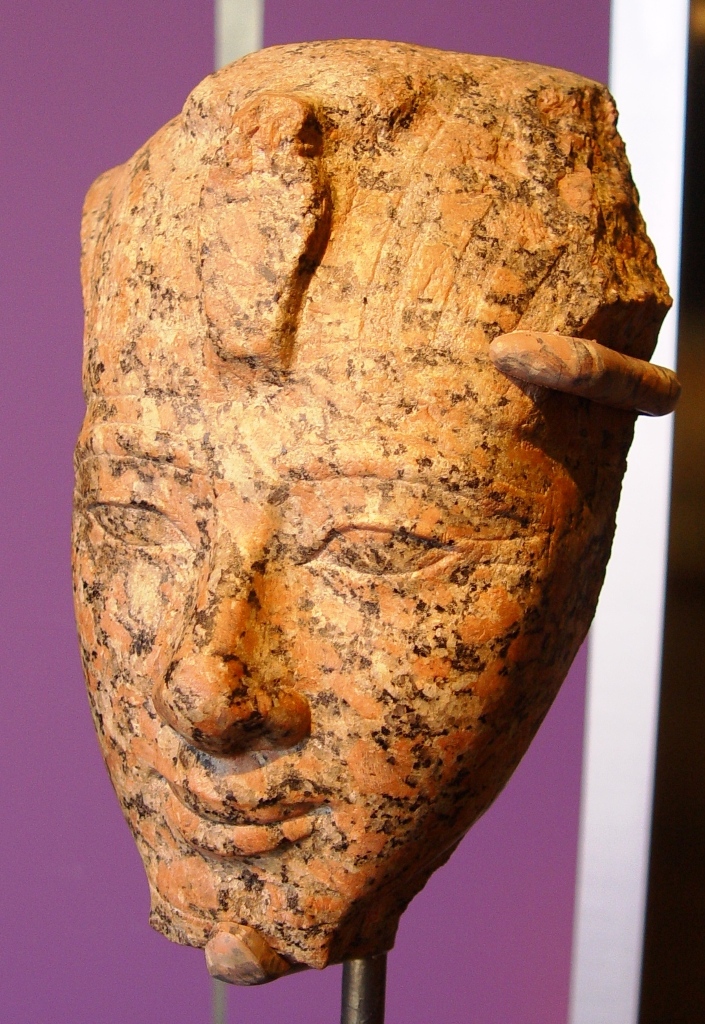
Also, note that the coin bears the image of the wife of Ptolemy II.  See photo below:

Ptolemy II. Brooklyn Museum. Photo ©Leon Mauldin.

Ptolemy II is the ruler who wanted the Hebrew Scriptures translated into Greek.  This was done in Alexandria.  Almost every OT quotation by Jesus and the NT writes is from this Greek translation, the Septuagint (LXX).


Homeward Bound

August 9, 2010

We are to leave the Morrow home shortly for the airport for the flight home. This has been a great trip and I trust that only good has been accomplished. I am grateful for every opportunity to teach God’s word.

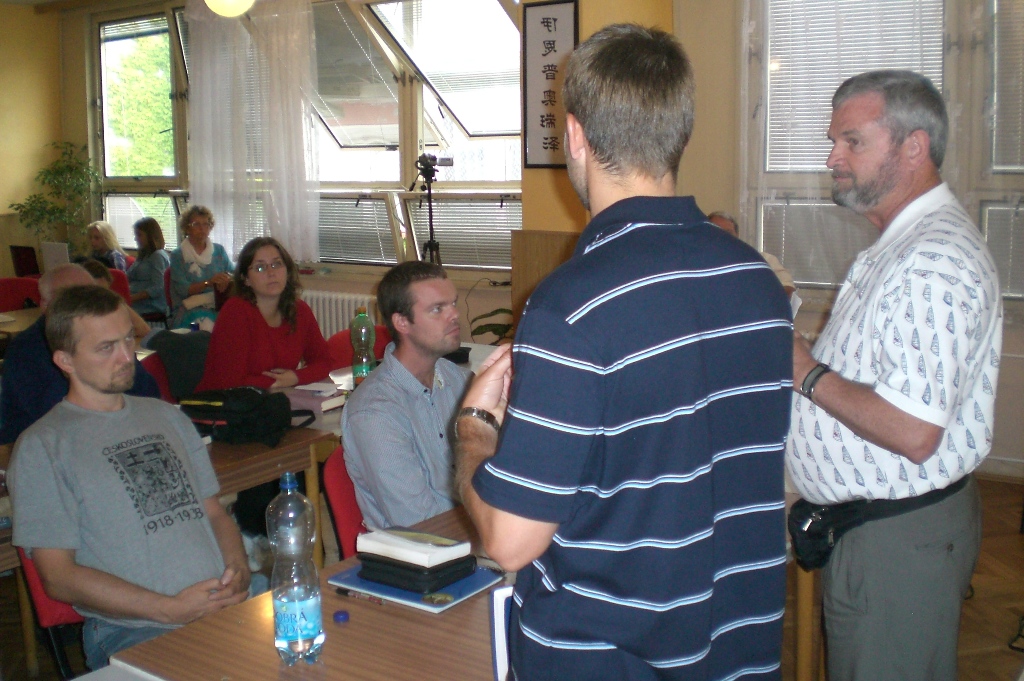
The photo below is from one of the sessions in Kamenice.  Mike does a great job of planning these annual lectures.
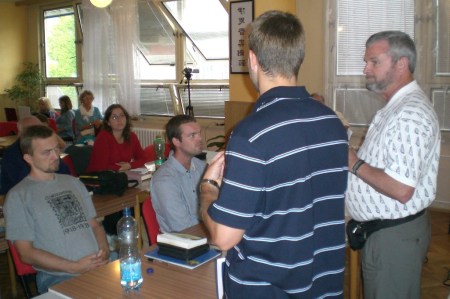
Session at Kamenice. Mike Morrow on far right. Photo by Leon Mauldin.

Mike’s lovely wife Tatiana helped me by inserting Czech translation for English text in my PowerPoint slides.  I’m glad my wife Linda could be with her as well as the other ladies here.
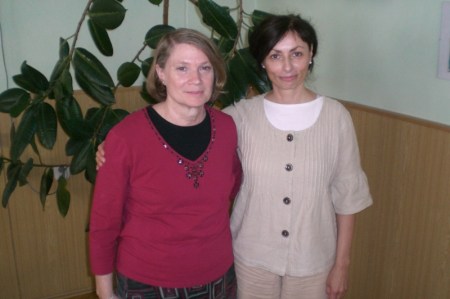
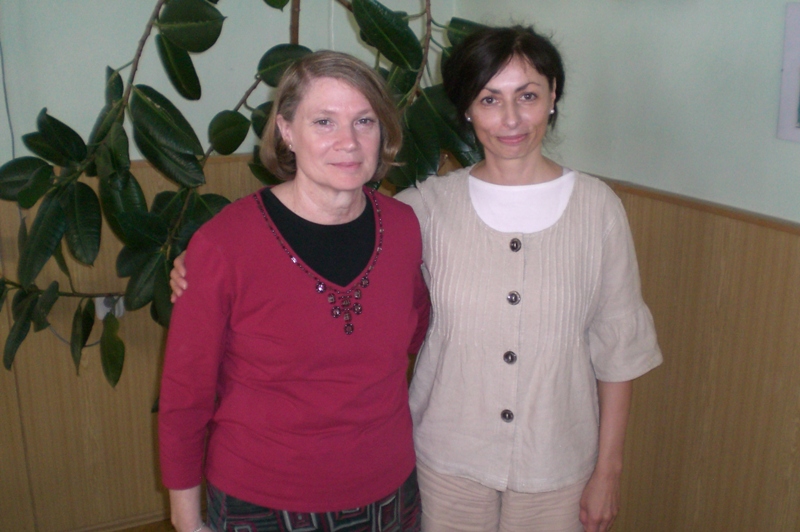
Tatiana Morrow (right) and Linda Mauldin. Photo by Leon Mauldin.

This annual lectureship furnishes a wonderful opportunity for European Christians from a widespread area to give and receive encouragement to/from one another.

One of the questions that was asked during a Q&A was on the subject of cremation; what does the Bible say?  Here is an answer I posted some years ago on www.goodfight.com (click on “Short Answers to Tough Questions”).

Question: What does the Bible say about cremation?

Answer:

1. Passages–What few Biblical references are made to cremation are in the Old Testament. 1 Sam. 31:11-13: Burning of bodies of Saul & his sons; this probably was an emergency measure lest the Philistines further molest the bodies. Lev.20:14; 21:9: Those guilty of sexual immorality.  Josh. 7:15,25: Those under a curse such as Achan and his family were to be burned. Occurrence of cremation is rare and exceptional.

2. Lack of proper burial was a great misfortune 1 Kgs.13:22; Jer. 16:6.

3. Related passages: Amos 2:1: He (Moab) burned the bones of the king of Edom into lime. cf. Amos 6:10.

4. Quotation from Edersheim: “Cremation was denounced as a purely heathen practice, contrary to the whole spirit of Old Testament teaching.” (Sketches of Jewish Life, p. 16).

5. The Bible Almanac, p.95:

Ghassul flourished during the latter half of the [?] fourth millennium. Archaeologists have documented the Ghassulian custom of burying the dead in ossuaries (ceramic receptacles for bones) in many other areas, particularly the coastal cities near modern Tel Aviv. These ossuaries were usually shaped like animals or houses, in imitation of those used in daily life. After the body was cremated mourners buried the ossuary in a stone cistern together with provisions for the afterlife.

6. Guy Woods:

Life is the union of the body and spirit; death the condition resulting from their separation. Once the spirit has flown, the body is lifeless and begins its return to its original elements. Whether the return is the slow disintegration of the body through the processes of decay or is achieved in seconds by fire, the result is the same–the return of the body’s elements to their original state. In the resurrection, these “building blocks” will be re-assembled… We are taught in the New Testament, largely by example, to exhibit proper respect for the dead and to deal with them in dignified and respectful fashion…

7. N.T. Emphasis. As I reflect upon the question, emphasis is placed on using one’s body in life to glorify the Lord (Rom. 12:1,2; 1 Cor. 6:18- 20); and upon the entrance of the soul into the hadean world at the point of death. Emphasis is not given to the disposal of the body. Stress is not placed on the funeral, but upon the life one lives prior to the funeral. cf. Lk.12:4; Matt. 10:28. Our hope is the resurrection with the new, spiritual, immortal body (see 1 Cor. 15; Rom. 8:18ff.; Phil. 3:20-21; 1 John 3:1-4).

8. Personal Preference. The question does not ask for my personal preference… but I do not want cremation for myself, or for any member of my family. But I know of no New Testament principle that is violated by cremation, if one does make that choice.
On to Ceske Budejovice

August 7, 2010

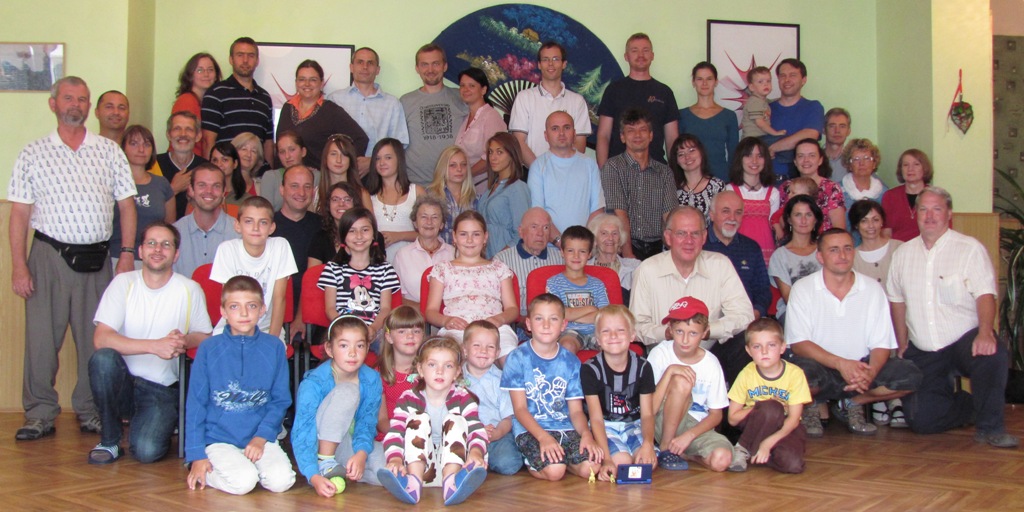
The lectures at Kamenice were well attended and enjoyable in every way.  It is wonderful to see folks we’ve known for many years, and also to meet new brethren.  My wife and I were both tired last night (actually we still are today), but it’s a good kind of tired. As I mentioned on my previous post, families and individuals traveled in some cases great distances, plus there were folks from various places in the Czech Republic.  See group photo below: (Click on image for larger view).

I was speaking each morning, and Bill Bynum each evening.  We also conducted a 2 hr Q&A session each afternoon.  Photo below shows Bill (on right), and my wife Linda and me.

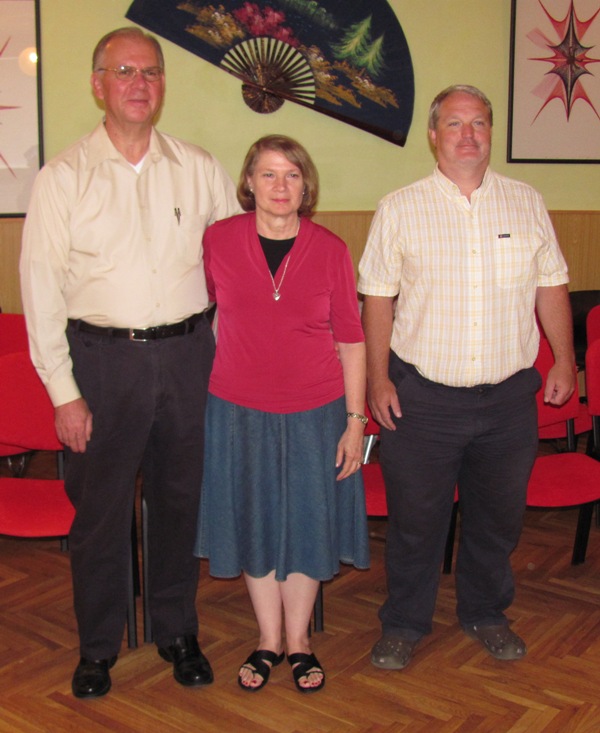
Leon & Linda Mauldin, and Bill Bynum. Kamenice Lectureship 2010.

As I surveyed the Old Testament, I began by giving the setting of the biblical world.  We talked about the amazing variety of the land of Israel.  At Joppa you are at sea level; at Jerusalem 35 miles inland you are 2500+ feet above sea level, and another 14 miles NE at Jericho you are 800 feet below sea level!

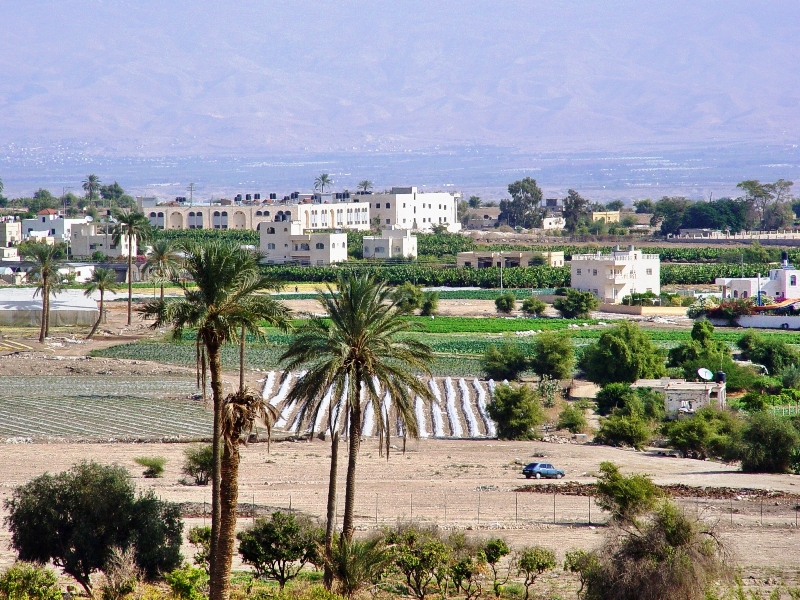
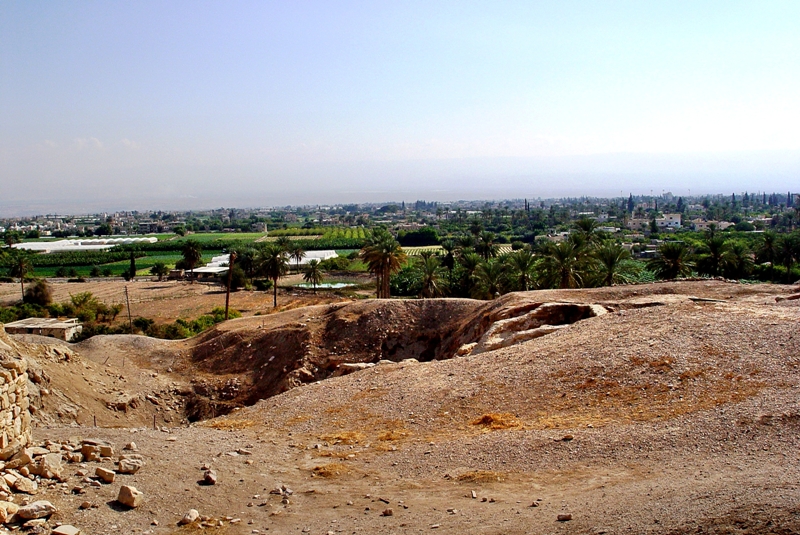
In the Bible Jericho is called the “city of palm trees” (Deut. 34:3).  In the photo below you can see why:

Jericho, biblical "city of palm trees." 800 feet below sea level. Photo ©Leon Mauldin.

In the distance you can see across the Jordan the hill country of Moab.  This was the home of Ruth, who was the great-grandmother of David (Ruth 4:18ff).

Here’s another shot of Jericho. In the foreground you see a portion of the ancient tel.  This was the first city taken by Joshua and the men of Israel after crossing the Jordan for the conquest of Canaan (see Joshua 6).  Because it was a kind of “first-fruits” of the land, the city was devoted to the Lord, instead of the spoils being divided up among the men of war.

OT Jericho. Ancient tel in foreground. Photo ©Leon Mauldin.

Today it has rained all day.  This morning, Mira, a friend and brother from Ceske Budejovice, arrived at Kamenice and drove my wife and me to Ceske Budejovice.  I am to preach here in the morning at worship services, and then spend some time visiting Mira and his good family on Mon.

This is my fourth trip to the Czech Republic.  I met Mira back in 1992 on that first trip.  It is a joy to see him again.  This city has an ancient history, dating back to the 12 century.  This is Linda’s first opportunity to travel here; I’ve wanted her for a long time to see a place which has been very special to me.


Lectures at Kamenice

August 3, 2010

This evening completes day two of the lectures at Kamenice.  Sessions are scheduled from 9 AM to 9 PM, so we’ve not had much time for posting.  We are sure enjoying the association of Christians who have gathered here for the week, many of whom have traveled hundreds of miles to be here.  I am thankful to God for such opportunities.

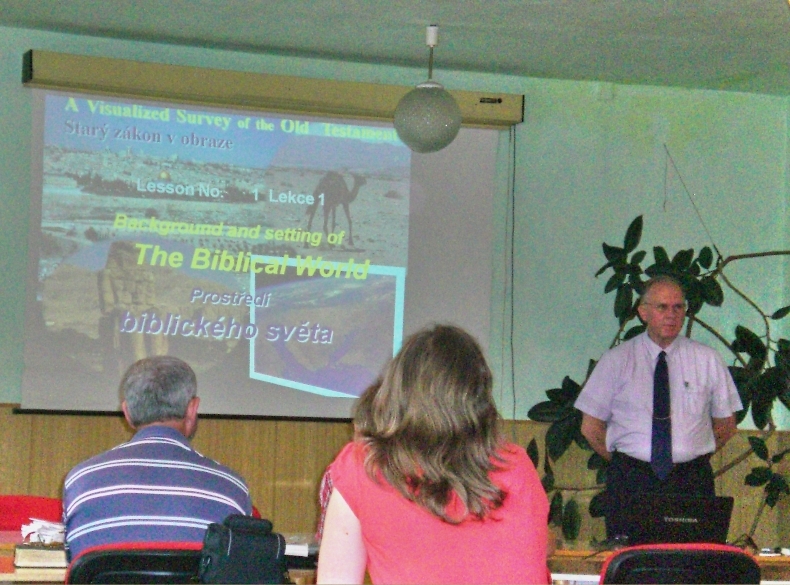
I have been asked to do a historical survey of the Old Testament.  I’m making use of hundreds of photos of Bible places as the events of scripture are narrated.

Lectures Kamenice Czech

My slides which include text are in both English and Czech.  As I speak a Czech translates for me.

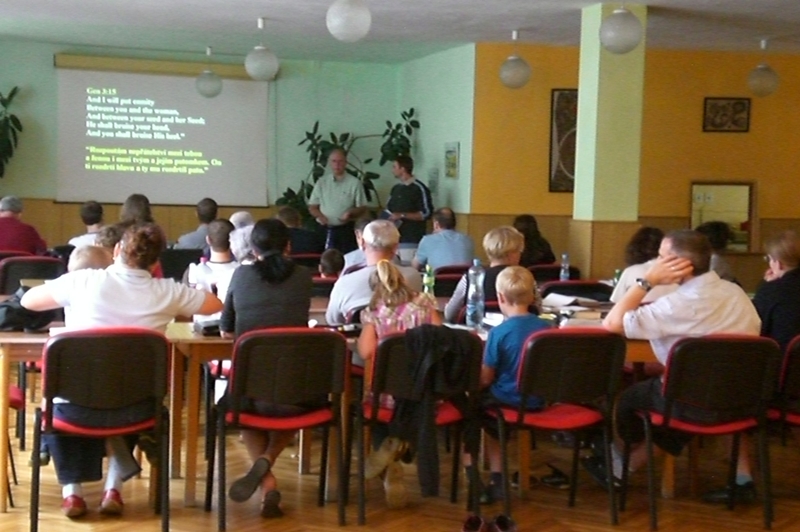
This series gives us an opportunity to study the theme of the Bible, the unfolding of God’s plan to save mankind through the redemptive work of Jesus Christ.  The first promise of Christ is found in Genesis 3:15, depicted below:

Lectureship at Kamenice

Kamenice is a very nice Czech village.  Perhaps I can share a few photos with you in the next day or two.

It is great to be associated with my friend and fellow preacher Bill Bynum.  He makes two trips per year to encourage European Christians in remote places.  Previously he has lived and worked as evangelist both in Czech as well as Hungary.

Click on photos for larger view. More later.


Safe Arrival at Prague

July 31, 2010

My wife and I arrived safely in Prague this morning.  I’m looking forward to teaching at the local congregation Sun AM, and then speaking at the annual lectureship at Kamenice Mon-Fri. It is good to be with Mike Morrow for this effort.

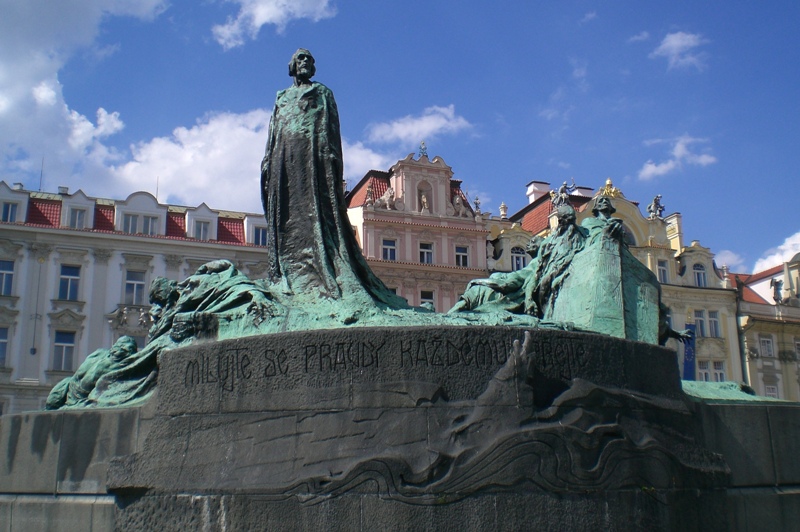
This afternoon Linda and I had the occasion to do some walking in and around the historic square in Prague.  There is a monument to the reformer John Huss, a Czech priest, philosopher and religious reformer.

John Huss. Prague. Photo ©Leon Mauldin.

John Huss was burned at the stake for his faith on July 6, 1415.  He continues to be held in high esteem by the Czechs.

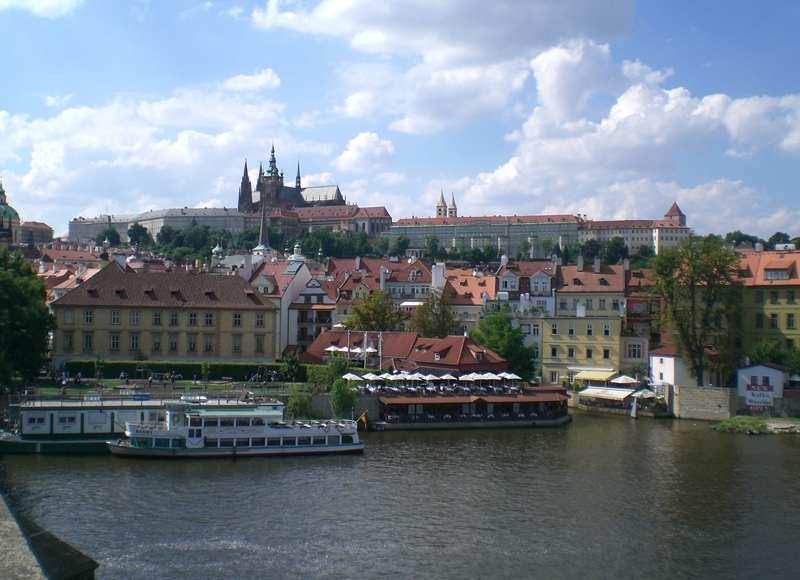
From the Charles Bridge over the Vltava River you have a view of the Czech Castle, seen at skyline of our photo.

Prague Castle. View from Vltava River. Photo ©Leon Mauldin.

Click on images for larger view/higher resolution.


“The next day unto Rhodes” (Acts 21:1)

July 28, 2010

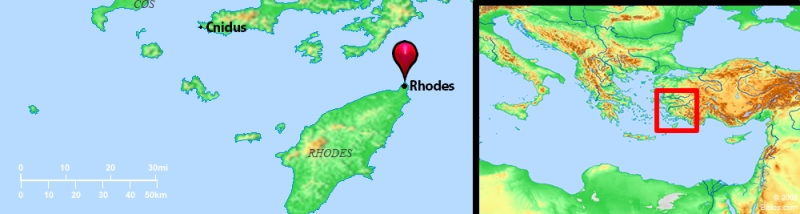
As Paul’s Third Missionary Journey neared its close, with Paul and his fellow travelers sailing the Mediterranean toward their destination of Jerusalem, Luke notes,  “Now it came to pass, that when we had departed from them [Ephesian Elders at Miletus] and set sail, running a straight course we came to Cos, the following day to Rhodes…” (Acts 21:1). Rhodes was an island off the southwestern shore of the Roman province of Asia Minor.  See map:

Island and City of Rhodes. Map courtesy of bibleatlas.org

You will notice both the island of Rhodes, and the city by that same name.  Regarding our Acts 21:1 passage quoted above, F.F. Bruce observes,

“Rhodes” here refers to the city rather than to the island of the same name (the chief island of the Dodecanese). The city of Rhodes, lying at the island’s north-eastern extremity, was founded in 408 B.C. by the amalgamation of three earlier settlements.  As the prevailing wind was from the north-east, they were able to accomplish this part of the voyage with a straight course (NICOT, Acts.420).

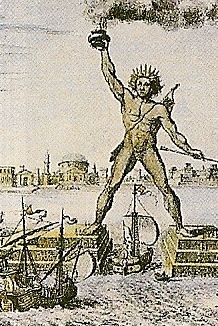
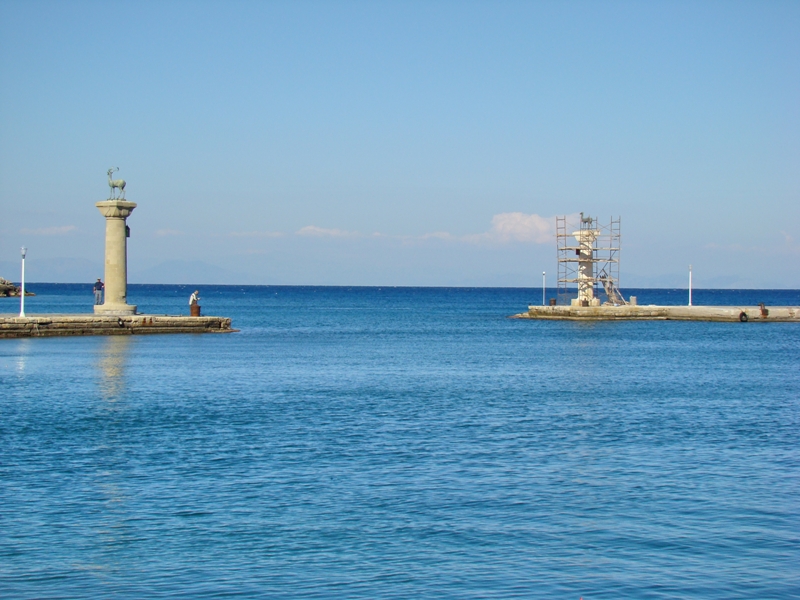
At Rhodes was one of the Seven Wonders of the Ancient World, the Colossus of Rhodes, a huge statue of the sun god Helios. It is traditionally depicted as straddling Mandraki harbor, but other believe it stood at the Temple of Apollo. See artist conception below:

Colossus of Rhodes, Painting by Fischer von Erlach, 1700. Source: Eyewitness Travel, The Greek Islands.

Gareth Reese, quoting Dale, writes:

For 56 years the brazen Colossus of Helios stood across the mouth of the barbor.  It was so large, being 105 feet high, that ships sailed between its legs.  It was considered one of the seven wonders of the ancient world.  The brazen Colossus represented the sun which shown almost every day on the island.  About 224 B.C., an earthquake threw the idol down. [Its fragments were still on the spot at the time of Paul’s visit.] In 600 A.C., its remains were sold to a Jew by the conquering Saracans.  It took 900 camels to carry the brass away (Acts.778).

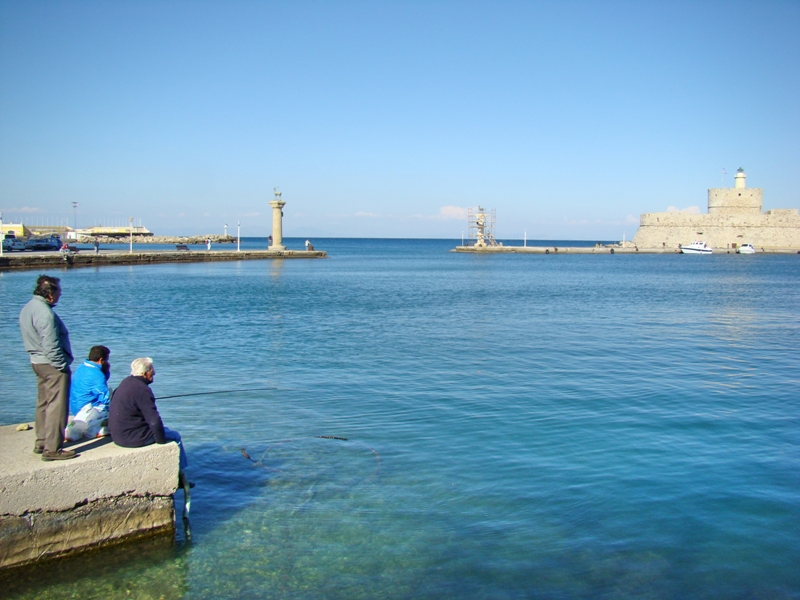
Our photo below, taken in March of this year, shows the harbor looking out through the entrance to the sea.

Harbor of Rhodes. Possible site of Colossus. Photo ©Leon Mauldin.

And here is a closer view:

Rhodes Harbor. Closer View. Photo ©Leon Mauldin.

Click on photos for larger view/higher resolution.


The Palace at Knossos Crete

July 20, 2010

In today’s post I wish to share a few more photos and some info re: Knossos, Crete, specifically pertaining to the palace.  Knossos was the capital of Minoan Crete, and had the largest and most sophisticated palace on the island.  The palace had more than 1,000 rooms.  The archaeologist and excavator Sir Arthur Evans determined that the palace was three to five stories high.

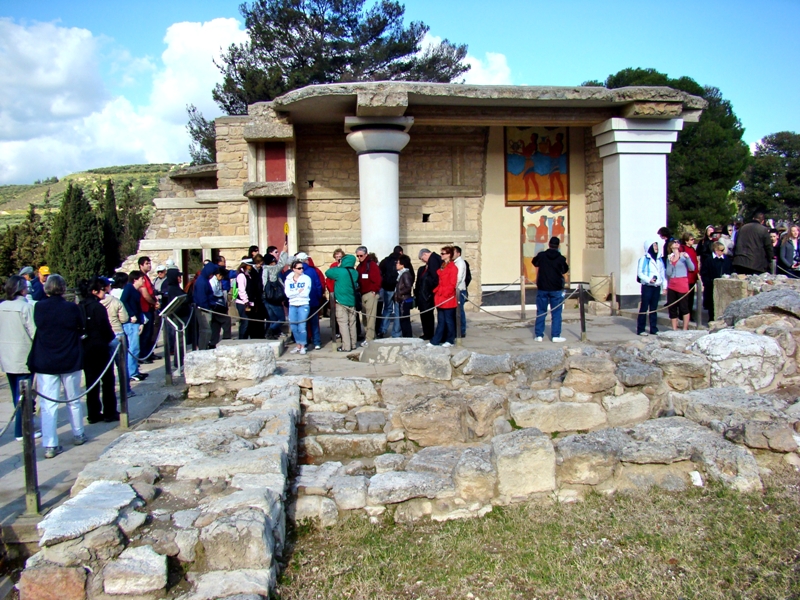
The Great Propylon (monumental gateway) is featured in our photo below:

South Propylon. Entrance to palace at Knossos Crete. Photo ©Leon Mauldin.

Some of our group are among the people in this photo; it was a cool, brisk March morning as you can tell by the coats most are wearing.

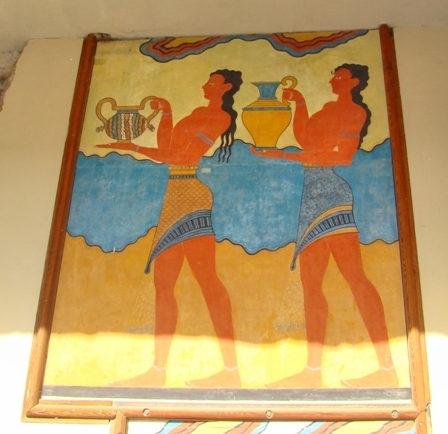
This monumental pillared gateway was the entrance to the palace on the south side. It was decorated with the Cup-Bearer figured.  See photo below.

Cup-Bearer Figure decorating South Propylon. Knossos Crete. Photo ©Leon Mauldin.

The throne room is thought to have been used as council and and law court for King Minos and the priesthood. See photo below.

Throne Room for King Minos. Knossos Crete. Photo ©Leon Mauldin.

Note the griffins which “guarded” the throne.  These mythical beasts with eagle’s head and lion’s body are thought to have symbolized royal and divine power.  In the floor you see a basin, used for ritual cleansing.

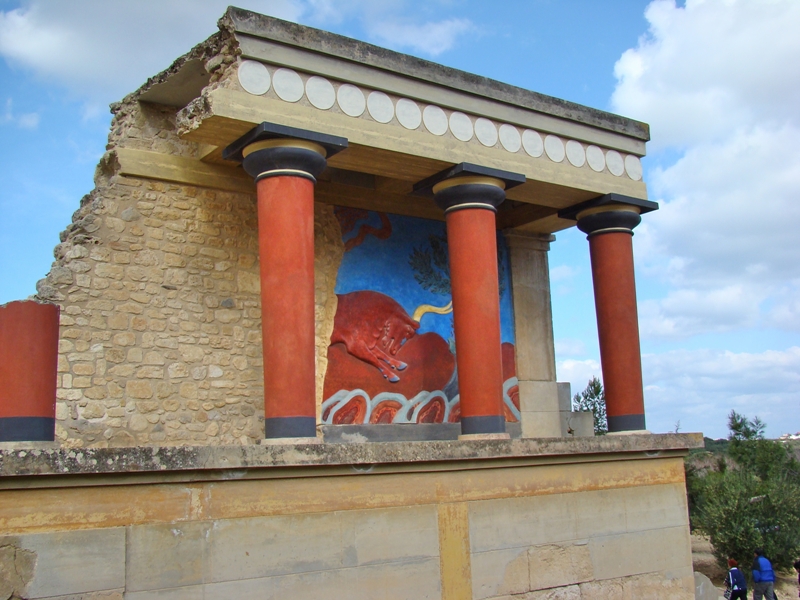
At the north end of the palace, located at the end of the road for the harbor, was another entrance to to the palace. You will notice it is decorated with a “Bull” fresco.  See our photo:

North Entrance for the Palace. Knossos, Crete. Photo ©Leon Mauldin.

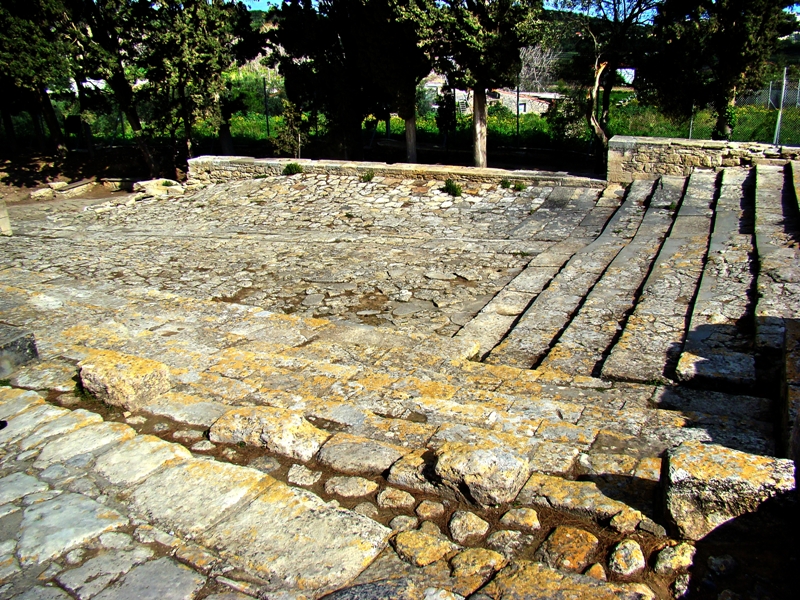
On the west side of the palace is the theater.  It was a stepped court located at the end of the Royal Road.  Some suggest its usage was for rituals associated with the reception of visitors.

Stepped Theater at Knossos, Crete. Photo ©Leon Mauldin.

The theater steps would have seated about 400 people.

Remember to click on images for higher resolution.