The True Meaning of Deisidaimonia

January 22, 2011

A reader writes to ask about the meaning of Acts 17:22, “Then Paul stood in the midst of the Areopagus and said, ‘Men of Athens, I perceive that in all things you are very religious’.” Specifically his question is about the interpretation of “very religious.” The Greek term is deisidaimonesterous. Should the text be rendered as “I perceive that you are worshippers of many demons” rather than “very religious” or “too superstitious” (KJV)? He asks, “What would be your answer to this interpretation?”

1. My first observation would be to look at how various reliable translations render the text. The KJV has “too superstitious.” The ESV, NASB, NKJ, NIV and NET have “very religious.” The CSB and NRSV have “extremely religious.” Always be wary when one suggests a meaning for a biblical term that cannot be found in commonly used, accurate translations.

2. The real discussion among biblical students/scholars about deisidaimonesterous is whether it is best rendered by “superstitious” or “religious,”—not whether it means worshiper of demons. For example, the NET note here observes, “The term deisidaimonesterous is difficult. On the one hand it can have the positive sense of ‘devout,’ but on the other hand it can have the negative sense of ‘superstitious.’ As part of a laudatory introduction (the technical rhetorical term for this introduction was capatatio), the term is probably positive here. It may well be a ‘backhanded’ compliment, playing on the ambiguity.”

3. Paul wants to appeal to the hearts of the Athenians with the Gospel.  How can he best approach them? F.F. Bruce says, “He begins by mentioning that what he has seen in their city has impressed him with the extraordinarily religious nature of the Athenians. . .” (The Book of the Acts, p. 355). In his work, The Greek New Testament, Henry Alford observes, “He wishes to commend their reverential spirit, while he shews its misdirection” (vol. 2, p. 196). In his Greek-English Lexicon, Thayer states that Paul uses the term with “kindly ambiguity” (p.127).

These above statements seem to best fit the context.  Paul states a fact—they were religious—without expressing approval or agreement with the object of their religion. But that served as an opener to go on to show basic truths about the nature of God and His will for man, His creation.

Acropolis at top. Stoa to your left. Paul's preaching in Athens is recorded in Acts 17. View from north. Photo by Leon Mauldin.


4. What then is the evidence for the interpretation “worshipers of many demons.”

First, in fairness, there is the literal meaning of the compound word, as seen in W.E. Vine’s work. Deisidaimon is composed of deido, “to fear,” and daimon, “a demon.” On the surface it would seem that it should be translated “one who fears/worships demons.” But that is not how word meanings are established.  Try that with the word “butterfly.”  When you define “butter” and “fly” have you shown what “butterfly” means? Vine goes on to give the best meaning of the word in Acts 17:22, as “more than others respectful of what is divine.” He says, “It also agrees with the meaning found in Greek writers; the context too suggests that the adjective is used in a good sense” (Expository Dictionary of New Testament Words. IV, p. 94). Meaning is established by usage.

Gareth Reese says, “It must be noted in passing that deisidaimon could be rendered “worshipper of many demons,’ an expression exactly suited to a pagan people like the Athenians who lived in fear of evil spirits and who went out of their way to keep from offending the spirits” (Acts, p. 627; thusly rendered in Amplified and Darby).  But one important rule of interpretation is to consider how the same word is used within Scripture. Our word is found in Acts 25:19 (noun form), where Festus explained to King Agrippa that the Jewish leaders, “. . . had some questions against him [Paul] about their own religion [deisidaimon] and about a certain Jesus, who had died, whom Paul affirmed to be alive.” Here Reese says, “There are reasons to believe Festus used it [deisidaimon] in a good sense here. It was the regular word by which a Roman would designate his own worship, and not being familiar with any technical Jewish word for worship, would naturally use the same word for their religion as he did for his own. Further, Agrippa professes a certain deference for the Jewish religion. Festus would not speak of the religion of his royal guest [Agrippa] in a derogatory sense” (Acts, p. 866).

In conclusion, my judgment is that deisidaimon is best rendered “religion” and deisidaimonesterous as “very religious.” “It was well suited to a general and supremely neutral expression for religion or piety because diamon is used generally for a supernatural power. In the NT it is used in this sense by Festus in Acts 25:19 and the adj. is used by Paul of the Athenians in Ac. 17:22” (Kittel, Vol. 2, p. 20).


The Erechtheion in Athens

January 18, 2011

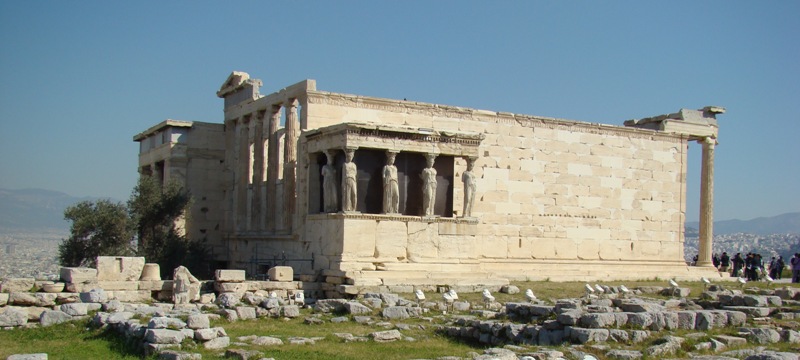
Among the important ruins situated upon the acropolis in Athens is the Erechtheion, a unique sanctuary dedicated to Athena Polias; Poseidon and Erechtheus were worshiped here.

Erechtheion at Athens. Photo by Leon Mauldin.

This view shows the Porch of the Kayatids, which used female figures as architectural supports as columns. These figures are a representation of the “Maidens of Karyai,” an ancient town of Peloponnese. The structure dates to the 5th century BC.

Below is a close up view:

Close-up of Porch of the Maidens. Photo by Leon Mauldin.

These maidens are actually replicas. The originals are encased in glass in the museum.

More to come.  Click on image for higher resolution.


Hollywood Hitpael

January 7, 2011

“There is one who makes himself rich, yet has nothing; And one who makes himself poor, yet has great riches” (Proverbs 13:7, NKJV). There may be many levels of application of Solomon’s words here. I think of the rich young ruler, who appeared to be rich, but when he “turned away sorrowful,” showed that he was in reality poor (Matt. 19:16-22). The rich man of Luke 12:15-21 was not really wealthy because he was “not rich toward God” (v.21).

It is interesting to compare the rendering of the English Standard Version which renders the text, “One pretends to be rich (emp. mine, L.M.), yet has nothing; another pretends to be poor, yet has great wealth” (Prov. 13:7; likewise rendered in NAS, CSB, NET, NIV, NRS).

This makes for an interesting word study. The NET textual note on the phrase pretends to be rich, states, “The Hitpael of עָשַׁר (’ashar, ‘to be rich’) means ‘to pretend to be rich’ (BDB 799 s.v. עָשַׁר Hithp); this is the so-called ‘Hollywood Hitpael’ (emp. mine, L.M.) function which involves “acting” or pretending to be something one is not.”

Hollywood Hitpael. That was a new one on me, but it makes sense. The world of Hollywood is a pretend world. Bearing this in mind may help us to pursue what is real and substantive: the Word of God, and being in right relationship with Him!


Jacob Watered the Flock of Laban

November 8, 2010

Jacob left Canaan to go to Haran of Padan Aram, fleeing from the wrath of his brother Esau who had determined to kill him.  Beyond that urgency however, was the fact that Isaac and Rebekah did not want Jacob to marry a Canaanite woman, as Esau had done (Gen. 27:46; 28:1-2).  Those women “were a grief of mind to Isaac and Rebekah” (Gen. 26:35).

When Jacob arrived in the vicinity of Haran, he “saw a well in the field; and behold, there were three flocks of sheep lying by it; for out of that well they watered the flocks. A large stone was on the well’s mouth” (Gen. 29:2). Jacob found out from the men who were there that he was at the right place. They knew Abraham’s family.  They knew Laban, who was Rebekah’s brother.  At the very time they were speaking, Rachel, Laban’s daughter, arrived with their sheep.

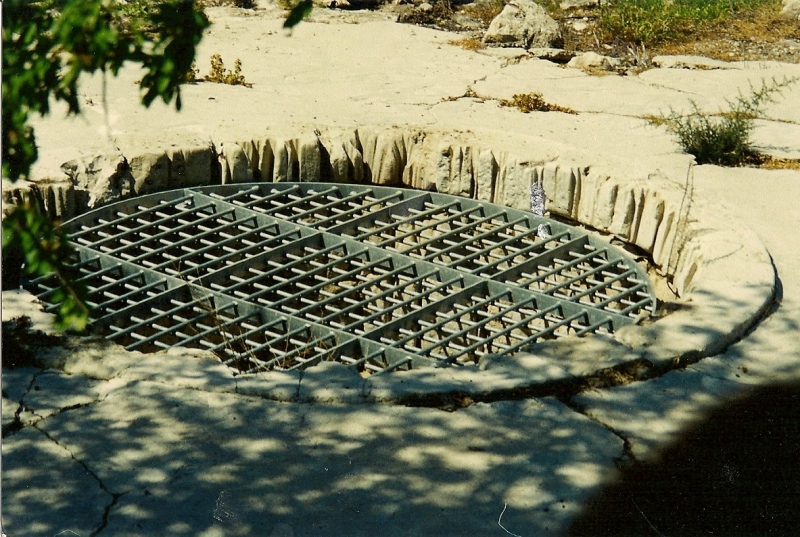
Jacob removed the stone that covered the well and watered the flocks of Laban.  Our photo helps us to visualize that scene.


Ancient Well. Photo ©Leon Mauldin.


You can see the grooves worn into the stone by ropes hauling up the water. This well is in Israel, but we use it here to illustrate the Genesis text with the setting in Mesopotamia.

Click on image for larger view.


Beth Guvrin

November 2, 2010

The site of Beth Guvrin is also known as Betogabris, Eleutheropolis,Tel Maresha, Tell Sandahanna, Beith Jibrin, Bet Giblin, Beth-guvrin, Bet Guvrin, Gibelin and Maresha according to Todd Bolenhttp://www.bibleplaces.com/bethguvrin.htm

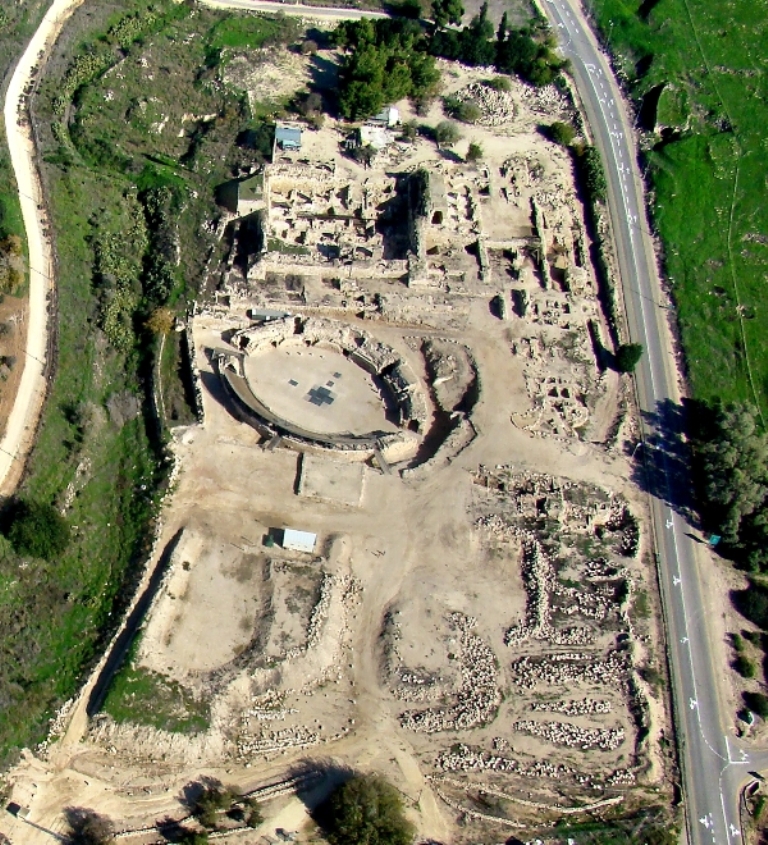
Aeriel Beit Guvrin. Photo ©Leon Mauldin.

An underground system of caves and tunnels was discovered where Jewish rebels hid from the Romans during the Second Jewish Revolt against Rome in the second century A.D. (132-135).  The Roman army was stationed in and around the city during this time.

At Beit Guvrin  an amphitheater has been excavated which can easily be seen in our photo (center). It was first identified in 1981 during an archaeological-architectural survey of Beth Guvrin.  Under the direction of Amos Kloner and A. Hubsch, large-scale excavations were conducted from 1993 to 1995.  Maximum measurements are 71 by 56 meters.  Gladiatorial contests, animal hunting exhibitions, contests between beasts and men as well as other forms of entertainment were conducted here.

“The construction of the amphitheater stemmed from the presence of these Roman army units in the area and the rebuilding of the city” (The New Encyclopedia of Archaeological Excavations in the Holy Land, Vol. 5, p. 1607).

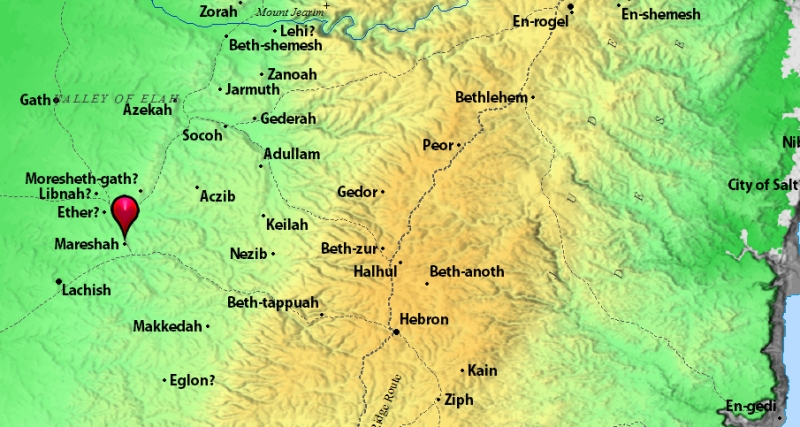
Beit Guvrin is about 1 1/2 miles north of biblical Mareshah, of the Shephelah. See map for orientation.

Mareshah. Map by BibleAtlas.org

Click on map/photo for larger image & higher resolution.


Khirbet-Qeiyafa

October 18, 2010

An archaeological site of current interest is Khirbet-Qeiyafa, the Elah Fortress.  Luke Chandler has been involved in digs there, and his blog reports on some of the findings there and their implications. Go to:

lukechandler.wordpress.com


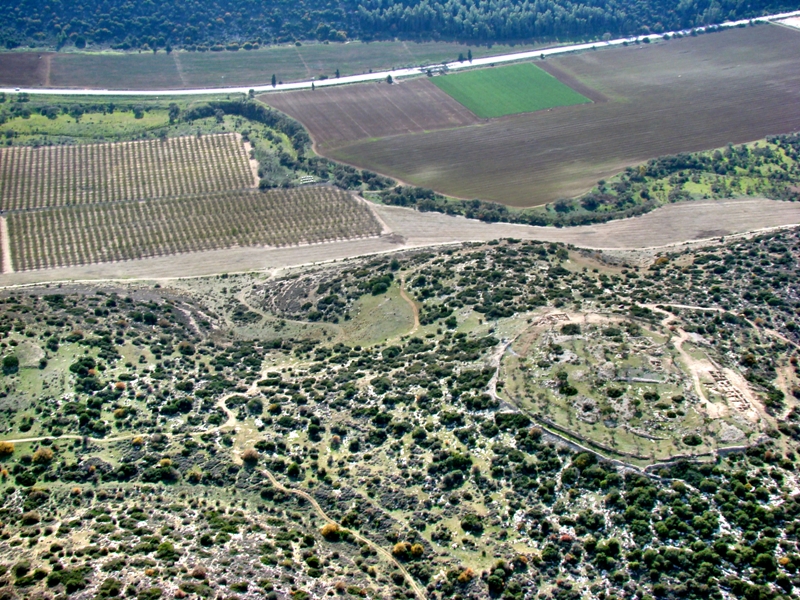
Many believe this site will prove to be an Israelite fortress that dates back to the reign of King David. Our aerial photo below shows the site in its context overlooking the Valley of Elah:

Khirbet-Qeiyafa, the Elah Fortress overlooking Valley of Elah. Photo ©Leon Mauldin.

You can see the circular tel on your right in the photo.  It was in the valley below that David killed Goliath.

Click on image for higher resolution.


Aphek/Antipatris

October 15, 2010

Aphek is mentioned in 1 Sam. 4:1 as the site of the Philistine camp as they prepared for battle against Israel.  This was in the last days of Eli’s tenure as High Priest and Judge of Israel.

Holman’s Bible Dictionary has this info on Aphek:

Place-name meaning “bed of brook or river” or “fortress.”  City whose king Joshua defeated (Josh. 12:18), where Philistine armies formed to face Israel in days of Samuel (1 Sam. 4:1) resulting in Philistine victory and capture of Israel’s ark of the covenant. Philistine armies including David and his men gathered in Aphek to fight Saul. The Philistine commanders forced Achish to send David back from battle (1 Sam. 29). Eventually the Philistines defeated Israel, bringing death to Saul and Jonathan. Aphek is located at modern Tell Ras elʹ Ain near the source of the Yarkon River in the Sharon plain northeast of Joppa. Egyptian execration texts from about 1900 B.C. apparently refer to Aphek.

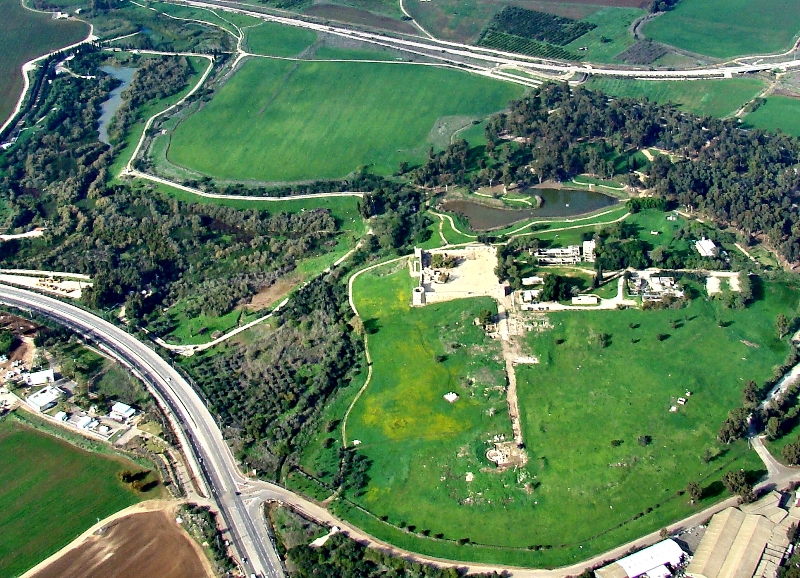
Our photo below gives an aerial view of Aphek. Click on image for higher resolution.


Aerial of Aphek. This was NT Antipatris. Photo ©Leon Mauldin.


In the New Testament this location was known as Antipatris, and is mentioned in Acts 23.  When the Roman commander Claudius Lysias became aware of an assassination plot to kill the Apostle Paul in Jerusalem, he order a military escort of Paul to Caesarea.  This was for Paul’s own protection.  The commander was thorough: two centurions were commanded to prepare 200 soldiers, 200 spearmen, and 70 horsemen.  The Roman militia departed at 9:00 PM (Acts 23:23). On the way to Caesarea, the governor’s residence, they went through Antipatris: “Then the soldiers, as they were commanded, took Paul and brought him by night to Antipatris” (v.31). The next day the horsemen went on with Paul to his destination, whereas the soldiers returned to the barracks (v.32) at Jerusalem.

On another (personal) note, I mentioned in a previous post that we were currently conducting a meeting at Pine Lane, Birmingham, which concluded last night.  On Wed PM our granddaughter was with my wife and me. One of the members there took this photo:


Leon & Granddaughter.


Isaac Went Out To Meditate

October 1, 2010

Genesis 24:63 reads, “Isaac went out to meditate in the field toward evening; and he lifted up his eyes and looked, and behold, camels were coming” (NASB).

This lengthy chapter narrates how a faithful servant of Abraham left Canaan to travel to Mesopotamia (Abraham had family there) to procure a wife for Isaac.  Abraham did not want his son to marry one of the idolatrous Canaanites whom God condemned; Abraham’s descendants were to be a separate people.  And thus Genesis 24 tells how Rebekah willingly made the journey to marry Isaac, whom she had never met.

Our text of Gen. 24:63 takes us to the time when Isaac saw Rebekah coming. He was meditating.

Previously he had been to Beer Lahai Roi, (v.62) which means “the well of the Living One who sees me” (see Gen. 16:14).  At this time the text tells us that Isaac “dwelt in the Negev” (Gen. 24:26). The word Negev is the designation for the southern desert region of Canaan.  Gen. 23 tells us that the patriarchal family was living in Hebron (v.2). Prior to that they were living in Beersheba (22:19).  See our map to locate these sites:
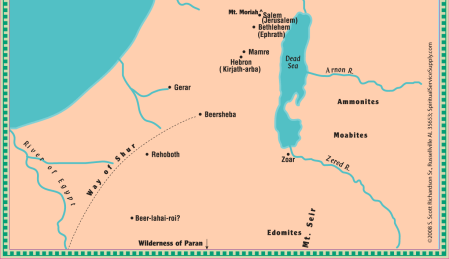
Beer lahai roi, Beersheba and Hebron. Map by Scott Richardson.

The Hebrew word for meditate in Gen. 24:63 is suach, which in this form is found only here in the Old Testament. It is derived from siach, of which the Theological Wordbook of the Old Testament says,

The basic meaning of this verb seems to be “rehearse,” repent,” or “go over a matter in one’s mind.” This meditation or contemplation may be done either inwardly or outwardly. Since English differentiates these two notions, the word is usually rendered “meditate,” or “talk” (II.875-6).

Consider first the idea of meditation as silent reflectionSiach is used of reflection on God’s works, “I will meditate with my heart” (Psa. 77:6) during a time when he was so troubled that he could not speak (v.4).  See the context: “I will meditate [here Heb. hagah] on all Your work And muse on Your deeds” (v.12, etc.).

Second, there is the idea of meditating, of silent reflection, on God’s word. Psalm 119 is that great chapter that in each of its 176 verses declares some point or principle regarding God’s word! It is not surprising that several verses speak of meditation. v. 15: “I will meditate on Your precepts And regard Your ways.” v. 48: “And I shall lift up my hands to Your commandments, Which I love; And I will meditate on Your statutes.” See also vv. 23, 27, 79, 148, each of which have our word siach.

For the use of the word siach meaning to talk, consider Proverbs 6:22, which speaks of the young man who has bound his father’s command and his mother’s law to his heart: “When you walk about, they will guide you; When you sleep, they will watch over you; And when you awake, they will talk [siach]to you.” What a beautiful picture: the son has listened, he has made wise teaching from his parents his own.  As he goes about in life, denoted by the words walk about, sleep, and awake, the teaching is always with him.  The word of the Lord talks to him!

But regarding Isaac, of what did his meditation consist?  In short, we don’t know what he was meditating about.  But from the context we can make a couple of suggestions:

1. Consider the emphasis that is given to the LORD (YHVH) in this chapter. He is referenced in vv. 3, 6, 12, 21, 26, 31, 35, 40, 42, 44, 48, 50, 51, 52, 56! This is truly a chapter about the LORD, about His will and His purpose!

2. Perhaps meditating on his future marriage? Considerable trouble and time was involved in Abraham’s servant making a journey of some 900 miles or so to obtain a wife for Isaac.  I would suggest Isaac may well have been meditating, reflecting, on the marriage he was about to enter, with a woman he had never seen before.  Isaac was a godly man, and he no doubt wanted his marriage, his home life, to be pleasing to God.

Lessons.

Time is well spent when it is devoted to meditating on God’s word. This is more than mere reading.  It means to make it your own, to let it dominate your thoughts.

Also, there is much to be said for preparation for marriage.  First, to be what God wants you to be, and second, to have a marriage that is pleasing to God, that He can bless.

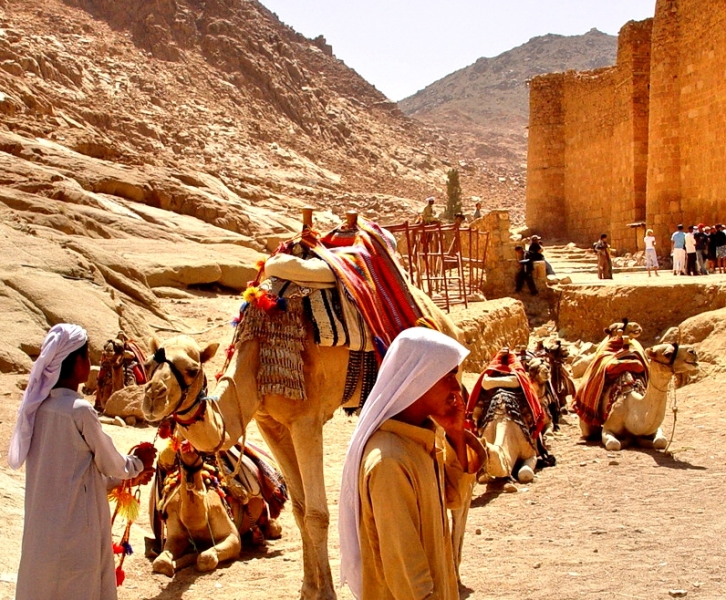
We’ll close with another camel photo, as camels are referenced in our text of Gen. 24:63.  This shot was taken at St. Catherine’s Monastery, at the foothills of Mt. Sinai.
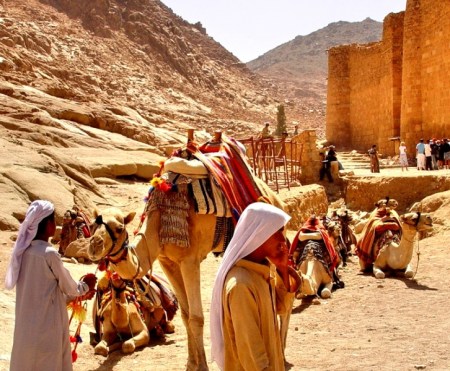
Camels at St. Catherine's at Foothills of Mt. Sinai. Photo ©Leon Mauldin.

Click on images for higher resolution.

Merneptah Stele

September 9, 2010

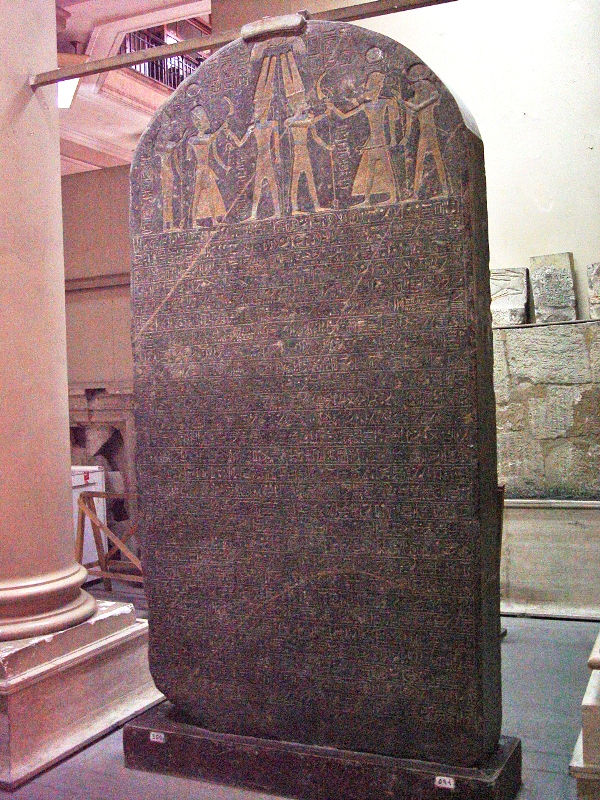
Merneptah, son of Rameses II, ruled Egypt 1213-1203 B.C.  The Merneptah Stele is an inscription of great archaeological and biblical importance.  It contains the first mention of Israel in a source besides the Bible.

Merneptah Stele. Egyptian Museum, Cairo. Photo ©Leon Mauldin.

The stele was discovered in 1896 at Thebes. It is 7.5 feet high, and made of black granite.  It is displayed now in the Egyptian Museum at Cairo. The inscription includes the lines:

“The princes, prostrated, say ‘Shalom’;

None raises his head among the Nine Bows.

Now that Tehenu has come to ruin, Hatti is pacified.

Canaan has been plundered into every sort of woe. Ashkelon has been overcome.

Gezer has been captured.

Yano‘am was made non-existent.

Israel is laid waste (and) his seed is not.

Hurru has become a widow because of Egypt.

All lands have united themselves in peace.

Anyone who was restless, he has been subdued by the King of Upper and Lower Egypt, Ba-en-Re-mery-Amun, son of Re, Mer-en-Ptah Hotep-her-Ma‘at, granted life like Re, daily. (BAR 16:05, Sept/Oct 1990).

Note: italics are supplied to emphasize the portion of the inscription that references the area of Canaan and Israel.

The date of this inscription would be about 1207 B.C.  By that point in time, Israel was established in the land of Canaan to such an extent that it would be included in a listing of nations defeated by the world’s most powerful monarch.

Many “scholars” deny that Israel even existed as a nation by this point in time, but the inscription proves them to be wrong.

For further reading I recommend Todd Bolen’s article in The Bible and Interpretation. He wrote on his blog, “I thank God every day for the Merneptah Stele.” Go to:

https://bibleinterp.arizona.edu/opeds/bolen357916

“The princes, prostrated, say ‘Shalom’;

None raises his head among the Nine Bows.

Now that Tehenu has come to ruin, Hatti is pacified.

Canaan has been plundered into every sort of woe. Ashkelon has been overcome.

Gezer has been captured.

Yano‘am was made non-existent.

Israel is laid waste (and) his seed is not.

Hurru has become a widow because of Egypt.

All lands have united themselves in peace.

Anyone who was restless, he has been subdued by the King of Upper and Lower Egypt, Ba-en-Re-mery-Amun, son of Re, Mer-en-Ptah Hotep-her-Ma‘at, granted life like Re, daily.”[i]


Editor, H. S. (2004; 2004). BAR 16:05 (Sep/Oct 1990). Biblical Archaeology Society.


Lectures at Kamenice

August 3, 2010

This evening completes day two of the lectures at Kamenice.  Sessions are scheduled from 9 AM to 9 PM, so we’ve not had much time for posting.  We are sure enjoying the association of Christians who have gathered here for the week, many of whom have traveled hundreds of miles to be here.  I am thankful to God for such opportunities.

I have been asked to do a historical survey of the Old Testament.  I’m making use of hundreds of photos of Bible places as the events of scripture are narrated.

Lectures Kamenice Czech

My slides which include text are in both English and Czech.  As I speak a Czech translates for me.

This series gives us an opportunity to study the theme of the Bible, the unfolding of God’s plan to save mankind through the redemptive work of Jesus Christ.  The first promise of Christ is found in Genesis 3:15, depicted below:

Lectureship at Kamenice

Kamenice is a very nice Czech village.  Perhaps I can share a few photos with you in the next day or two.

It is great to be associated with my friend and fellow preacher Bill Bynum.  He makes two trips per year to encourage European Christians in remote places.  Previously he has lived and worked as evangelist both in Czech as well as Hungary.

Click on photos for larger view. More later.