Shepherd with His Sheep

December 22, 2014

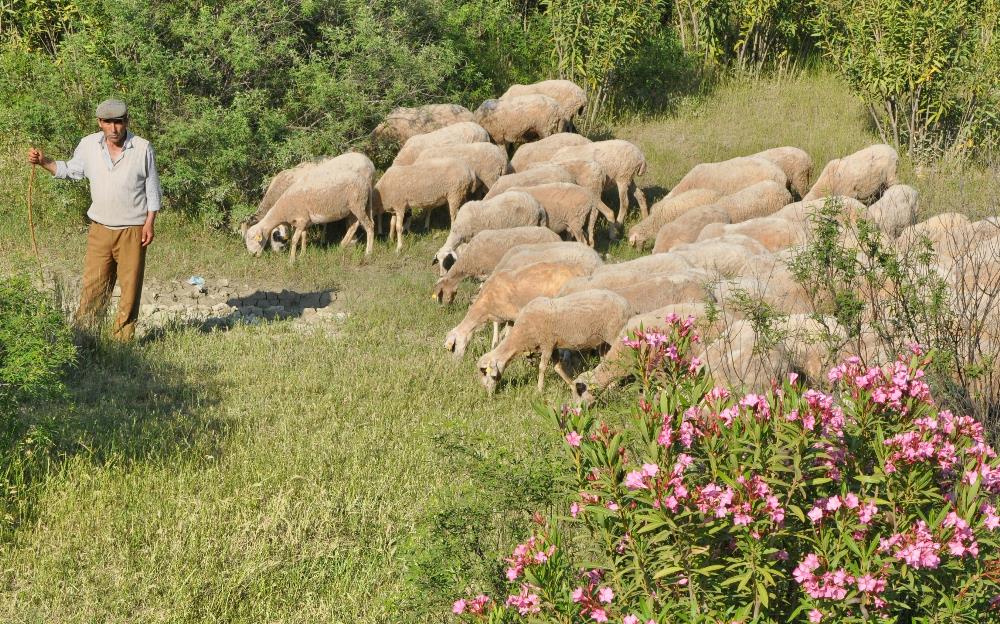
When visiting biblical sites I never tire of seeing sheep and their shepherds. I’m sure that is due in large measure to the frequent references in the Bible, not only to literal shepherds and sheep, but also the metaphorical usage.

Shepherd with sheep in biblical Pamphilia. Photo by Leon Mauldin.

Shepherd with sheep in biblical Pamphylia. Photo by Leon Mauldin.

Isaiah 53:6 All we like sheep have gone astray; We have turned, every one, to his own way; And the LORD has laid on Him the iniquity of us all.

Psalm 23:1 The LORD is my shepherd; I shall not want.

John 1:29 The next day John saw Jesus coming toward him, and said, “Behold! The Lamb of God who takes away the sin of the world!

John 10:27 My sheep hear My voice, and I know them, and they follow Me.

1 Peter 2:25 For you were like sheep going astray, but have now returned to the Shepherd and Overseer of your souls.

Elders of local churches are told: 1 Peter 5:2 Shepherd the flock of God which is among you, serving as overseers, not by compulsion but willingly, not for dishonest gain but eagerly.

Revelation 7:17 for the Lamb who is in the midst of the throne will shepherd them and lead them to living fountains of waters. And God will wipe away every tear from their eyes.


Samsun in Biblical Pontus

December 15, 2014

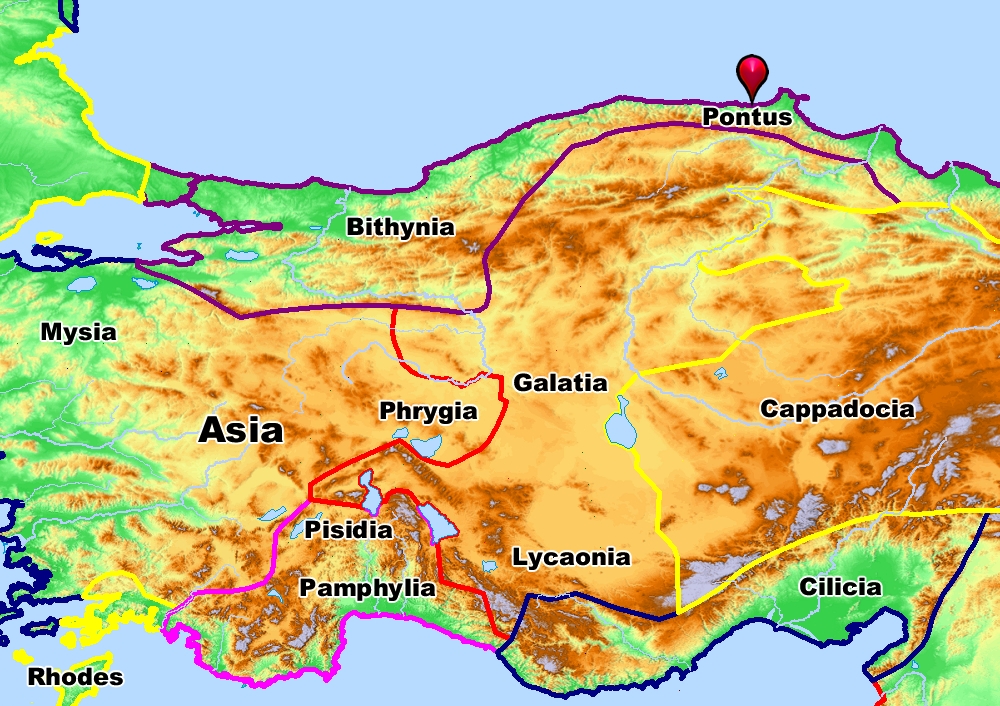
The Roman province of Pontus is mentioned three times in the Bible.

Pontus. Map by BibleAtlas.org.

Pontus. Map by BibleAtlas.org.

There were residents of Pontus (among many other) present for the Day of Pentecost in Acts 2, the day on which the Gospel message of salvation through the resurrected Christ was preached for the first time: “Parthians and Medes and Elamites, and residents of Mesopotamia, Judea and Cappadocia, Pontus and Asia” (Acts 2:9).

Paul’s dear friend and fellow-tentmaker Apollos, was from Pontus: “And he found a Jew named Aquila, a native of Pontus, having recently come from Italy with his wife Priscilla, because Claudius had commanded all the Jews to leave Rome” (Acts 18:2).

The Apostle Peter wrote the letter of 1 Peter to Christians in Pontus (and other Roman provinces): “Peter, an apostle of Jesus Christ, To those who reside as aliens, scattered throughout Pontus, Galatia, Cappadocia, Asia, and Bithynia. . .” (1 Pet. 1:1).

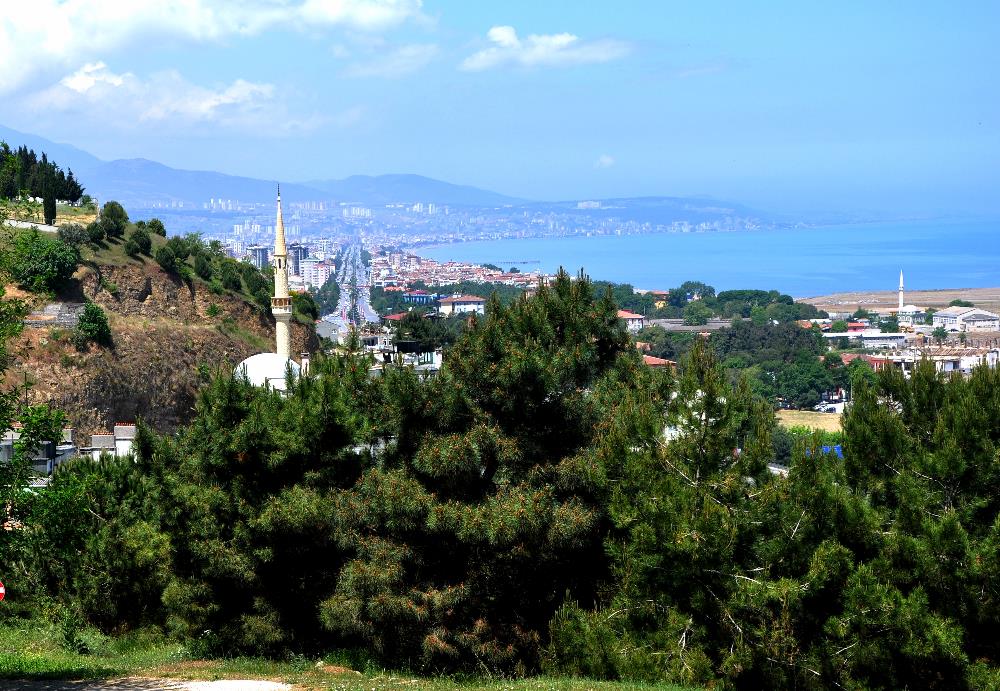
Samsun (also known as Amisus) was a major port city of Pontus located on the Black Sea. This is in Turkey’s territory today.

Samsun, port city of Pontus. Photo by Leon Mauldin.

Samsun, port city of Pontus. Photo by Leon Mauldin.

Many scholars believe that the messenger of 1 Peter (& 2 Peter) would have stopped here at Samsun. I concur. See Ferrell Jenkins here and here.

Click image for larger view.


Goddess Artemis at Vatican Museum

August 23, 2014

There is a statue of the goddess Artemis housed in the Vatican Museum.

Goddess Artemis in Vatican Museum. Photo by Leon Mauldin.

Goddess Artemis in Vatican Museum. Photo by Leon Mauldin.

This is the goddess mentioned in Acts 19, in the context of Paul’s preaching efforts at Ephesus:

About that time there occurred no small disturbance concerning the Way. For a man named Demetrius, a silversmith, who made silver shrines of Artemis, was bringing no little business to the craftsmen; these he gathered together with the workmen of similar trades, and said, “Men, you know that our prosperity depends upon this business. You see and hear that not only in Ephesus, but in almost all of Asia, this Paul has persuaded and turned away a considerable number of people, saying that gods made with hands are no gods at all. Not only is there danger that this trade of ours fall into disrepute, but also that the temple of the great goddess Artemis be regarded as worthless and that she whom all of Asia and the world worship will even be dethroned from her magnificence.” When they heard this and were filled with rage, they began crying out, saying, “Great is Artemis of the Ephesians!” (verses 23-28).

The ISBE has this info:

She may, however, be identified with the Cybele of the Phrygians whose name she also bore, and with several other deities who were worshipped under different names in various parts of the Orient. In Cappadocia she was known as Ma; to the Syrians as Atargatis or Mylitta; among the Phoenicians as Astarte, a name which appears among the Assyrians as Ishtar; the modern name Esther is derived from it. The same goddess seems to have been worshipped by the Hittites, for a female deity is sculptured on the rocks at Yazili Kaya, near the Hittite city of Boghazkeui. It may be shown ultimately that the various goddesses of Syria and Asia Minor all owe their origin to the earlier Assyrian or Babylonian Ishtar, the goddess of love, whose chief attributes they possessed. The several forms and names under which she appears axe due to the varying developments in different regions.

Tradition says that Diana was born in the woods near Ephesus, where her temple was built, when her image of wood (possibly ebony; Pliny, NH, xvi. 40; Acts 19:35) fell from the sky. Also according to tradition the city which was later called Ephesus was founded by the Amazons, and Diana or Cybele was the deity of those half-mythical people. Later when Ephesus fell into the possession of the Greeks, Greek civilization partly supplanted the Asiatic, and in that city the two civilizations were blended together. The Greek name of Artemis was given to the Asiatic goddess, and many of the Greek colonists represented her on their coins as Greek. Her images and forms of worship remained more Asiatic than Greek. Her earliest statues were figures crudely carved in wood. Later when she was represented in stone and metals, she bore upon her head a mural headdress, representing a fortified city wall; from it, drapery hung upon each side of her face to her shoulders. The upper part of her body was completely covered with rows of breasts to signify that she was the mother of all life. The lower arms were extended. The lower part of the body resembled a rough block, as if her legs had been wrapped up in cloth like those of an Egyptian mummy. In later times her Greek followers represented her with stags or lions standing at her sides. The most renowned of her statues stood on the platform before the entrance to her temple in Ephesus. As the statues indicate, she impersonated the reproductive powers of men and of animals and of all other life.

We have previously referenced Artemis in posts here, here, here and here.

Click on image for larger view.


King Eumenes, Brother of Attalus II

July 1, 2014

The biblical city of Philadelphia, one of the seven churches of Asia Minor (Rev. 3:7-13) was founded by Attalus II, king of Pergamum (159–138 BC).

W.M. Ramsay tells us that Attalus II’s “truth and loyalty to his brother Eumenes won him the epithet Philadelphus” (The Letters to the Seven Churches of Asia, p. 391). Hence the name of the city, Philadelphia, which means brotherly love.

“Because of its strategic location, it [Philadelphia] served as a vital link in communication and trade between Sardis and Pergamum to the west and Laodicea and Hierapolis to the east. It was a center of agriculture, leather production, and textile industry” (Harper’s Bible Dictionary). Today Philadelphia is called Alaşehir.

Attalus II was also the founder of Attalia, mentioned in Acts 14:25-26 in connection with Paul’s return trip on his 1st Missionary Journey. This is the site of today’s Antalya, one of Turkey’s largest cities.

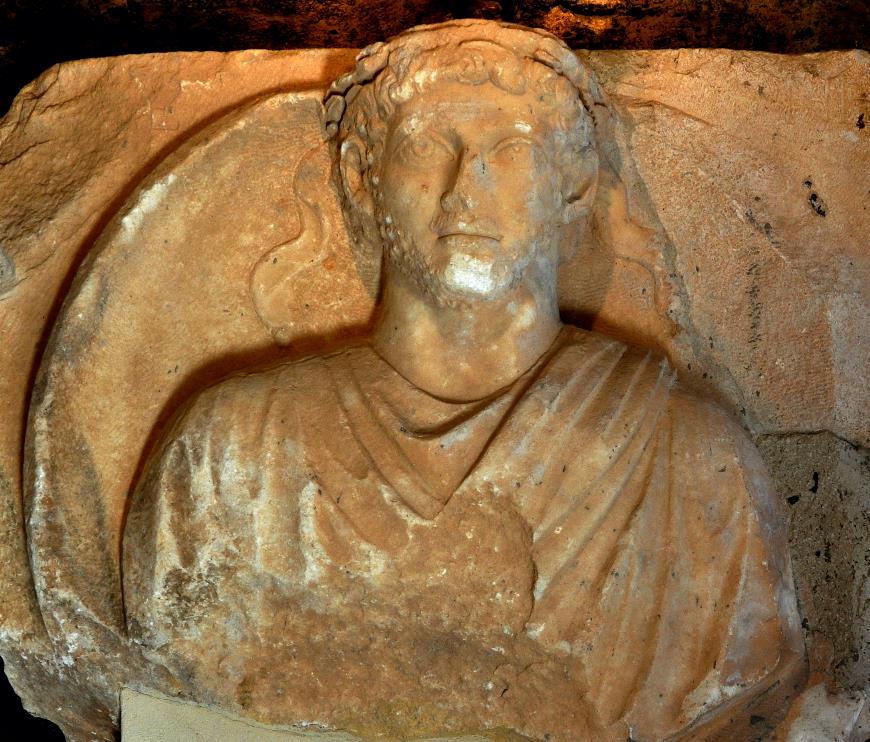
Eumenes, brother of Attalus II, was king of Pergamun 197-157 BC. He was the founder of the city of Hierapolis (Col. 4:13). It is fitting that there is a bust of Eumenes in the museum at Hierapolis.

King Eumenes II, brother to Attalus II Philadelphus. Photo ©Leon Mauldin.

King Eumenes II, brother to Attalus II Philadelphus. Photo ©Leon Mauldin.

Click image for larger view.


Travel in Bible Times–Tomb of Merchant Flavius Zeuxis

June 26, 2014

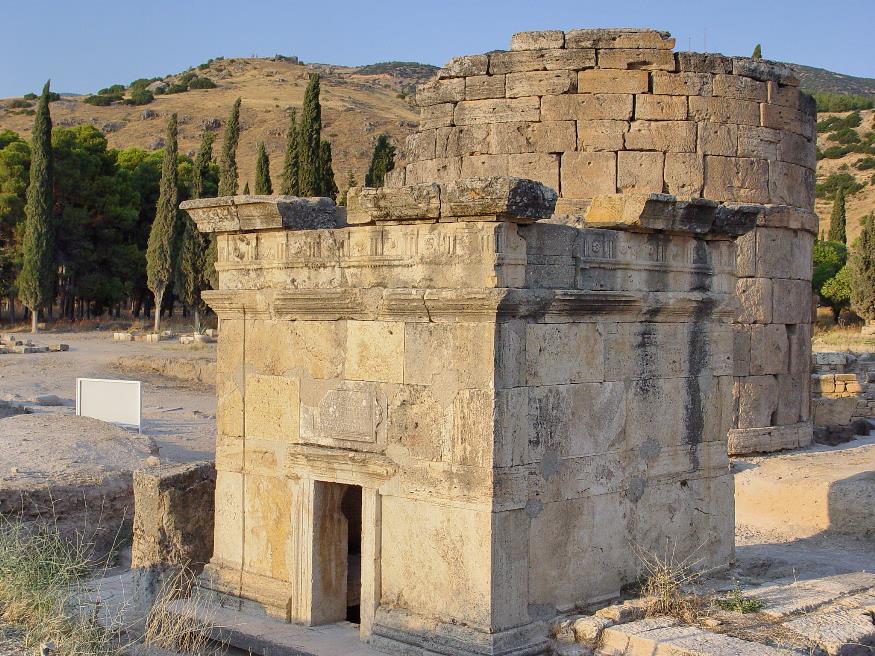
The necropolis of Hierapolis is one of  the largest ancient burial sites in Turkey. Tombs there date from 2nd century BC through 3rd century AD. One of the more interesting is that of T. Flavius Zeuxis and his sons (1st century AD).
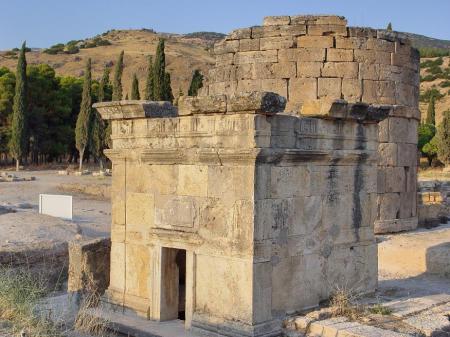
Tomb of Flavius Zeuxis, merchant of Hierapolis. Photo ©Leon Mauldin.

Tomb of Flavius Zeuxis, merchant of Hierapolis. Photo ©Leon Mauldin.

Dr. Carl Rasmussen observes: “Note the finely carved doorway with doorposts and lintel, the carved base, the slightly protruding stones of the corners (pilasters) of the tomb, the upper molding, and the Doric frieze composed of triglyphs and metopes filled with rosettes!” Click here.

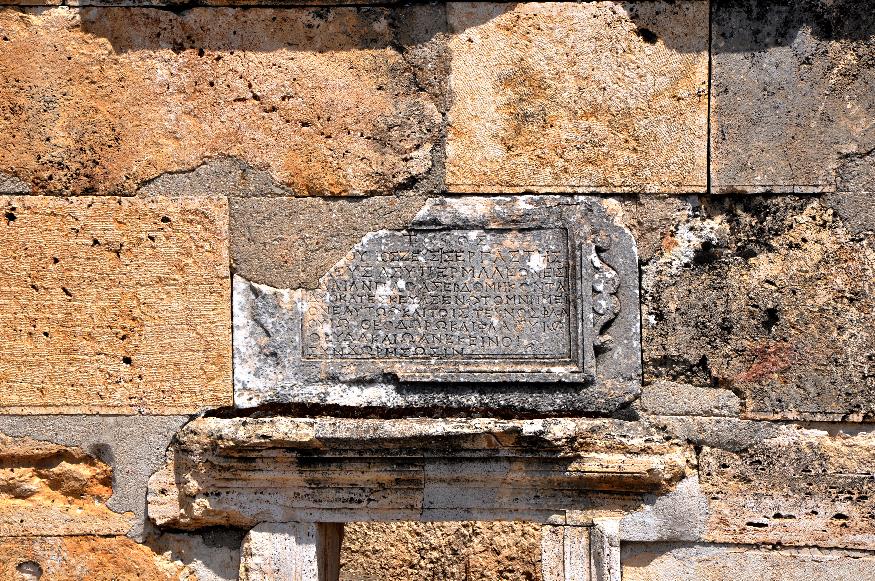
The inscription above the tomb entrance is translated, “Flavius Zeuxis, merchant, who sailed seventy-two trips around Cape Malea to Italy, built this.”
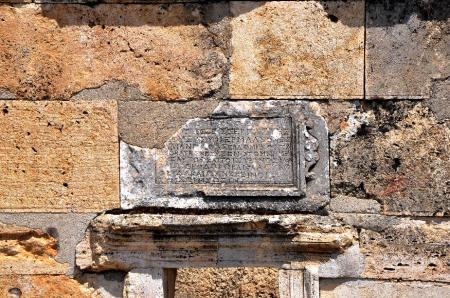
Tomb Inscription above door. Photo ©Leon Mauldin.

Tomb Inscription above door. Photo ©Leon Mauldin.

This inscription is helpful on several counts. Cape Malea is the southern tip of Greece’s Peloponnesus peninsula. It is famous for its treacherous weather and seas. William Barclay wrote:

It was a dangerous cape, and to round Cape Malea had in ancient days much the same sound and implications as to round Cape Horn had in later times. The Greeks had two sayings which showed what they thought of the voyage round Malea-“Let him who sails round Malea forget his home,” and, “Let him who sails round Malea first make his will.” (The Letters to the Corinthians, p.1).

Obviously it would have been considered quite an accomplishment to have made 72 trips around the Cape. This would mean a total of 36 round trips this merchant had made from Hierapolis of Asia Minor to Italy and back! Some have suggested that Zeuxis would have made two or three trips per year from Hierapolis to sell his goods in Italy.

This has implications for several biblical texts. For example, when Paul (as a prisoner under house arrest) was writing the NT letter of Colossians from Rome, Epaphras of Colossae was with him (Col. 1:7). Paul went on to referenced the tri-cities of Colossae, Hierapolis, and Laodicea as he spoke of Epaphras’ work among them:

Epaphras, who is one of you, a bondservant of Christ, greets you, always laboring fervently for you in prayers, that you may stand perfect and complete in all the will of God. For I bear him witness that he has a great zeal for you, and those who are in Laodicea, and those in Hierapolis. (Col. 2:12-13, NKJV).

The Zeuxis inscription shows it would not be unusual for residents of the Lycus River Valley, such as Epaphras, to make the voyage to Rome and back.

The travel of merchants such as Zeuxis also helps us relate to Paul’s journeys recorded in Acts, many of which were by sea. Further, it is not without significance that Paul mentioned the dangers he faced, including those on the sea:

 I have been on journeys many times, in dangers from rivers, in dangers from robbers, in dangers from my own countrymen, in dangers from Gentiles, in dangers in the city, in dangers in the wilderness, in dangers at sea, in dangers from false brothers (2 Cor. 11:26, NET).

But notwithstanding the potential dangers faced, travel by sea in the 1st century was common!

Also we might think of Rev. 18:11-13, with its extensive list of trade good that merchants (like our Flavius Zeuxis) from various locations in the Empire, brought to Rome. Contextually this passage speaks of the mourning that will come as a result of the fall of Rome:

And the merchants of the earth will weep and mourn over her, for no one buys their merchandise anymore: merchandise of gold and silver, precious stones and pearls, fine linen and purple, silk and scarlet, every kind of citron wood, every kind of object of ivory, every kind of object of most precious wood, bronze, iron, and marble; and cinnamon and incense, fragrant oil and frankincense, wine and oil, fine flour and wheat, cattle and sheep, horses and chariots, and bodies and souls of men.

Click on images for larger view.

Laodicea, a Wealthy City — a Poor Church

June 18, 2014

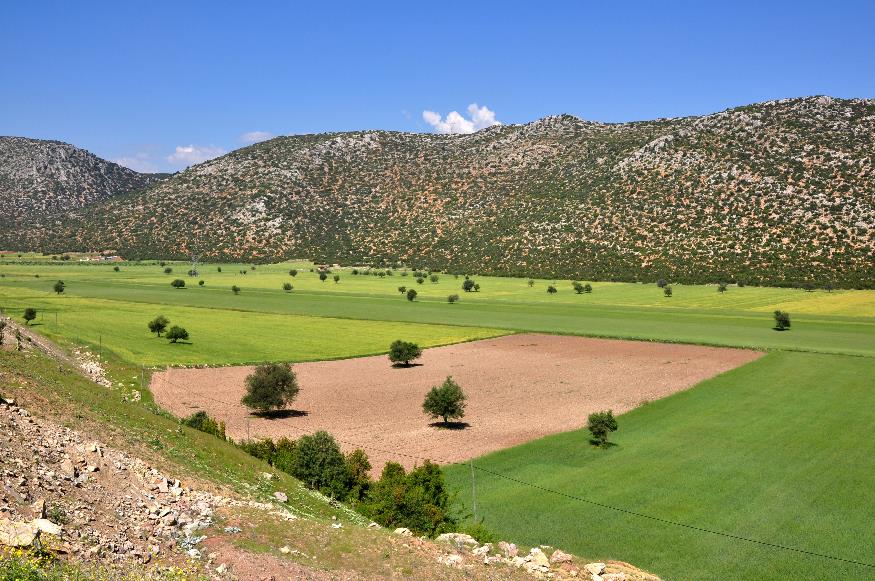
There is some beautiful scenery as you make the drive from the Mediterranean coast at Antalya (biblical Attalia) north and west to Laodicea.

En Route NW to Laodicea from Med. coast. Photo ©Leon Mauldin.

En Route NW to Laodicea from Med. coast. Photo ©Leon Mauldin.

Laodicea was known to be a wealthy city. It was a banking center, had a medical school specializing in ophthalmology, and manufactured clothing, especially known for its black wool market.

It is always a danger that God’s people become like the world around them. Jesus addressed the church at Laodicea (Revelation 3:14-21) and rebuked them for their self-satisfied, complacent attitude:

Because you say, “I am rich, and have become wealthy, and have need of nothing,” and you do not know that you are wretched and miserable and poor and blind and naked, I advise you to buy from Me gold refined by fire so that you may become rich, and white garments so that you may clothe yourself, and that the shame of your nakedness will not be revealed; and eye salve to anoint your eyes so that you may see (vv.16-18).

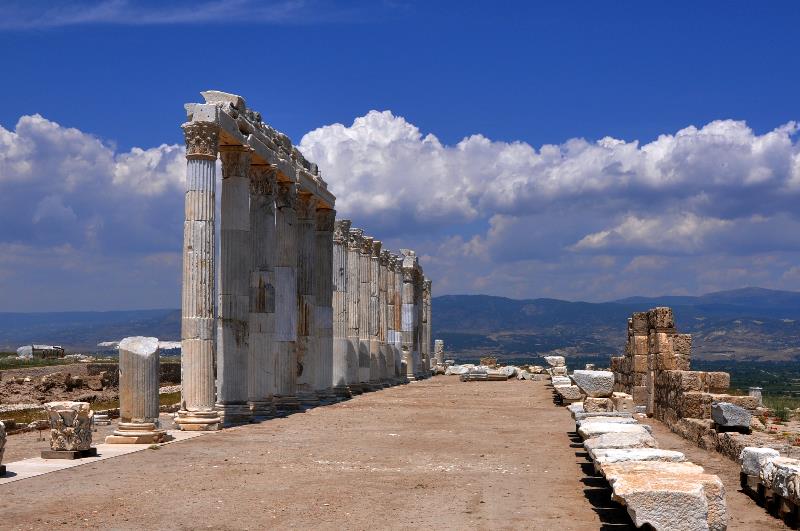
Excavations have shown numerous indications of Laodicea’s wealth.

Columns lining street in Laodicea. Photo ©Leon Mauldin.

Columns lining street in Laodicea. Photo ©Leon Mauldin.

W.M. Ramsay wrote:

It is characteristic of a city devoted to commercial interests and the material side of life, that the Church of Laodicea is entirely self-satisfied. It says, as the city said in A.D. 60, when it recovered its prosperity after the great earthquake without any of that help which the Imperial government was generally ready to bestow, and which the greatest cities of Asia had always been ready to accept, “I have grown rich, and have need of nothing.” It has never seen its real condition: it is poor and blind and naked (Letters to the Seven Churches, p.428).

Their complacency led to lukewarmness, and this nauseated the Lord (v.16). This is the only church of the seven addressed in Rev. 2-3 about which nothing good is said.

We have made several other posts on Laodicea. Use search box at upper right for more articles & photos.

Click on images for larger view.


Decorations at Nicaea’s Eastern Gate

May 31, 2014

Recently we posted here on Nicaea. A remarkable portion of the Roman walls and gates can still be seen.

Some useful info on the decor of the gates at Nicaea and elsewhere can be found here:

Nicaea’s walls are well decorated with reliefs, with large heads, and also with column-shafts, both as horizontal wall-ties and as decoration: in the central one of the three square towers of the north wall, some 37 columns are used to decorate the upper stories and, at the same time, to act as floor-joists. The East Gate has reliefs, still visible, which impressed Kinnear, as did the reliefs and heads on the North (Constantinople) Gate. The south gate, for Bursa, has marble blocks and an inscription. The walls and towers on the north side are noticeably of creamy-white marble (in contrast with the much darker blocks used elsewhere: it is far from fanciful to perceive the desire to create an effect on the side of the city facing Constantinople, since we find exactly the same attention given to marble display in the more important parts of other citadels, such as Seljuk. Thus the antique monuments of Nicaea have been reused in the construction of the first set of mediaeval walls, in a direct echo of the marble prestige of the finest of Constantinople’s set pieces, the Porta Aurea itself.

Nicaea Head Decor at East Gate. Photo ©Leon Mauldin.

Nicaea Head Decor at East Gate. Photo ©Leon Mauldin.

See also Ferrell Jenkins’ earlier post here.


Pagan Temple at Laodicea

May 30, 2014

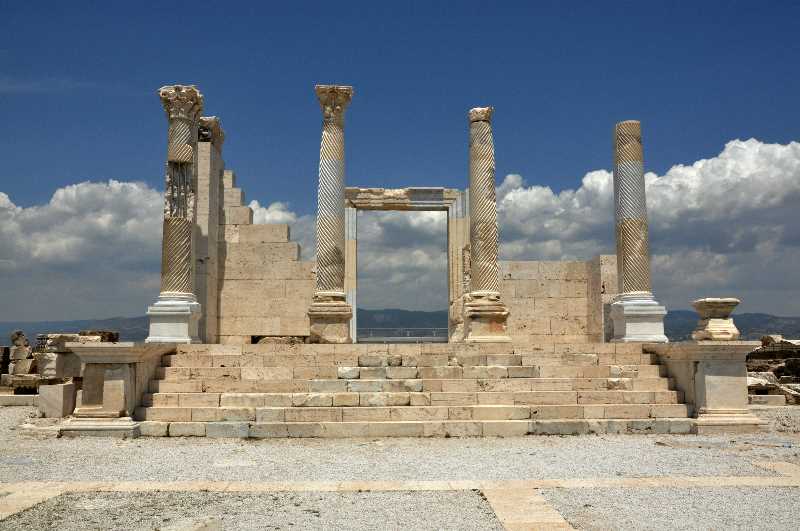
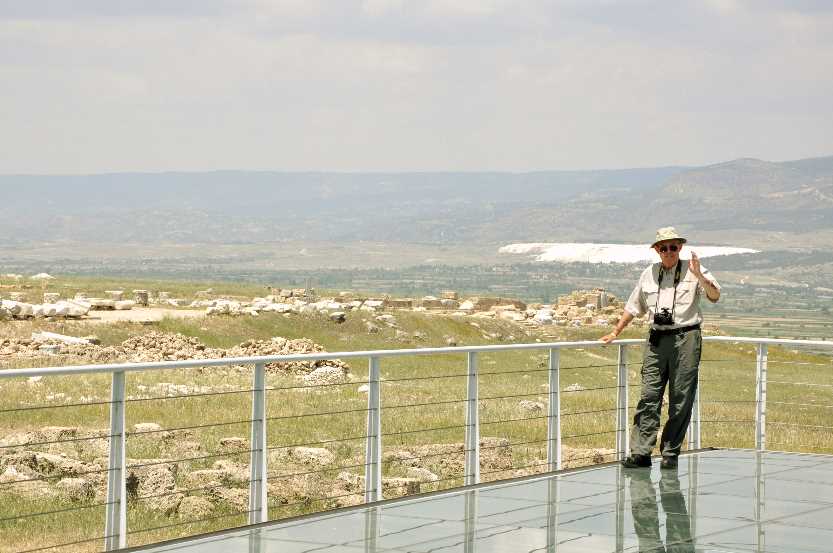
The last few years have seen an enormous amount of excavation in Laodicea. It is still ongoing, as Ferrell Jenkins and I saw several sectors of the very large tel that had teams of workers. One site of importance is the restoration of a pagan temple which reflects some of the wealth and splendor for which this city was famous. Remember God had His people here in Laodicea also, and they were the recipients of the 7th of the Seven Letters (Rev. 2-3).

Pagan Temple at Laodicea. Photo ©Leon Mauldin.

Pagan Temple at Laodicea. Photo ©Leon Mauldin.

At the back of the temple there is a clear platform through which you can look down and see more excavation several meters below.

Ferrell Jenkins behind temple. The white spot 6 miles distance is Hierapolis. Photo ©Leon Mauldin.

Ferrell Jenkins behind temple. The white spot behind (6 miles distance across the Lycus Valley) is Hierapolis. Photo ©Leon Mauldin.

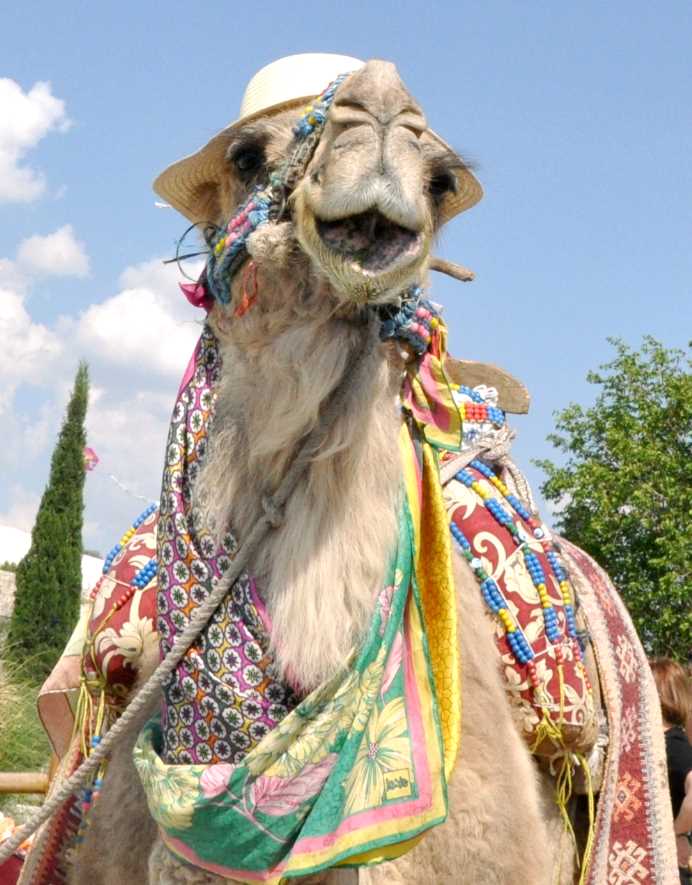
On the lighter side I present you with a camel photo.

Happy Camel at Hierapolis. Photo ©Leon Mauldin.

Happy Camel at Hierapolis. Photo ©Leon Mauldin.

May I say it’s good to be back in Sweet Home Alabama!


Temple of Apollo at Hierapolis

May 28, 2014

One of the many benefits of traveling to the lands  where biblical events occurred is that of gaining insight into just how pervasive idolatry was. It has always been necessary to make a choice of who you will serve (Joshua 24:14-15). Temples devoted to many gods abounded. The Gospel reveals the true God who claims exclusive service and worship to Him alone.

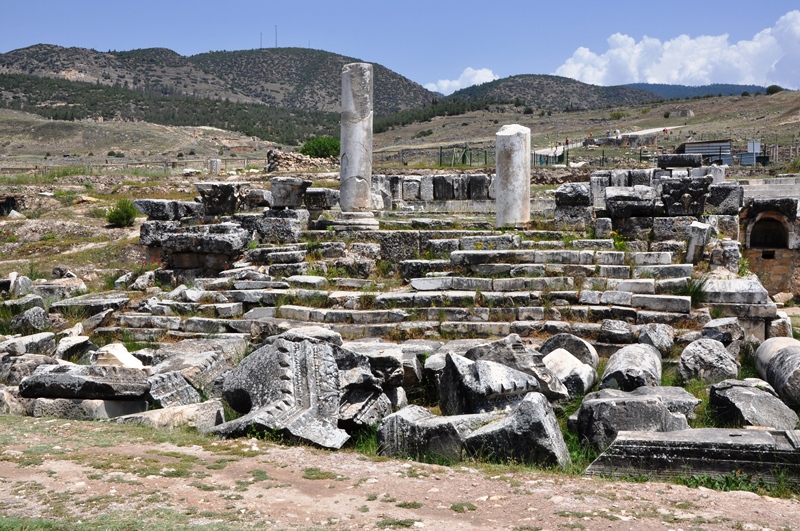
At Hierapolis one can view the ruins of the temple of Apollo.

Temple of Apollo at Hierapolis. Photo by Leon Mauldin.

Temple of Apollo at Hierapolis. Photo by Leon Mauldin.

Currently at Istanbul, we look forward to our flights home tomorrow.


Theater At Hierapolis

May 27, 2014

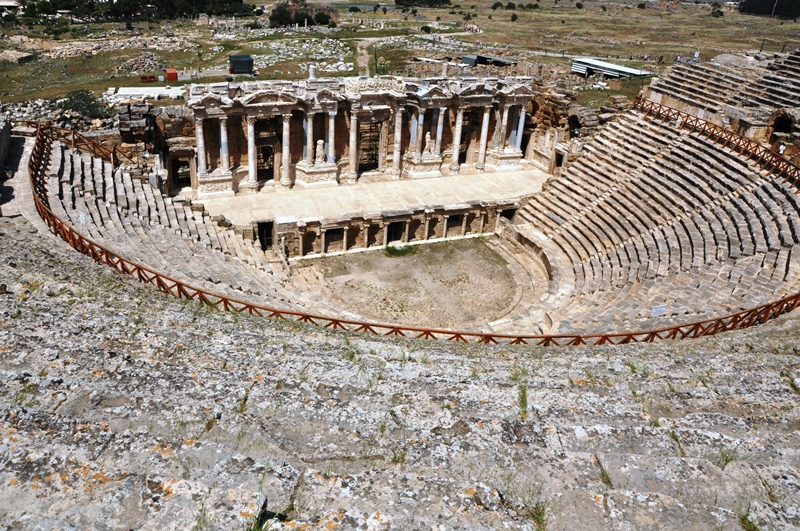
Today was devoted to exploring Hierapolis. I think today was the hottest day of our trip, and we did a lot of walking. There is a lot to see here.

First century Christians living in Hierapolis are mentioned in Colossians 4:12-13:

Epaphras, who is one of you, a servant of Christ Jesus, greets you, always struggling on your behalf in his prayers, that you may stand mature and fully assured in all the will of God. 13 For I bear him witness that he has worked hard for you and for those in Laodicea and in Hierapolis.

Every significant Roman city ordinarily had a theater.

Hierapolis Theater. Photo by Leon Mauldin.

Hierapolis Theater. Photo by Leon Mauldin.

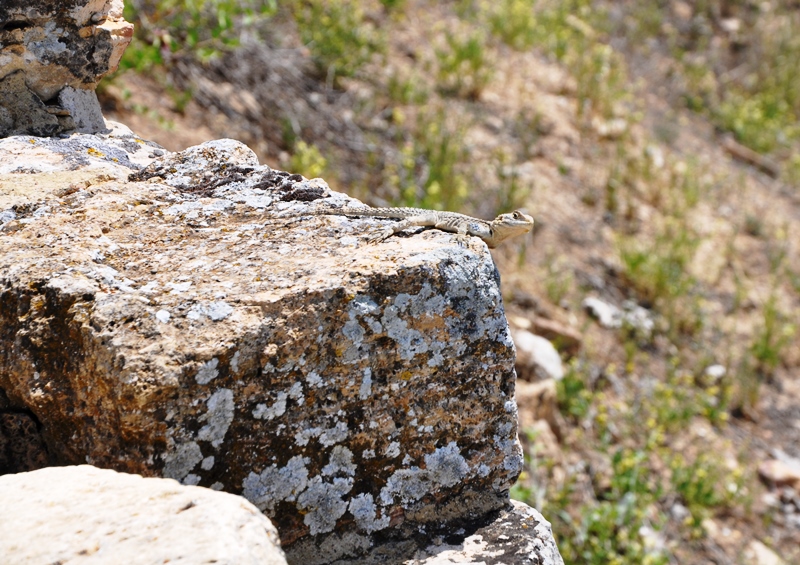
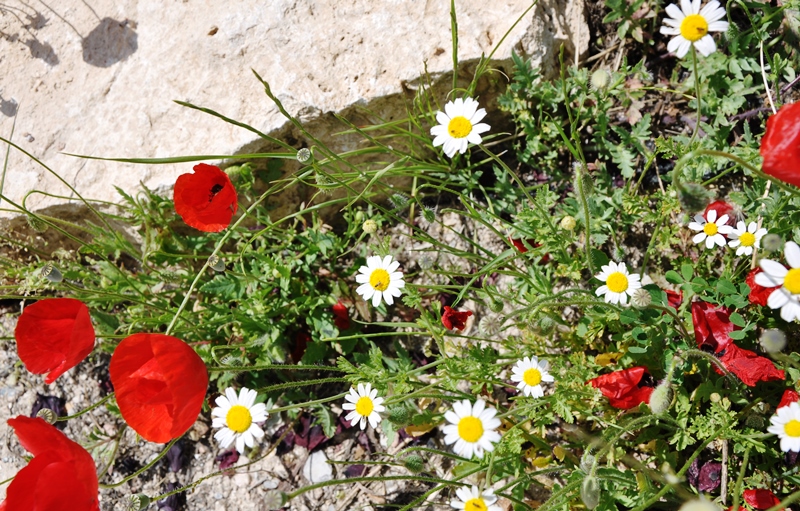
Some flora and fauna at Heriapolis:

Gecko at Hierapolis. Photo by Leon Mauldin.

Gecko at Hierapolis. Photo by Leon Mauldin.

Wild flowers at Hierapolis. Photo by Leon Mauldin.

Wild flowers at Hierapolis. Photo by Leon Mauldin.

Today wraps up this photo/study trip for various sites in Turkey for Ferrell Jenkins & me.  We have made several trips of this nature, and I always enjoy them and learn a lot. Tomorrow morning is a 4 hr. drive back to the airport at Antalya and then a flight to Istanbul and homeward bound from there.