Tonight I thought I’d share a group photo taken today in front of the Arch of Constantine. The Colosseum can be seen at right.
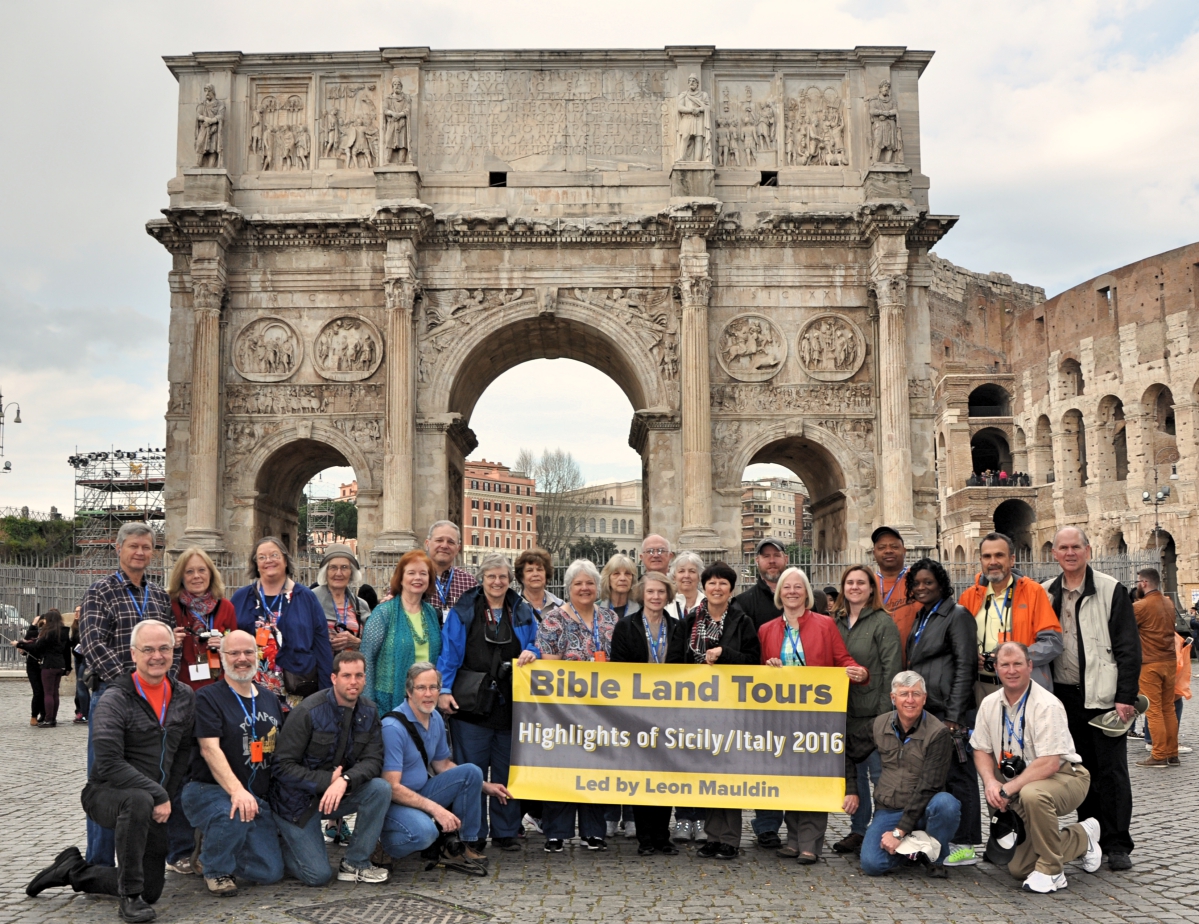
Group photo at Colosseum in Rome.
There is 3,000 years of history in Rome. More later. Thanks for following our blog.
Tonight I thought I’d share a group photo taken today in front of the Arch of Constantine. The Colosseum can be seen at right.
Group photo at Colosseum in Rome.
There is 3,000 years of history in Rome. More later. Thanks for following our blog.
 Leave a Comment » |
  photography, Roman Empire, Rome, Travel | Tagged: Colosseum |
  Permalink
 Posted by Leon Mauldin
We continue to share some photos and info from our recent trip to Italy. Capitoline Hill, one of the seven hills of Rome, was the citadel of the earliest Romans. The Campdoglio Piazza, created by Michelangelo in 1536-1546, encompasses Capitoline Hill.
At the center of the piazza is an equestrian (depicting horseback riding) statue of Roman Emperor Marcus Aurelius, (r. AD 161-180).

Emperor Marcus Aurelius at Campdoglio Piazza in Rome. Photo by Leon Mauldin.
Wikipedia has this info:
The statue was erected in 175 CE. Its original location is debated: the Roman Forum and Piazza Colonna (where the Column of Marcus Aurelius stands) have been proposed.
Although there were many equestrian imperial statues, they rarely survived because it was practice to melt down bronze statues for reuse as coin or new sculptures in the late empire. Statues were also destroyed because medieval Christians thought that they were pagan idols. The statue of Marcus Aurelius was not melted down because in the Middle Ages it was incorrectly thought to portray the first Christian Emperor Constantine. Indeed, it is the only fully surviving bronze statue of a pre-Christian Roman emperor.
In the medieval era it was one of the few Roman statues to remain on public view. In the 8th century it stood in the Lateran Palace in Rome, from where it was relocated in 1538 to the Piazza del Campidoglio (Capitoline Hill) during Michelangelo’s redesign of the Hill. Though he disagreed with its central positioning, he designed a special pedestal for it. The original is on display in the Palazzo dei Conservatori of the Musei Capitolini, while a replica has replaced it in the square.
Click on image for larger view.
Leave a Comment » | Italy, photography, Roman Empire, Rome, Travel | Tagged: Marcus Aurelius | Permalink
Posted by Leon Mauldin
Piazza Navona is a city square in Rome, Italy, built on the site of the Stadium of Emperor Domitian (AD 81-96). The piazza follows the layout of the open space of the stadium. One of the attractions here is the Fountain of Four Rivers.
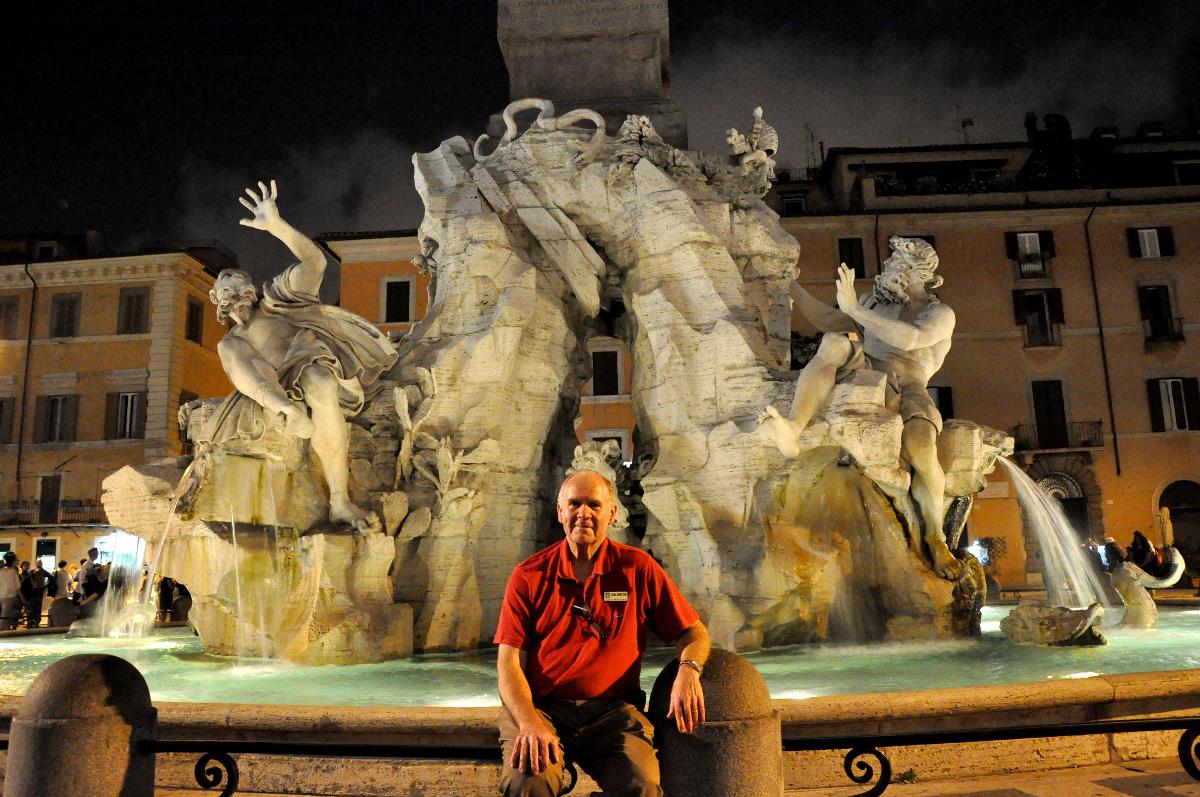
Fountain of Four Rivers. Photo by Nancy Picogna.
The fountain, a work of the famous artist Bernini, depicts the four “river gods.” Wikipedia: “Collectively, they represent four major rivers of the four continents through which papal authority had spread: the Nile representing Africa, the Danube representing Europe, the Ganges representing Asia, and the Río de la Plata representing America.”
Info from http://www.rome.info/bernini/fountain-four-rivers/
Rome’s love affair with fountains goes back to antiquity, whilst the city today can boast a collection of public fountains that has no parallel to any other city in the world! In Baroque Rome, fountains were seen as a reflection of the generosity associated with papal families.
The play of water over marble, no matter how humble the design, provided local Romans with entertainments and a much needed, secure supply of water which could easily be carried home. The popes saw this art form as an excellent PR exercise and exploited the concept to the advantage of their standing with the local people. Pope, Innocent X Pamphilj (reigned 1644-1655) eventually commissioned Gian Lorenzo Bernini to sculpt Rome’s greatest achievement in this genre, the Fountain of the Four Rivers, located in Piazza Navona, the ancient stadium of the Emperor Domitian and the site of the Pamphilj family palace. As early as 1647 Innocent had decided to erect an obelisk as a central ornament for the piazza in tandem with a fountain, as he methodically cleaned up and beautified what was one of Rome’s most squalid neighbourhoods!
A competition was announced for design submissions by the leading artists of the day, with the exception of the gifted Bernini, who at the time was out of favor because of his close association with the previous papal regime, the Barberini.
The greatest artist of the day was not to be deterred however, arranging for the model of his fountain design to be seen by the Pope, upon which Innocent immediately ordered Bernini to begin the execution of his design, reputedly saying afterwards, “that the only way to avoid employing Bernini was not to see his designs.”
The Fountain of the Four Rivers depicts gods of the four great rivers in the four continents as then recognized by the Renaissance geographers: the Nile in Africa, the Ganges in Asia, the Danube in Europe and the Río de la Plata in America.
Each location is further enhanced by animals and plants of that country. The Ganges carries a long oar, representing the river’s navigability. The Nile’s head is draped with a loose piece of cloth, meaning that no one at that time knew exactly where the Nile’s source was. The Danube touches the Papal coat of arms, since it is the largest river closest to Rome. And the Río de la Plata is sitting on a pile of coins, a symbol of the riches America might offer to Europe (the word plata means silver in Spanish).
Each River God is semi-prostrate, in awe of the central tower, epitomized by the slender Egyptian obelisk (built for the Roman Serapeum in AD 81), symbolizing Papal power and surmounted by the Pamphilj symbol of the dove.
The Fountain of the Four rivers is a theater in the round, whose leading actor is the movement and sound of water splashing over and cascading down a mountain of travertine marble. The masterpiece was finally unveiled to the world on June 12, 1651, to joyous celebration and the inevitable criticisms of the day. Then as today the Fountain of the Four Rivers continues to amaze and entertain visitors to Rome. Bernini triumphs yet again!
Click on image for larger view.
2 Comments | Italy, photography, Roman Empire, Rome, Travel | Tagged: Bernini, Fountain of Four Rivers | Permalink
Posted by Leon Mauldin
There is a statue of the goddess Artemis housed in the Vatican Museum.

Goddess Artemis in Vatican Museum. Photo by Leon Mauldin.
This is the goddess mentioned in Acts 19, in the context of Paul’s preaching efforts at Ephesus:
About that time there occurred no small disturbance concerning the Way. For a man named Demetrius, a silversmith, who made silver shrines of Artemis, was bringing no little business to the craftsmen; these he gathered together with the workmen of similar trades, and said, “Men, you know that our prosperity depends upon this business. You see and hear that not only in Ephesus, but in almost all of Asia, this Paul has persuaded and turned away a considerable number of people, saying that gods made with hands are no gods at all. Not only is there danger that this trade of ours fall into disrepute, but also that the temple of the great goddess Artemis be regarded as worthless and that she whom all of Asia and the world worship will even be dethroned from her magnificence.” When they heard this and were filled with rage, they began crying out, saying, “Great is Artemis of the Ephesians!” (verses 23-28).
The ISBE has this info:
She may, however, be identified with the Cybele of the Phrygians whose name she also bore, and with several other deities who were worshipped under different names in various parts of the Orient. In Cappadocia she was known as Ma; to the Syrians as Atargatis or Mylitta; among the Phoenicians as Astarte, a name which appears among the Assyrians as Ishtar; the modern name Esther is derived from it. The same goddess seems to have been worshipped by the Hittites, for a female deity is sculptured on the rocks at Yazili Kaya, near the Hittite city of Boghazkeui. It may be shown ultimately that the various goddesses of Syria and Asia Minor all owe their origin to the earlier Assyrian or Babylonian Ishtar, the goddess of love, whose chief attributes they possessed. The several forms and names under which she appears axe due to the varying developments in different regions.
Tradition says that Diana was born in the woods near Ephesus, where her temple was built, when her image of wood (possibly ebony; Pliny, NH, xvi. 40; Acts 19:35) fell from the sky. Also according to tradition the city which was later called Ephesus was founded by the Amazons, and Diana or Cybele was the deity of those half-mythical people. Later when Ephesus fell into the possession of the Greeks, Greek civilization partly supplanted the Asiatic, and in that city the two civilizations were blended together. The Greek name of Artemis was given to the Asiatic goddess, and many of the Greek colonists represented her on their coins as Greek. Her images and forms of worship remained more Asiatic than Greek. Her earliest statues were figures crudely carved in wood. Later when she was represented in stone and metals, she bore upon her head a mural headdress, representing a fortified city wall; from it, drapery hung upon each side of her face to her shoulders. The upper part of her body was completely covered with rows of breasts to signify that she was the mother of all life. The lower arms were extended. The lower part of the body resembled a rough block, as if her legs had been wrapped up in cloth like those of an Egyptian mummy. In later times her Greek followers represented her with stags or lions standing at her sides. The most renowned of her statues stood on the platform before the entrance to her temple in Ephesus. As the statues indicate, she impersonated the reproductive powers of men and of animals and of all other life.
We have previously referenced Artemis in posts here, here, here and here.
Click on image for larger view.
Leave a Comment » | Bible History and Geography, Bible Study, Italy, New Testament, photography, Roman Empire, Rome, Travel, Turkey | Tagged: Artemis, Vatican Museum | Permalink
Posted by Leon Mauldin
One of the innumerable attractions in Rome is Michelangelo’s Moses, housed in the Church of San Pietro in Vincoli.

Church of San Pietro in Vincoli, Rome. Photo ©Leon Mauldin.
The main attraction inside is the statue of Moses, sculpted by Italian High Renaissance artist Michelangelo Buonarroti, creating this work in the years 1513-1515. This sculpture was originally commissioned in 1505 by Pope Julius II for his tomb.

Michelangelo’s Moses, 1513-1515. In Rome. Photo ©Leon Mauldin.
Moses is here depicted as seated, holding the two tablets of stone. Some suggest the intensity portrayed is meant to represent his holy anger when he cast down the stones upon being confronted with Israel’s idolatry.
Moses is seen here with horns on his head. This is based on a rendering in the Vulgate, the Latin translation of the Bible in use during Michelangelo’s time. The text of our English Standard Version renders Exodus 34:29, which speaks of Moses coming down from Mt. Sinai after talking with God, says, “When Moses came down from Mount Sinai, with the two tablets of the testimony in his hand as he came down from the mountain, Moses did not know that the skin of his face shone because he had been talking with God.” The Latin Vulgate renders the Hebrew word qaran, “to shine” as “horned.” Hence the horns on Michelangelo’s Moses.
The statue stands 8 feet, 4 inches and is made of solid marble.
Click on images for larger view.
Leave a Comment » | Bible History and Geography, Biblical Interpretation, Italy, photography, Rome, Travel | Tagged: Michelangelo, Moses | Permalink
Posted by Leon Mauldin
During our recent tour of Italy we were able to take some photos of the Forum of Julius Caesar, the first of the Imperial Forums. Construction was begun by Caesar in 54 BC (Rome: Oxford Archaeological Guides). This is the location where the senate would meet before him. It was also here that Caesar built the Temple of Venus Genitrix.
The temple (Fig. 62) was introduced to Caesar’s original plan at a slightly later stage. It was vowed by Caesar the night before the Battle of Pharsalus in 48 BC, during his civil war with Pompey, to win over Pompey’s favoured goddess Venus Victrix, though when inaugurated in 46 BC (while still unfinished) it actually honoured her as Venus Genetrix, ‘universal mother’, from which Julius Caesar’s family (and thus all the emperors from Augustus to Nero) claimed descent (ibid.)
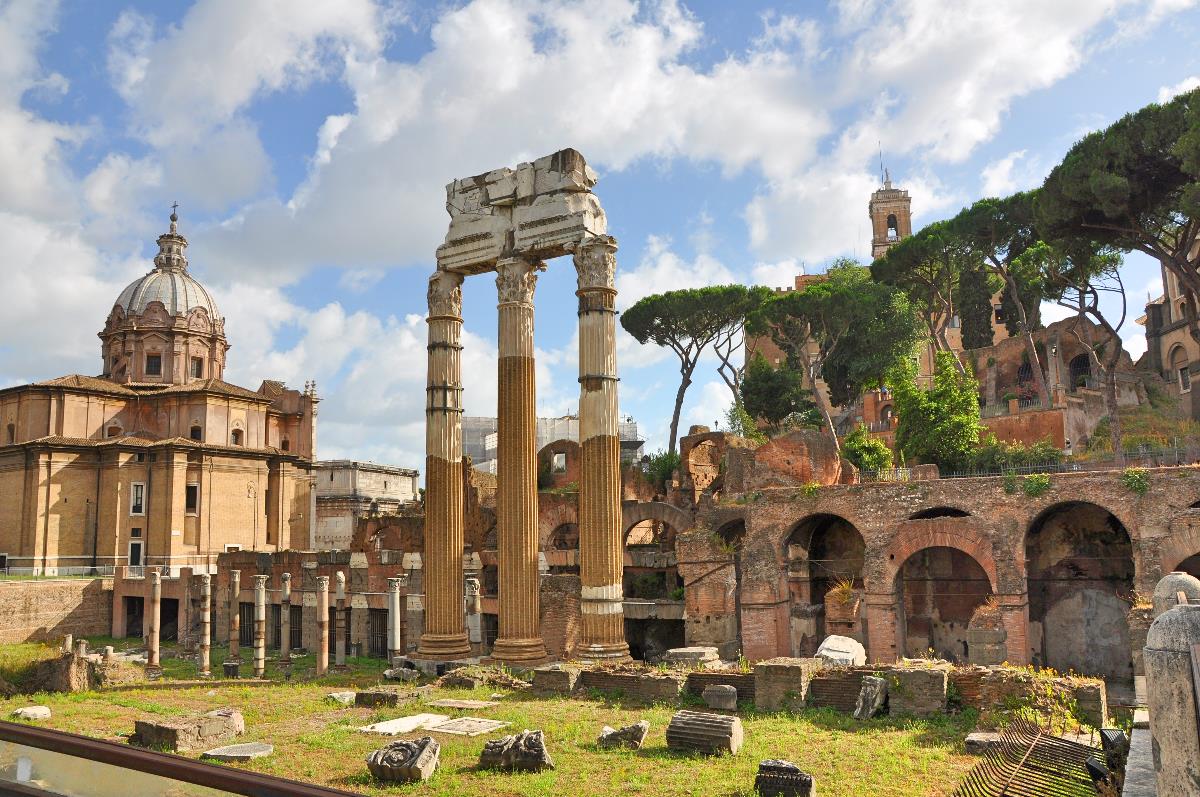
Forum of Julius Caesar. Photo ©Leon Mauldin.
The three Corinthians columns were added at the time of Hadrian.
Leave a Comment » | Bible History and Geography, Italy, photography, Roman Empire, Rome, Travel | Permalink
Posted by Leon Mauldin
It is not unusual for a tour group to discuss what was their favorite or most meaningful location/event during their trip. On our recent “Highlights of Italy Tour,” many of our group cited the Mamertine Prison in Rome as being at the top of their list. To be able to walk down to the dark prison cell, and recall Paul’s last words in 2 Tim. 4, really enhances one’s understanding of the text and of Paul’s circumstances:
6 For I am already being poured out as a drink offering, and the time of my departure is at hand. 7 I have fought the good fight, I have finished the race, I have kept the faith. 8 Finally, there is laid up for me the crown of righteousness, which the Lord, the righteous Judge, will give to me on that Day, and not to me only but also to all who have loved His appearing. 9 Be diligent to come to me quickly; 10 for Demas has forsaken me, having loved this present world, and has departed for Thessalonica — Crescens for Galatia, Titus for Dalmatia. 11 Only Luke is with me. Get Mark and bring him with you, for he is useful to me for ministry. 12 And Tychicus I have sent to Ephesus. 13 Bring the cloak that I left with Carpus at Troas when you come — and the books, especially the parchments. 14 Alexander the coppersmith did me much harm. May the Lord repay him according to his works. 15 You also must beware of him, for he has greatly resisted our words. 16 At my first defense no one stood with me, but all forsook me. May it not be charged against them. 17 But the Lord stood with me and strengthened me, so that the message might be preached fully through me, and that all the Gentiles might hear. And I was delivered out of the mouth of the lion. 18 And the Lord will deliver me from every evil work and preserve me for His heavenly kingdom. To Him be glory forever and ever. Amen! (2 Tim. 4:6-18).
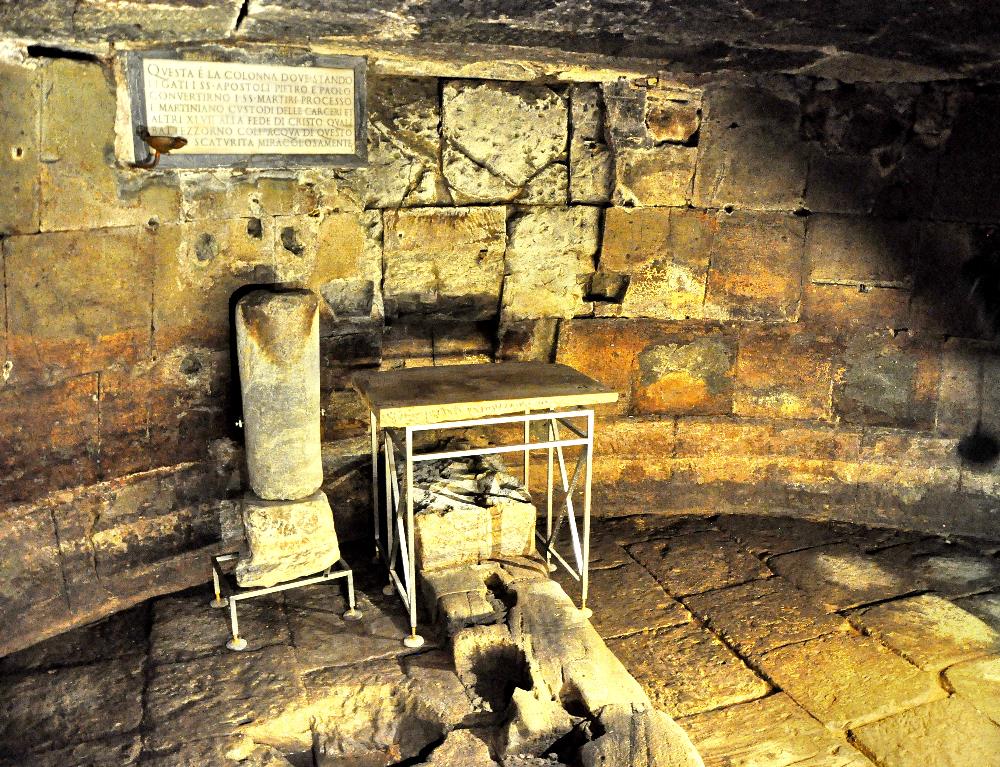
Mamertine Prison in Rome. Photo ©Leon Mauldin.
We cannot affirm that this is the exact part of the prison that Paul was in as he penned the above text. But this is definitely a part of the state prison complex, and it illustrates the biblical setting as Paul, near death, penned his last letter to his faithful friend and fellow-worker, Timothy. I.e., it is safe to say that Paul was in a cell like this, in this area, awaiting execution. BAS in their photo collection has this information:
Near the Forum, at the base of the Capitoline Hill, is the dungeon of the Mamertine Prison. This was the state prison of Rome, and Paul may have ended his days here.
We see the lower of two chambers constructed of blocks cut from tufa, the local porous rock. Originally, this 30-foot diameter room could be reached only through the hole visible in its ceiling. This would have been the dungeon cell for prisoners; above it is a smaller room for the warders. Conflicting Roman traditions attributed the building of the prison to different rulers of the 7th and 6th centuries B.C.E. Some modern investigations have suggested a 3rd-century B.C.E. date for this lower chamber and a 1st-century B.C.E. date for the room above, but there is no question that it was in use in Paul’s time. Christian tradition also places Peter’s final internment here, at the time of Nero’s persecution. (Biblical Archaeology Society: The Biblical World in Pictures).
The Wycliffe Historical Geography of Bible Lands has this entry:
Tradition has it that during his second imprisonment Paul was detained in the Mamertine Prison in Rome. The name Mamertinus is postclassical; during the Empire the place was known simply as the Carcer. This was the ancient state prison of Rome at the foot of the Capitoline Hill. It was used as a place of detention, not of penal servitude, although executions occurred there. The upper room is a vaulted trapezoid, the sides varying in length from eleven to sixteen feet.
Below it was a subterranean chamber, originally accessible only by a hole in the roof. This Tullianum was nearly twenty-one feet in diameter and, according to Sallust, twelve feet high. All who wrote of the place described it with horror. Sallust (86–34 B.C.) described it as “exceeding dark, unsavory, and able to craze any man’s senses.” Under such circumstances the apostle would indeed have felt the need of the cloak and the books he had left behind at Troas (2 Tim. 4:13).
As Paul wrote Second Timothy, he had none of the optimism expressed in his earlier letters, when he expected release. He had obtained a preliminary hearing, and it had been a dismal failure (2 Tim. 4:16). Though he found himself in dire circumstances, he delivered what sometimes has been called his valedictory, for he was about to “graduate.” “For I am now ready to be offered, and the time of my departure is at hand. I have fought a good fight, I have finished my course, I have kept the faith: Henceforth there is laid up for me a crown of righteousness, which the Lord, the righteous judge, shall give me at that day: and not to me only, but unto all them also that love his appearing” (2 Tim. 4:6–8) (Eds. Pfeiffer & Vos, 1996).
Click on image for larger view.
Scroll down to see more from our recent trip to Italy.
1 Comment | Bible History and Geography, Bible Study, Italy, New Testament, photography, Roman Empire, Rome, Travel | Tagged: Apostle Paul, prison, Timothy | Permalink
Posted by Leon Mauldin
We continue to explore the Roman Forum. In our photo below we see the Tabularium, the large building in the back.
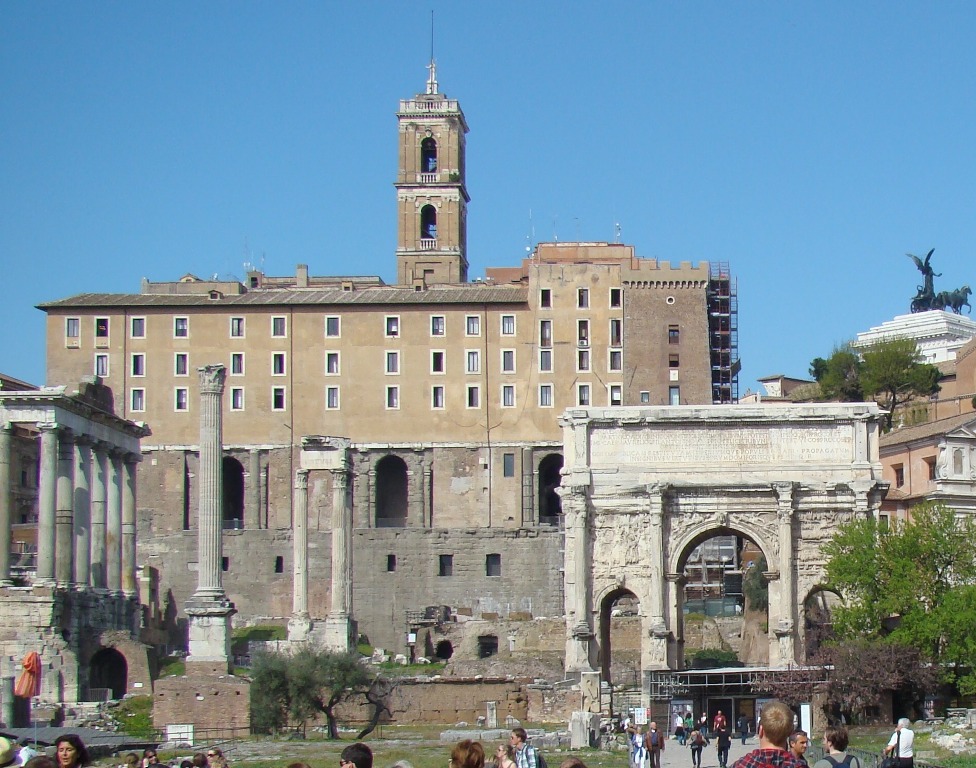
Tabularium in Roman Forum. Photo by Leon Mauldin.
“Tabularium” is a term for a record building. A number of other tabularia were scattered around Rome and other ancient Roman cities, but this article is about the prototype example.
The Tabularium was the official records office of ancient Rome, and also housed the offices of many city officials. Situated within the Roman Forum, it was on the front slope of the Capitoline Hill, below the Temple of Jupiter Optimus Maximus, to the southeast of the Arx and Tarpeian Rock.
Within the building were the remains of the temple of Veiovis. In front of it were the Temples of Vespasian & Concord, as well as the Rostra and the rest of the forum. Presently the Tabularium is only accessible from within the Capitoline Museum, although it still affords an excellent panoramic view over the Forum.
The Tabularium was first constructed around 78 BC, by order of M. Aemilius Lepidus and Q. Lutatius Catulus. It was later restored and renovated during the reign of the Emperor Claudius, about 46 AD. (Wikipedia).
The lower level, the gray portion, is the Roman period; upper level was built later.
In a entry entitled “Obtaining Citizenship,” (Roman citizenship) F.F. Bruce is referenced as stating
that legislation at the turn of the first century A.D. called for a legitimately born child of Roman citizens to be registered within thirty days of birth. Children born in the provinces would be legally acknowledged (professio) before the Roman provincial authority at the public record office (tabularium publicum). The professio was then entered in the register (album professionum). We do not know if Paul’s birth was before or after this legislation, but some such formal procedure had to have been in effect earlier. At regular intervals a citizen’s name, age, status and property holdings would thereafter be recorded by census. (Dictionary of New Testament Background: A Compendium of Contemporary Biblical Scholarship.)
At right in the photo you can see the Arch of Septimius Severus, dedicated in AD 203.
*******
At present I am en route to Cyprus to join Ferrell Jenkins for a few days of photographing biblical sites, and biblically related sites, in Cyprus and Turkey.
Click on image for larger view.
Leave a Comment » | Bible History and Geography, Italy, photography, Roman Empire, Rome, Travel, Uncategorized | Permalink
Posted by Leon Mauldin
In our post today we continue to share some photos of sites of signifance in the Roman Forum. Today’s photo features the Temple of Vespasian and Titus.
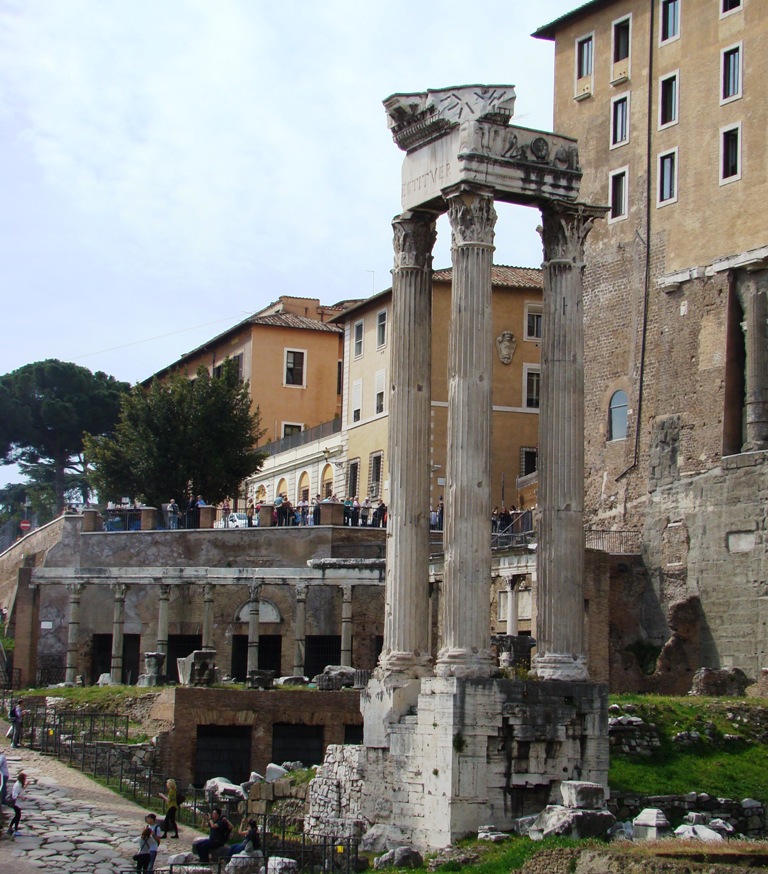
Temple of Vespasian and Titus in Roman Forum. Photo by Leon Mauldin.
Wikipedia has some helpful generic info:
The Temple of Vespasian and Titus (Latin: Templum divi Vespasiani, Italian: Tempio di Vespasiano) is located in Rome at the western end of the Roman Forum between the Temple of Concordia and the Temple of Saturn. It is dedicated to the deified Vespasian and his son, the deified Titus. It was begun by Titus in AD 79 after Vespasian’s death and Titus’s succession. Titus’ brother, Domitian, completed and dedicated the temple to Titus and Vespasian in approximately AD 87.
Throughout Roman history, there was an emphasis on increasing the fame and glory of a family name, often through monuments commemorating the deceased. Therefore, the temple was constructed to honor the Flavian Dynasty, which comprised the emperors Vespasian (69-79), Titus (79-81), and Domitian (81-96). Historians question whether or not Titus and Domitian had a good relationship; however, Domitian ensured the deification of his brother into the imperial cult in order to exalt the prominence of the Flavian name. Titus and Vespasian were each deified through the ceremony of apotheosis. In doing so, tradition guaranteed that Roman citizens and subjects would honor Vespasian and Titus (or at least honor their genius) as Roman deities. This imperial cult worship was as much a sign of allegiance to the emperor of Rome, or as a political and diplomatic gesture, as it was a formal religion.
Structure. The Temple of Vespasian was in the Corinthian order, hexastyle (i.e., with a portico six columns wide), and prostyle (i.e., with free standing columns that are widely spaced apart in a row).[4] It was particularly narrow due to the limited space, measuring 33 meters long and 22 wide. In a constricted space between the temple and the Concord, a small, two story vaulted room made of brick and concrete, and lined with marble, was built against the wall of the Tabularium, and apparently was dedicated to Titus.
Construction and Renovation. Titus began construction and presumably finished the foundations, made of tufa concrete, and the core of the podium, made of white marble. Domitian, however, completed the interior work after Titus’ death. The cella (inner) walls were in travertine, lined with marbles imported at great expense from the eastern provinces. The interior is highly ornate and the frieze depicts sacred objects that would have been used as the symbols, or badges, of the various priestly collegia in Rome. Around 200 to 205, Emperors Septimius Severus and his son, Caracalla, conducted renovations on the temple.
Click on image for larger view.
1 Comment | Bible History and Geography, photography, Roman Empire, Rome, Travel | Tagged: Titus, Vespasian | Permalink
Posted by Leon Mauldin
The Roman goddess Vesta was the goddess of the hearth. She
was considered the patron of the fire that symbolized the perpetuity of the state. It was the responsibility of the priestesses to maintain this sacred fire and to renew it each year on March 1, the first day of the Roman year (The Wycliffe historical geography of Bible lands).
We photographed the remains of the Temple of Vesta in the Roman Forum a few weeks ago.
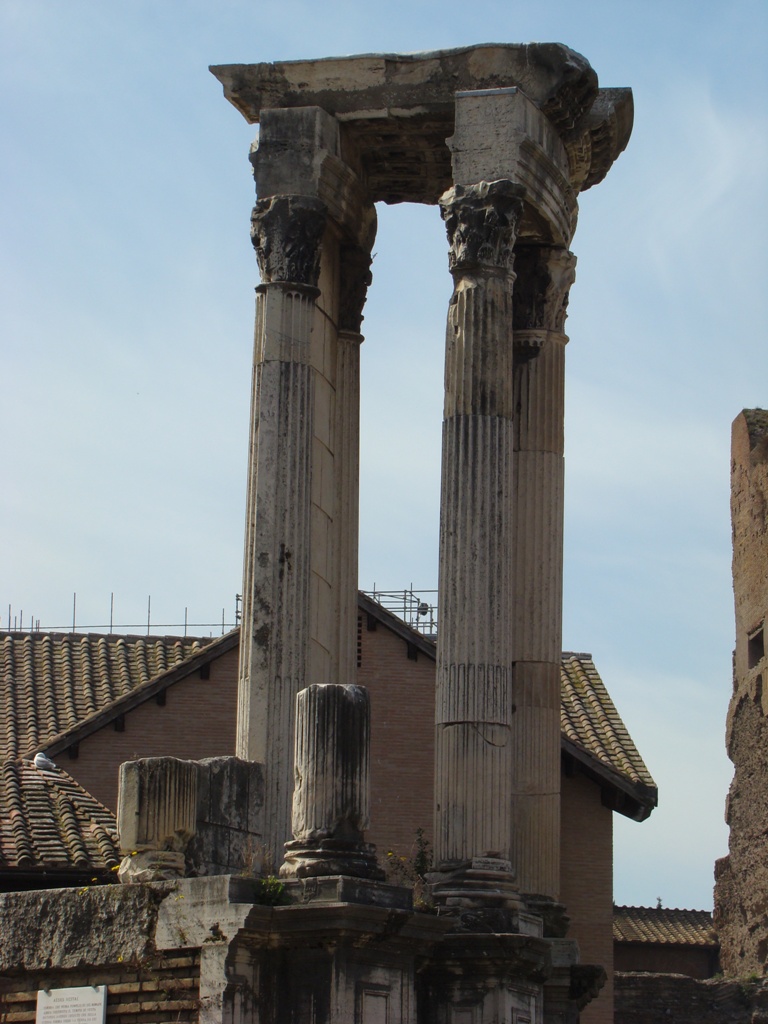 Temple of Vesta in Roman Forum. Photo by Leon Mauldin.
Vos, in his work, Nelson’s New Illustrated Bible Manners & Customs: How the People of the Bible Really Lived, asks the reader to suppose that when Paul’s trial was conducted in Rome that he entered the Forum on the east side:
As Paul came into the Forum area down the Sacred Way from the east, the first building he would have passed was the house of the vestal virgins. He might have observed that the house was rather large for a sisterhood of only six priestesses. But such an objection is erased with the observation that the vestals were held in high esteem and that their house was chosen by private citizens and by the state as a safe deposit for documents.
Adjacent to this house was the Temple of Vesta, considered the goddess of the hearth and the patron of the fire that symbolized the perpetuity of the state. It was the responsibility of the priestesses to maintain this sacred fire and to renew it each year on March 1, the first day of the Roman year (p.606).
The extant temple used Greek architecture with Corinthian columns, marble, and a central cella. The remaining structure indicates that there were twenty Corinthian columns built on a podium fifteen metres in diameter. The roof probably had a vent at the apex to allow smoke release.
***********
My friend Ferrell Jenkins is currently directing a biblical study tour in Turkey & Greece. He will be posting as time permits on Ferrell’s Travel Blog.
Click on image for larger view.
Leave a Comment » | Archaeology, Bible History and Geography, Bible Study, photography, Roman Empire, Rome, Travel | Tagged: Vesta | Permalink
Posted by Leon Mauldin
You are currently browsing the archives for the Rome category.

 leonmauldin.blog