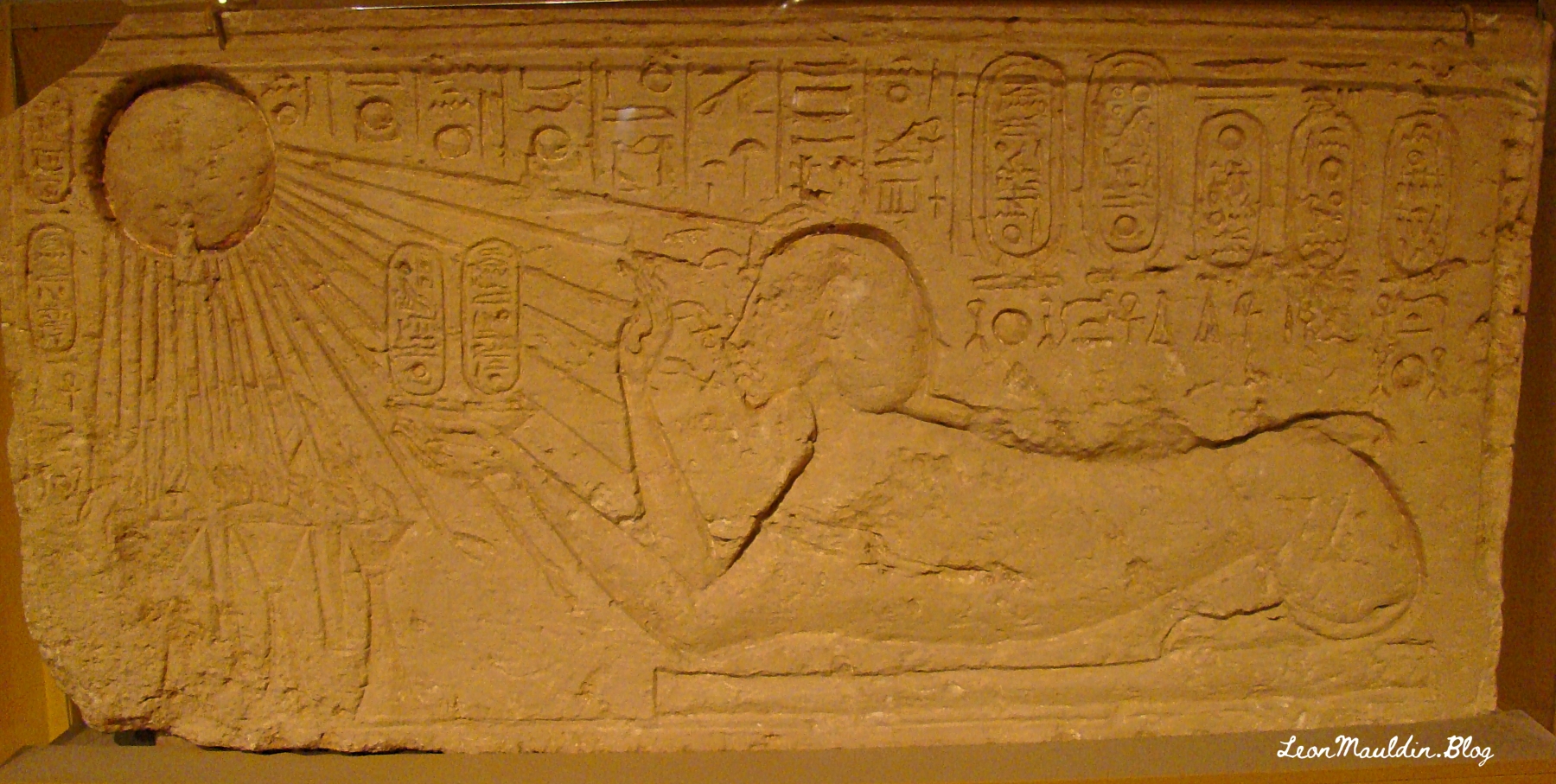
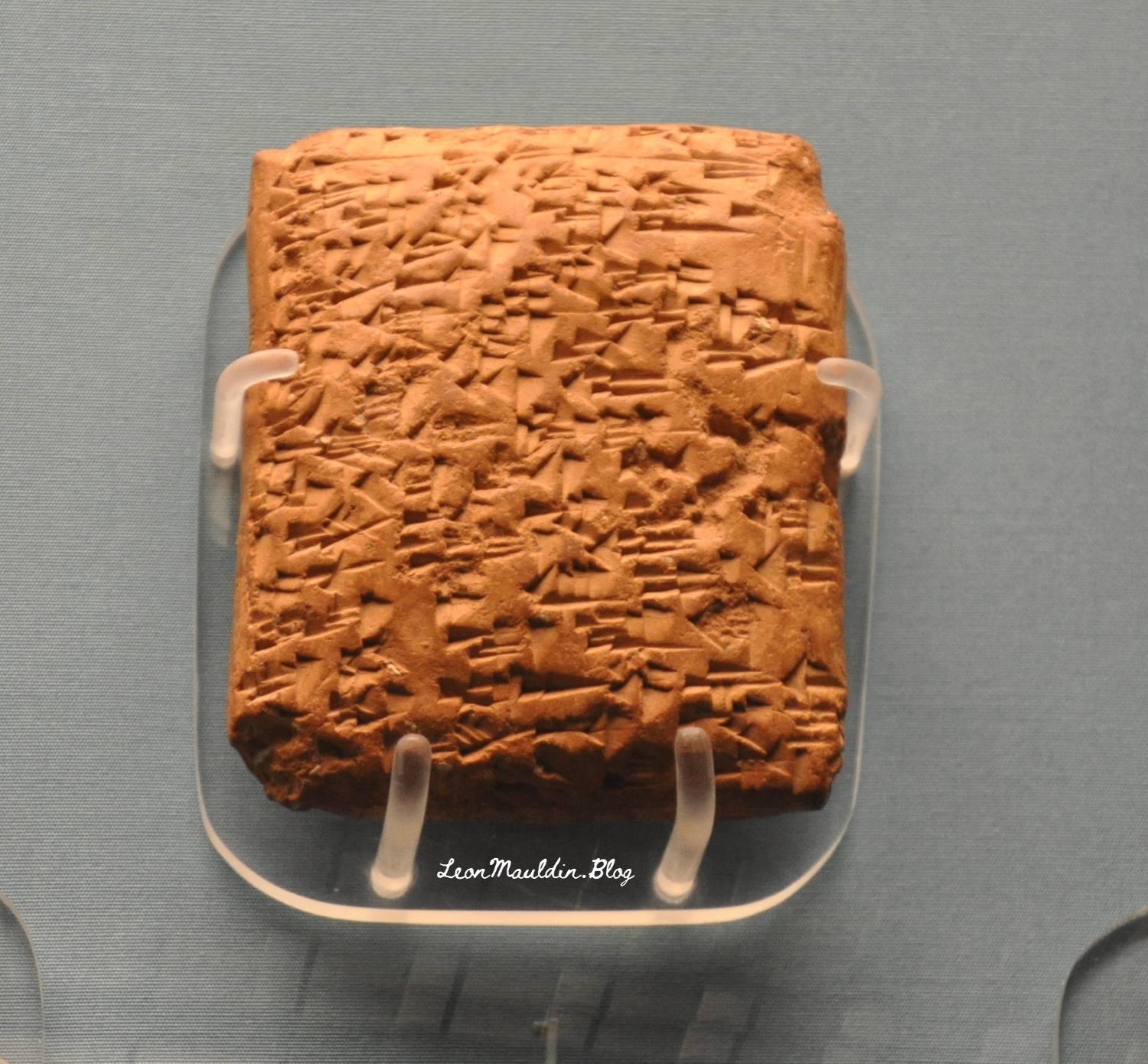
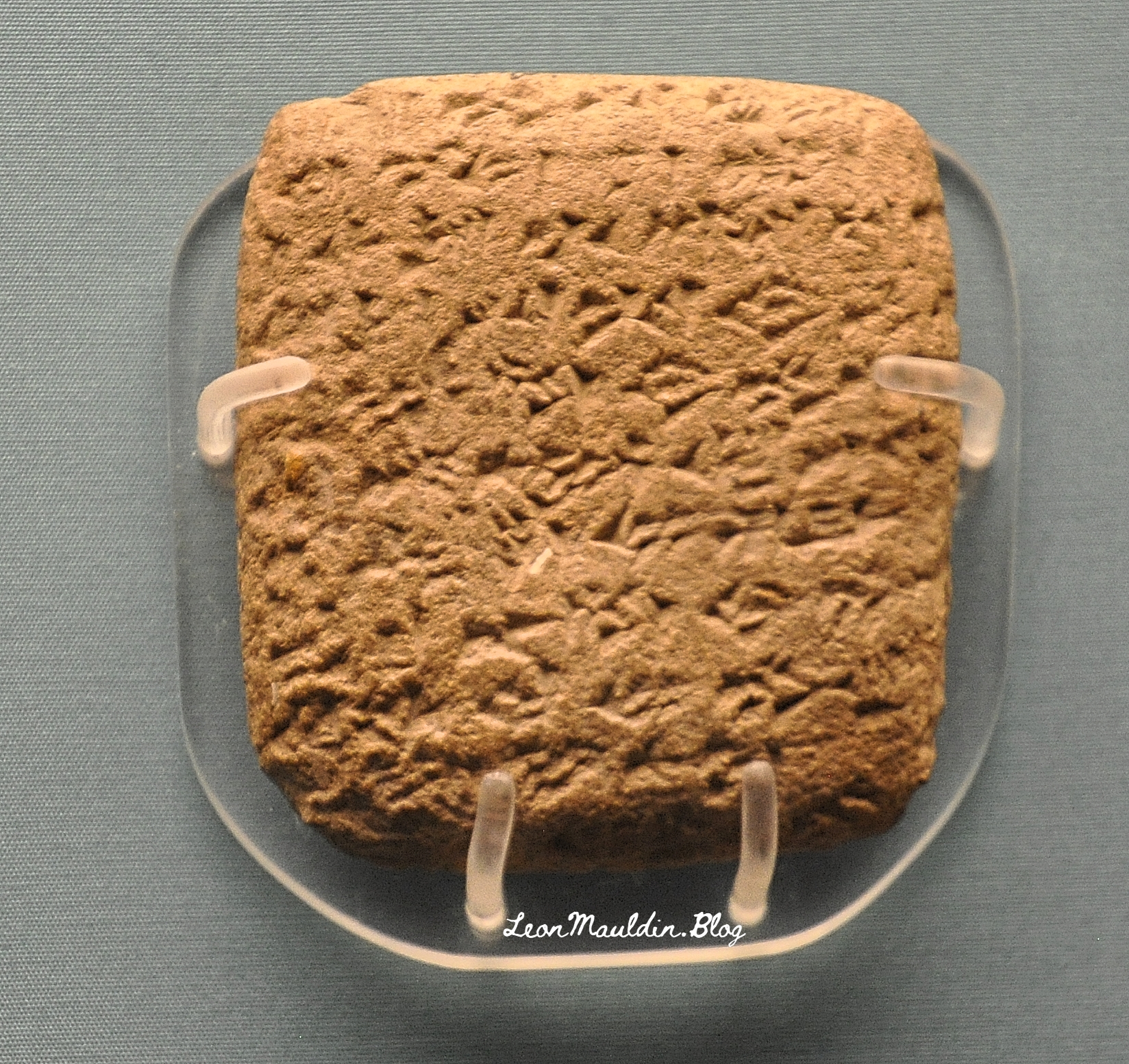
The collection of El-Amarna tablets represent diplomatic correspondence from princes/kings of from varioius parts of the Egpytian Empire during the reigns of Amenophis III, Akhenaton and Tutankhamun. These tablets were found in the ruins of Akhenaton’s (the “heretic” pharaoh) capital at El-Amarna. The British Museum displays some of the El-Amarna tablets from various locations in Canaan, which will be the focus of this post. We will feature tablets from Hazor, Lachish, Gezer, Megiddo and Shechem, all five of which were very important sites in Canaan.
Discovered at the site of Tell el-Amarna in Middle Egypt, these cuneiform documents are letters dating to the mid-14th century BCE that were written in varieties of Akkadian, the lingua franca of the time, by scribes from all over the ancient Near East on behalf of local kings. The letters are commonly divided into two groups: letters from the “greater” powers (the Egyptian, Mitannian, Hittite, Assyrian, and Kassite kings) and letters from the “lesser” powers (smaller kingdoms and city-states from across the Levant, including the land of Canaan). Interestingly, even though the Canaanite rulers were among the least powerful kings writing to Egypt (in fact, they were under Egyptian rule), they left behind the largest number of letters. Source: https://library.biblicalarchaeology.org/article/letters-to-pharaoh-the-canaanite-amarna-tablets/?utm_source=WhatCountsEmail&utm_medium=BHDA%20Spotlight%201-90&utm_campaign=TS%20BAS%20Scholars%20Series%208-21-24
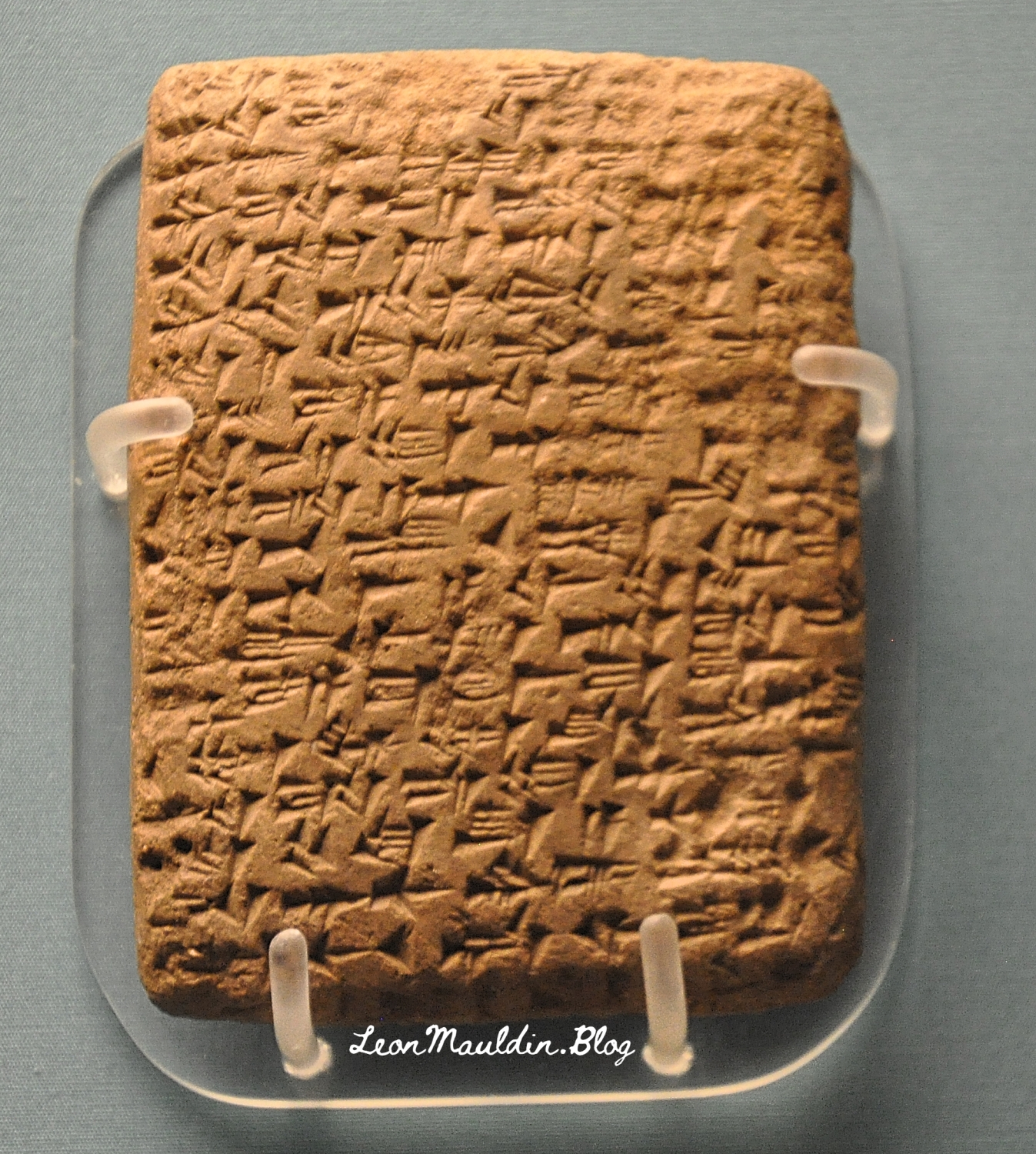
This tablet is from Abdi-Tirshi, King of Hazor. The info sign says that he “reassures pharaoh that he is loyal and is keeping his cities in good order.”
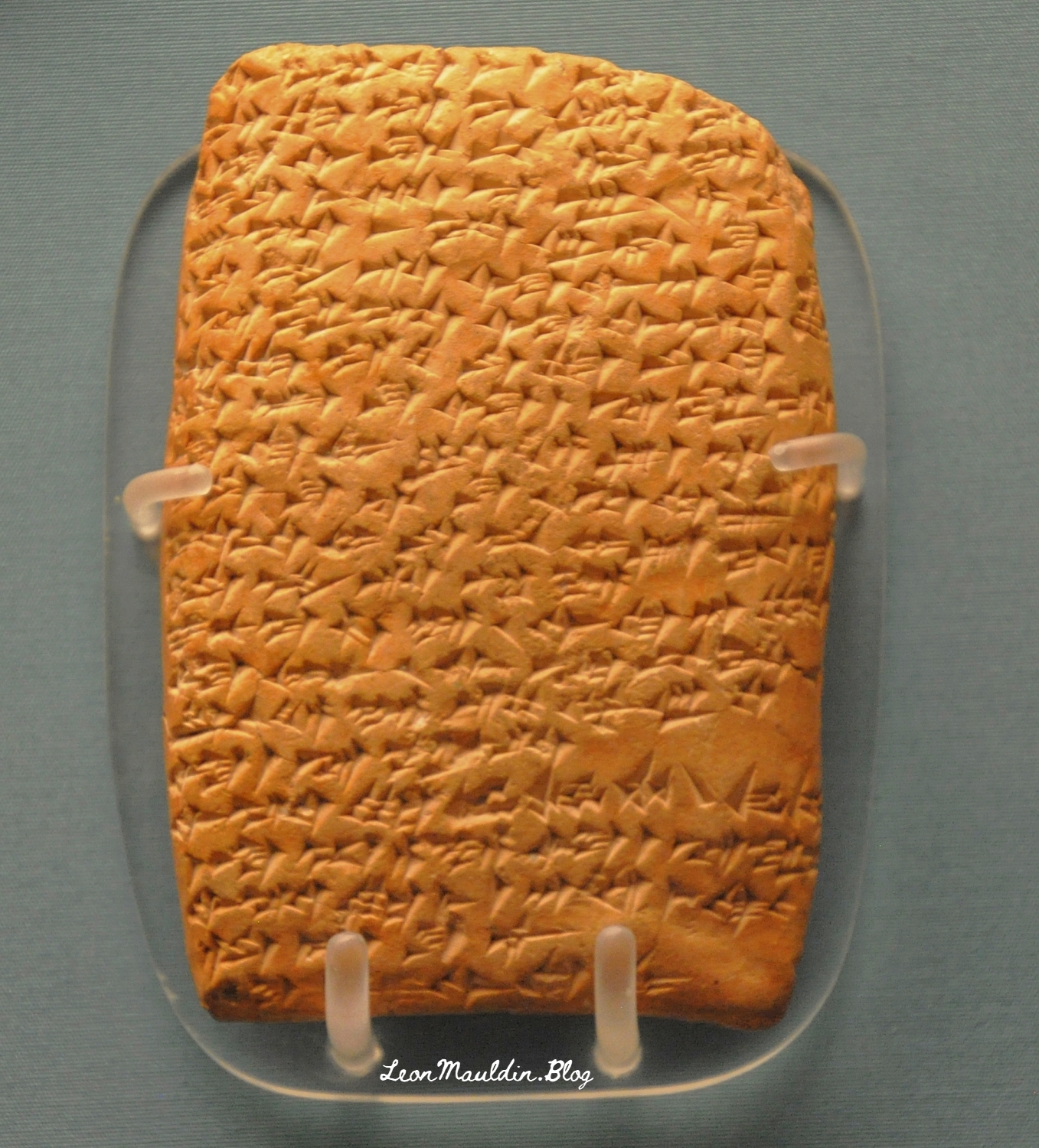
Here is the tablet from Gezer’s king Yapahu, who “begs pharaoh for help in defending his city against raids by the Hapiru.” Many scholars believe that the “Hapiru” here refer to the Hebrews.
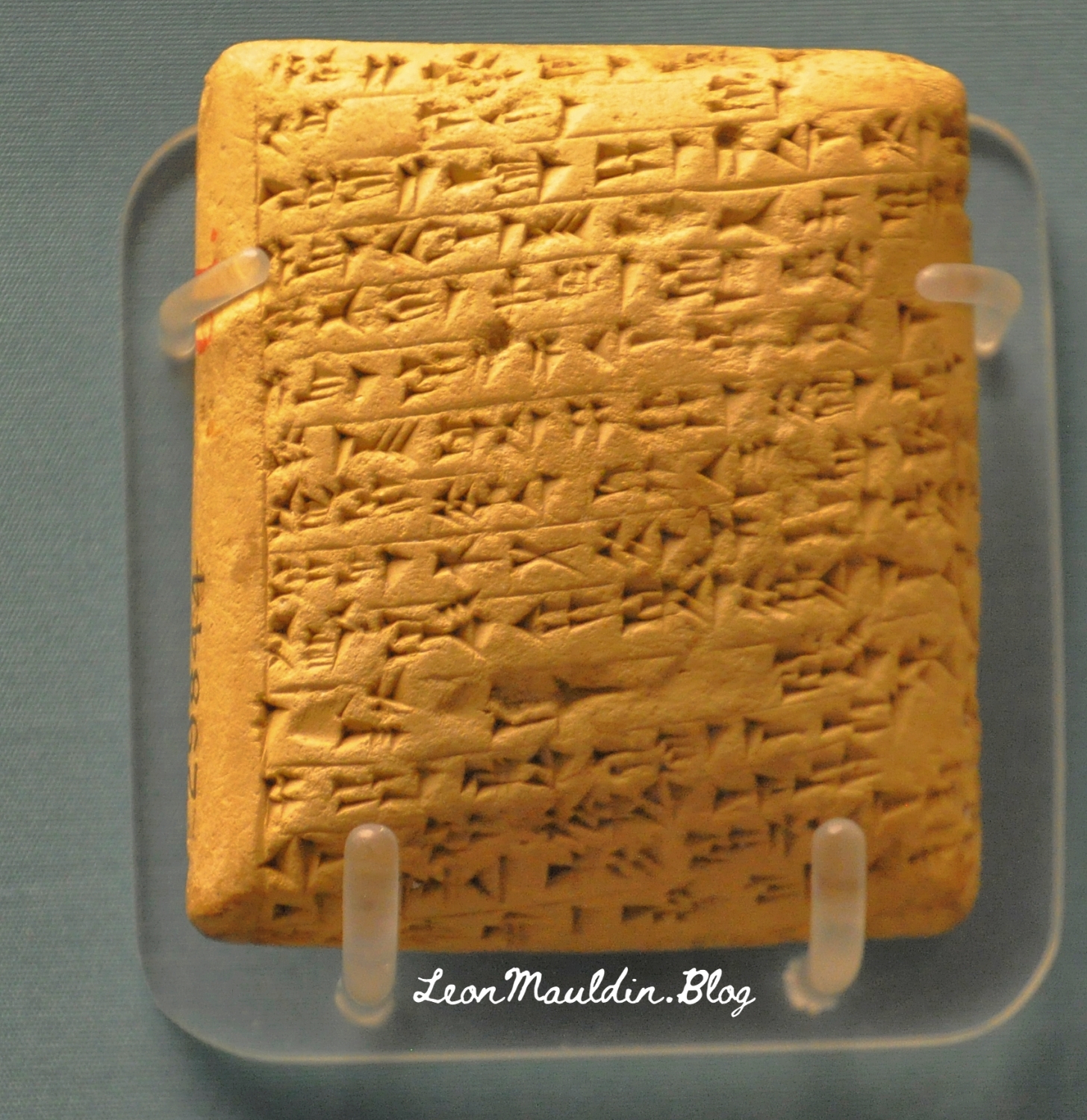
Here is the tablet from Biridiya, king of Megiddo. He “accuses the king of Acco of treachery by releasing the captured Hapiru leader, Labayu, instead of sending him to Egypt.”
Mandell went on the say regarding the script of these tablets, “The Amarna Letters were not written in alphabetic or Egyptian scripts. They were written in cuneiform, a wedge-shaped script that was developed in Mesopotamia in the late fourth millennium BCE to write Sumerian and, later, Akkadian. By the Amarna period, ancient people from all over the Near East wrote in this script by impressing a stylus into clay to create wedge-shaped signs” (Ibid.).
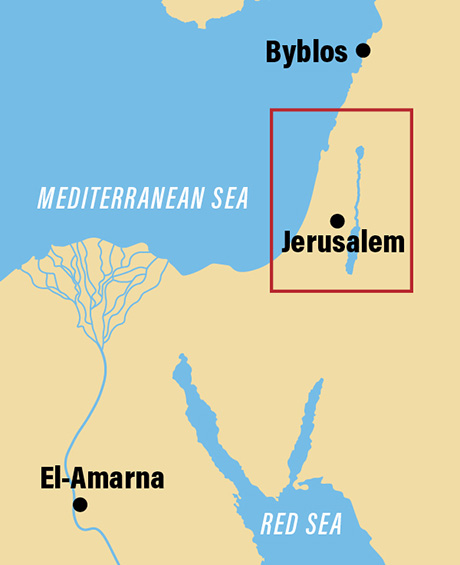
The BAS article also provided a couple of helpful maps.
Map shows the location of El-Amarna relative to Canaan.
Location of El-Amarna in Egypt. Map by BAS.
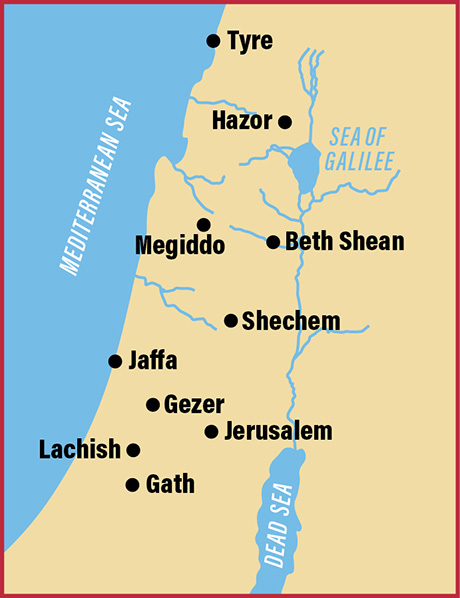
This map includes the sites of the origin of the tablets we featured above.
Cities in Canaan represented our display of tablets. Map by BAS.
This post shows an Anthropoid Coffin from Deir el-Balah, south of Gaza, one of the cities of the Philistines. Scholars date this artifact to the 13th century BC. It demonstrates Egyptian influence reaching into the SW coast of Canaan. The patriarch Joseph may have been put in a coffin such as this.
The Philistines are mentioned numerous times in the Bible, in the days of the Judges and Kings, and as well as references in the prophets. For example, Zephaniah 2:4: “For Gaza shall be deserted, and Ashkelon shall become a desolation; Ashdod’s people shall be driven out at noon, and Ekron shall be uprooted” (ESV). This text mentions four of the five cities of the Philistine Pentapolis, the fifth being Gath (see 1 Sam. 6:16).
The context of Zephaniah’s prophecy is one of judgment, of the wrath of God, called “The great day of the LORD” (1:14). Though Zephaniah is addressing the Jews of Jerusalem/Judah, God is the God of all the nations. Here the prophet was warning of the destruction of the Philistines (2:5).
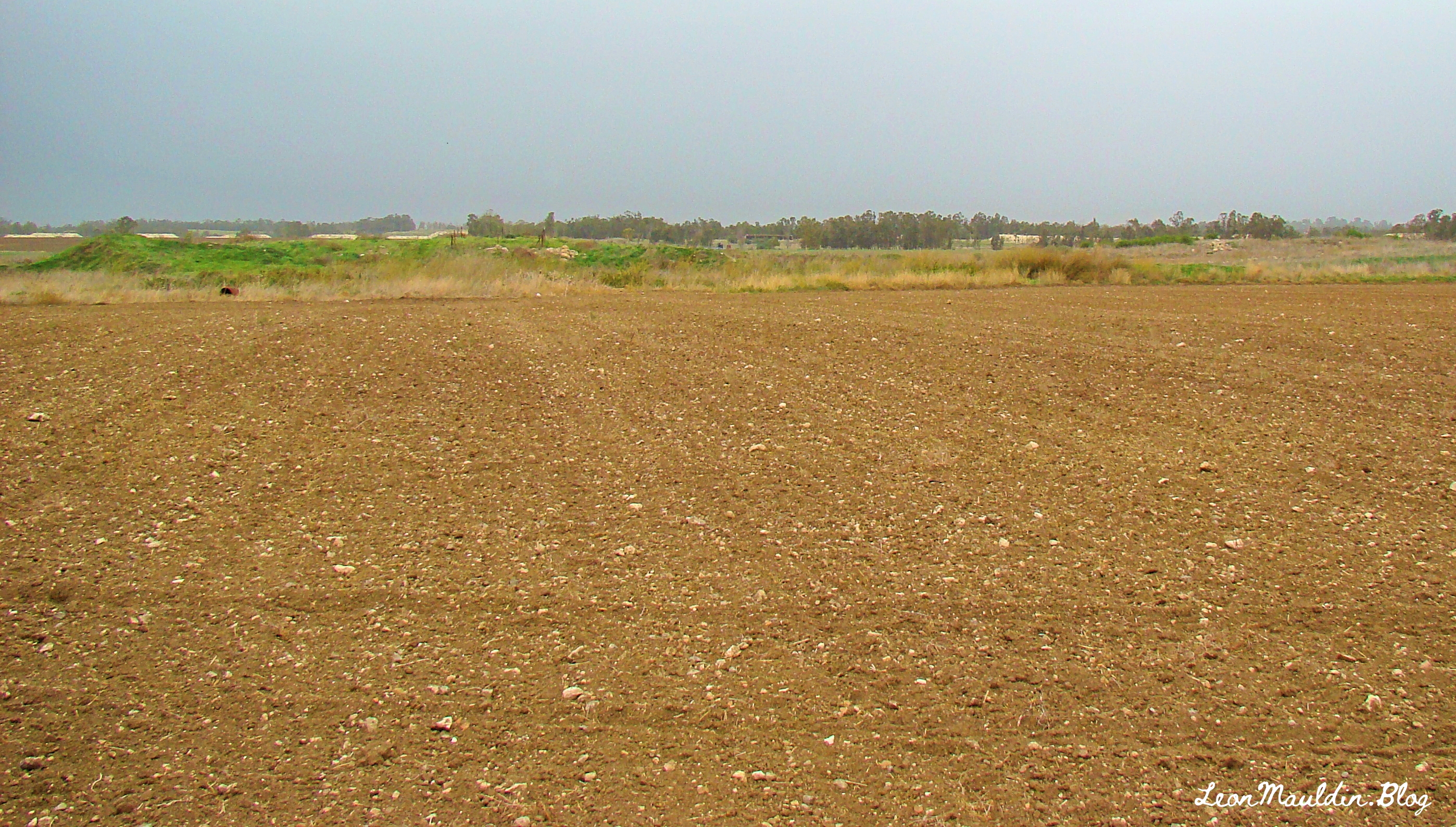
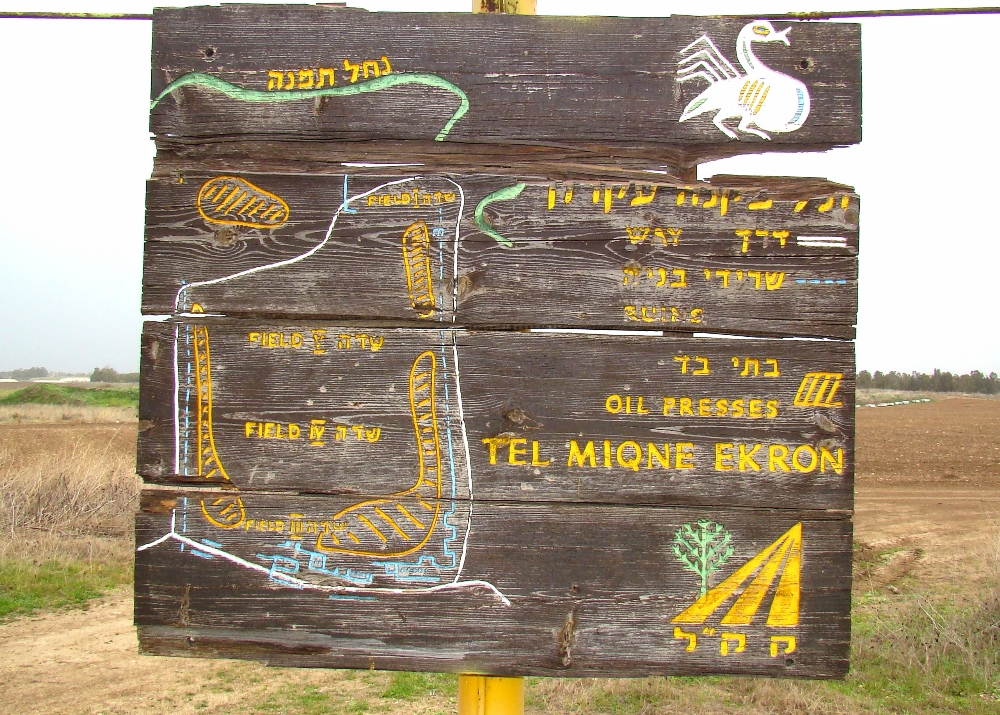
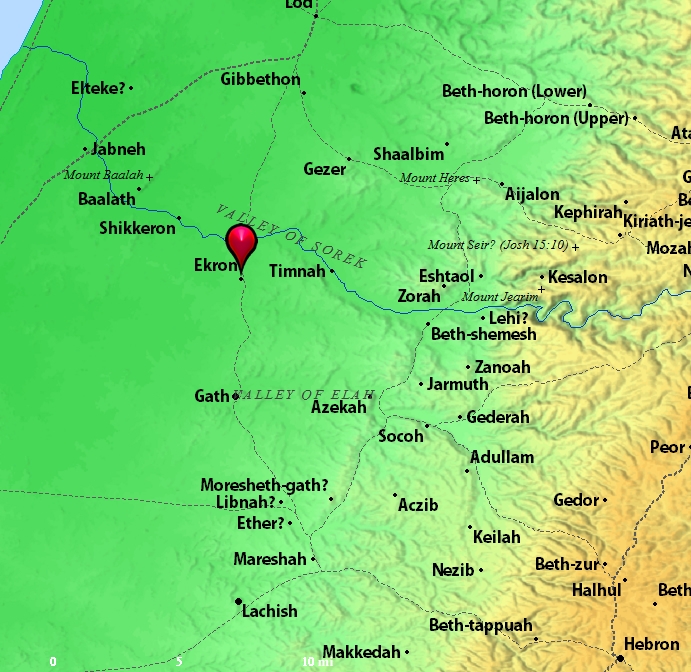
This post will deal briefly with Ekron, which today is known also as Tel Miqne.
Though originally in Israel’s territory at the time of the Conquest led by Joshua (Josh. 15:11, 45-56), Ekron was later in the hands of the Philistines by the time of the Judges. Much of the territory originally taken by the Israelites in the conquest was not retained in subsequent years, largely due to Israel’s lack of diligence and compromise with the surrounding nations.
Location of Ekron. Map by BibleAtlas.Org.
Ekron is a tel composed of about 50 acres. It was known for its olive oil industry.
Holman Illustrated Bible Dictionary has this information on Ekron:
Northernmost of the five major Philistine cities known as the Pentapolis. The site of ancient Ekron has been much debated but now is generally agreed to be modern Tell Miqne, about 14 miles inland from the Mediterranean Sea and 10 miles from Ashdod. The site is one of the largest in Palestine, covering some 50 acres. Ekron lies on the road leading from Ashdod into the Judean hill country and up to Jerusalem through the Sorek Valley.
Ekron was assigned to both Judah (Josh. 15:11, 45–46) and Dan (Josh. 19:43) in the tribal allotments. It probably lay on the border between the tribes. Judges 1:18 reports that Judah captured Ekron along with other parts of the Philistine coast, but Ekron was certainly in Philistine hands at the time the ark was captured (1 Sam. 5:10). It was also the place to which the Philistines retreated after David slew Goliath (1 Sam. 17:52). Ahaziah, the son of King Ahab of Israel, called on the god of Ekron, Baal-zebub, when he was sick (2 Kings 1:2–16).
Excavations at Tell Miqne have discovered much pottery that is typically Philistine. From the last period before Tell Miqne was destroyed by the Babylonians, the excavators found an important industrial complex near the city gate. A hoard of iron agricultural tools was found. Hundreds of whole pottery vessels were present. Perhaps most importantly, a well-preserved olive press was discovered. This press is the largest and best preserved known in Israel. A horned altar was also found during the excavations. (pp. 469–470).
I have previously posted on Ekron, Tel Miqne, here.
As one studies the biblical text, such as the letter to the church at Sardis (Rev. 3:1-6), one of the Seven Churches of Asia addressed in the book of Revelation, it is helpful to know somewhat of the conditions in which those first century Christians lived.
The city of Sardis has a rich history in many ways. This post will deal with just one: the Royal Road. Cyrus the Great (r. 559-529 BC) was the founder of the Persian Empire following his conquering of the Babylonian Empire. Cambyses II succeeded him (r. 529-522 BC), whose successor was Darius (r.521-486 BC). (This is the king who was defeated in 490 BC at the battle of Marathon).
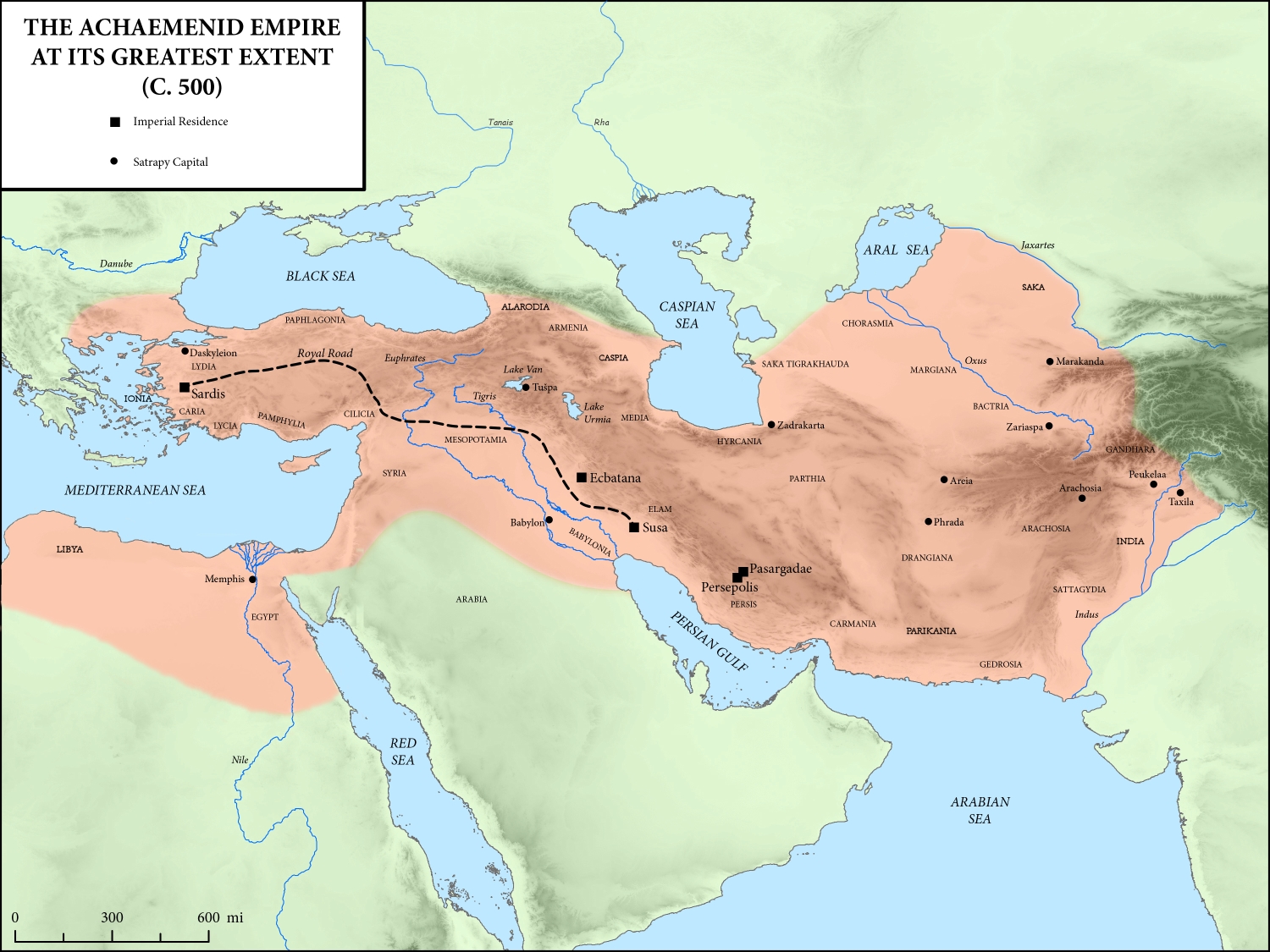
But scholars make the case that his great achievement was his construction of the Royal Road, which extended from the capitol of Susa to Sardis:
Darius is perhaps best remembered for instituting an advanced highway system throughout the empire, a route traditionally called the “Persian Royal Road.” According to Herodotus, the “father of history,” this roadway stretched from Susa (in Elam) to Sardis (in Lydia) and was comprised of a total of 111 intermediate resting-stages, passing through some six Persian provinces, and requiring a total of 90 days to travel the entire course of approximately 1,685 miles. Herodotus adds that another three days were required to journey from Sardis to the coast at Ephesus, from which some scholars have deduced that the “Royal Road” may have extended as far as the Aegean coast. At its other end, a road continued from Susa that ran to Persepolis and beyond.
Beitzel, B. J. (2009). The New Moody Atlas of the Bible (p. 206). Moody Publishers.
The following map depicts this route:
Map shows route of Royal Road from Persian capital at Susa westward to Sardis. Map courtesy of Wikipedia Commons.
This linkage from the capital to Sardis “located Sardis on a major trade and communications route that persisted into the Roman period, positioning the city for ongoing prosperity” (deSilva, Lexham Geographic Commentary, p. 667).
Official communication. The historian Herodotus said of the Persian royal messengers:
Now there is nothing mortal that accomplishes a course more swiftly than do these messengers, by the Persians’ skillful contrivance. It is said that as many days as there are in the whole journey, so many are the men and horses that stand along the road, each horse and man at the interval of a day’s journey. These are stopped neither by snow nor rain nor heat nor darkness from accomplishing their appointed course with all speed.
Herodotus. (1920). Herodotus, with an English translation by A. D. Godley (A. D. Godley, Ed.). Harvard University Press.
Administration.
Rapid Troop Movemnt.
Trace and commerce.
In later history, Alexander the Great would make use of the Royal Road in his conquest of Persia. Dr. Mark Wison notes, “After Alexander the Great captured the city from the Persians in 334 BC, Sardis served as the western capital of the Selucid Empire nor nearly a hundred years (281-190 BC)” (Biblical Turkey, p. 290). In 133 BC Sardis became a part of the Roman province of Asia.
God had his people in Sardis. The church at Sardis was the 5th of the Seven Churches addressed by John (Rev. 1-3).
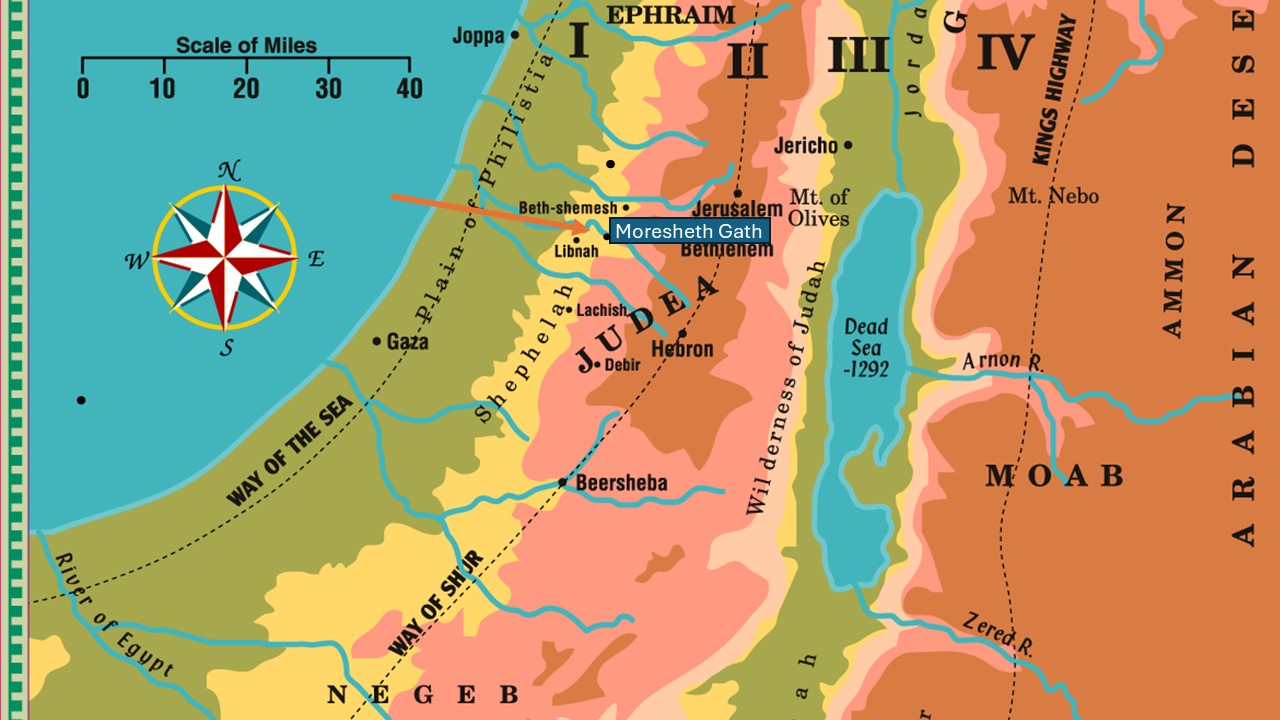
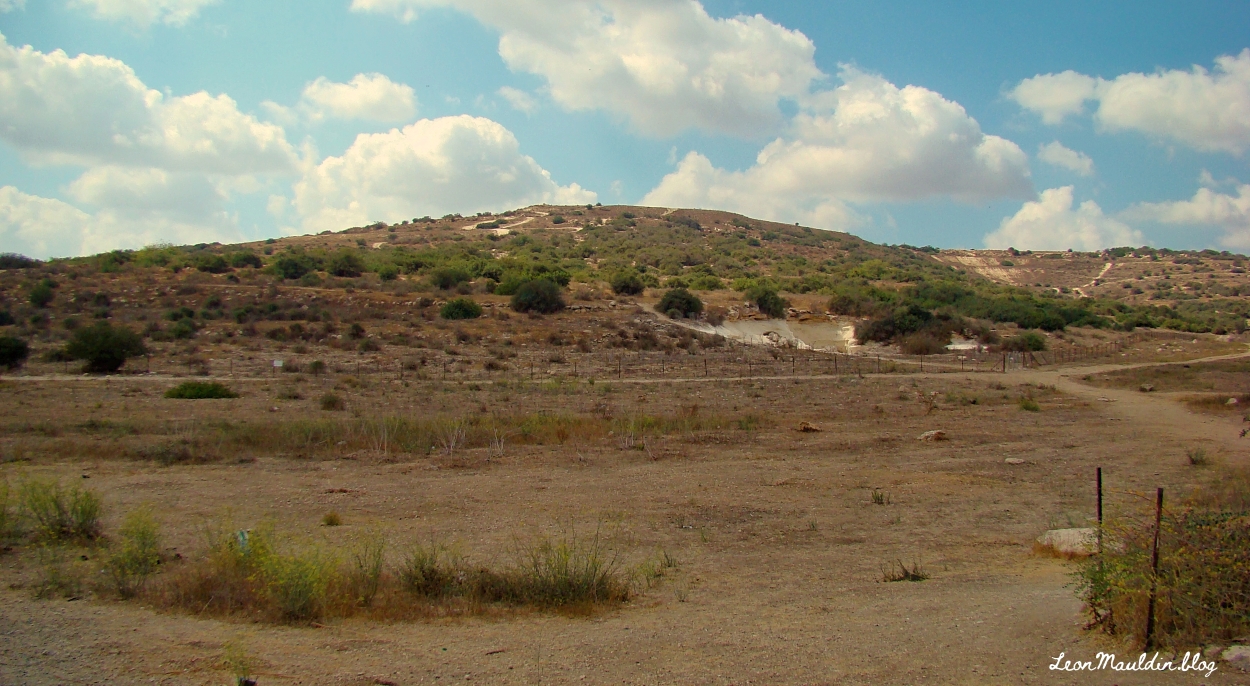
The 8th century BC prophet Micah identifies himself as “Micah of Moresheth” (Mic. 1:1). As his message continues in chapter one, he references “Moresheth Gath” (1:14). Moresheth Gath is tentatively identified by many scholars as Tel Goded (Tell ej-Judeideh).
The geography of Israel is defined by four longitudinal zones: The Coastal Plain, the Central Hill Country, the Jordan Valley, and the Transjordan Plateau. As one goes east from the coastal plain, before arriving in the hill country, one passes through the Shephelah (שְׁפֵלָה, usually rendered “lowland” in Scripture), which consists of gently rolling hills (see Deut. 1:7, etc.). See map here:
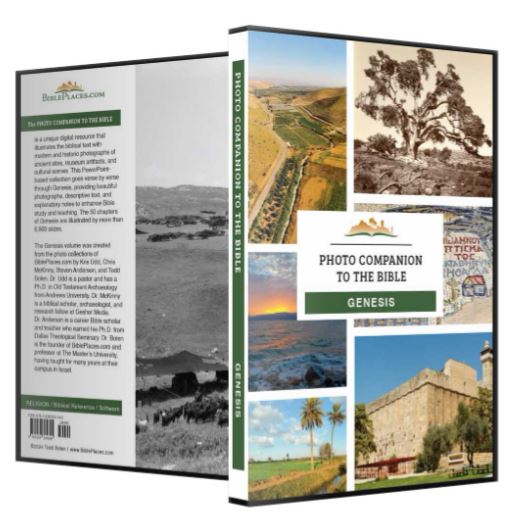
I am enjoying perusing the newly published Photo Companion to Genesis, the latest addition to the Photo Companion to the Bible, by Dr. Todd Bolen and his team. As with the other volumes in this set, each chapter in Genesis (all 50!) is treated separately with its own PowerPoint. For example, chapter one has 225 slides; chapter two has 171 slides, chapter 10 has 604 slides! Another helpful feature: the slides include notes with further explantion, suggested resources, photo credits, etc.
I have been using Dr. Bolen’s materials for more than 20 years, and highly recommend this new addition. Knowing the geographical, archaeological and cultural context of the Bible enhances our understanding of the biblical text, and can help fortify one’s faith. This collection of photos, maps, and explanation chapter by chapter is a great resource.
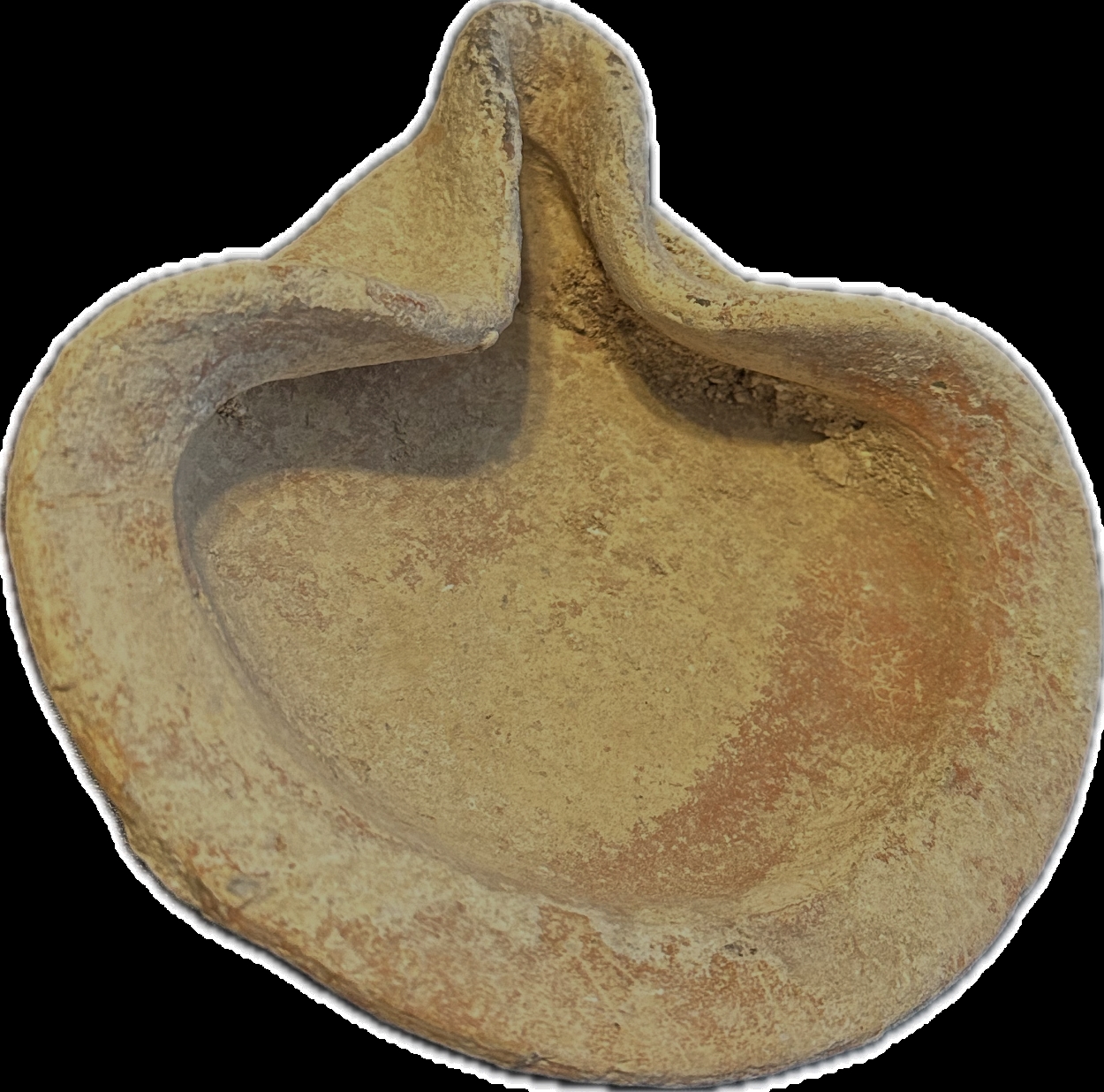
In 2 Chronicles in the context of the Divided Kingdom during the reign of Jehoram, king of Judah, the statement is made, “Yet the LORD was not willing to destroy the house of David because of the covenant which He had made with David, and since He had promised to give a lamp to him and his sons forever” (21:7). (The NET Bible reads, “But the LORD was unwilling to destroy David’s dynasty because of the promise he had made to give David a perpetual dynasty”).
To say that Jehoram was very wicked would be an understatement. His first act when his co-regency with his father Jehoshaphat (good king!) ended was to murder all six of his brothers! (21:4). Jehoram was married to Athaliah, the wicked daughter of Ahab and Jezebel, and greatly swayed by them. Though King of Judah, “he walked in the way of the kings of Israel, just as the house of Ahab had done” (21:6).
Lamp, dating to the time of the Divided Kingdom. Author’s personal collection. Photo by Leon Mauldin.
Our inspired historian is stating that although Jehoram deserved destruction, as had indeed been meted out to several dynasties in Israel, that Yahweh, the faithful God of the Covenant, would insure that the lineage of David would continue. The use of the word picture of a lamp which continues to burn, and is not extinguished, was a fitting metaphor. The Davidic lineage (here seen in the kings of Judah, both good and bad) would continue until the Messiah came to earth, God Incarnate. This fulfilled the promise made in 2 Samuel 7; cf. 1 Chron. 17, and etc.). Indeed, “the Scripture cannot be broken” (John 10:35).
I have earlier written about Judah’s King Jehoram here.
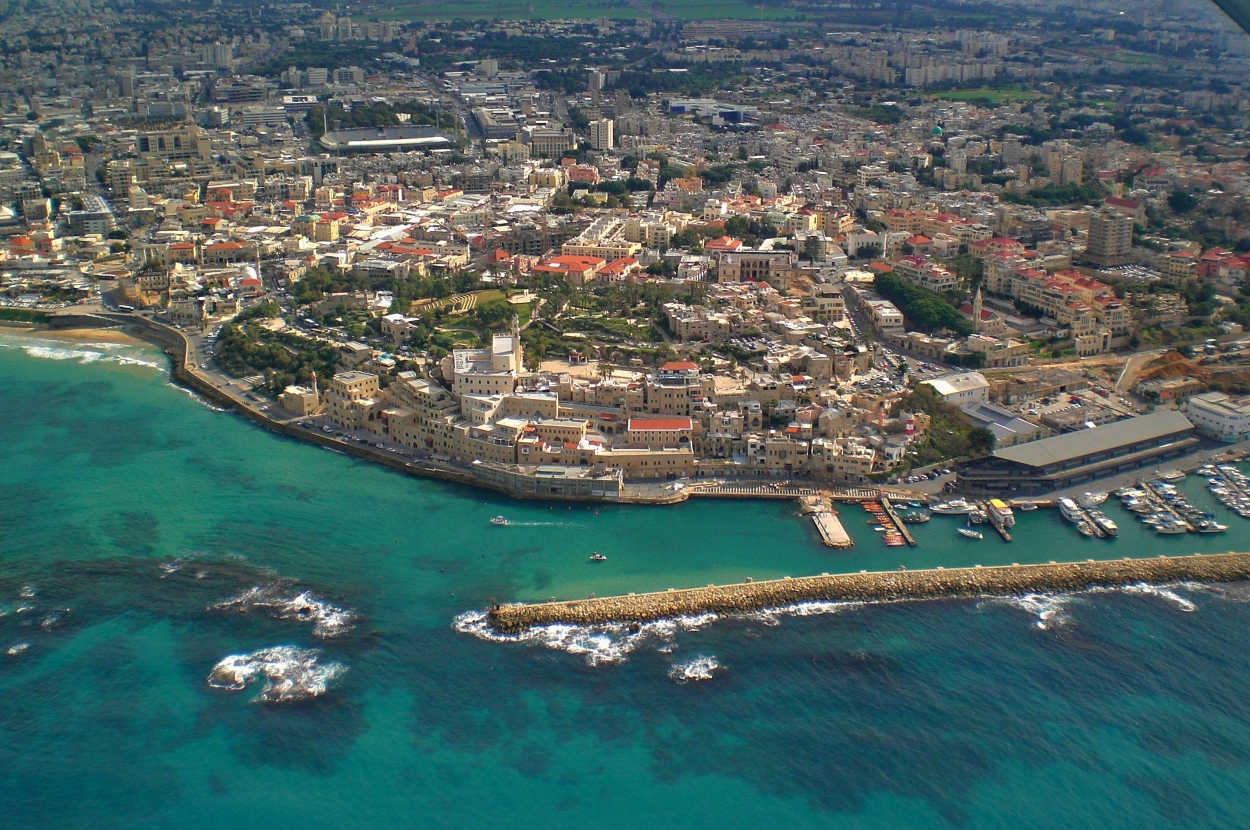
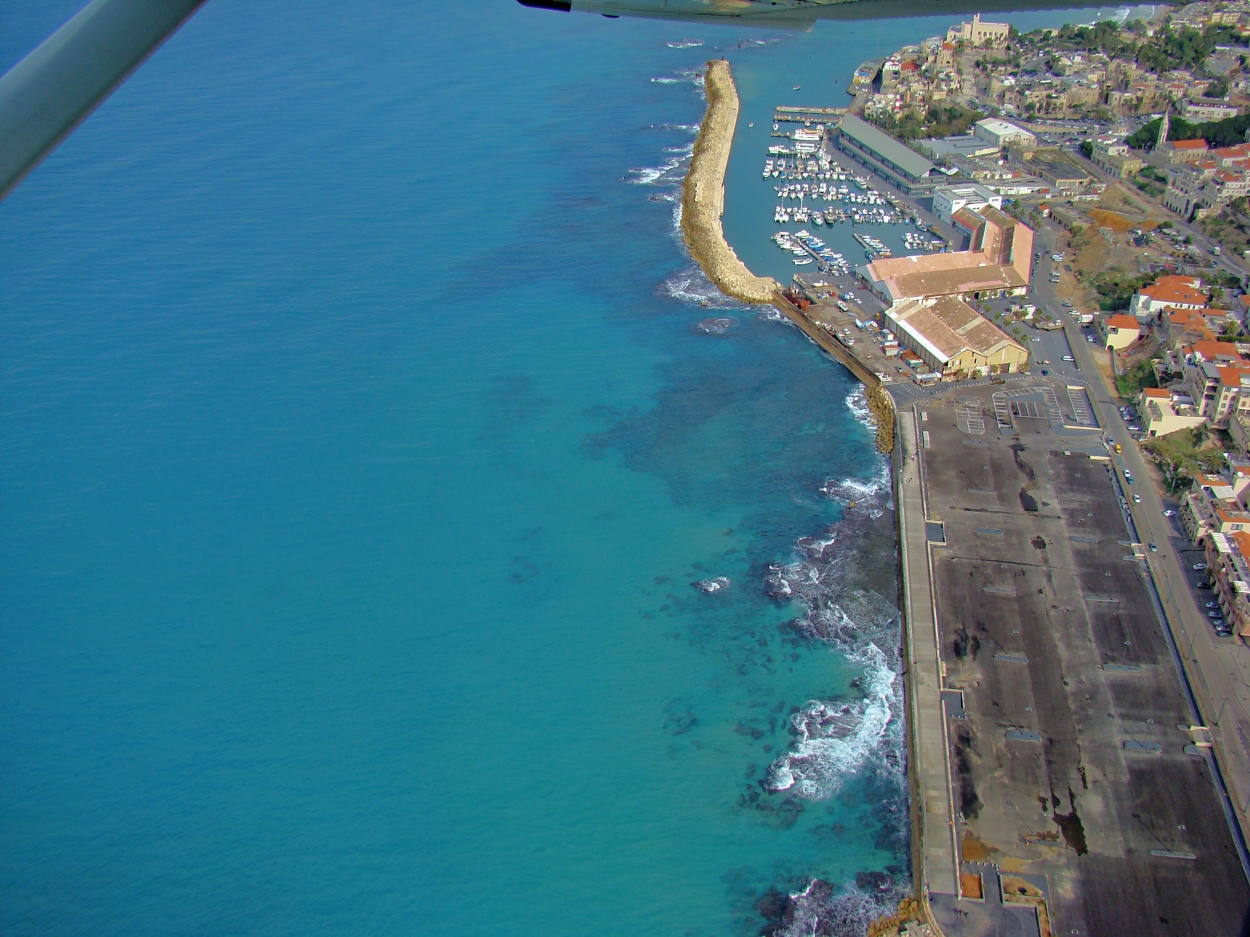
My first opportunity to do some aerial photography in Israel was with Ferrell Jenkins, as he and I were on a personal study trip in 2009. Among the sites we photographed from that (tiny) plane was biblical Joppa.
Here in the foreground you can still see some of the ruins of the ancient harbor, an ancient Mediterranean harbor of Canaan and Israel, dating back to Old Testament time. At center is the old city, the geographical setting for many biblical events:
When Solomon was to construct the temple, the king of Tyre offered, “We will get all the timber you need from Lebanon and bring it in raft-like bundles by sea to Joppa. You can then haul it on up to Jerusalem.” (2 Chron. 2:16, NET).
Joppa was again used in this same manner when the second temple was rebuilt (Ezra 3:7). It’s about 35 miles from Joppa to Jerusalem.
Joppa figures in with the narrative of Jonah, who, when God told him to preach to Nineveh, “Instead, Jonah immediately headed off to Tarshish to escape from the commission of the LORD. He traveled to Joppa and found a merchant ship heading to Tarshish. So he paid the fare and went aboard it to go with them to Tarshish far away from the LORD” (Jonah 1:3, NET).
In NT times, there were disciples of Christ at Joppa. It was here that Peter raised Tabitha from the dead (Acts 9:36-43). Peter remained at Joppa for “many days” (Acts 9:43) and was there when the Gentile Cornelius, a Roman centurion stationed at Caesarea, sent for him, that he could hear the Gospel message of salvation (Acts 10; 11:1-18; see esp. 11:14).
I visited Joppa for the first time in 1999. It gives a different perspective to see such sites from above.
Some context: Mareshah in southern Israel was a city which Solomon’s son, King Rehoboam fortified (2 Chronicles 11:8). Later Judah’s King Asa met a military force of Cushites which greatly outnumbered Judah’s forces, but YAHWEH granted deliverance (2 Chronicles 14:9ff). Here is a photo of a Blessed Milkthistle I took while there a few years ago:
A helpful resource, Chronicles of the Land: Archaeology in the Israel Museum Jerusalem, regarding the above artifact, simply notes, “Head of a statue depicting an Ammonite deity, late 8th century BCE” (p. 87). That date would fit in the bibilcal period of the Divided Kingdom, or perhaps Judah Alone (Israel fell in 722 BC).
The inside BAR article notes,
Ancient inscriptions tell us that the people of Ammon called themselves the bene ammon (“children of Ammon”), a designation also found in the Book of Kings (1 Kings 11:7,33). The Ammonites had their own language and script, which developed from Proto-Canaanite and was closely related to Phoenician, Hebrew, and Moabite. They worshiped their own chief deity, Milkom [spelled “Milcom” in most translations], who is mentioned in both Ammonite inscriptions and the Bible (e.g., 1 Kings 11:5,33).
(BAR/Winter 2023, p. 50).
The Ammonites had their origin in Lot, the nephew of Abraham. The sad story is told in Genesis 19:30-38. In time to come, during the biblical period of the Judges, Israel worshiped “the gods of the people of Ammon”, among other gods (Judges 10:6). Later during the days of the United Kingdom, Saul fought (successfully) against the Ammonites (1 Samual 14:47). They were also subdued under King David (2 Samuel 8:11-12). Unfortunately, Israel’s forces were besieging Rabbah, Ammon’s capital, when David “tarried in Jerusalem” and committed adultery with Bathsheba (2 Samuel 11:1-5). Another sad event: “Furthermore, on the hill east of Jerusalem Solomon built a high place for the detestable Moabite god Chemosh and for the detestable Ammonite god Milcom” (1 Kings 11:7, NET Bible).
Our map here below shows the location of Ammon.
Location of Ammon, beyond the Jordan. Map by BibleMapper.com.


 Posted by Leon Mauldin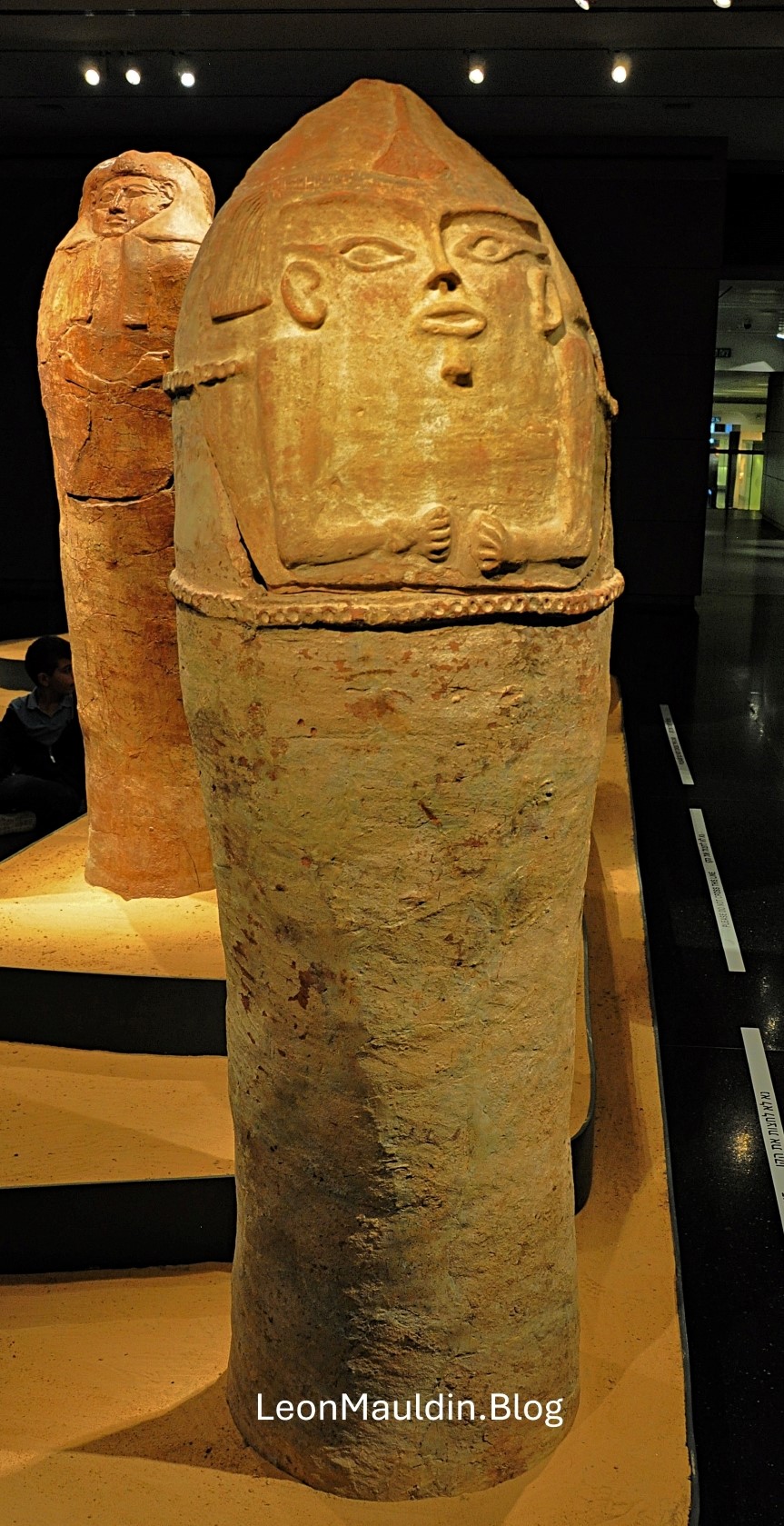




 leonmauldin.blog