Arch of Titus

March 3, 2012

The Arch dedicated to Titus is in the Forum at Rome, located at the highest point of the Via Sacra. It was on this street that most of the religious processions took place.

Arch of Titus, located in Forum of Ancient Rome. Photo by Nancy Picogna.

The arch was built to commemorate the Roman defeat of Judea, including the destruction of Jerusalem and its Temple. Inside the arch, one side depicts the Roman soldiers removing the menorah, table of showbread and silver trumpets from the temple as it was destroyed in AD 70. Vespasian was Emperor and Titus was the commander of the Roman army at that time.  Titus was Emperor AD 79-81. After Titus’ death, the arch was constructed ca.AD 81 by Titus’ brother, the new Emperor Domitian.

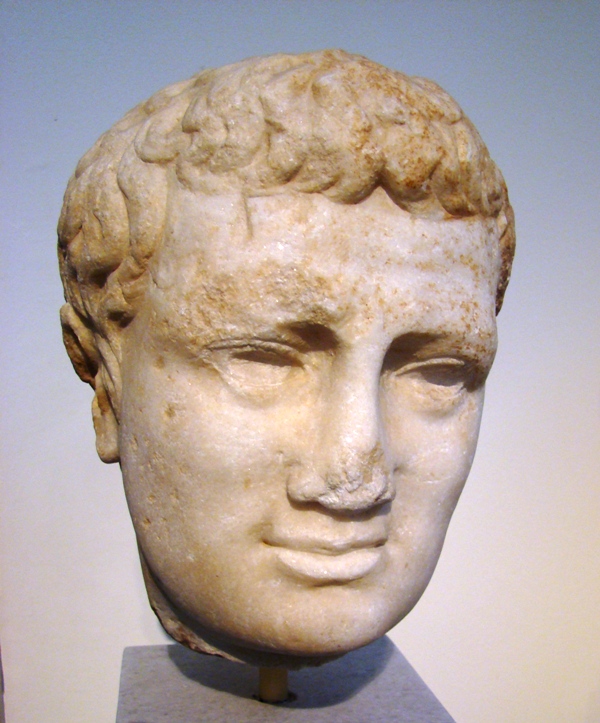
Emperor Titus, AD 79-81. Photo by Leon Mauldin.

This head of Titus (exhibit #348, Athens Museum), is made of Pentelic marble and was “probably found at Smyrna, Asia Minor. It is an earlier portrait head (possibly of the emperor Caligula) with parts reworked to render the features of Titus.”


Some (Brief) Features of Italian Geography

February 25, 2012

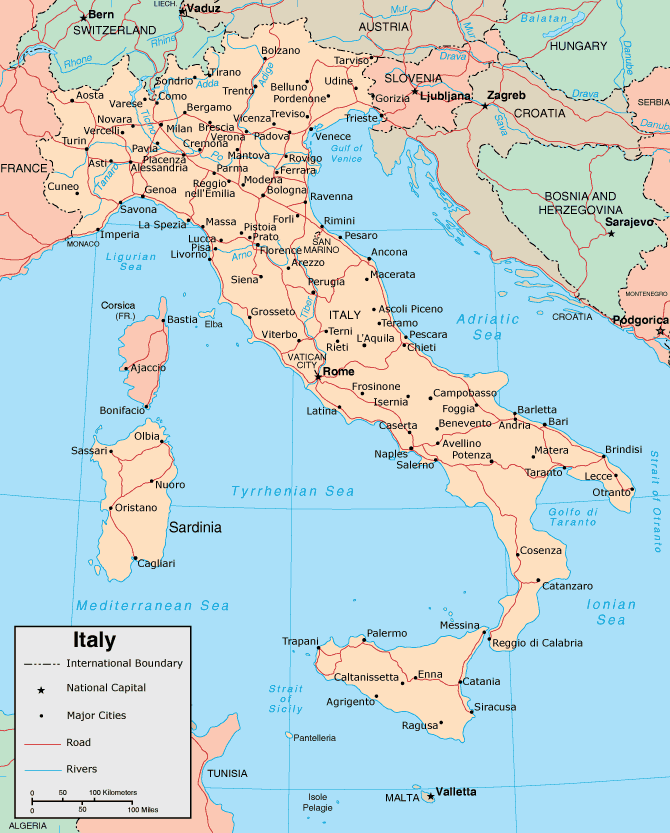
A resource I have found beneficial is The Cultural Atlas of the World series. There are several volumes in the series; one I’ve recently been gleaning is The Roman World, by Tim Cornell and John Matthews. The opening chapter, “A City Destined to Grow Great,” is obviously dealing with the city of Rome. But first an overview of the geography of Italy is given, including some reasons why the location was chosen for the foundation of this ancient city (ca. 753 BC).

The most important feature of the historical geography of Italy is the close interaction of plain, hill and mountain. Only about 1/5 of the total land surface of Italy is officially classified as plain (that is, land below 300 meters), and of this lowland area more than 70% is accounted for by the valley of the Po [north Italy, runs east-west, LM]. Of the rest, about 2/5 is classified as mountain (land over 1000 meters) and the remaining 2/5 as hill (land between 300 and 1000 meters). The alternation of these types of relief and their distribution throughout the country create a great diversity of climatic conditions and sharp contrasts in the physical appearance of the landscape from one region to another.

Italy is separated from central Europe by the great barrier of the Alps. In spite of their altitude these mountains have not kept Italy isolated from the rest of the continent. Although the winter snows make them impenetrable for more than half the year, most of the passes have been known since the earliest times; movements of people across the Alps have taken place throughout history, sometimes on a very large scale, for example during the incursions of the Celts and the Cimbri in the republican period and the barbarian invasions in the 5th and 6th centuries of our era.

In general the Tyrrhenian side [western side, LM] enjoys certain natural advantages over the Adriatic side . . . These differences relate largely to climate and to the nature of the soil . . . The Tyrrhenian coast is moreover fortunate in being served by relatively large rivers, at least two of which, the Tiber and the Arno, were navigable waterways in classical antiquity. The streams which flow into the Adriatic on the other hand are mostly dried up in the summer, and in winter become raging torrents which erode the thin soil from the upland slopes. The Adriatic coast is at a further disadvantage in having no good harbors.

The consequence of this natural imbalance has been that the western side of Italy has played a more prominent part in the history of civilization than the east, ever since the earliest Greek colonists rejected the desolate Adriatic coast and chose to make their homes on the Ionian and Tyrrhenian shores.

. . . Along the Tyrrhenian coast is a series of small alluvial plains, while the interior of the region is traversed by an interconnected chain of elevated basins which borders the eastern side; the most important of these alluvial valleys are the upper Arno between Florence and Arezzo, The Val di Chiana, the middle Tiber, and the Liri, Sacco and Volturno valleys which connect Latium and Campania.

These river valleys are also natural corridors of communication, and together they form the main longitudinal route along the western side of Italy which is followed today by the main railroad track and the Autostrada del Sole between Florence and Naples. The chief natural lines of communication from the coast to the interior also run along the river valleys, and above all along the Tiber. The lower Tiber valley is the nodal point of the network of natural communications of central Italy, and it was inevitable that the lowest available crossing of the Tiber, which occurs at Rome, should become an important center (emp. mine, LM). A defensible position with a good supply of fresh water, it dominated the crossing point at the Tiber island, where the first bridge, the Pons Sublicius, was constructed in the reign of King Ancus Marcius. In historical times, this part of the city comprised the commercial harbor (the Portus) and the cattle marker (the Forum Boarium). It was also the site of the “Great Altar” of Hercules. . . (pgs. 11-14).
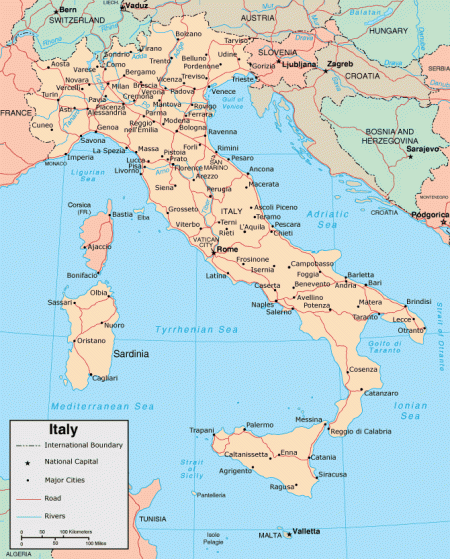
Map of Italy, by Wikipedia

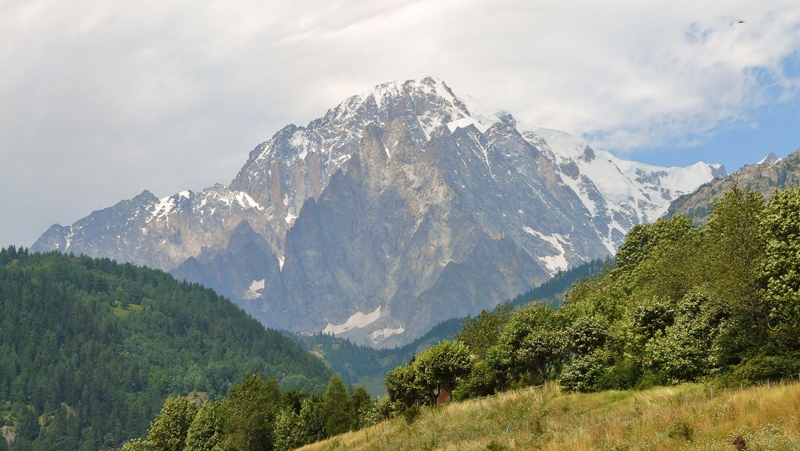
The highest point of elevation in Italy is Mont Blanc, in Aosta Valley.
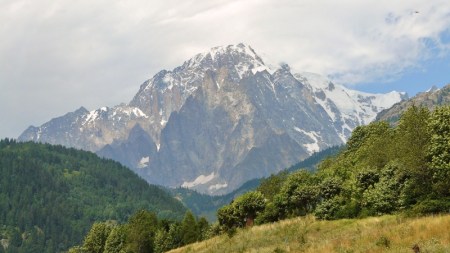
Mont Blanc. Photo: Wikipedia Commons.

Italy is mentioned 4 times in the New Testament:

Acts 18:2 “And he [Paul] found a Jew named Aquila, a native of Pontus, having recently come from Italy with his wife Priscilla, because Claudius had commanded all the Jews to leave Rome.”

Acts 27:1 “When it was decided that we would sail for Italy, they proceeded to deliver Paul and some other prisoners to a centurion of the Augustan cohort named Julius.”

Acts 27:6 “There the centurion found an Alexandrian ship sailing for Italy, and he put us aboard it.”

Hebrews 13:24 “Greet all of your leaders and all the saints. Those from Italy greet you.”

There are several scriptural references to Rome, which we plan to consider at a later time.

Click on images for larger view.


Jerusalem, the Kidron, and Mt. of Olives

February 3, 2012

Yesterday’s post featured a photo of a hen with her chicks, imagery used by Jesus Himself in His lamentation over Jerusalem, as He wanted to gather the people unto Himself but they refused. Immediately he left the temple courts, crossed the Kidron with His disciples, and went to the Mount of Olives where He gave what has become known as the “Olivet Discourse” (Matthew 24).

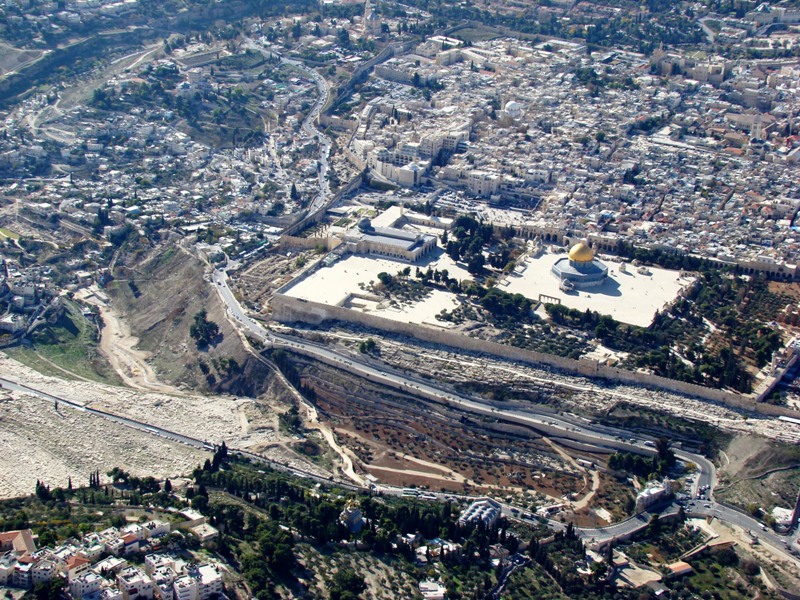
Our photo provides an overview of the setting for these events. You can easily recognize the temple mount. Below that is the Kidron Valley. Next, at bottom of photo is the Mt. of Olives.

Temple Mount in Jerusalem, Kidron, and Mt. of Olives. Photo by Leon Mauldin.

Click on image for larger view.


As a Hen Gathers Her Chicks

February 2, 2012

On the last day of Jesus’ public ministry, the Tuesday before He was betrayed on Thursday night, when Jesus left the temple courts He said,

O Jerusalem, Jerusalem, the one who kills the prophets and stones those who are sent to her! How often I wanted to gather your children together, as a hen gathers her chicks under her wings, but you were not willing! 38 See! Your house is left to you desolate; 39 for I say to you, you shall see Me no more till you say, “Blessed is He who comes in the name of the LORD!” (Matthew 23:37-39).

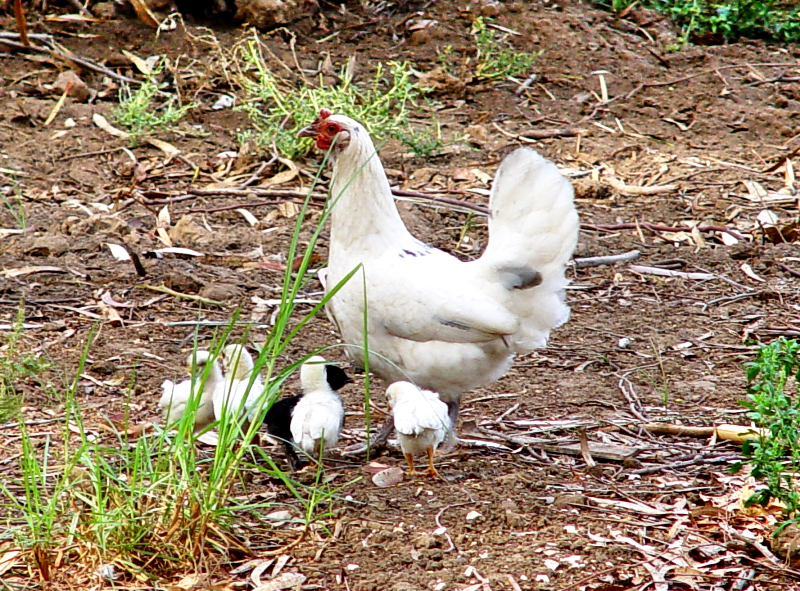
The imagery of a mother hen shielding her chicks may need explaining to those (city dwellers) who have not seen this display of instinctive protection. It is not “learned behavior;” it is God-given and natural. When danger is perceived, the chicks run to the hen for safety and security.

I could not help but think of the above passage when I saw this scene in Galilee.

Chicks going to the mother hen. Photo by Leon Mauldin.

When I initially approached to take the photo the chicks were a bit scattered. But as I advanced closer, they all went right to the mother hen.

Jesus wanted the inhabitants of Jerusalem to come to Him, for safety, security and for salvation. But sadly, they were not willing. Man is unique to creation. We don’t merely act instinctively. God has given us freedom of choice. He appeals to our heart, He beckons through the Gospel, but He will not force.

For a related post, “Not One Stone Upon Another,” see here.

Click on image for larger view.


Traditional Site of Jesus’ Birth in Bethlehem

December 18, 2011

Justin Martyr (c.103-165 AD), wrote in Dialogue with the Jew Trypho:

But when the Child was born in Bethlehem, since Joseph could not find a lodging in that village, he took up his quarters in a certain cave near the village; and while they were there Mary brought forth the Christ and placed Him in a manger . . . (The Ante-Nicene Fathers Vol. I, p. 237).

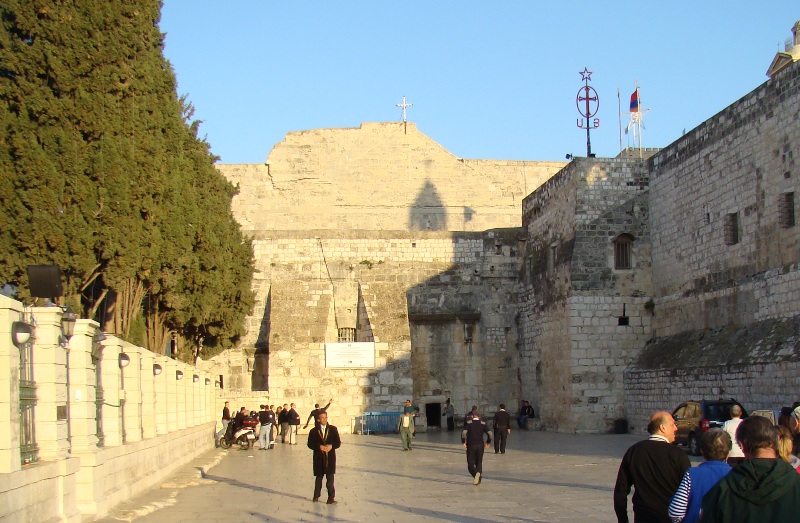
The Church of the Nativity was built by Helena, Constantine’s mother in 339 AD. It was built above the traditional cave which is associated with Jesus’ birth. This photo shows the approach to the church.

Church of the Nativity in Bethlehem. Photo by Leon Mauldin.

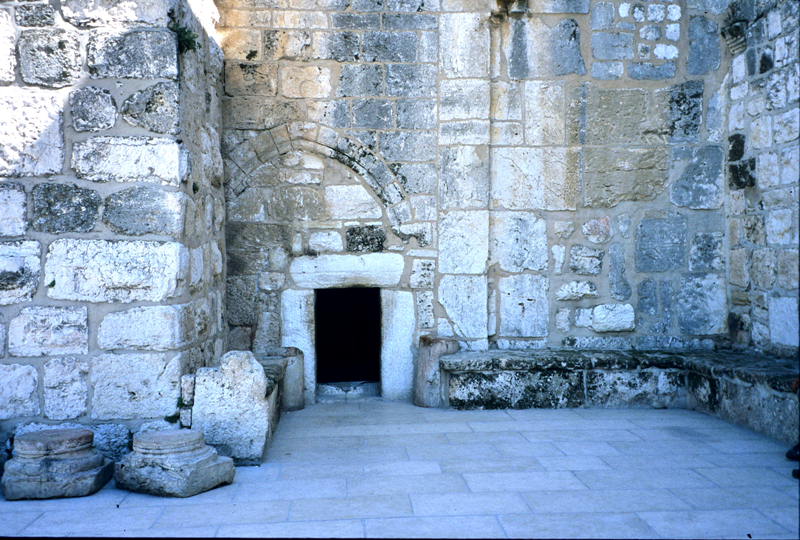
Here is a close-up of the entrance to the church.

Church of Nativity Entrance. Bethlehem. Photo by Leon Mauldin.

The above photo is a scanned slide I took in 1999.

Inside you can see the cave, the traditional place of Jesus’ birth.

Star Marking the Place of Jesus' Birth in Bethlehem. Photo by Leon Mauldin.

Other early evidence pointing to this spot as the location of Jesus’ birth includes that of Origen and Jerome.

For some thoughts on the useful purpose of shrines in this context, see Ferrell Jenkin’s post here.

Click on images for larger view.


Humble Birth: the Manger

December 17, 2011

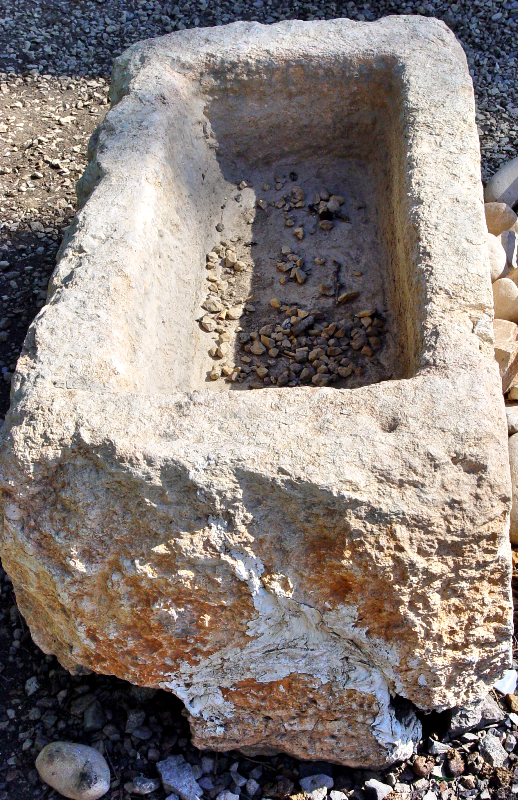
This time of year the word manger is at the top of the list of search words that brings folks to this site. Here is a manger we photographed in Jericho back in November, 2005. This was among other artifacts visitors could see; there was no info available as to where the manger was actually discovered, whether near Jericho or elsewhere.

Manger at Jericho. Photo by Leon Mauldin.

Other posts on Jesus’ becoming flesh and being placed in a manger may be seen here and here. I continue to stand amazed at the thought of our eternal Creator becoming flesh, and having a feeding trough as a bassinet! It thrills my soul to think of God becoming flesh!

Luke 2:7 And she gave birth to her firstborn son; and she wrapped Him in cloths, and laid Him in a manger, because there was no room for them in the inn. (NASB).

Note the rendering of the CSB: Then she gave birth to her firstborn Son, and she wrapped Him snugly in cloth and laid Him in a feeding trough– because there was no room for them at the inn.

John 1:14 And the Word became flesh, and dwelt among us, and we saw His glory, glory as of the only begotten from the Father, full of grace and truth. (NASB).

It was necessary in God’s Redemptive Plan that the Eternal Word should become flesh, that he might defeat Satan, and become the propitiation for our sins.

It is also helpful to remember that when the Apostle John saw the resurrected Christ, the Son of God in His present glory, he did not see a baby in a manger. At Patmos, John wrote, “When I saw Him, I fell at His feet like a dead man. And He placed His right hand on me, saying, ‘Do not be afraid; I am the first and the last, and the living One; and I was dead, and behold, I am alive forevermore, and I have the keys of death and of Hades'” (Rev. 1:17-18, NASB).

Likewise we would do well not to limit our thoughts of Jesus to a baby in a manger, but see Him also as the Lord of lords and King of kings, the One before Whom all shall give account on the last day.

Click on image for larger view.


Ancient Street in Tarsus

December 16, 2011

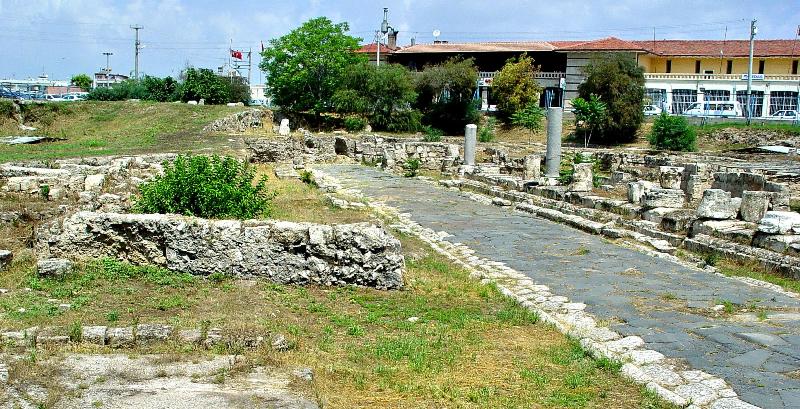
As we further explore what can be seen of ancient Tarsus, one important archaeological point of interest is a street built during the late Hellenistic period, thus predating the Apostle Paul.

Tarsus, Ancient Street. Dates back to the time of Paul. Photo by Leon Mauldin.

The discovery of this street, along with the ancient shops and houses that have been unearthed, is a story that has been often repeated. Work was being initiated for an underground parking deck when this discovery was made. So frequently it is the case that it is in connection with various construction projects that such discoveries are made (see here for “rolling stone tomb” in Israel).

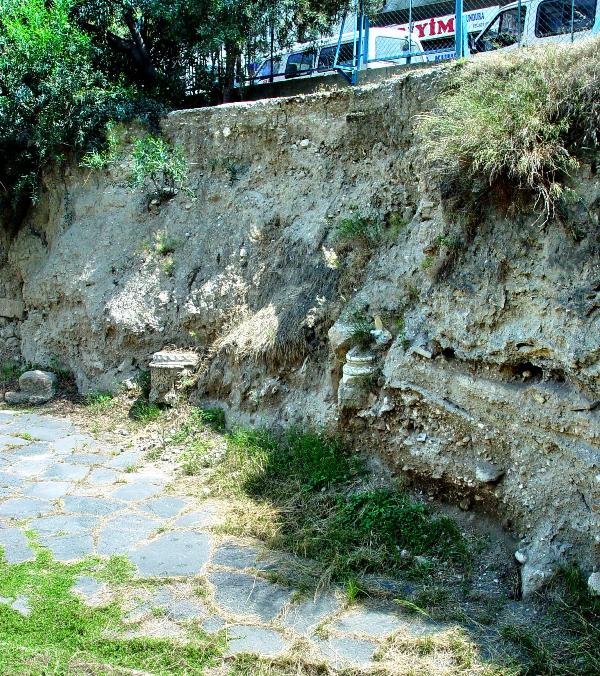
Behind and to our right of our position in the above photo you can get a glimpse of how much silt has built up above street level: 23 feet at this point.

23 feet of silt accumulated above Tarsus Street of Paul's Day. Photo by Leon Mauldin.

This allows you to see the location of the modern city in relation to the ancient ruins below.

Click on image for larger view.


Cleopatra’s Gate in Tarsus

December 15, 2011

In our last post we mentioned that the Apostle Paul was in Tarsus from the point of Acts 9:30 until going to Antioch at the invitation of Barnabas in Acts 11:25.

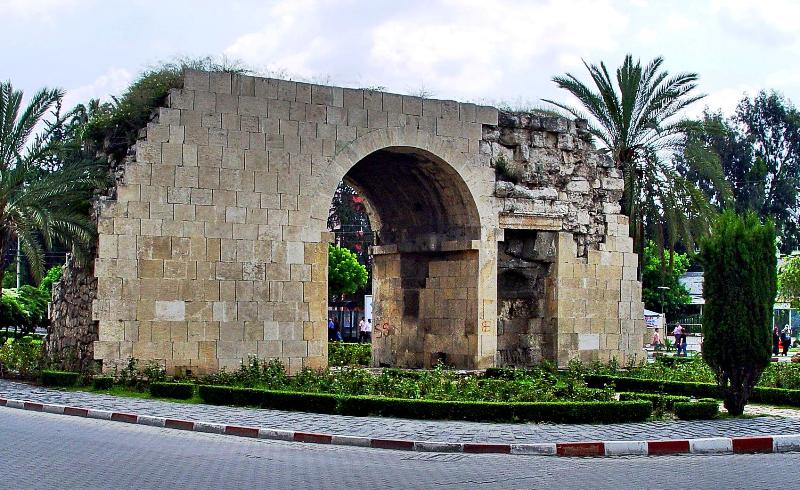
One attraction in Tarsus is “Cleopatra’s Gate,” also called the “Sea Gate,” as well as “St. Paul’s Gate.

Cleopatra's Gate in Tarsus. Photo by Leon Mauldin.

The Biblical Archaeological Society info re: this site included in The Biblical World in Pictures states:

This stone gateway is the only one of Tarsus’s three Roman city gates that has survived and is one of the few remnants of the city Paul knew that has not been destroyed or buried under the modern city of Turkish Tersous. Tarsus was connected by the Cydnus River to the Mediterranean; this was the gate that led into the city from the river. It is called Cleopatra’s Gate, commemorating a state visit that Queen Cleopatra made to Tarsus on her royal barge while Marc Antony was there in 38 B.C.E.

Others suggest that while the gate would mark the location of the Roman Gate, that the better evidence is that the structure that is visible is Byzantine.

Click image for larger view.


St. Paul’s Well

December 13, 2011

Paul is said to be a “man of Tarsus” in Acts 9:11, ASV). Tarsus was the capital of the Roman province of Cilicia, located on what is today the southern coast of Turkey. It was a cultural and intellectual center in the first century. Fant and Reddish quote Strabo’s description of Tarsus as having “surpassed Athens, Alexandria, or any other place that can be named where there have been schools and lectures of philosophers” (A Guide to Biblical Sites in Greece and Turkey, p. 324).

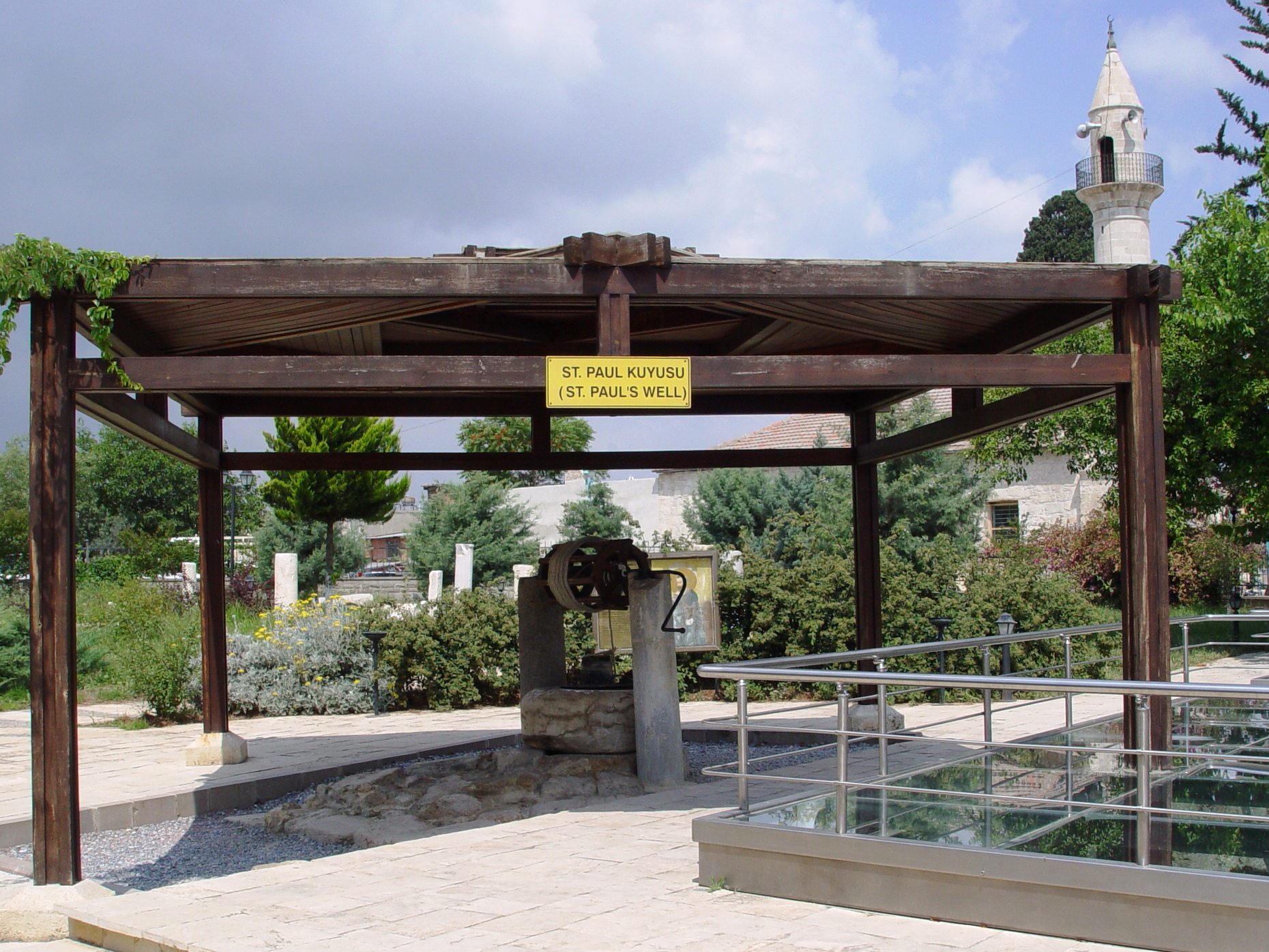
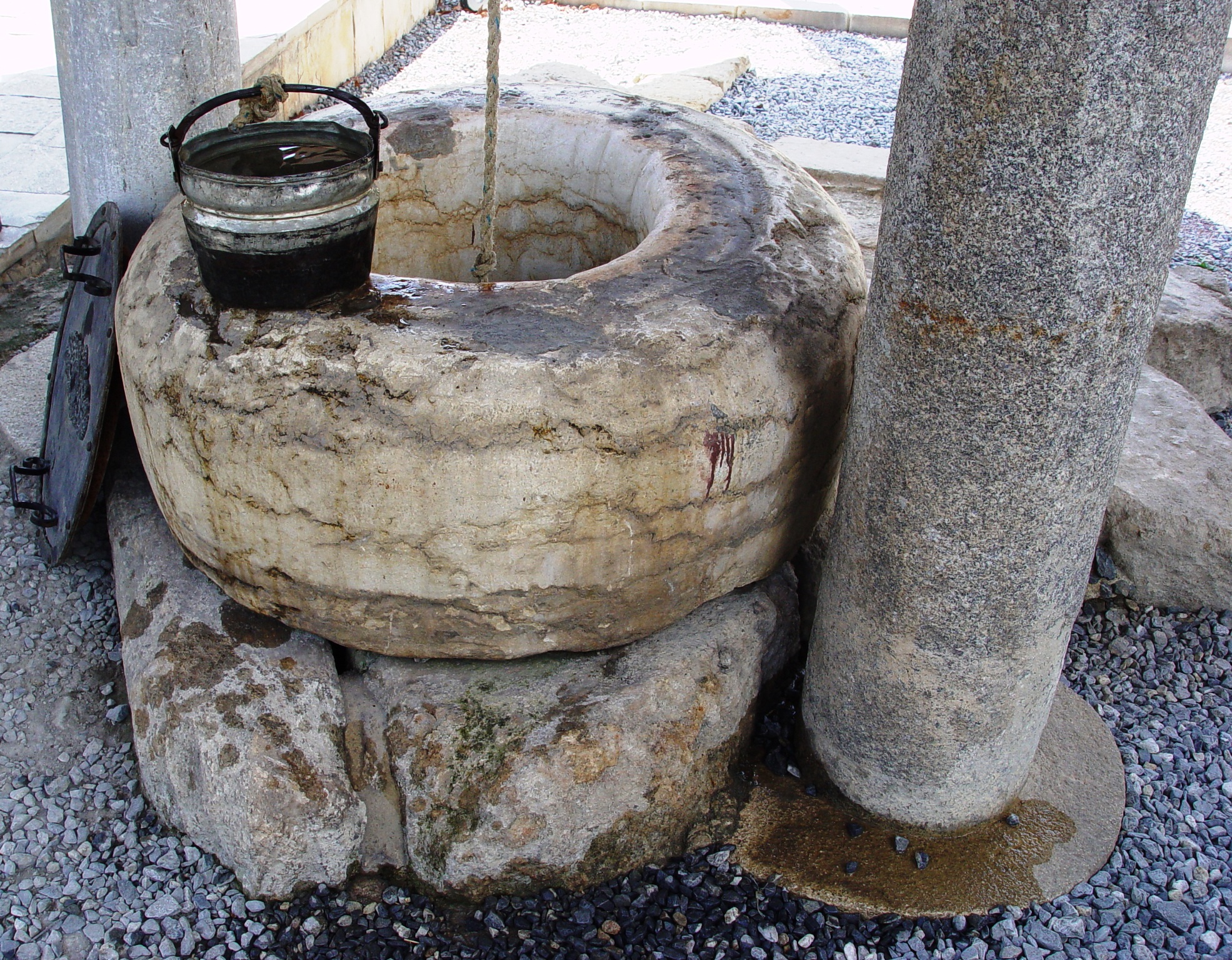
Not much can be seen of the Tarsus of Paul’s day, because the modern city with its population of 350,000+ is built on the ancient ruins. One exception to this is “St. Paul’s Well,” a well that dates back to Roman times.

"St. Paul's Well" at Tarsus. Photo by Leon Mauldin.

Visitors to this site are told that Paul certainly drank of this well, and therefore the waters are said to have curative properties. It would be more accurate to say that because the well certainly dates back to Roman times that Paul may have drunk from this well; the fact that it goes back to the time of Paul is what gives it special value to students of Scripture.

Well at Tarsus, Paul's home. Dates back to Roman Period. Photo by Leon Mauldin.

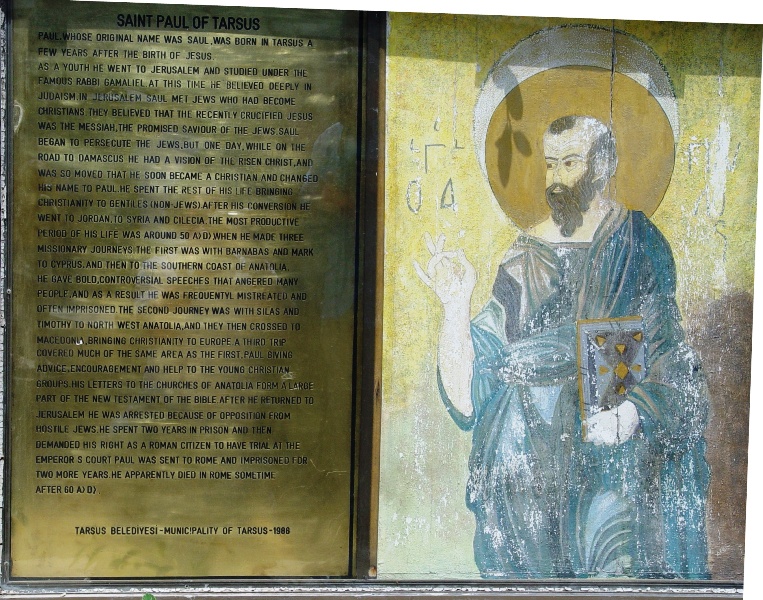
There is an info sign on the premises:

Info Sign on location near well. Photo by Leon Mauldin.

Though Tarsus was Paul’s home, as a youth he was “brought up in this city [Jerusalem], educated with strictness under Gamaliel according to the law of our ancestors” (Acts 22:3 NET). After his conversion there was a period where again Paul was in Tarsus (Acts 9:30), prior to his work in Antioch (Acts 11:25-26).

Click on images for larger view.


Resource: Trials from Classical Athens

December 5, 2011

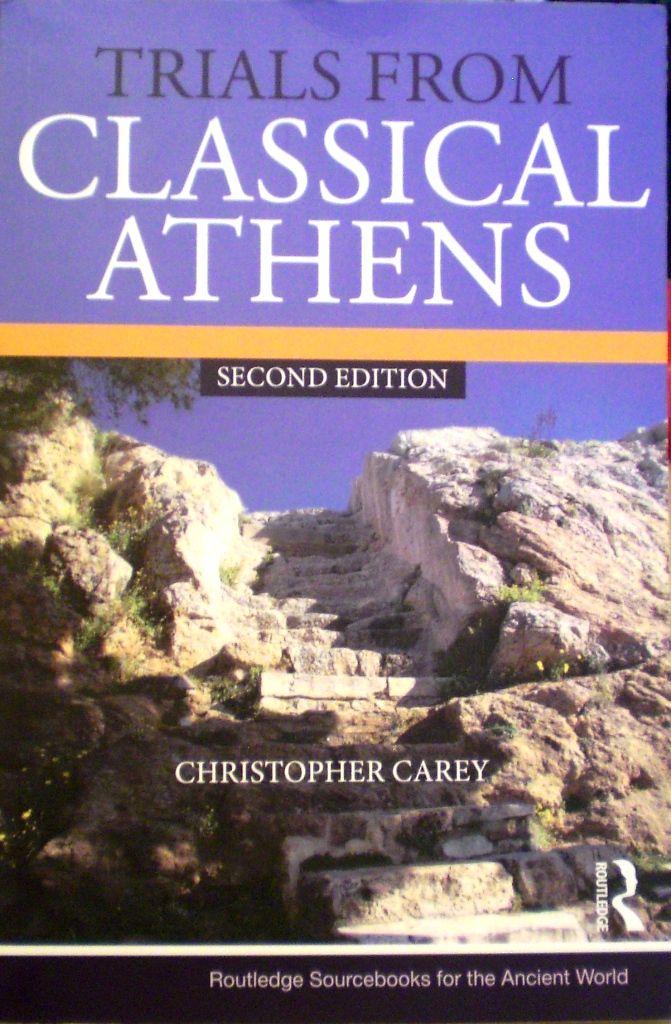
The Routledge Sourcebooks for the Ancient World includes Trials From Classical Athens. The 2nd edition is to be available as of Dec. 11, according to Amazon.

The setting for the trials in classical Athens is the Areopagus. The cases in this book came before the Athenian courts in the period of classical Athenian democracy, late fifth and fourth century BC.

Bible students know that the Areopagus is also mentioned in Acts 17 in connection with Paul’s opportunity to preach to  the Athenians, including the Epicurean and Stoic philosophers (Acts 17:22f.).

I’m looking forward to reading this resource, authored by Christopher Carey, professor of Greek at University College, London, UK.

Front cover, Trials from Classical Athens. Photo by Leon Mauldin.

From the back cover:

The ancient Athenian legal system is both excitingly familiar and disturbingly alien to the modern reader. It functions within a democracy which shares many of our core values but operates in a disconcertingly different way. Trials from Classical Athens assembles a number of surviving speeches written for trials in Athenian courts, dealing with themes which range from murder and assault, through slander and sexual misconduct to property and trade disputes and minor actions for damage. The texts illuminate key aspects both of Athenian social and political life and the functioning of the Athenian legal system.

This new and revised volume adds to the existing selection of key forensic speeches with three new translations accompanied by lucid explanatory notes. The introduction is augmented with a section on Athenian democracy to make the book more accessible to those unfamiliar with the Athenian political system. To aid accessibility further a new glossary is included as well as illustrations for the first time.

Providing a unique and guided introduction to the Athenian legal system and explaining how the system reveals the values and social life of Classical Athens, Trials from Classical Athens remains a fundamental resource for students of Ancient Greek history and anyone interested in the law, social history and oratory of the Ancient Greek world.

I granted permission to the publishers usage of my photo for the front cover. It depicts the steps up the Areopagus from the back side.

Leon’s Message Board has a post on the Areopagus here, which includes the above photo.

Ferrel Jenkins has a current post which shows the Areopagus from this same side but further back. See here.

I noticed on Amazon’s site that Dr. Carey’s book sells for $35.39 in paperback and $111.52 in hardback.

(Click on images for larger view).