January 31, 2017
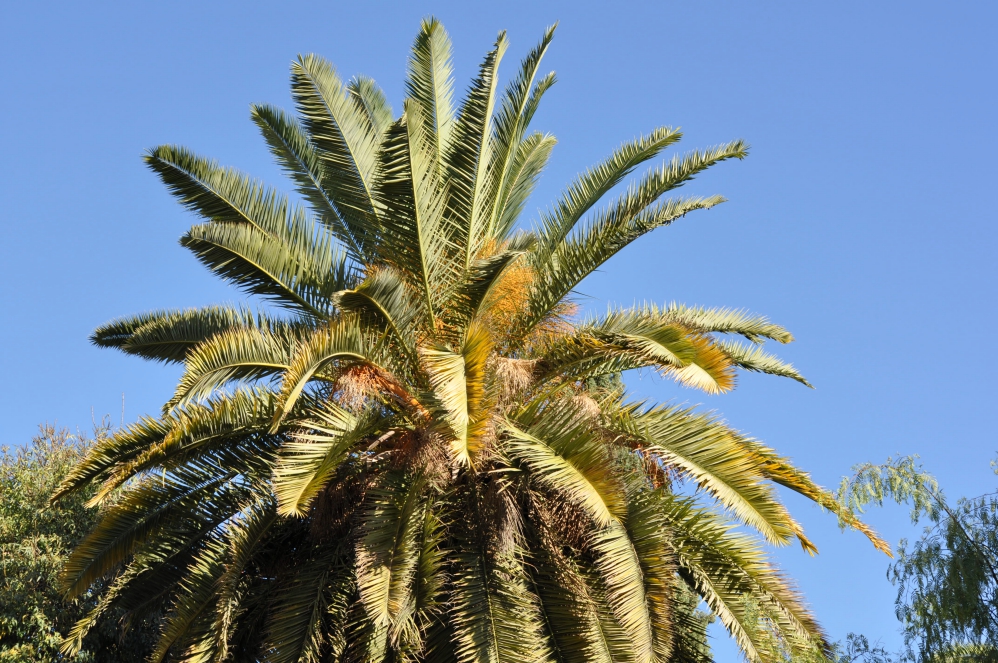
When Jesus began the Final Week of His ministry, He rode on a donkey (fulfilling Zechariah 9:9) from the Mount of Olives to the city of Jerusalem. It was on a Sunday. The text reads, “Most of the crowd spread their coats in the road, and others were cutting branches from the trees and spreading them in the road” (Matt. 21:8, NASB). John’s record tells us the large crowd “took the branches of the palm trees and went out to meet Him, and began to shout, “Hosanna! BLESSED IS HE WHO COMES IN THE NAME OF THE LORD, even the King of Israel” (John 12:13, NASB). While in Jerusalem in November (2016) I made this photograph.
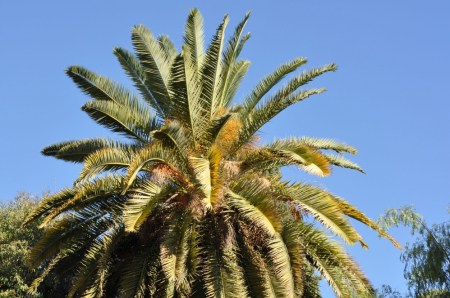
Palm tree in Jerusalem. Photo©Leon Mauldin.
This is why that Sunday prior to Jesus’ crucifixion is today commonly known as “Palm Sunday.”
Click image for larger view.
 Leave a Comment » |
  Bible History and Geography, Bible Study, Israel, Jerusalem, New Testament, photography, Travel, Uncategorized | Tagged: Life of Christ, Palm tree |
  Permalink
 Posted by Leon Mauldin
January 24, 2017
I am currently enjoying teaching 1 Chronicles in our Bible class in our local congregation. The record of David’s ill-advised census and its terrible consequences is found in 1 Chron. 21. An angel and a prophet were used by God to instruct David: “Now the angel of the LORD had commanded Gad to say to David that David should go up and raise an altar to the LORD on the threshing floor of Ornan the Jebusite” (v.18, ESV). David purchased the threshing floor at the “full price” from Ornan, “And David built there an altar to the LORD and presented burnt offerings and peace offerings and called on the LORD, and the LORD answered him with fire from heaven upon the altar of burnt offering” (v.26, ESV).
Ornan had made this offer: “See, I give the oxen for burnt offerings and the threshing sledges for the wood and the wheat for a grain offering; I give it all,” but David insisted that he pay “the full price” (v.24); David would not offer to the Lord “that which costs me nothing.”
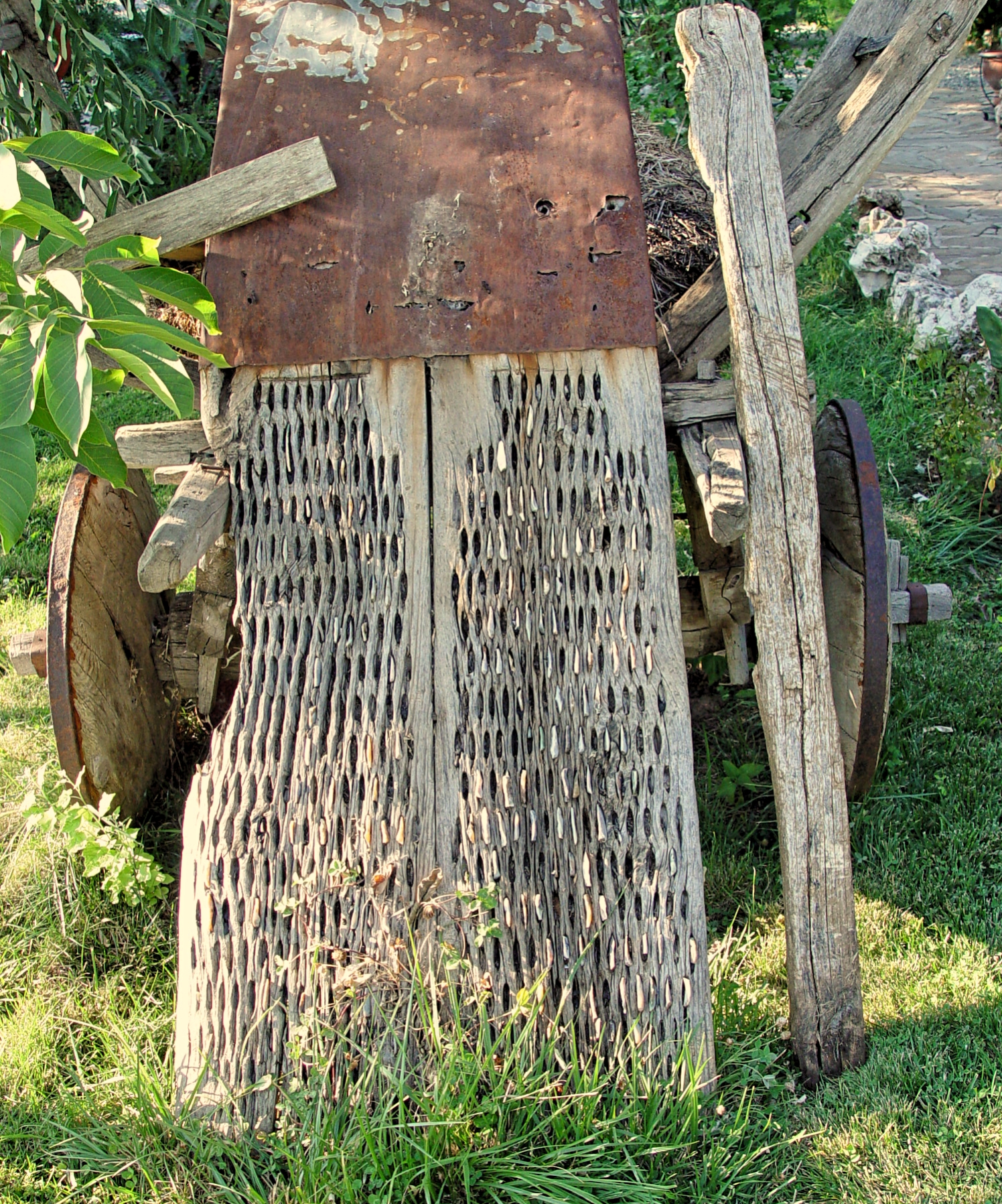
Note that reference is made to the “threshing sledges for the wood.” The threshing sledge was pulled across the grain to separate the kernel from the chaff. In Aphrodisias, Turkey, I had the opportunity to photograph several threshing sledges. This helps us to visualize what David used for wood for the burnt offerings in our Chronicles text.
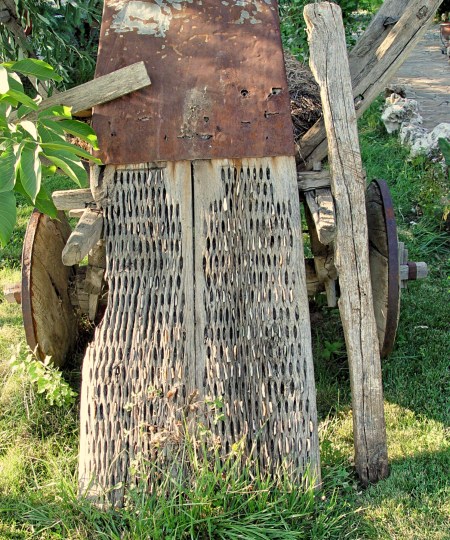
Threshing Sledge at Aphrodisias, Turkey. Photo by Leon Mauldin.
Though the text is challenging, it seems that its placement in Chronicles is to show the usage God made of the event. The property David purchased for offering for atonement for sin would become the site for Solomon’s building the temple! “Then David said, ‘Here shall be the house of the LORD God and here the altar of burnt offering for Israel'” (22:1).
Click photo for larger view.
Leave a Comment » | Bible History and Geography, Bible Study, Biblical Interpretation, Israel, Jerusalem, Old Testament, photography, Travel, Turkey, Uncategorized | Tagged: Aphrodisias, David, Threshing sledge | Permalink
Posted by Leon Mauldin
November 17, 2016
On our recent trip to Israel, while we were in the area of the Antonia Fortress, our guide Zack showed us some artwork that I found to be a helpful illustration of the area north of the temple in Jerusalem.
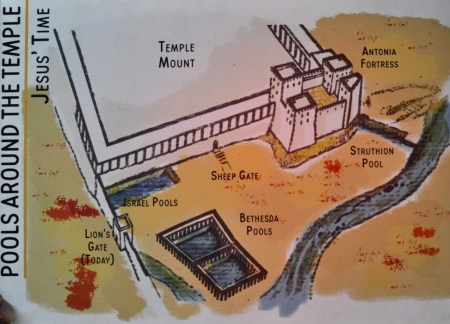
Pools of Jerusalem. Shows area north of temple mount. Photo by Leon Mauldin.
This is useful for showing the location of the Antonia Fortress, which would have housed the Roman soldiers stationed in Jerusalem to keep peace (to the chagrin of the Jewish nation). While many believe that it would have been here that Jesus was put on trial before Pilate, it is more likely that Pilate would have been at Herod’s palace there in Jerusalem. For more on this, see the excellent post by Ferrell Jenkins here.
The Antonia Fortress would have been the location of the barracks where Paul was taken when some Jews in Jerusalem were enraged to the point of seeking to kill him: “the commanding officer ordered Paul to be brought back into the barracks. He told them to interrogate Paul by beating him with a lash so that he could find out the reason the crowd was shouting at Paul in this way (Acts 22:24, NET).
This illustration is also helpful in visualizing the setting of John 5, where Jesus healed the man who had been paralyzed thirty-eight years: “Now there is in Jerusalem by the Sheep Gate a pool, which is called in Hebrew, Bethesda, having five porches” (v.2). Here you can see the location of the sheep gate, as well as the twin pools of Bethesda.

Excavations at the Pool of Bethesda. Photo by Leon Mauldin.
My previous posts on Bethesda can be seen by clicking here, here, here and here.
When you study the Bible, you are studying real events, real places, real people!
Leave a Comment » | Bible History and Geography, Bible Study, Israel, Jerusalem, New Testament, photography, Travel | Tagged: Antonia Fortress, Pool of Bethesda | Permalink
Posted by Leon Mauldin
November 7, 2016
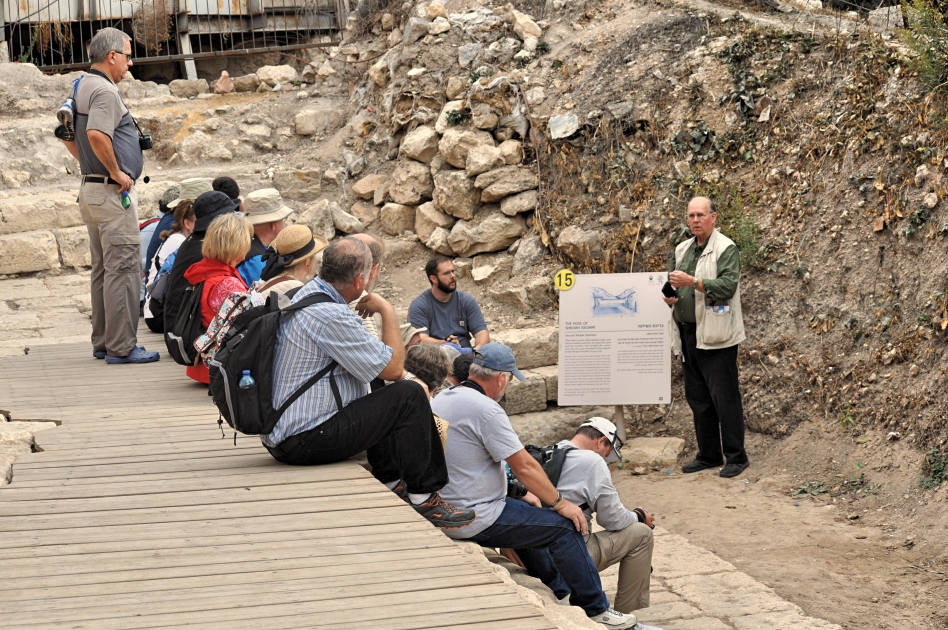
Today was a walking tour of Jerusalem. One of my favorite sites (among others) is the pool of Siloam, referenced in John 9. This site was excavated in late 2004. Jesus anointed with clay the eyes of the man born blind, and told him to go to this pool to wash his eyes. He did so, and he went away seeing. This miracle was evidence to validate Jesus’ claim that He was the light of the world (John 9:5).
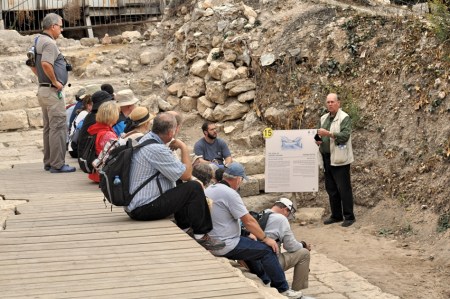
At the pool of Siloam, where the blind man received his sight (John 9). Photo by Zachary Shavin.
Note the text of John 9:1-7:
Now as Jesus passed by, He saw a man who was blind from birth. 2 And His disciples asked Him, saying, “Rabbi, who sinned, this man or his parents, that he was born blind?” 3 Jesus answered, “Neither this man nor his parents sinned, but that the works of God should be revealed in him. 4 “I must work the works of Him who sent Me while it is day; the night is coming when no one can work. 5 “As long as I am in the world, I am the light of the world.” 6 When He had said these things, He spat on the ground and made clay with the saliva; and He anointed the eyes of the blind man with the clay. 7 And He said to him, “Go, wash in the pool of Siloam” (which is translated, Sent). So he went and washed, and came back seeing.
This was one of seven miracles recorded in the Gospel of John. John’s stated purpose:
And truly Jesus did many other signs in the presence of His disciples, which are not written in this book; but these are written that you may believe that Jesus is the Christ, the Son of God, and that believing you may have life in His name. (John 20:30-31)
We have previously posted on Siloam here and here.
Click on image for larger view. Thanks for following our travels.
Leave a Comment » | Archaeology, Bible History and Geography, Bible Study, Israel, Jerusalem, New Testament, photography, Travel | Tagged: Pool of Siloam | Permalink
Posted by Leon Mauldin
November 5, 2016
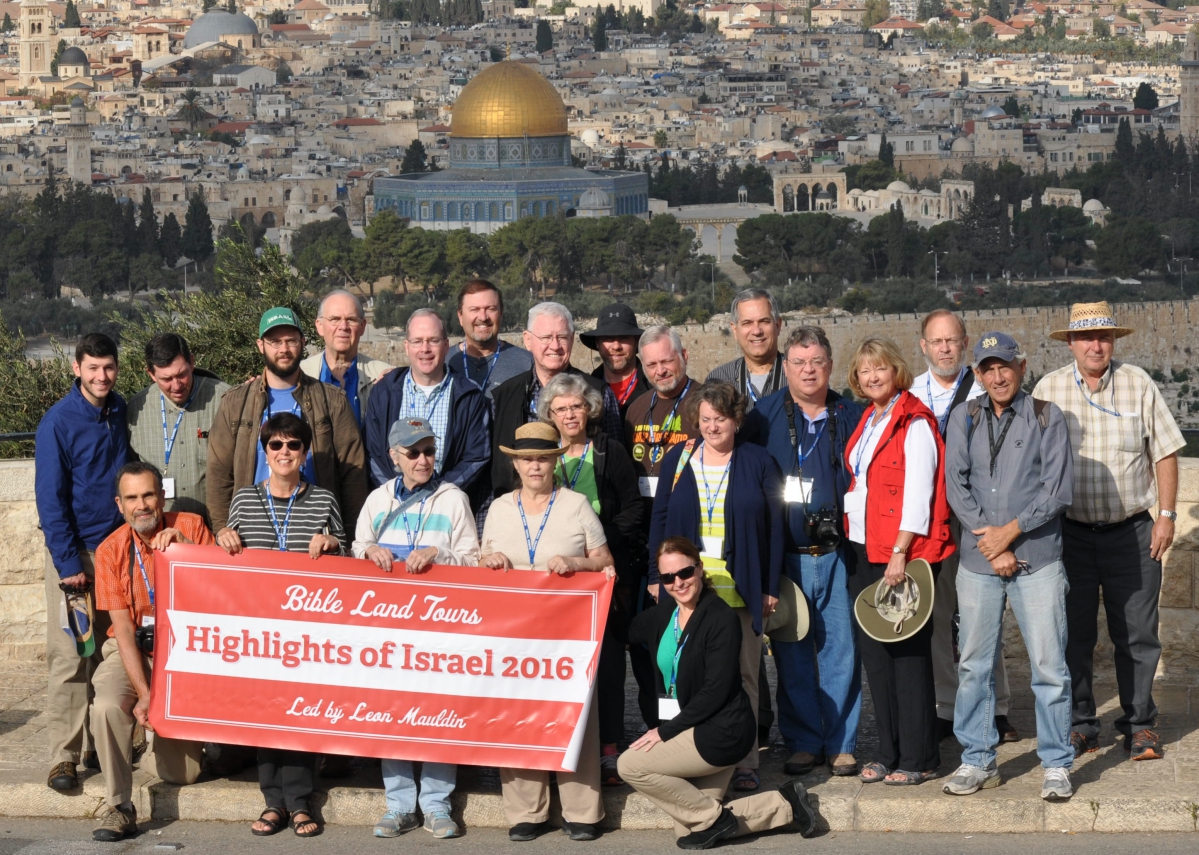
This morning we began the day with a visit to the Mount of Olives. We then saw Gethsemane where we reflected, read appropriate passages, and sang. We walked through Kidron to the southern end of the temple mount. We ended the day with a visit to Bethlehem.
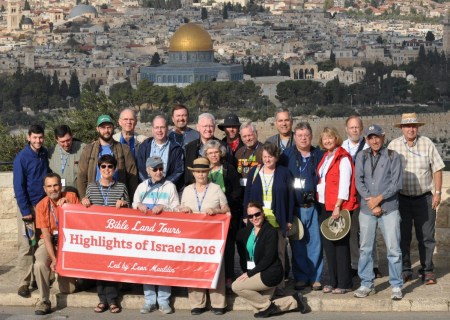
Group Photo Mt. of Olives. Photo ©Leon Mauldin.
We paused for a group shot while on the Mount of Olives.
It was on the Mount of Olives that Jesus gathered with His apostles and instructed them a final time before His ascension back into heaven:
4 And being assembled together with them, He commanded them not to depart from Jerusalem, but to wait for the Promise of the Father, “which,” He said, “you have heard from Me; 5 “for John truly baptized with water, but you shall be baptized with the Holy Spirit not many days from now.” 6 Therefore, when they had come together, they asked Him, saying, “Lord, will You at this time restore the kingdom to Israel?” 7 And He said to them, “It is not for you to know times or seasons which the Father has put in His own authority. 8 “But you shall receive power when the Holy Spirit has come upon you; and you shall be witnesses to Me in Jerusalem, and in all Judea and Samaria, and to the end of the earth.” 9 Now when He had spoken these things, while they watched, He was taken up, and a cloud received Him out of their sight. 10 And while they looked steadfastly toward heaven as He went up, behold, two men stood by them in white apparel, 11 who also said, “Men of Galilee, why do you stand gazing up into heaven? This same Jesus, who was taken up from you into heaven, will so come in like manner as you saw Him go into heaven.” 12 Then they returned to Jerusalem from the mount called Olivet, which is near Jerusalem, a Sabbath day’s journey. (Acts 1:4-12).
I’m thankful to say that all of our folks here continue to be well. Thanks for following our blog.
Leave a Comment » | Bible History and Geography, Bible Study, Israel, Jerusalem, New Testament, photography, Travel | Tagged: Mount of Olives, Touring Israel | Permalink
Posted by Leon Mauldin
August 16, 2016
When Jehu (841 BC) killed King Jehoram (Israel) and King Ahaziah (Judah), Ahaziah’s mother, Queen-mother Athaliah (daughter of Ahab and Jezebel) moved quickly to position herself in power as ruler of Judah. Called “that wicked woman Athaliah” (2 Chron. 24:7, NIV), she killed all of her son Ahaziah’s children, her own grandchildren, and proclaimed herself ruler of Judah. Only one-year-old Joash was spared (unknown to Athaliah) by faithful priest Jehoiada and his wife Jehosheba (sister to Ahaziah! (2 Kings 1:1-3)
Jehoiada waited six years to make his move:
Now in the seventh year Jehoiada sent and brought the captains of hundreds of the Carites and of the guard, and brought them to him in the house of the LORD. Then he made a covenant with them and put them under oath in the house of the LORD, and showed them the king’s son (2 Kings 11:4).
Then on a Sabbath at the time of the shift change, so as to include all who were finishing their duties as well as those who were arriving, armed with swords, spears and shields, and surrounding young Joash, Jehoiada “put the crown on him and gave him the testimony; and they made him king and anointed him, and they clapped their hands and said, ‘Long live the king!'”

Model of Temple Mount and city of David. Bible Lands Museum, Jerusalem. Photo by Leon Mauldin.
The inspired historian continues:
When Athaliah heard the noise of the guard and of the people, she came to the people in the house of the LORD. 14 She looked and behold, the king was standing by the pillar, according to the custom, with the captains and the trumpeters beside the king; and all the people of the land rejoiced and blew trumpets. Then Athaliah tore her clothes and cried, “Treason! Treason!” 15 And Jehoiada the priest commanded the captains of hundreds who were appointed over the army and said to them, “Bring her out between the ranks, and whoever follows her put to death with the sword.” For the priest said, “Let her not be put to death in the house of the LORD.” 16 So they seized her, and when she arrived at the horses’ entrance of the king’s house, she was put to death there. 17 Then Jehoiada made a covenant between the LORD and the king and the people, that they would be the LORD’S people, also between the king and the people. 2 Kings 11:13-17.
Our photo shows a very nice model of the temple and city of David, featured at the Bible Lands Museum in Jerusalem. This can help us visualize the setting for the events of our text of 2 Kings 11.
Leave a Comment » | Bible History and Geography, Bible Study, Israel, Jerusalem, Old Testament, photography, Travel | Tagged: 2 Kings | Permalink
Posted by Leon Mauldin
May 4, 2016
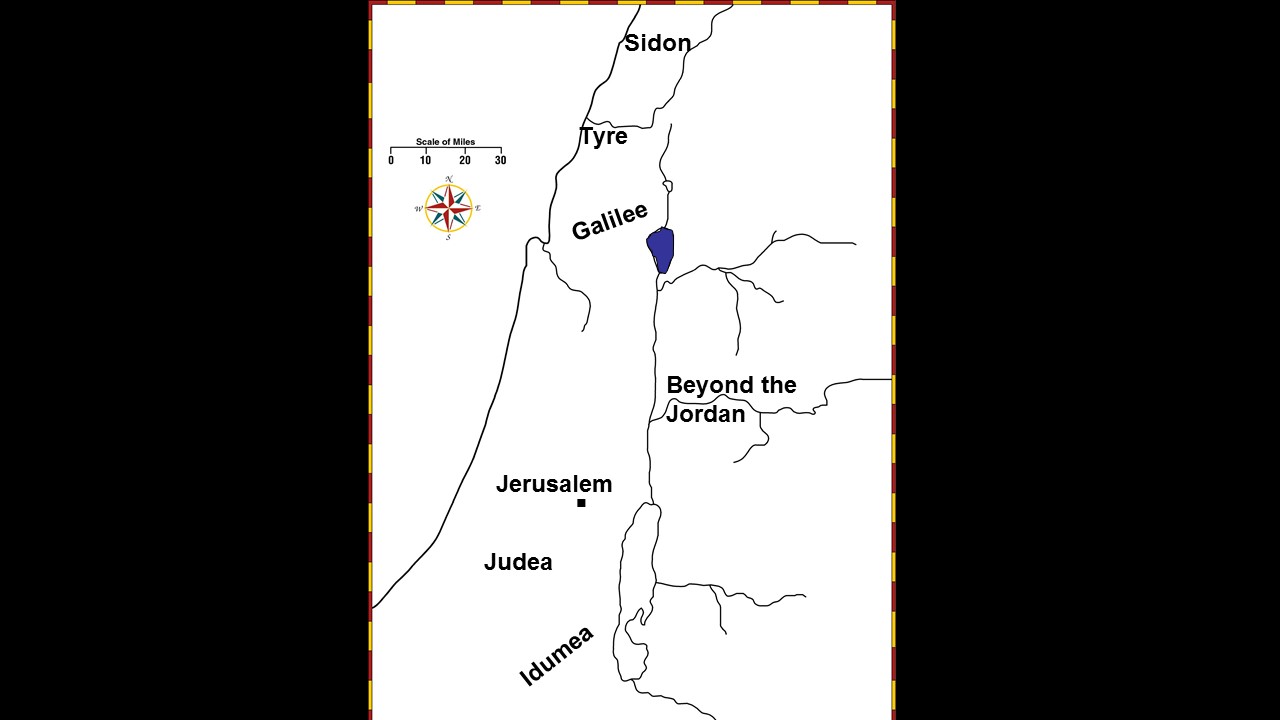
Frequently the Bible will have “summary statements,” such as is found regarding Jesus’ Galilean Ministry: ” Jesus withdrew to the sea with His disciples; and a great multitude from Galilee followed; and also from Judea, and from Jerusalem, and from Idumea, and beyond the Jordan, and the vicinity of Tyre and Sidon, a great number of people heard of all that He was doing and came to Him” (Mark 3:7-8, NASB).
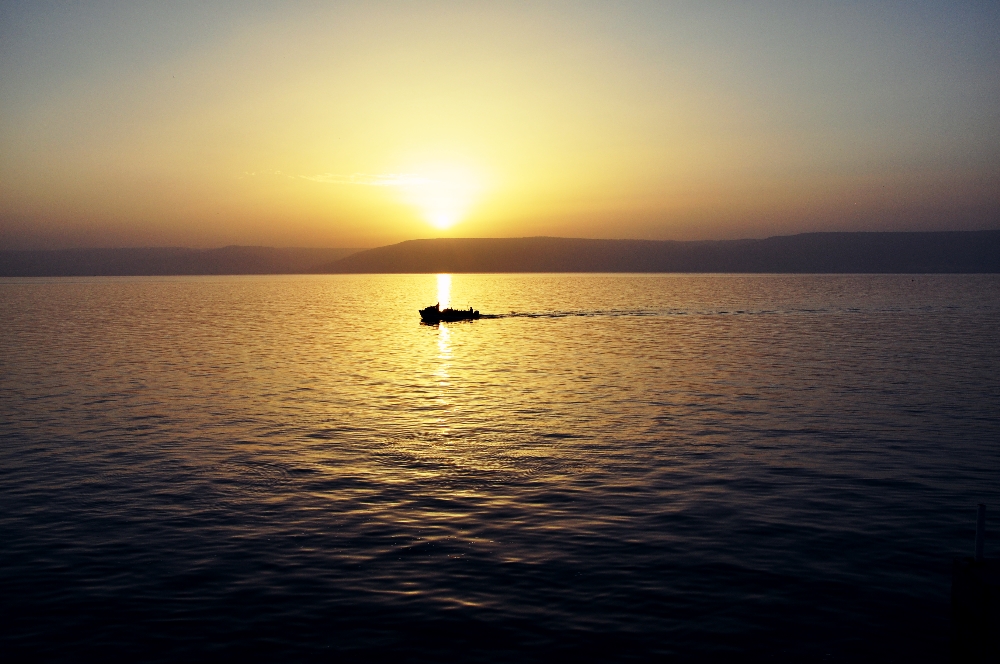
Note Jesus “withdrew to the sea,” meaning the Sea of Galilee, which is really a fresh water lake fed by the Upper Jordan. Its surface is currently 696 feet below sea level. Here see a sunrise view I photographed last month:
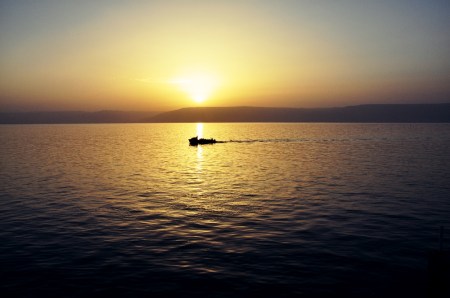
Sunrise at the Sea of Galilee. Photo ©Leon Mauldin.
I labeled this blank map to show all the sites mentioned in these two verses.
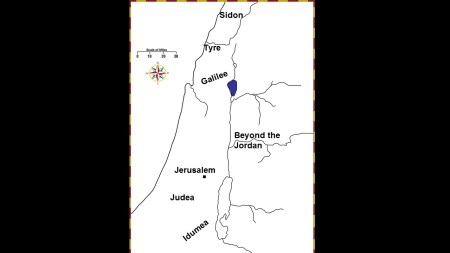
Map, areas mentioned in Mark 3:7-8. Blank map by Bob Waldron & Scott Richardson.
The text is saying that people from all of these areas came to hear and see Jesus when He “withdrew to the sea.” Mark records the above portion of Jesus’ ministry immediately before he narrates Jesus’ selection and appointment of the twelve apostles.
Leave a Comment » | Bible History and Geography, Bible Places, Bible Study, Galilee, Israel, Jerusalem, New Testament, photography, Sea of Galilee, Travel | Permalink
Posted by Leon Mauldin
February 10, 2016
John records the beginning of Jesus’ ministry, including this visit to Jerusalem for Passover:
The Passover of the Jews was near, and Jesus went up to Jerusalem. And He found in the temple those who were selling oxen and sheep and doves, and the money changers seated at their tables. And He made a scourge of cords, and drove them all out of the temple, with the sheep and the oxen; and He poured out the coins of the money changers and overturned their tables; and to those who were selling the doves He said, “Take these things away; stop making My Father’s house a place of business.” (John 2:13-16).
It is noteworthy that Jesus both began (above text) and concluded (Matt. 21:12-13) His ministry by cleansing the temple (hieros), “My Father’s house,” of its abuses–of its being turned into a “house of merchandise.”
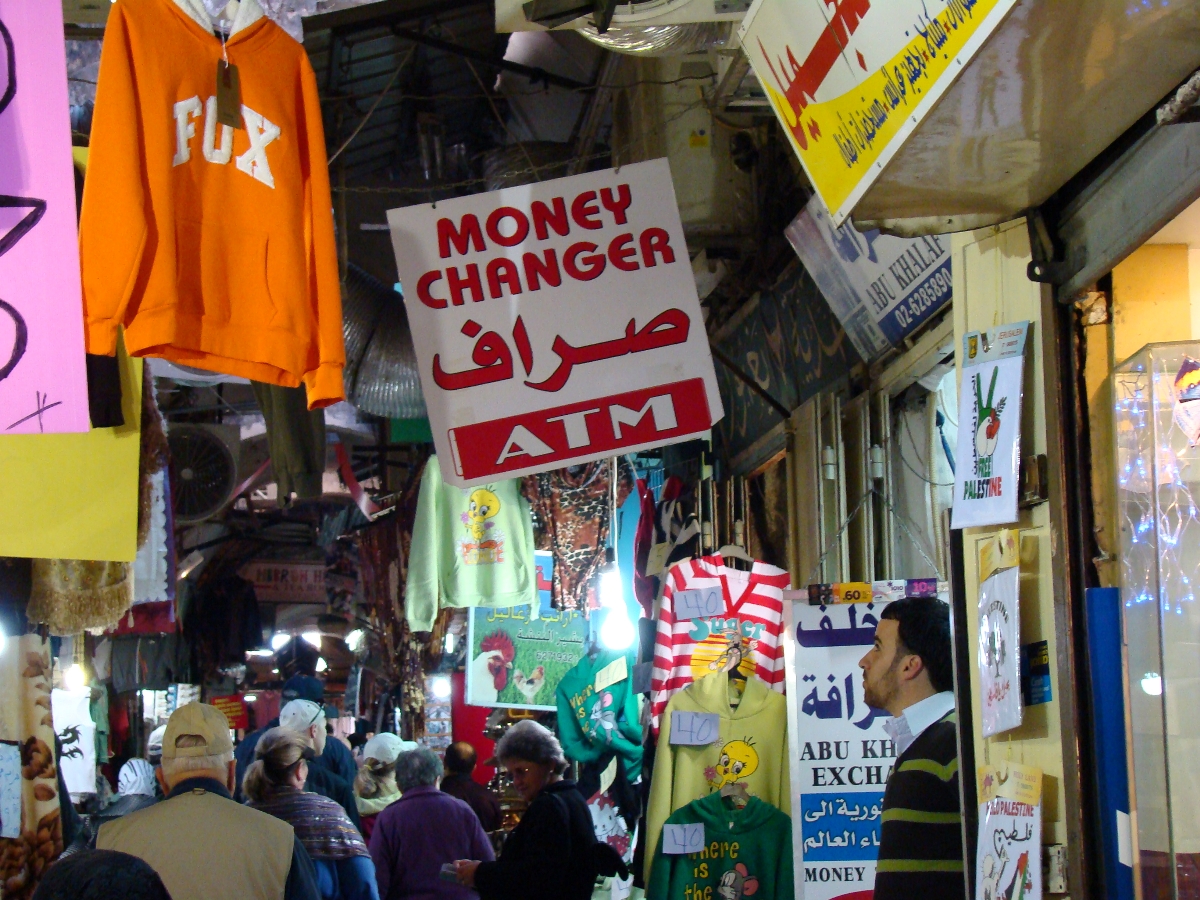
I’ve thought of these biblical texts when walking through Old Jerusalem and seeing signs such as this one:
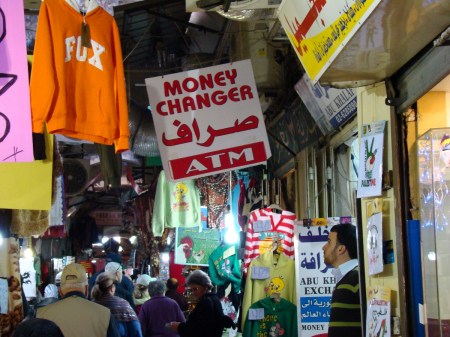
Money-changers in Jerusalem. Photo by Leon Mauldin.
Money-changers were:
bankers who exchanged one nation’s currency, or one size of coin, for another. These people provided a convenience, charging a fee (often exorbitant) for their services. Some moneychangers operated in the temple area (the Court of the Gentiles), because all money given to the Temple had to be in the Tyrian silver coin. According to Exodus 30:11–16, every Israelite 20 years old or older was required to pay an annual tax of a half-shekel into the treasury of the sanctuary (Nelson’s New Illustrated Bible Dictionary).
Note the location is the hieros (temple area with its spacious courts, John 2:14-15) and not the naos, or sanctuary, where only the priests could go.
What do you think Jesus might do if He were to walk among “modern churches” today? (I know the church in the biblical sense is not the physical church building/meeting place, but rather is the people of God).
Click image for larger view.
1 Comment | Bible History and Geography, Bible Study, Biblical Interpretation, Israel, Jerusalem, New Testament, photography, Travel | Tagged: Money-changers, Temple | Permalink
Posted by Leon Mauldin
November 10, 2015
It is fascinating to view the gates of Old Jerusalem!
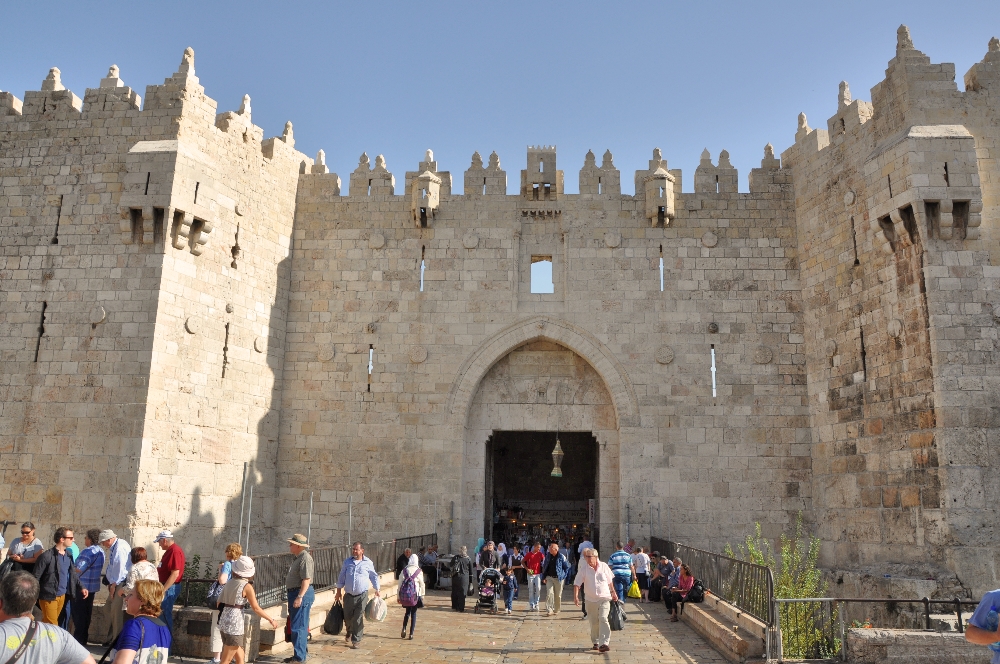
The Damascus Gate is located on the north side of Jerusalem, so named because this would be the direction going out of Jerusalem to Damascus, ca. 150 miles NNW. The Jews call this gate the Shechem Gate, and the Arabs call it Bab el-Amud.
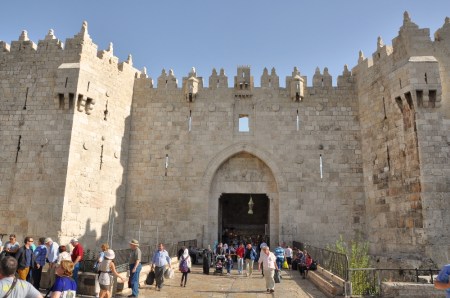
Damascus Gate Jerusalem. North entrance. Photo by Leon Mauldin.
This entrance gate
along the present north wall dramatically accents the spot that has been the main north entrance to Jerusalem for almost two millennia. R. W. Hamilton’s sounding here in 1937 and Basil Hennessey’s excavations in the 1960s; have revealed, below the modern entrance, layer upon layer of earlier gateways, reaching back through Arab, Crusader and Byzantine constructions to Roman Age foundations. The earliest certain construction here dates to Aelia Capitolina, the second to fourth-century C.E. city of Hadrian, but both Hamilton and Hennessey felt they found evidence that Hadrian’s gateway was built on foundations that went back to the Second Temple period. BAS Biblical World in Pictures. (2003).
Hadrian had built a triple-arched gateway to serve as entrance here. The eastern arch is well-preserved.
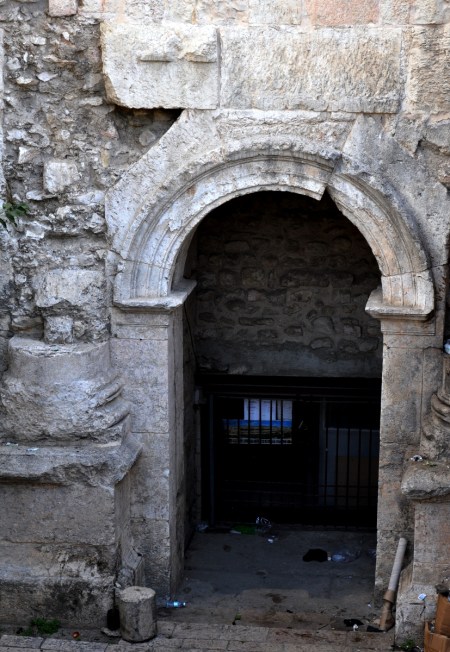
Hadrian Gate, eastern arch. ca. AD 135. North wall, Jerusalem. Photo by Leon Mauldin.
The Latin inscription above the keystone of the arch says, “…according to the decurians [the city council] of Col[onia] Ael[ia] Cap[itolina],” Hadrian’s designation for Jerusalem.
Click images for larger view.
Leave a Comment » | Archaeology, Bible History and Geography, Bible Study, Gates, Israel, Jerusalem, New Testament, photography, Travel | Tagged: Damascus Gate, Hadrian Gate | Permalink
Posted by Leon Mauldin
November 20, 2014
The god Asclepius, the healing god, was widely worshiped in biblical times, especially in Grecian and Roman periods. The Asclepian at Pergamum in Asia Minor was world famous. We’ve previously posted, click here and here on that one.
It may surprise you to know that there was a healing center devoted to this god in Jerusalem, just 100+ yards north of the Herodian temple adjacent to the pool of Bethesda.
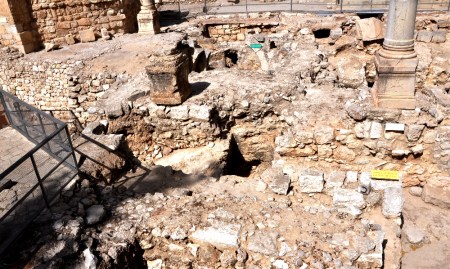
Temple to the healing god Asclepius at Pool of Bethesda. Photo by Leon Mauldin.
This temple dates back to Roman times, but after the ministry of Jesus.
We’ve posted on Bethesda here and here.
Asclepius is also associated with the Egyptian god Serapis (see here and here), Serapis having become one of the most popular deities in the Roman Empire. The yellow placard in photo the above photo in Jerusalem names both identifies this site as “Temple de Serapis” as well as “Asclepian Temple.”

Serapis, Egyptian god of healing, assimilated by Romans. Photo by Leon Mauldin. Metro Museum NY.
Paul would write the Corinthians, “For even if there are so-called gods whether in heaven or on earth, as indeed there are many gods and many lords, yet for us there is but one God, the Father, from whom are all things and we exist for Him; and one Lord, Jesus Christ, by whom are all things, and we exist through Him” (1 Cor. 8:5-6).
Click images for larger view.
2 Comments | Bible History and Geography, Bible Study, Egypt, Israel, Jerusalem, photography, Travel | Tagged: Asclepius, Serapis | Permalink
Posted by Leon Mauldin