En Route to the Pool of Bethesda, Lavigerie

November 18, 2014

On the north end of Jerusalem one can see the ruins of the pool(s) of Bethesda, mentioned in John 5 as the location where Jesus healed a lame man. That was one of seven miracles recorded by divine selection in the Gospel of John to provide reasons for believing in Jesus, evidences for faith in Him as the Christ, the Son of God (John 20:30-31).

While my group was visiting Israel last year, I photographed a statue of Lavigerie, located close by the pools.

Lavigerie in Jerusalem, near Pool of Bethesda. Photo by Leon Mauldin.

Lavigerie in Jerusalem, near Pool of Bethesda. Photo by Leon Mauldin.

I will acknowledge that the name Charles Martial Allemand Lavigerie is not one I was familiar with. But sometimes you shoot (photograph!) first and ask questions later.

The Dictionary of African Christian Biography relates this info regarding Lavigerie (1825-1892):

Cardinal Archbishop of Algiers and Carthage, Primate of Africa, missionary founder and anti-slavery campaigner, was born near Bayonne in the Basque region of southern France. After his schooling, he studied theology at Saint Sulpice in Paris. In 1854, after priestly ordination and further studies, he was appointed professor of church history in the university of the Sorbonne, Paris. In 1860, as director of the work for oriental schools, he travelled to Lebanon and Syria to administer relief to Christians there, following the massacre by the Druses. . .

In 1863 he was appointed Bishop of Nancy, France and was placed in line for the important archiepiscopal see of Lyons. However, he declined this prestigious appointment, and asked instead for the colonial see of Algiers, to which he was appointed archbishop in 1867. Algeria had become a French colony in 1830, and under Napoleon III was designated an “Arab Kingdom.” . . .

From 1878 his missionaries established themselves in the Great Lakes region of Eastern Africa and, after his death, in the French territories of West Africa. Created a Cardinal in 1882, Lavigerie revived the ancient see of Carthage, with the title Primate of Africa, when the French annexed Tunisia. Throughout 1888 Lavigerie conducted a personal campaign against slavery in the capitals of Europe. In this campaign he made known the heart-rending experiences of slavery witnessed by his missionaries in equatorial Africa. The campaign resulted in the anti-slavery conferences of Brussels and Paris. . .

Click image for larger view.


Jerusalem’s Eastern Wall

November 17, 2014

In ancient times, city walls were essential for defense and security. An unwalled city was defenseless.

The concept of a city without walls is used metaphorically in Proverbs 25:28: “Whoever has no rule over his own spirit Is like a city broken down, without walls.”

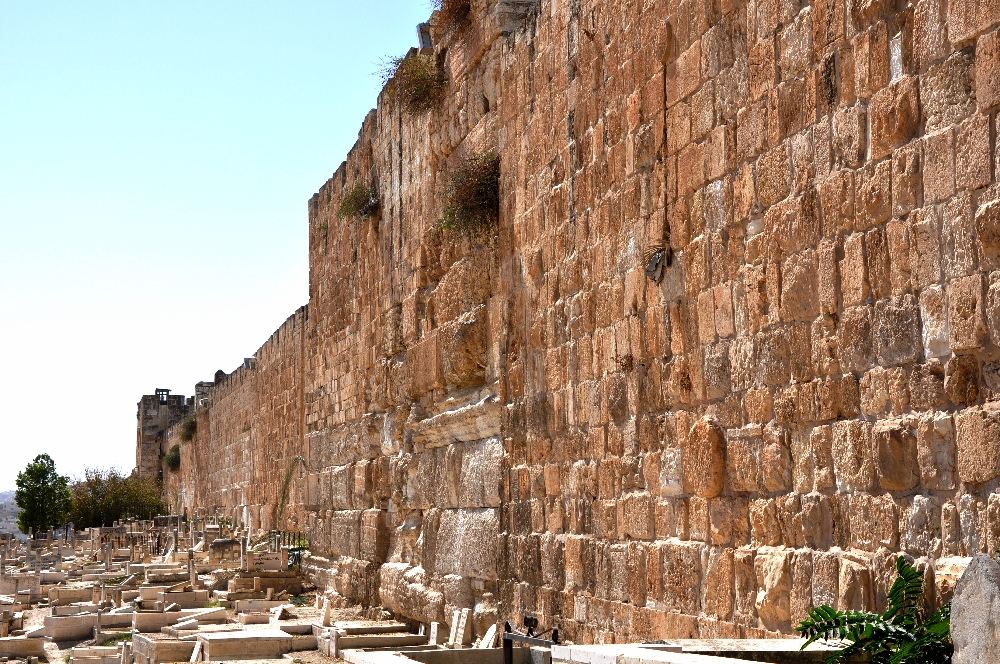
Here is a view of Jerusalem’s eastern old city wall, as you look to the south.

Jerusalem's Eastern Wall. Photo by Leon Mauldin.

Jerusalem’s Eastern Wall. Photo by Leon Mauldin.

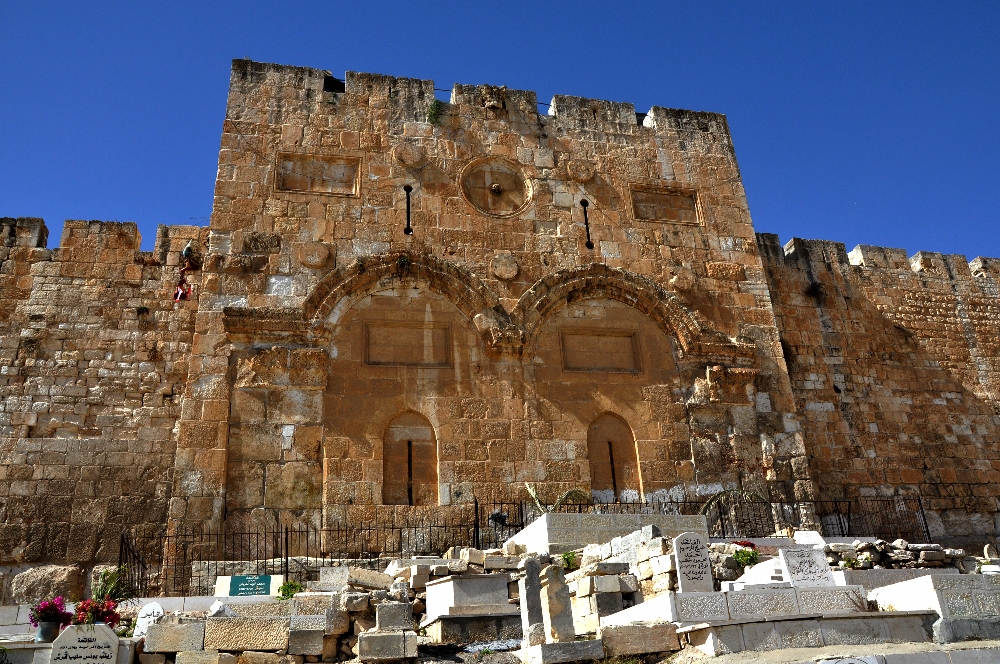
A close up of Jerusalem’s Eastern Gate:

Eastern Gate  in Jerusalem. Photo by Leon Mauldin.

Eastern Gate in Jerusalem. Photo by Leon Mauldin.

Today a Muslim cemetery is located at the front of the gate.

Click image for larger view.


Pool of Bethesda

May 14, 2013

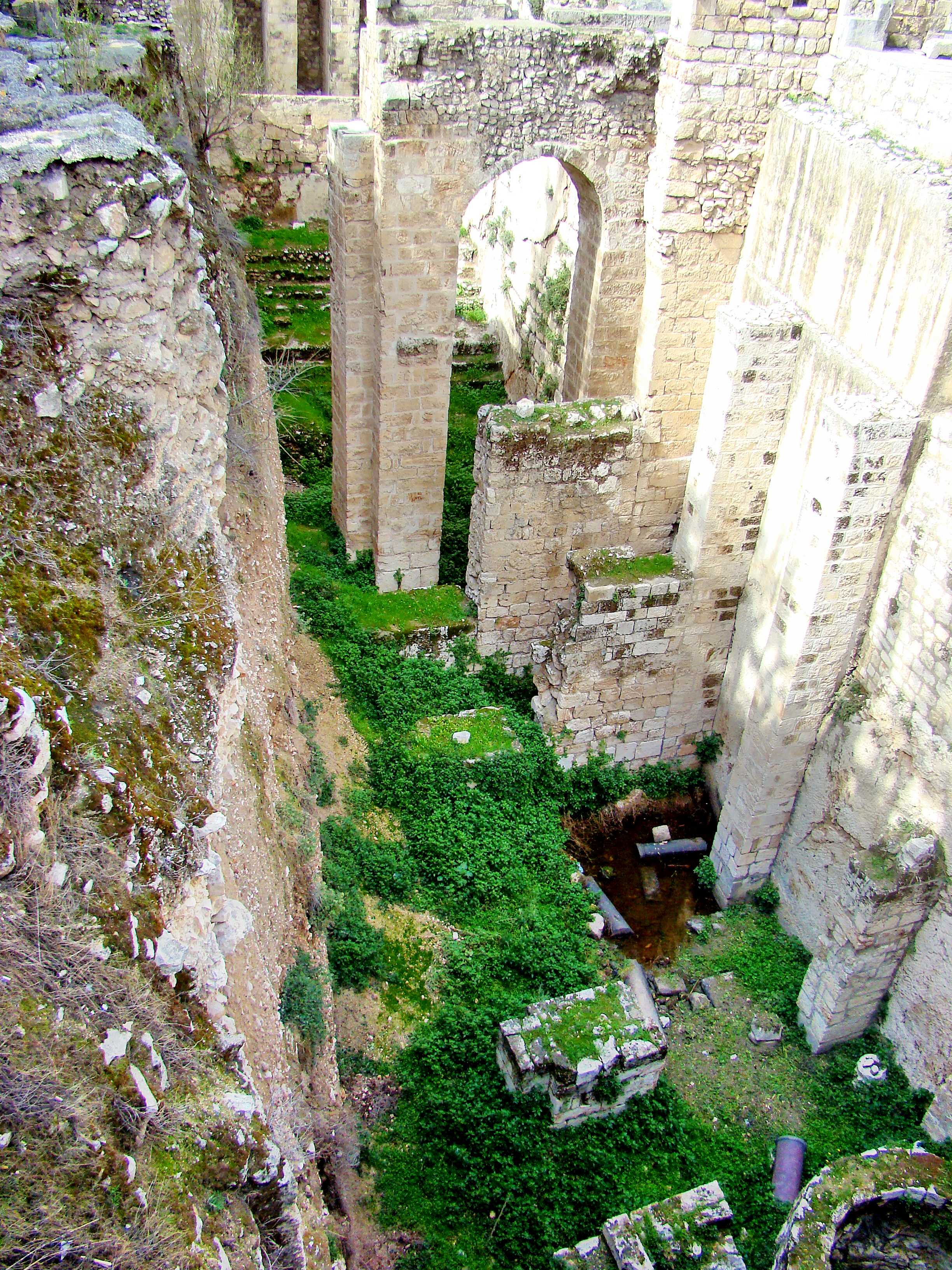
As follow-up on yesterday’s post I wanted to include a photo of the pool of Bethesda. There were actually two adjacent pools. Our photo shows excavations of the southern pool.

Southern Pool of Bethesda. Setting of John 5. Photo by Leon Mauldin.

Southern Pool of Bethesda. Setting of John 5. Photo by Leon Mauldin.

These pools date back to about 200 BC, and furnished water for the temple. As noted yesterday, this is the setting of the miracle of John 5, when Jesus healed the man who had been lame for 38 years.

Click on image for higher resolution.


St. Anne’s Church at Pool of Bethesda

May 13, 2013

John 5 records Jesus’ miraculous healing of a man lame from birth at the pool of Bethesda in Jerusalem. He had been in this condition for 38 years. Such miracles show who Jesus is: He has power over disease. He has power over time; the fact that the man had been in that condition for 38 years did not in any way lessen Jesus’ power to heal. Jesus came to deliver and redeem man from sin. The Good News of the Gospel is that though one may have been in the bondage of sin for many years, Jesus has power to save.

It is possible to see the pools of Bethesda today in the NE section of the Old City in the Muslim Quarter (comprised of 76 acres). St. Anne’s church is located there, dating back to AD 1138. Jerome Murphy-O’Conner describes it as the “loveliest church in the city” (The Holy Land: An Oxford Archaeological Guide from Earliest Times to 1700).

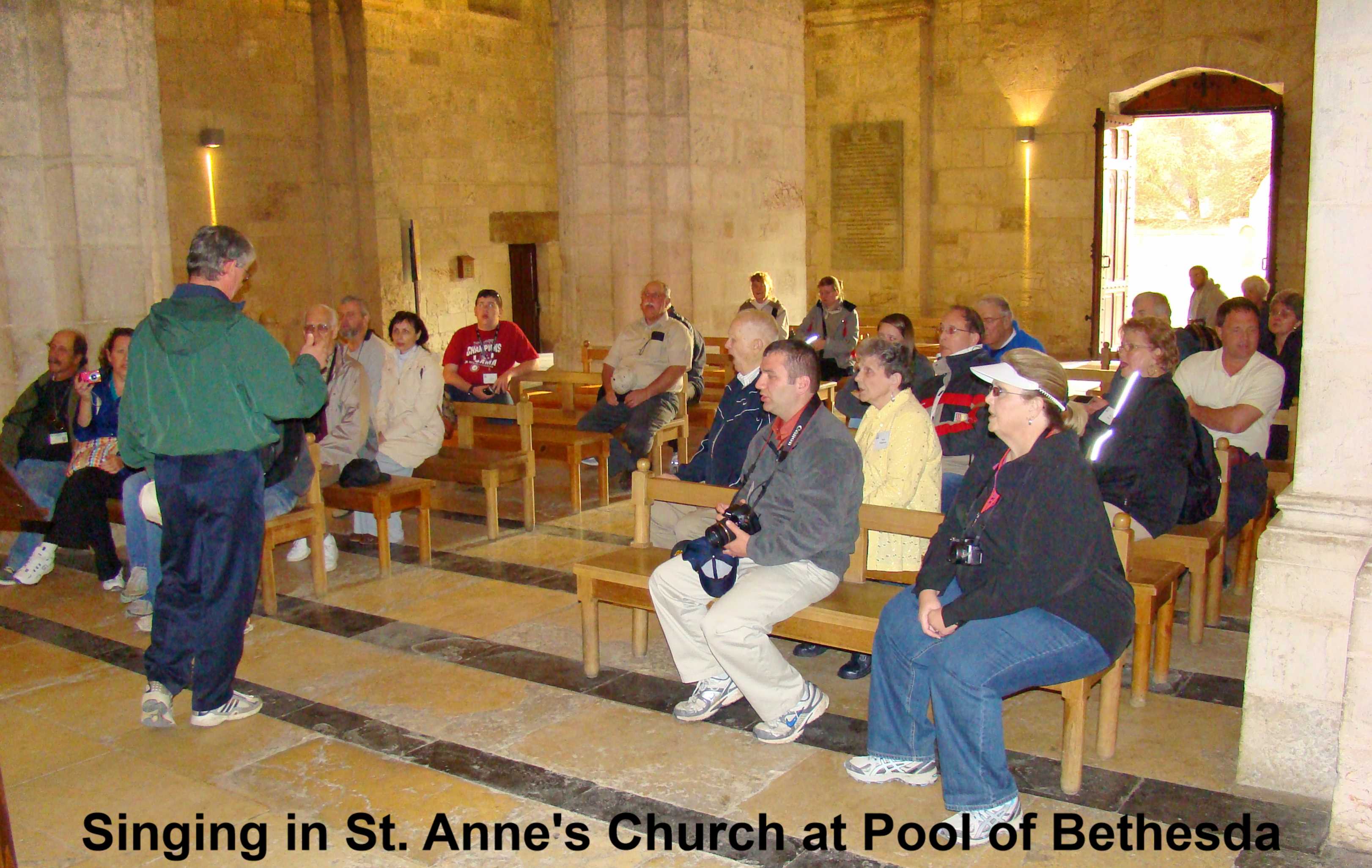
In 2011 my group went inside St. Anne’s and sang spiritual songs, such as “Amazing Grace,” “Alleluia,” and many others. The acoustics are marvelous.

Singing at St. Anne's Church near Pool of Bethesda in Jerusalem. Photo by Leon Mauldin.

Singing at St. Anne’s Church near Pool of Bethesda in Jerusalem. Photo by Leon Mauldin.

Click on photo for larger view.


On the Steps of the Pool of Siloam

May 11, 2013

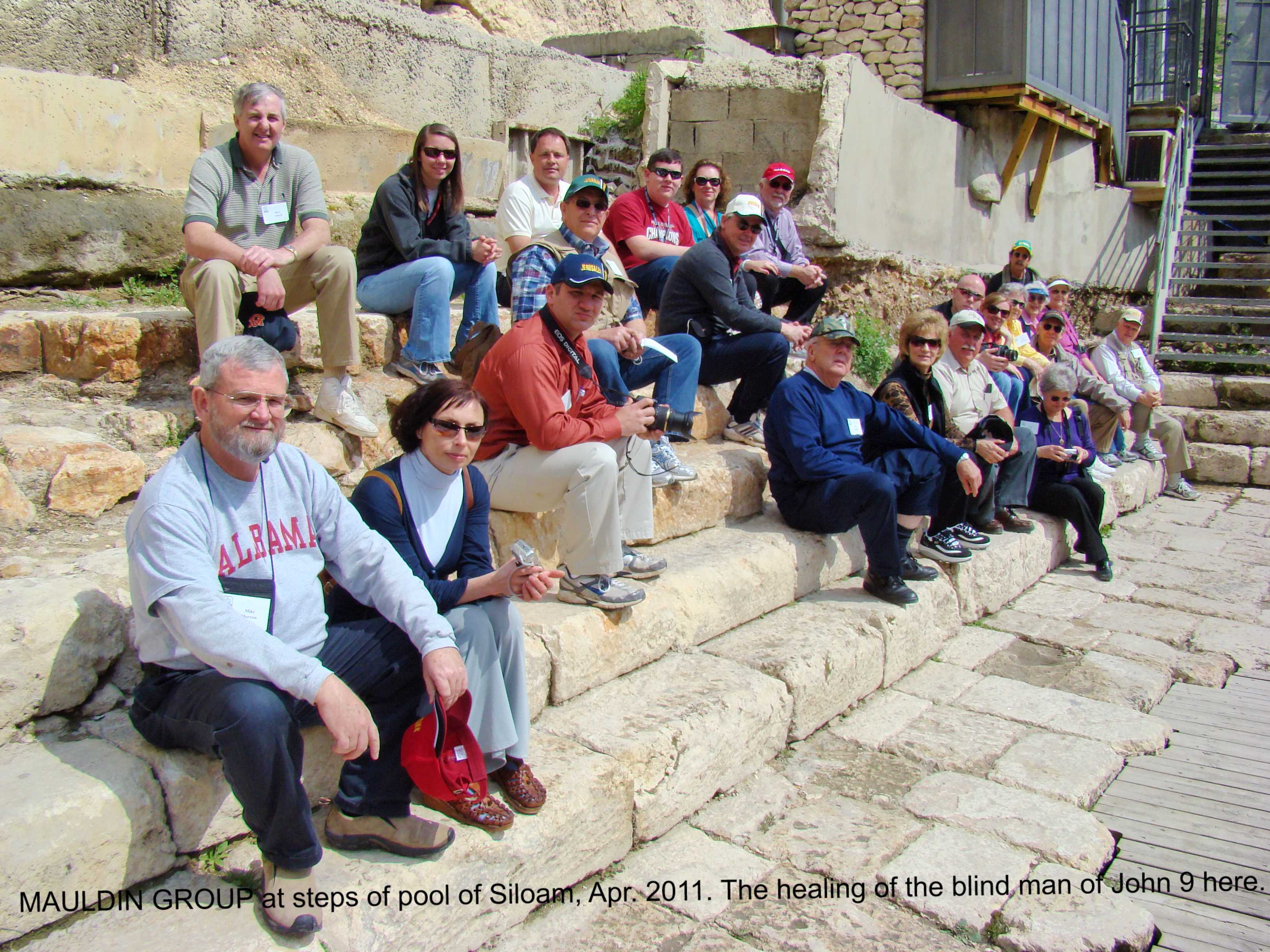
One of the most exciting of recent archaeological discoveries in Israel has been that of the pool of Siloam. I first saw this site in fall of 2005, when it was still “freshly” excavated. This photo illuminated the text of John 9, where Jesus healed the man born blind. Jesus spat upon the ground, made clay of the spittle, anointed the man’s eyes and told him to go to the pool of Siloam and wash. He did so, and received his sight (John 9:1-7).

On Steps of Siloam. Mauldin Group 2011

On Steps of Siloam. Mauldin Group 2011

All manner of pressure was brought to bear upon him by Jewish authorities to renounce Jesus as a sinner, but he refused to cave in. “One thing I know: that though I was blind, now I see” (John 9:25).

This is one of Jesus’ seven miraculous signs recorded in the gospel of John:

Now Jesus performed many other miraculous signs in the presence of the disciples, which are not recorded in this book.  But these are recorded so that you may believe that Jesus is the Christ, the Son of God, and that by believing you may have life in his name (John 20:30-31).

There is great value in on-site biblical study.

I previously posted on the Hezekiah’s tunnel which emptied into the pool of Siloam here and here.

My friend Ferrell Jenkins has recently return from conducting a tour in Israel, and then staying on several days to take more photos. I’m looking to seeing those in the near future here.


Jerusalem, the Kidron, and Mt. of Olives

February 3, 2012

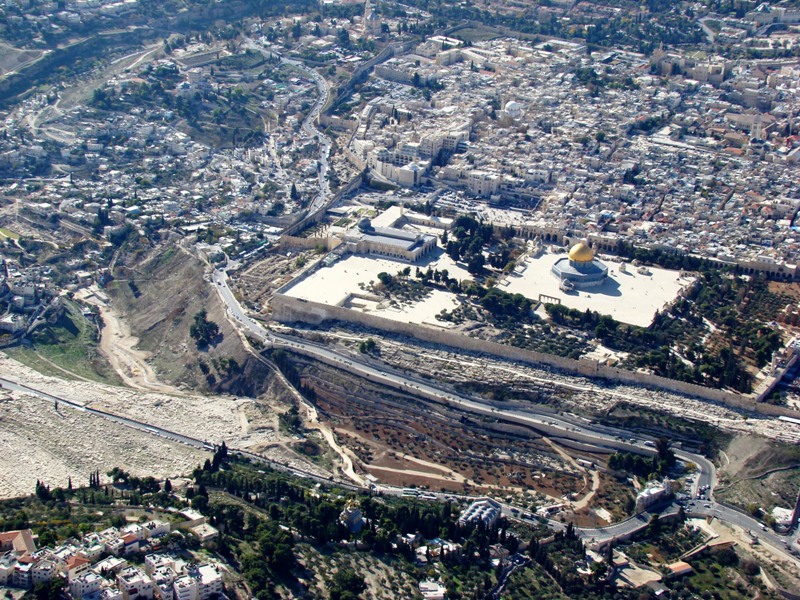
Yesterday’s post featured a photo of a hen with her chicks, imagery used by Jesus Himself in His lamentation over Jerusalem, as He wanted to gather the people unto Himself but they refused. Immediately he left the temple courts, crossed the Kidron with His disciples, and went to the Mount of Olives where He gave what has become known as the “Olivet Discourse” (Matthew 24).

Our photo provides an overview of the setting for these events. You can easily recognize the temple mount. Below that is the Kidron Valley. Next, at bottom of photo is the Mt. of Olives.

Temple Mount in Jerusalem, Kidron, and Mt. of Olives. Photo by Leon Mauldin.

Click on image for larger view.


Reading From the Scroll

September 2, 2011

Today Ferrell Jenkins and I were able to visit a site we’ve both wanted to see for years, the tel and cave of Adullam. This site is mentioned in the biblical narrative of David’s life, specifically of a time in which he was being pursued by the Philistines (2 Sam. 23:13ff.). We were able to secure the services of a local guide with a 4-wheel drive jeep. A memorable day.

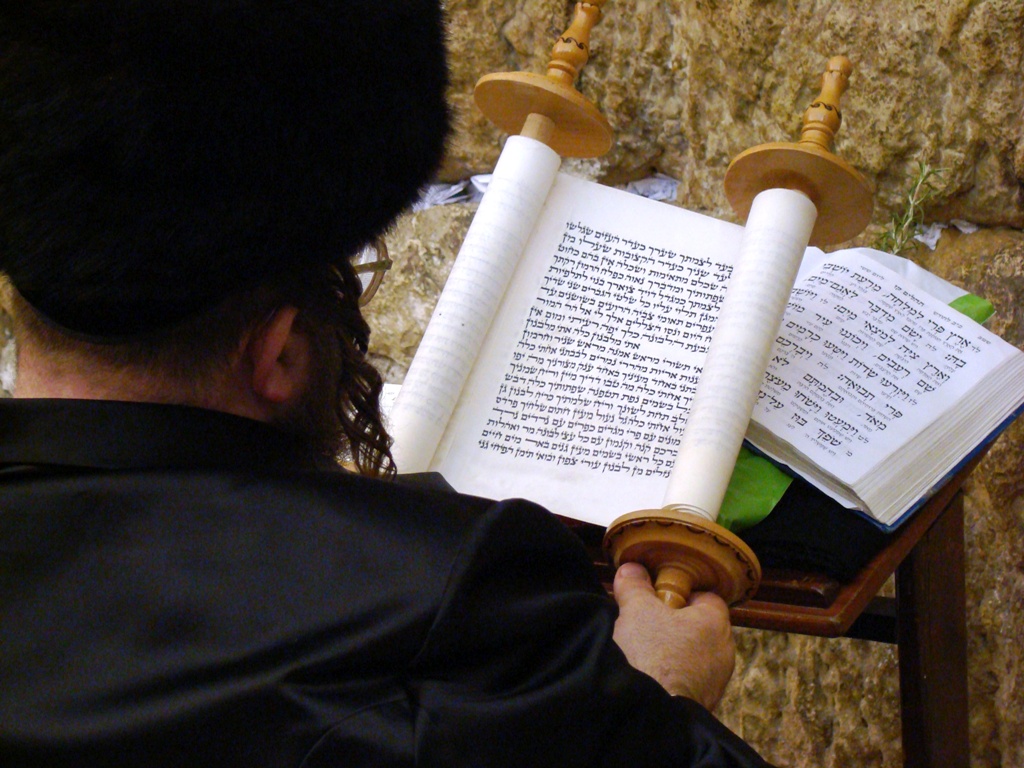
Late in the afternoon we were back in Jerusalem. We visited the Western Wall, and just north of the wall we entered Wilson’s Arch. This area is a reading room and prayer room. Today’s photo shows one of the Jews present reading from a scroll.

Reading a Scroll in Wilson's Arch. Photo by Leon Mauldin.

This can be used to illustrate the writing and reading of Scripture in both Old and New Testament times. For example, Luke records a moment Jesus’ Galilean ministry:

16 He came to Nazareth, where He had been brought up. As usual, He entered the synagogue on the Sabbath day and stood up to read. 17 The scroll of the prophet Isaiah was given to Him, and unrolling the scroll, He found the place where it was written: 18 The Spirit of the Lord is on Me, because He has anointed Me to preach good news to the poor. He has sent Me to proclaim freedom to the captives and recovery of sight to the blind, to set free the oppressed, 19 to proclaim the year of the Lord’s favor. 20 He then rolled up the scroll, gave it back to the attendant, and sat down. And the eyes of everyone in the synagogue were fixed on Him. 21 He began by saying to them, “Today as you listen, this Scripture has been fulfilled.” (Luke 4:16-21).

Click on image for higher resolution.


“Not one stone upon another”

August 22, 2011

During the final week of the Lord’s ministry, Jesus rebuked the Pharisees, the Jewish rulers, for their hypocrisy and for their basic rejection of truth. His last words before leaving the temple area were

 Jerusalem, Jerusalem, the one who kills the prophets and stones those who are sent to her! How often I wanted to gather your children together, as a hen gathers her chicks under her wings, but you were not willing! 38 See! Your house is left to you desolate; 39 for I say to you, you shall see Me no more till you say, ‘Blessed is He who comes in the name of the LORD!’ (vv. 37-38)

As Jesus and the disciples left, the disciples pointed out the temple buildings to Him. His response no doubt greatly startled them: “”Do you not see all these things? Assuredly, I say to you, not one stone shall be left here upon another, that shall not be thrown down” (Matt. 24:2).

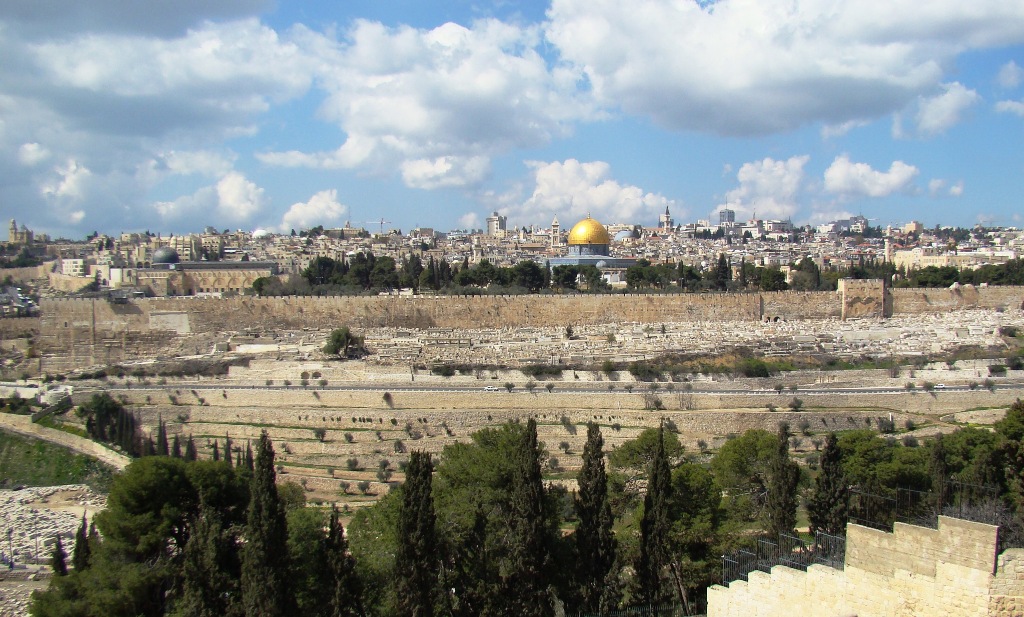
Jesus crossed the Kidron Valley and came to the Mount of Olives and sat down. It was here that the “Olivet Discourse” occurred, in which the disciples asked Him to explain what He meant.

View of Temple Mount, Jerusalem from Mt. of Olives. Photo by Leon Mauldin.

From the Mount of Olives the disciples could have seen the temple area in Jerusalem as Jesus’ foretold its coming destruction.

Excavations which reached 1st century street level uncovered stones of the temple buildings hurled down from above. The destruction took place in AD 70, by Rome’s Tenth Legion.

Stones from temple buildings in Tyropoeon Valley in Jerusalem, from AD 70 destruction. Photo by Leon Mauldin.

Click on images for higher resolution.


“A Shack in a Cucumber Field”

August 17, 2011

The prophet Isaiah said, “Daughter Zion is abandoned like a shelter in a vineyard, like a shack in a cucumber field, like a besieged city” (Isaiah 1:8). What is meant by that statement?

Zion, the city of Jerusalem, became David’s capital city. It was there that Solomon built the temple of the Lord Yahweh. Jerusalem, Mount Zion was central to Israel’s worship, and to their identity as a people. During much of Isaiah’s lengthy career (740-690 BC) Jerusalem was prosperous. “Their land has also been filled with silver and gold and there is no end to their treasures; their land has also been filled with horses and there is no end to their chariots” (Isa. 2:7).

But in saying “The daughter of Zion is left as a booth in a vineyard,” Isaiah speaks of their future desolation as though it has already occurred. Isaiah makes use of the prophetic perfect (perfect meaning “completed action”), a grammatical form used “to present future events as if they have already happened . . . the use of the perfect form to express completeness and factuality is so prominent that it is even used for a future event” (A Biblical Hebrew Reference Grammar.364).

Our photo below illustrates the imagery of the Isaiah text, and was taken near biblical Sardis. Some workers, perhaps family members, have constructed a shelter in the field to have a place to rest and refresh themselves before getting back to work.

Booth in Vineyard Near Sardis. Illustrates Isa. 1:8. Photo ©Leon Mauldin.

Because of the idols which had filled the land of Israel (Isaiah 2:8), God was going to reduce the magnificent city of Zion, Jerusalem the fortress city, to a hut.

Click on image for larger view.


Jaffa Gate

July 21, 2011

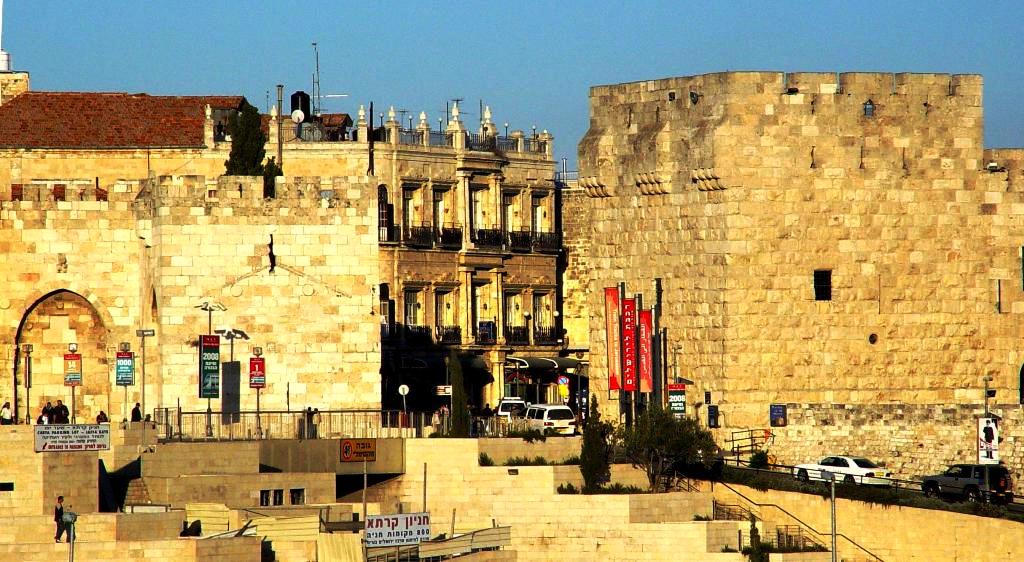
The Jaffa Gate is located on the western side of Jerusalem, thusly named because of its leading out to Joppa to the west.

Jaffa Gate, located on Jerusalem's Western Wall. Photo by Leon Mauldin.

The Jaffa Gate is located on your left in this photo. Crystallinks.com states

This gate is the principal entrance to the Old City. Its name in Arabic is Bab-el-Khalil, the gate of Hebron, as the main road to Hebron started here. It was also called Jaffa Gate because the road to the port city of Jaffa (Joppa) – the coast also started from it. This gate is the only one on the western side of the Old City. A low part of the city wall was torn down and the Crusader moat of the Citadel filled in 1898 for the visit of the German Kaiser Wilhelm II. This gate was also the famous scene of the English General Allenby’s entrance in 1917.

You can see some of our previous posts for a map showing Jerusalem’s gates to help with orientation.

Click on image for higher resolution.