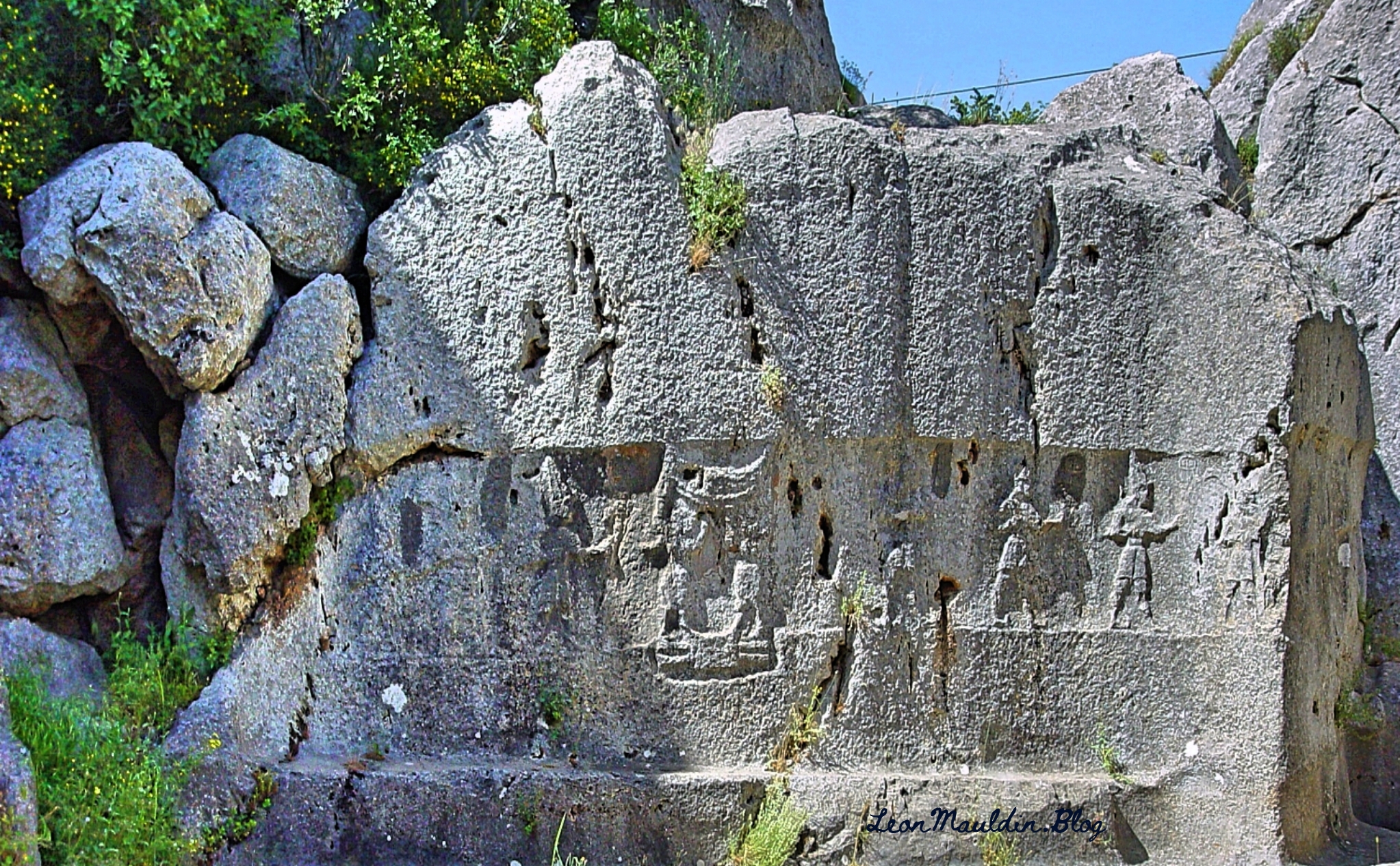
Yazılıkaya is an open-air rock sanctuary located about 1 mile NE of the Great Temple of Hattuşa, in the heart of Hittite country (New Kingdom). It consists of two chambers (A and B) formed inside a group of rock outcrops.
Hittite King Tudhaliya IV reigned 1245-1215 BC (Middle Chronology), or 1237-1209 BC (Short Chronology).
Trevor Bryce writes:
This renovation of the city was the inspiration of King Hattusili III (c. 1267–1237 B.C.), though his son and successor, Tudhaliya IV (c. 1237–1209 B.C.), did most of the work. Not only did Tudhaliya substantially renovate the acropolis; he more than doubled the city’s size, developing a new area lying south of and rising above the old city. In the new “Upper City,” a great temple complex arose. Hattusa could now boast at least 31 temples within its walls, many built during Tudhaliya’s reign. Though individually dwarfed by the enormous Temple of the Storm God in the “Lower City,” the new temples left no doubt about Hattusa’s grandeur, impressing upon all who visited the capital that it was the religious as well as the political and administrative heart of the Hittite empire.
Tudhaliya also constructed massive new fortifications. The main casemate wall was built upon an earthen rampart to a height of 35 feet, punctuated by towers at 70-foot intervals along its entire length. The wall twice crossed a deep gorge to enclose the Lower City, the Upper City and an area to the northeast; this was surely one of the most impressive engineering achievements of the Late Bronze Age. (https://library.biblicalarchaeology.org/article/the-last-days-of-hattusa/)
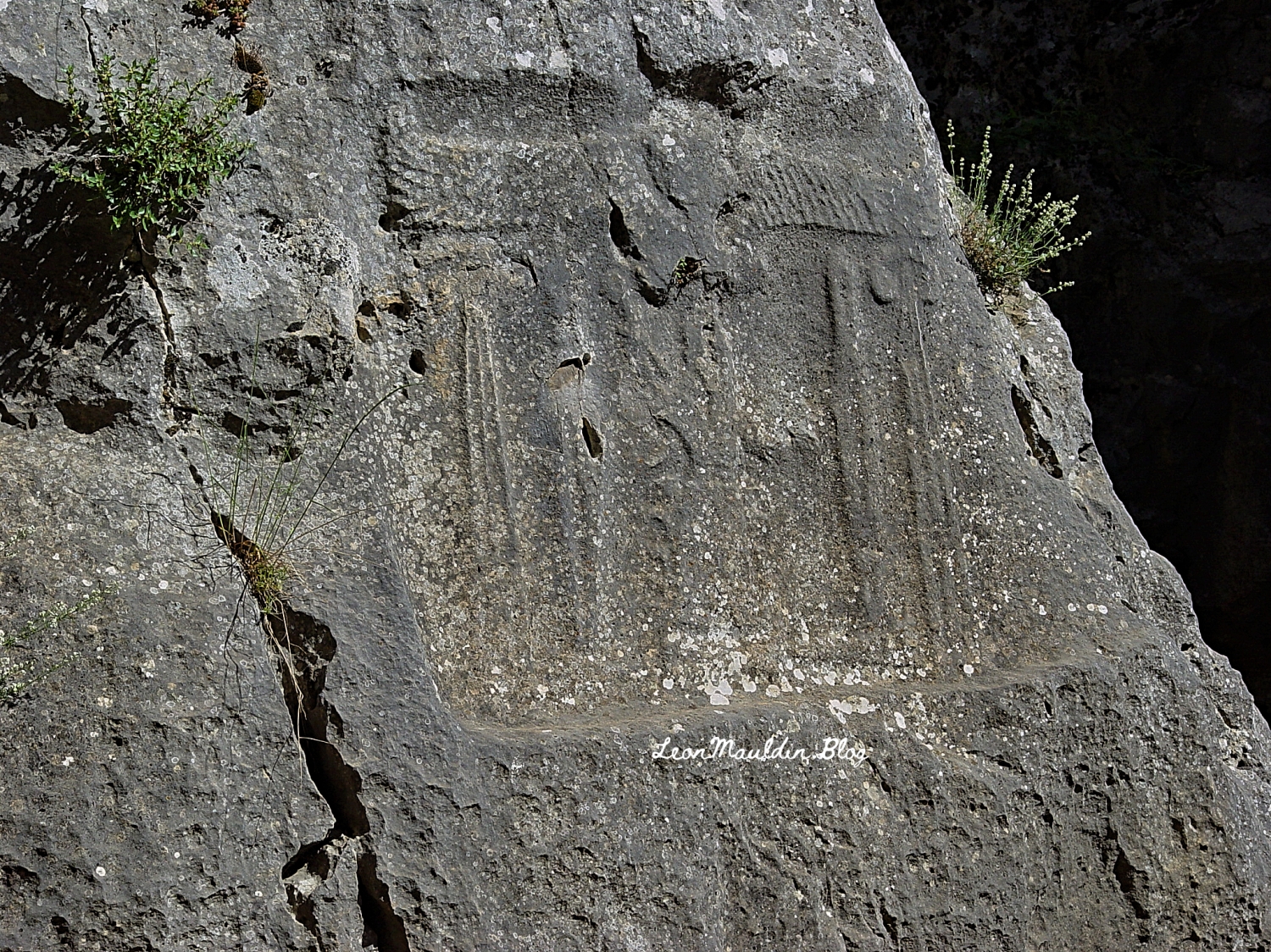
Here inscribed on the rock wall at Yazılıkaya is the cartouch of Great King Tudhaliya IV:
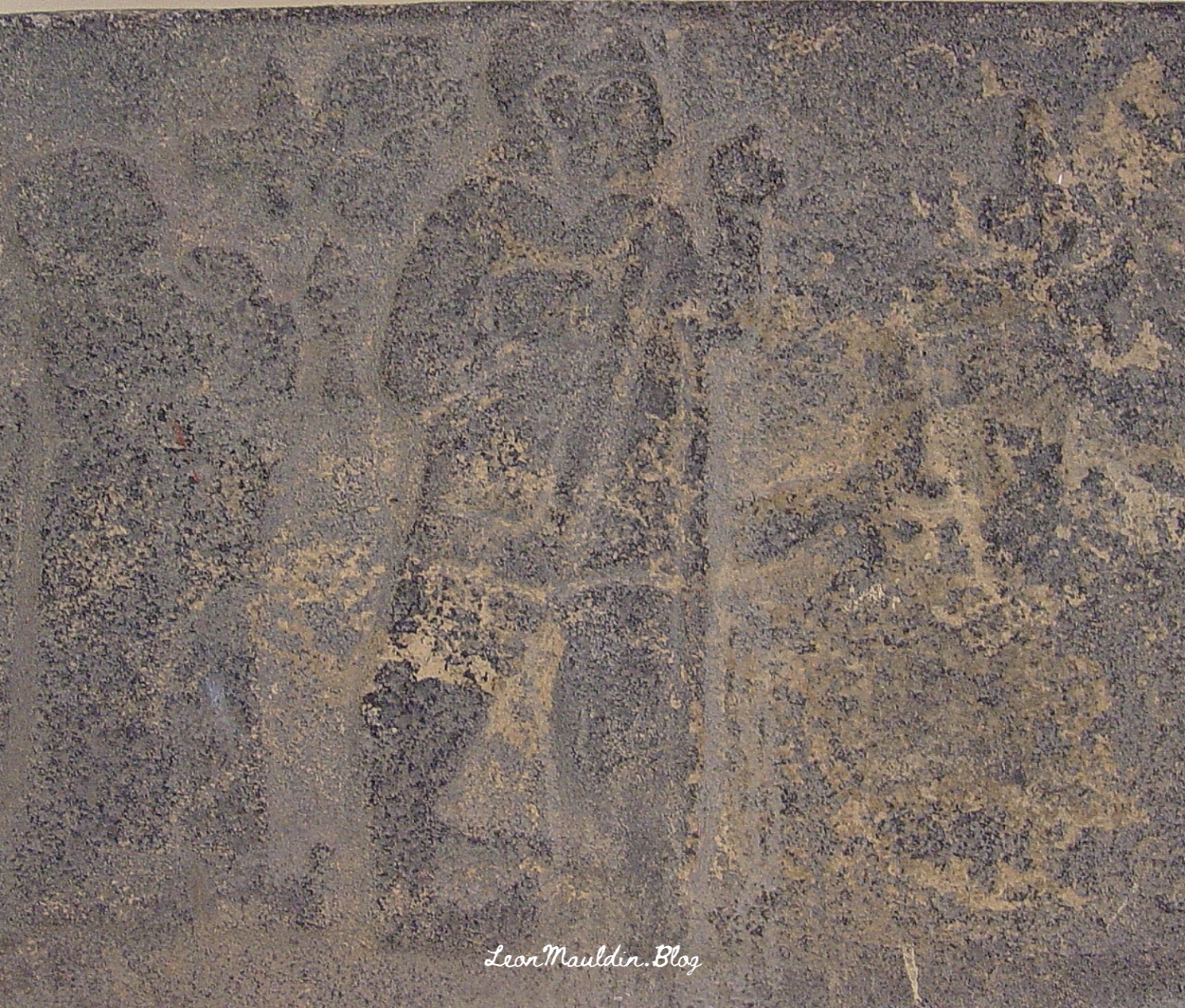
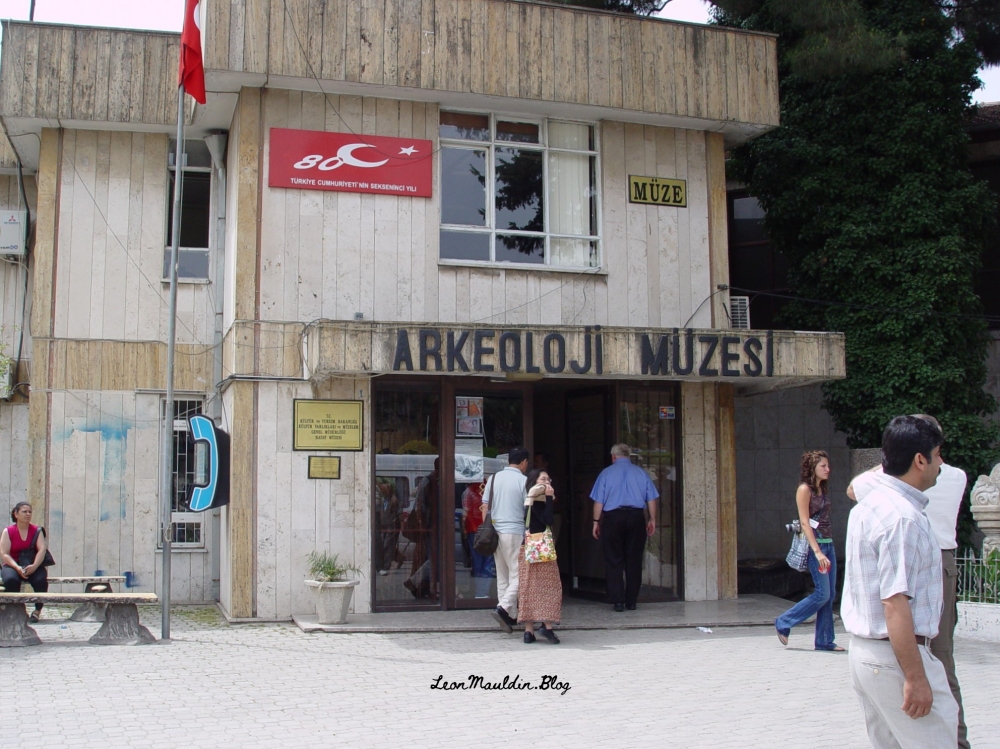
In 2007 I photographed this relief of Tudhaliya IV (dated to 13th century BC), at the Archaeological Museum in Antakya. Antakya is in Turkey, but in New Testament times was Antioch of Syria (Acts 11:20, etc.).
In doing some study in the prophet Malachi this morning I came across one of the many biblical references to Esau (from whom descended the Edomites). Malachi 1:2-3 illustrates the necessity of contextual biblical study: “Jacob I have loved, But Esau I have hated.” In short, this had nothing to do with the salvation of individual Edomites, or God’s personal like or dislike of Jacob or Esau, but rather underscores God’s sovereignty in choosing to provide salvation in that descendant of Jacob, Jesus the Christ.
The territory occupied by Edom included Petra. By Roman Times the Edomites had been displaced by a people known as the Nabateans. Petra was the capital of the Roman Province of Arabia.
One of the many interesting archaeological finds at Petra is the High Place, including the altar for sacrifice. The photo here was taken in 2019 by tour member David Deason.
High Place at Petra. Altar at center (and slight right). Photo by David Deason.
The High Place at Petra is one of the best preserved of all such sacred installations in the ancient Near East. Its location is imposing, approximately 3,400 feet above sea level and 625 feet above the temenos. The altar platform was approached by three steps. It is situated about 3 feet above the level of an adjoining courtyard area and is equipped with drains and basins for sacrifices and ablutions.
The Biblical World in Pictures; BAS Biblical World in Pictures. (2003). Biblical Archaeology Society.
Sardis is the fifth of the seven churches addressed by Jesus through the Apostle John, while John was on the Island of Patmos. In summary, Jesus’ assessment of the church there was, “I know your works, that you have a name that you are alive, but you are dead” (Rev. 3:2).
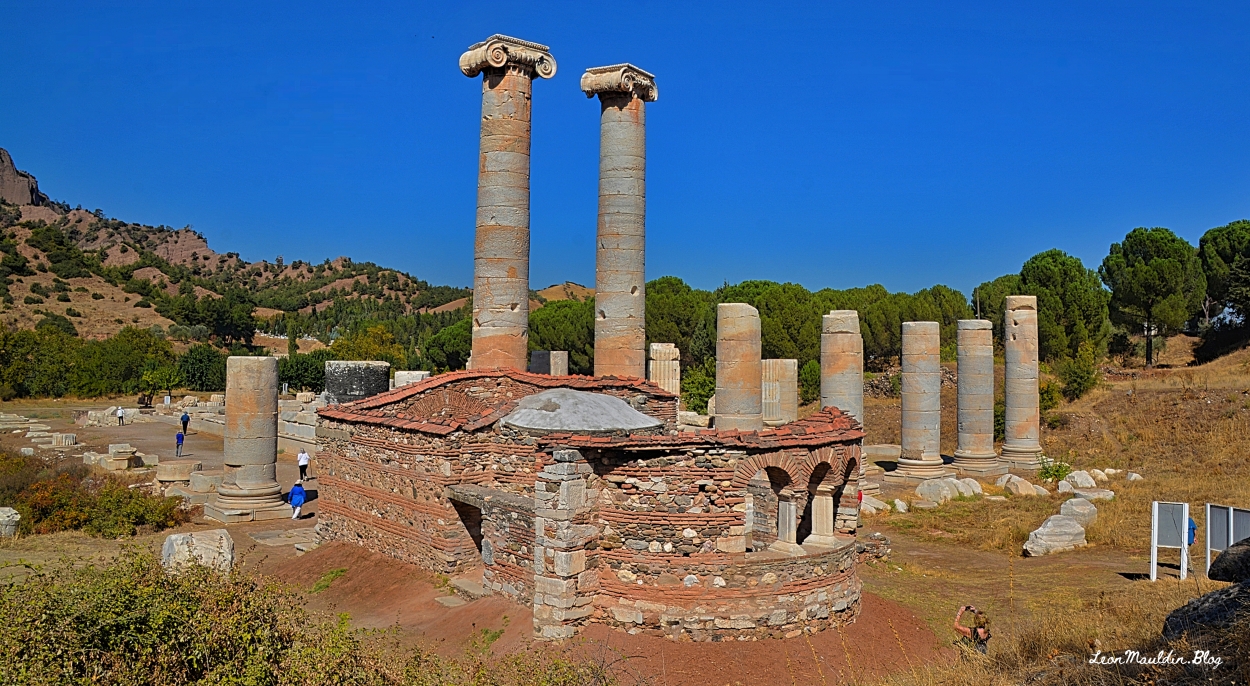
Archaeologists have uncovered and identified many structures and other items of interest at Sardis, including a Byzantine chapel in the southeast corner of the temple of Artemis.
Dr. Mark Wilson writes, “The inner western chapel dates to the 4C [4th century AD] and is one of the earliest preserved churches in western Asia Minor; the larger, outer apse dates to the 6C” (Biblical Turkey, A Guide to the cJewish and Christain sites of Asia Minor, p. 291).
The temple of Artemis, whose partial ruins are in view here, would have been in use when those Christians of the 1st century AD at Sardis received the letter (Rev. 3:1-6). It’s hard to overemphasize how pervasive idolatry was in the biblical world!
We have previously posted several articles on Sardis: click hereherehere and here.
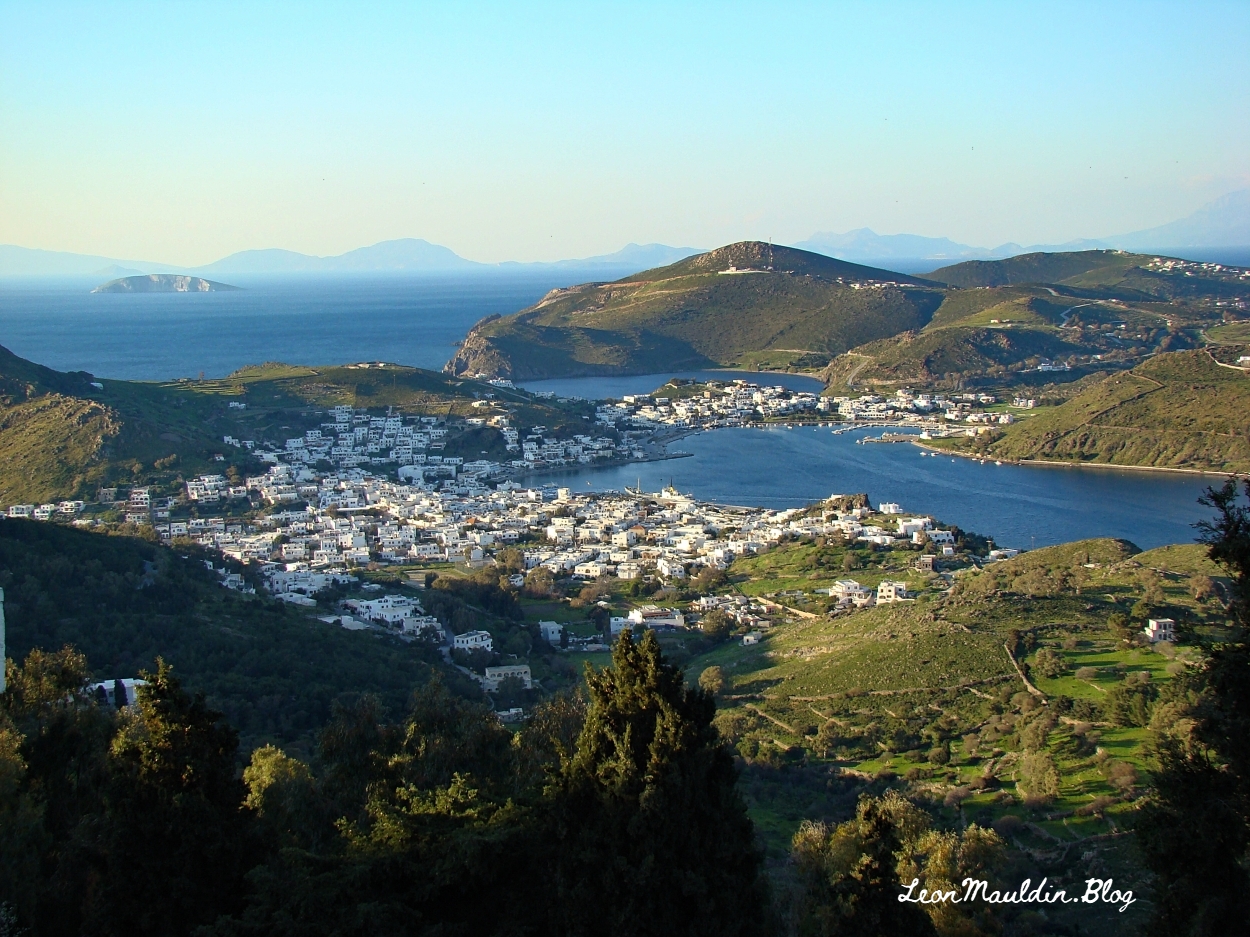
In our local congregation we are continuing to explore the Seven Churches of Asia, of Revelation 2-3. John the Apostle received the Revelation on the Island of Patmos.
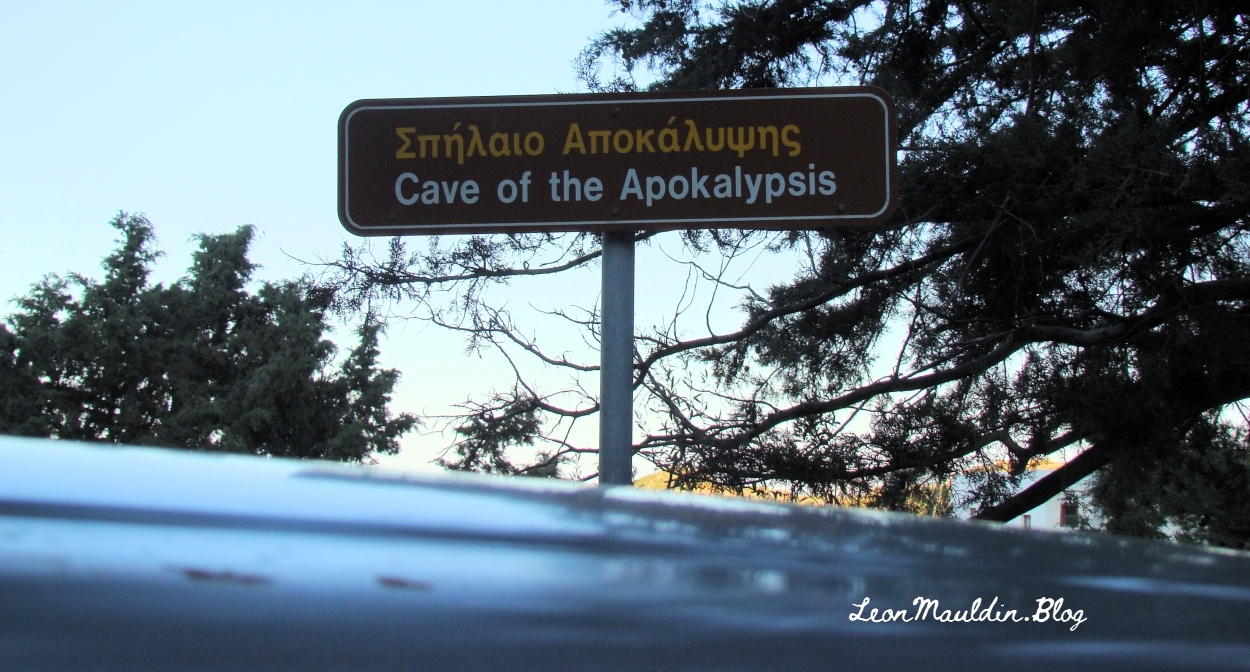
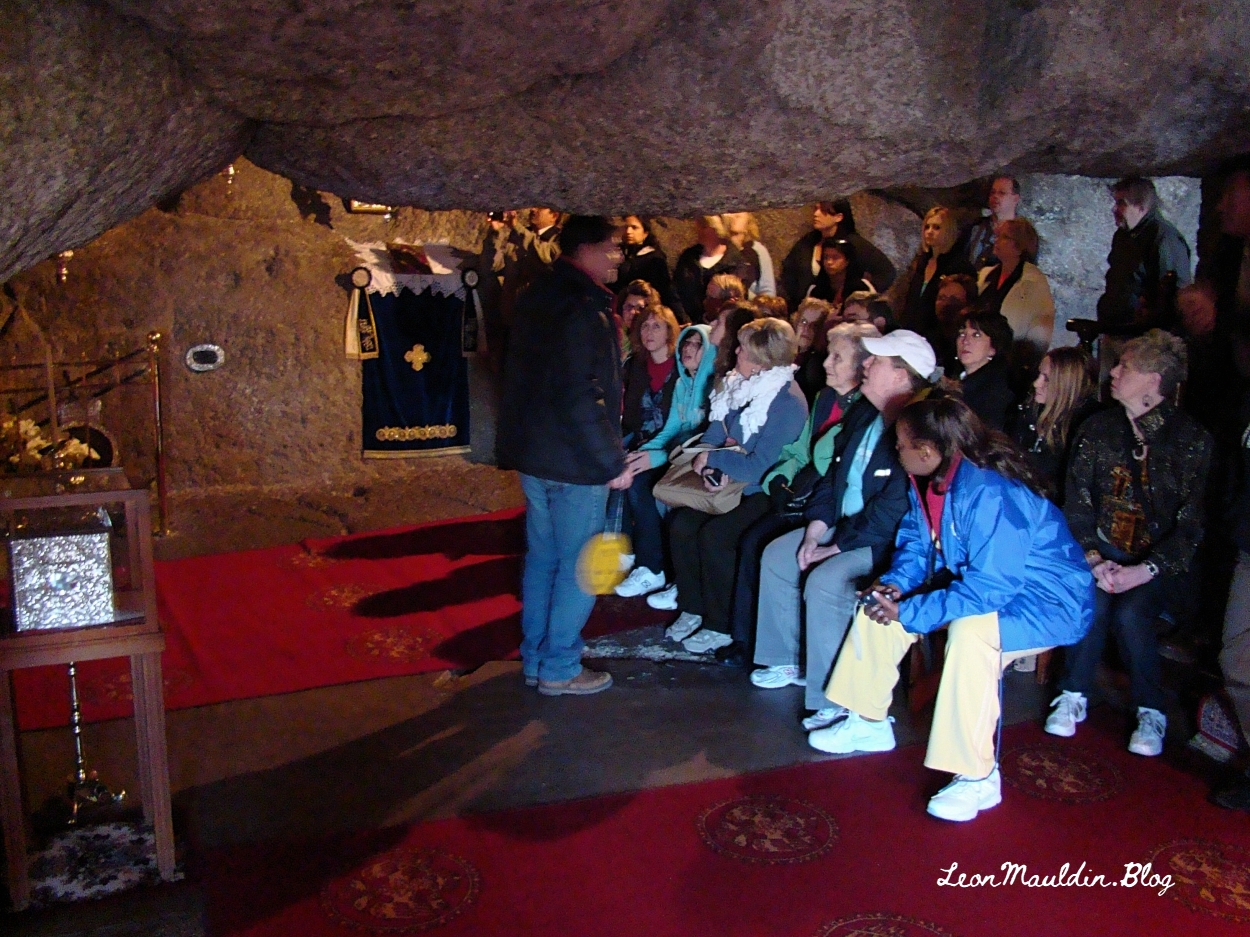
While we cannot know the exact spot on the island where John was when he was “in the Spirit on the Lord’s Day” and told, “What you see, write in a book and send it to the seven churches which are in Asia” (Rev. 1:10-11), visitors to Patmos are shown a “traditional” location, known as the “Cave of the Apocalypse.”
The church at Pergamum lived “where Satan’s throne is . . . where Satan dwells (Rev. 2:13). There have been many suggestions as to the basis of this designation. Pergamum was known for its worship of Asklepios (god of healing), Serapis, Athena, Dionysus, Demeter, as well as being a center for the Imperial Cult (emperor worship).
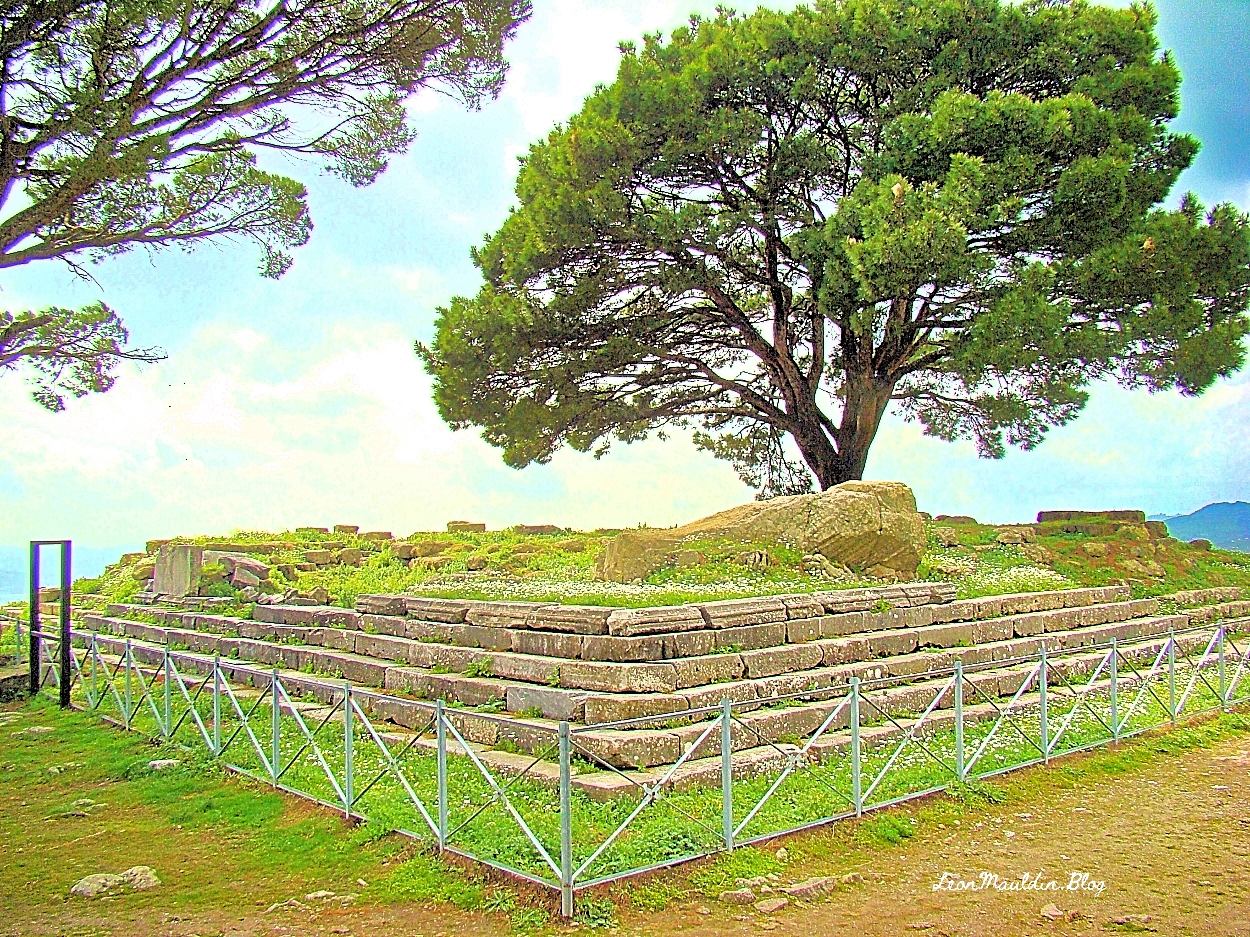
David A. DeSilva suggests: “[T]he distinctive altar of Zeus on the brow of the acropolis may have been more in John’s view” (The Social and Geographical World of Pergamum (Revelation 1:11; 2:12–17). In B. J. Beitzel, J. Parks, & D. Mangum (Eds.), Lexham Geographic Commentary on Acts through Revelation (p. 638). Lexham Press).
The altar of Zeus, located on the southern crest of the acropolis, was without a doubt the most distinctive and most prominently visible structure overlooking Pergamum. Construction was begun in the early- to mid-second century BC under Eumenes II, possibly in connection with his victory over the invading Galatians. The massive throne-like altar complex resembled an open-air temple, complete with columned porticoes surrounding its staircase and inner courtyards. The whole had a footprint of about 120 by 110 feet (36.5 × 33.5 m), and it rose to a height of 40 feet (12 m). The sacrificial altar proper sat within the inner courtyard, which was approached by a wide, grand staircase. The reconstructed monument now sits in the Pergamum Museum in Berlin. The altar was adorned with nearly four hundred linear feet (122 m) of frieze, its scenes carved about seven feet (2 m) high. The frieze around the structure’s perimeter depicted the mythological battle between the Olympian gods and the giants, with Zeus and Athena prominently featured on the front side. An interior frieze told the story of Telephus, the mythic founder of Pergamum. An L-shaped agora or forum was set just below the precincts of the altar of Zeus. The identification of some of the buildings as warehouses makes it likely that this particular forum served as a commercial center in the old city.
deSilva, D. A. (2019). The Social and Geographical World of Pergamum (Revelation 1:11; 2:12–17). In B. J. Beitzel, J. Parks, & D. Mangum (Eds.), Lexham Geographic Commentary on Acts through Revelation (pp. 645–646). Lexham Press.
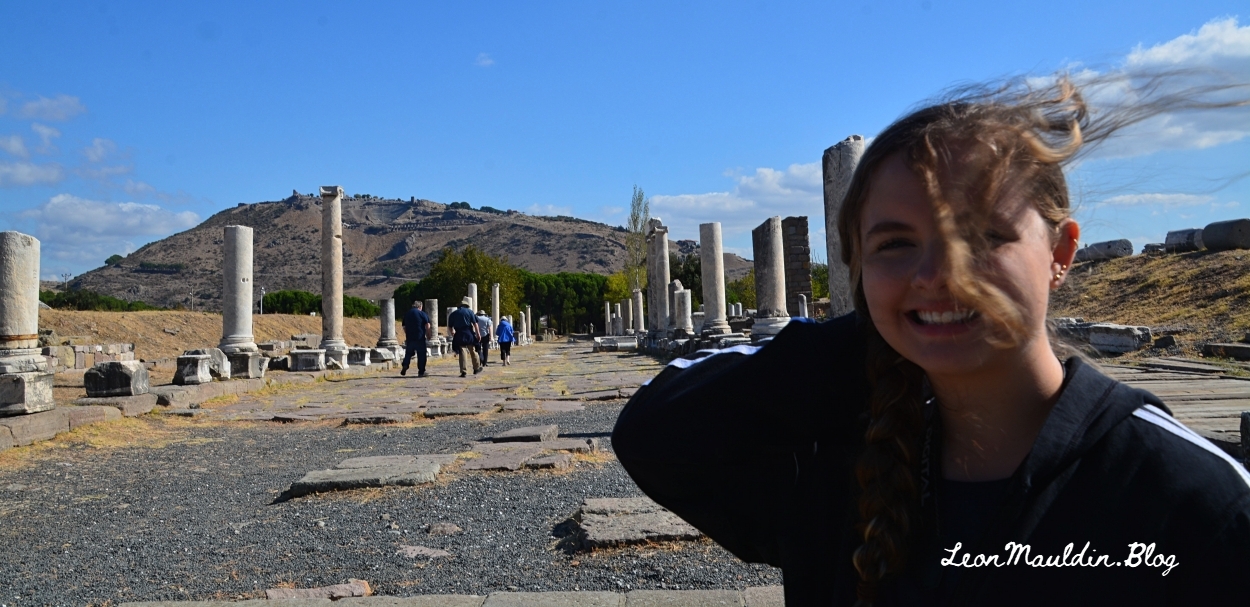
Here is a photo of the acropolis of Pergamum, with the Asklepion at our back. Sometimes it gets windy on our tours (as my granddaughter can attest).
Our preaching theme for January in our local congregation is a study of the Seven Churches of Asia (Rev. 2-3). I’m looking forward to this study. Ephesus is the first of the cities addressed (Rev. 2:1-7).
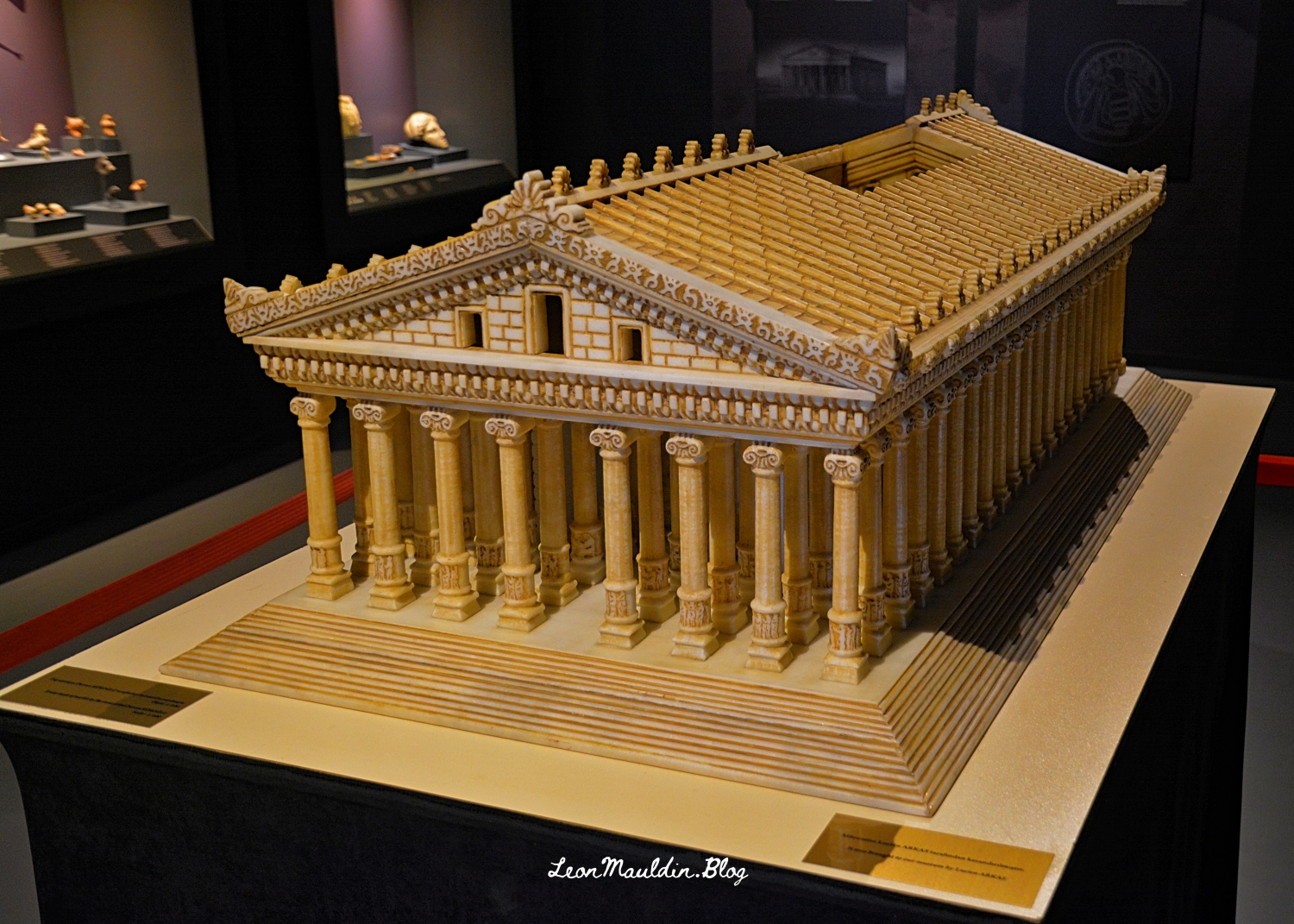
It is helpful to understand somewhat of the local conditions in which these 1st Century Christians lived. Ephesus was the city which featured the temple to the goddess Artemis (Diana), which at that time was one of the Seven Wonders of the World.
Here is a model of the temple which is housed in the museum at Ephesus:
A helpful resource, Chronicles of the Land: Archaeology in the Israel Museum Jerusalem, regarding the above artifact, simply notes, “Head of a statue depicting an Ammonite deity, late 8th century BCE” (p. 87). That date would fit in the bibilcal period of the Divided Kingdom, or perhaps Judah Alone (Israel fell in 722 BC).
The inside BAR article notes,
Ancient inscriptions tell us that the people of Ammon called themselves the bene ammon (“children of Ammon”), a designation also found in the Book of Kings (1 Kings 11:7,33). The Ammonites had their own language and script, which developed from Proto-Canaanite and was closely related to Phoenician, Hebrew, and Moabite. They worshiped their own chief deity, Milkom [spelled “Milcom” in most translations], who is mentioned in both Ammonite inscriptions and the Bible (e.g., 1 Kings 11:5,33).
(BAR/Winter 2023, p. 50).
The Ammonites had their origin in Lot, the nephew of Abraham. The sad story is told in Genesis 19:30-38. In time to come, during the biblical period of the Judges, Israel worshiped “the gods of the people of Ammon”, among other gods (Judges 10:6). Later during the days of the United Kingdom, Saul fought (successfully) against the Ammonites (1 Samual 14:47). They were also subdued under King David (2 Samuel 8:11-12). Unfortunately, Israel’s forces were besieging Rabbah, Ammon’s capital, when David “tarried in Jerusalem” and committed adultery with Bathsheba (2 Samuel 11:1-5). Another sad event: “Furthermore, on the hill east of Jerusalem Solomon built a high place for the detestable Moabite god Chemosh and for the detestable Ammonite god Milcom” (1 Kings 11:7, NET Bible).
Our map here below shows the location of Ammon.
Location of Ammon, beyond the Jordan. Map by BibleMapper.com.
When Moses was still atop Mt. Sinai, receiving the Ten Commandments, the nation of Israel grew impatient and said to Aaron, “Come, make us a god who will go before us; as for this Moses, the man who brought us up from the land of Egypt, we do not know what has become of him” (Ex. 32:1). Accordingly, Aaron fashioned a golden molten calf; and they said, “This is your god, O Israel, who brought you up from the land of Egypt” (Ex. 32:4). In the New Testament, Stephen would explain that in their hearts Israel turned back to Egypt (Acts 7:39).
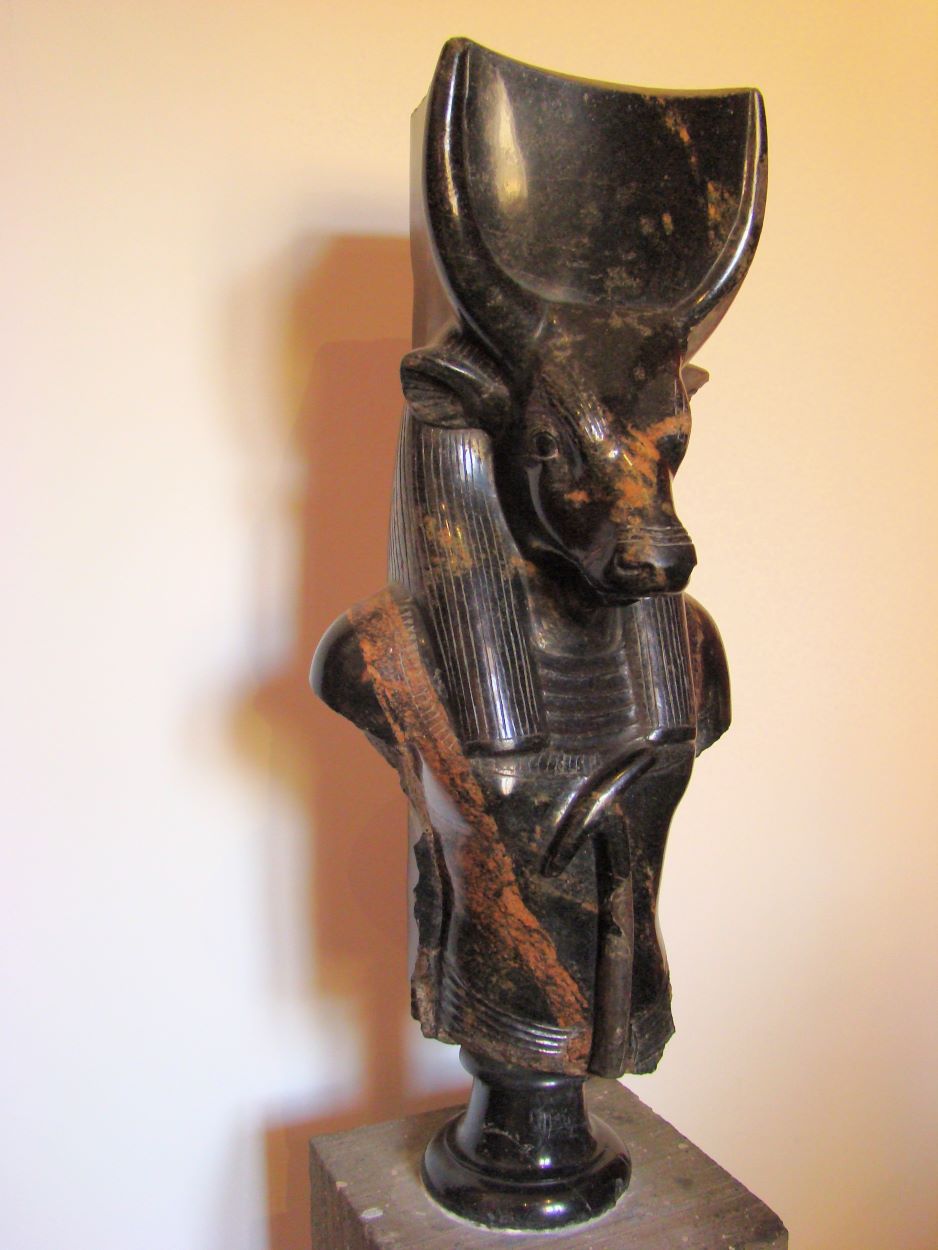
Egyptian mythology presents the Apis bull as the incarnation of the Egyptian creator god Ptah, or the son of Hathor, the primeval goddess. Cattle represented other significant Egyptian gods.
Here is an informative article by M. Froelich, from the Lexham Bible Dictionary:
APIS (חַף, chaph; Ἄπις, Apis). Egyptian bull god of agriculture and fertility. Apis came to be associated with Ptah, chief god of Memphis, and was embodied as a live, sacred bull in the temple there.
Biblical Relevance Although Apis does not appear in the Hebrew text of the Old Testament, the Septuagint text of Jeremiah includes him in a prophecy against Egypt. The text reflects the common understanding that cities and peoples were protected by patron gods, whose withdrawal or weakness could spell doom (e.g., Ezek 8–11; Matt 23:38–39; Homer, Iliad, 22.350–59). In this case, the king of Babylon is able to defeat Egypt because “Apis, your chosen calf,” has fled after being weakened by the Lord (Jer 26:13–15 LES). The Septuagint text does not offer specifics about the Apis cult, but it indicates that he was considered a patron or protector of Memphis, which is named in Jer 26:14 (LXX). The corresponding text in the Hebrew Bible (and in English translations) is Jer 46:13–15. Although this version mentions Memphis (Jer 46:14), it generally refers to “bulls” instead of naming Apis. Bull worship was common in the ancient world and appears in the Old Testament. Gods such as Baal, Zeus, El, and others appear with bull imagery in mythology and in worship. The incident of the golden calf in Exod 32 is an example of Semitic bull worship. Calf worship also is mentioned in 1 Kgs 12:25–33, in which Jeroboam returns from Egypt and sets up calf statues in the northern kingdom.
Mythology and History Apis is the bull god of the Egyptian pantheon. According to religious belief, Apis was the son of Ptah, who impregnated the mother cow via lightning bolts or moonbeams. In some myths, Apis was the son of Hathor, a heifer goddess often depicted with the sun disk between her horns; the same symbol often appears in visual representations of Apis (see Malaise, “Histoire et signification”). Apis’ most important temple was in Memphis and dates at least as far back as Egypt’s New Kingdom (16th–11th centuries BC), though the god himself goes back to the earliest periods of Egyptian history. Apis was broadly popular, and his worship lasted at least into the late Ptolemaic period; the latest bull found buried in his temple in Memphis dates to the late second or early first century BC. In Memphis and possibly elsewhere, the worship of Serapis seems to have taken over by the Graeco-Roman era. Like many important ancient deities, Apis was associated with the king and his powers. Because the most important of these powers was the fertility of the land, worship of Apis inspired festival traditions such as the trampling of a farm plot (Meeks and Favard-Meeks, Daily Life, 137). Plutarch states that the Egyptians revered the Apis bull “being the image of the soul of Osiris” (Plutarch, De Iside et Osire, 20). This association between Apis and Osiris was part of the process that eventually led to their assimilation in Serapis.
Cult and Worship One of the main features of the Apis cult was the worship of the bull at the Memphis temple. The bull was believed to be the god himself. He would be selected as a calf, whose distinctive markings had to include a white triangle on the forehead and a wing pattern across the back. During his journey to Memphis, young women would gather to lift their skirts before him in order to guarantee their fertility. The animal (and often its mother) lived in luxury at the temple. Some ancient sources claim that he had a harem of cows; others emphasize that Apis had no offspring and “that a cow was selected and presented to Apis once a year, and then put to death so that no offspring would come of the match” (Meeks and Favard-Meeks, Daily Life, 137). The bull’s death would bring elaborate funeral rites and preparation, including the mummification and burial of the animal in a nearby cemetery. Then the search for a new Apis would begin. A stele, possibly of the late Ptolemaic or early Roman period, depicts the Apis bull on a funeral vessel, being mourned by Isis and Nephthys. Although the piece was not found in situ, it most likely is from the nearby Saqqara Serapeum and represents the funeral procession for the Apis bull (Farag, “Two Serapeum Stelae,” 165–66).
Froelich, M. (2016). Apis. In J. D. Barry, D. Bomar, D. R. Brown, R. Klippenstein, D. Mangum, C. Sinclair Wolcott, L. Wentz, E. Ritzema, & W. Widder (Eds.), The Lexham Bible Dictionary. Lexham Press.
It would seem reasonable then, that when Israel worshipped the golden calf at Sinai, they rejected the true God in favor of the idols they knew. Later, when the kingdom divided, Jeroboam, first king of the northern kingdom of Israel, installed golden calves at Dan and Bethel, and called on Israel to worship. He said, “It is too much for you to go up to Jerusalem; behold your god, O Israel, that brought you up from the land of Egypt” (1 Kings 12:28).
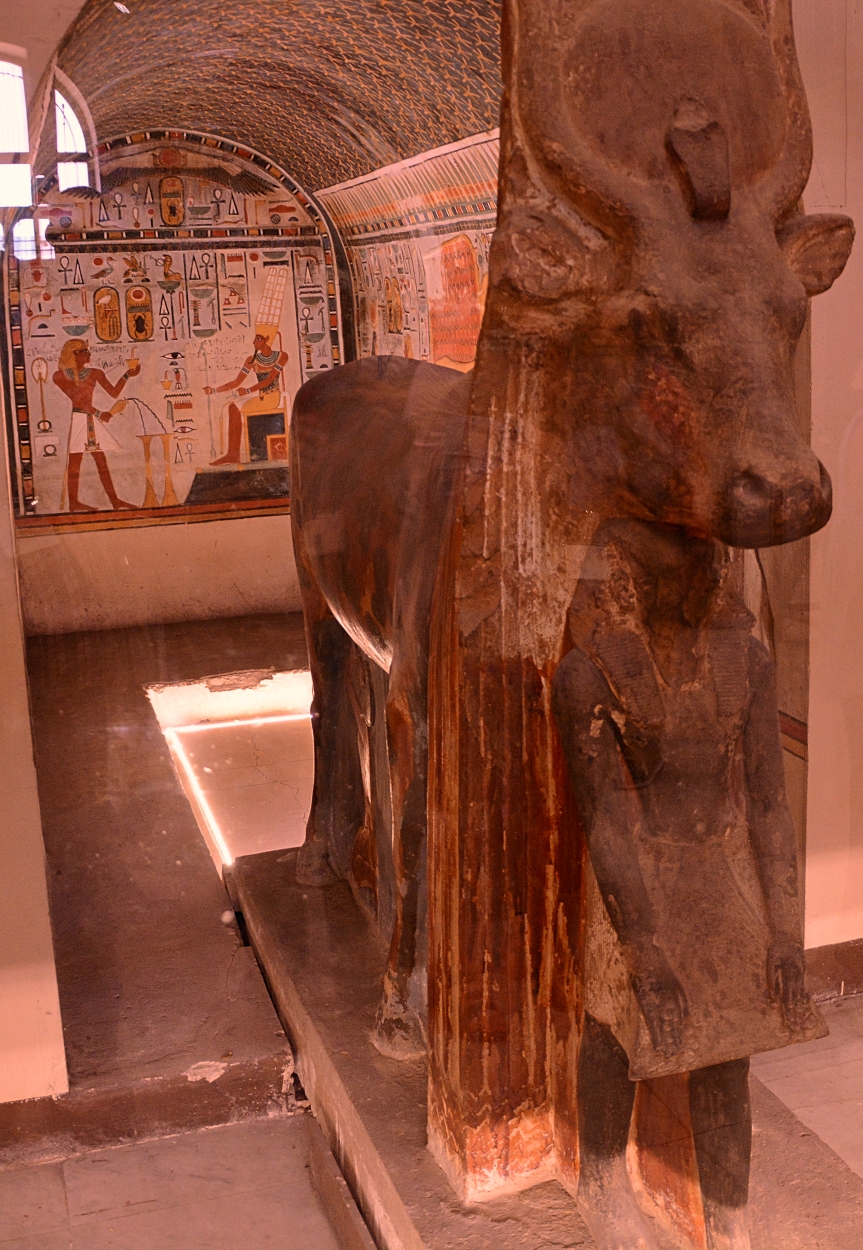
As we continue to explore some of the displays in the Egyptian Museum in Cairo, we look at the shrine dedicated by Tutmosis III to the goddess Hathor at Deir-el-Bahari.
The goddess Hathor appears here in the form of a cow. This was excavated between the temples of Mentuhotep and Hatshepsut by E. Naville, of the Egypt Exploration Fund, 1906, and dates to the 18th dynasty (New Kingdom), at the end of the reign of Tutmosis III (c. 1504-1450) and the beginning of the reign of Amenophis II (c. 1453-1409).
The painting in the back shows Tutmosis III (left) pouring a libation and burning incense to Amon-Re, seated (at right). The dark blue vaulted ceiling depicts the stars of heaven.
The cult of the Sacred Cow was long associated with Hathor, the goddess of the Theban necropolis. Hatshepsut dedicated her sanctuary to the goddess. Prior to its excavation, earthquakes had buried the entrance to the chapel of the Sacred Cow.
The statue of the sacred cow in our photo bears the name of Tutmosis’s successor, Amenophis II. He is here depicted as crouching beneath the head of the sculpture. Hathor is surrounded by papyrus stems. She wears the Hathoric horns with the sun disk and a uraeus serpent on her forehead.
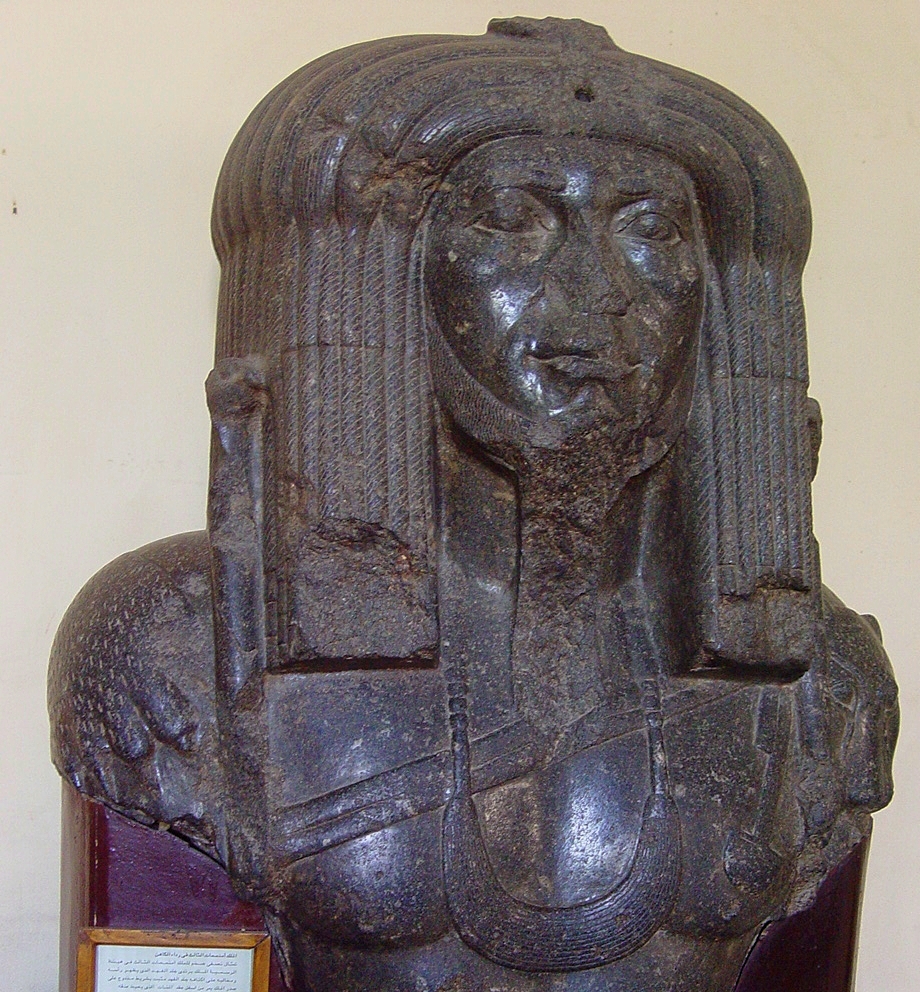
In our previous post we featured the Sphinx of Amenemhat III (ca. 1859-1813), who ruled during the time of the biblical patriarchs. This unique colossal bust of Amenemhat III was found on the site of the ancient capital of The Fayum, Shedet (the Crocodilopolis of the Greeks). The Pharaoh is dressed in a panther skin, with its head and paws lying on the king’s shoulders. A double band across his chest passes under the menat collar worn about his neck. The upper portion of two scepters terminating in falcon heads are visible on each side of his head.
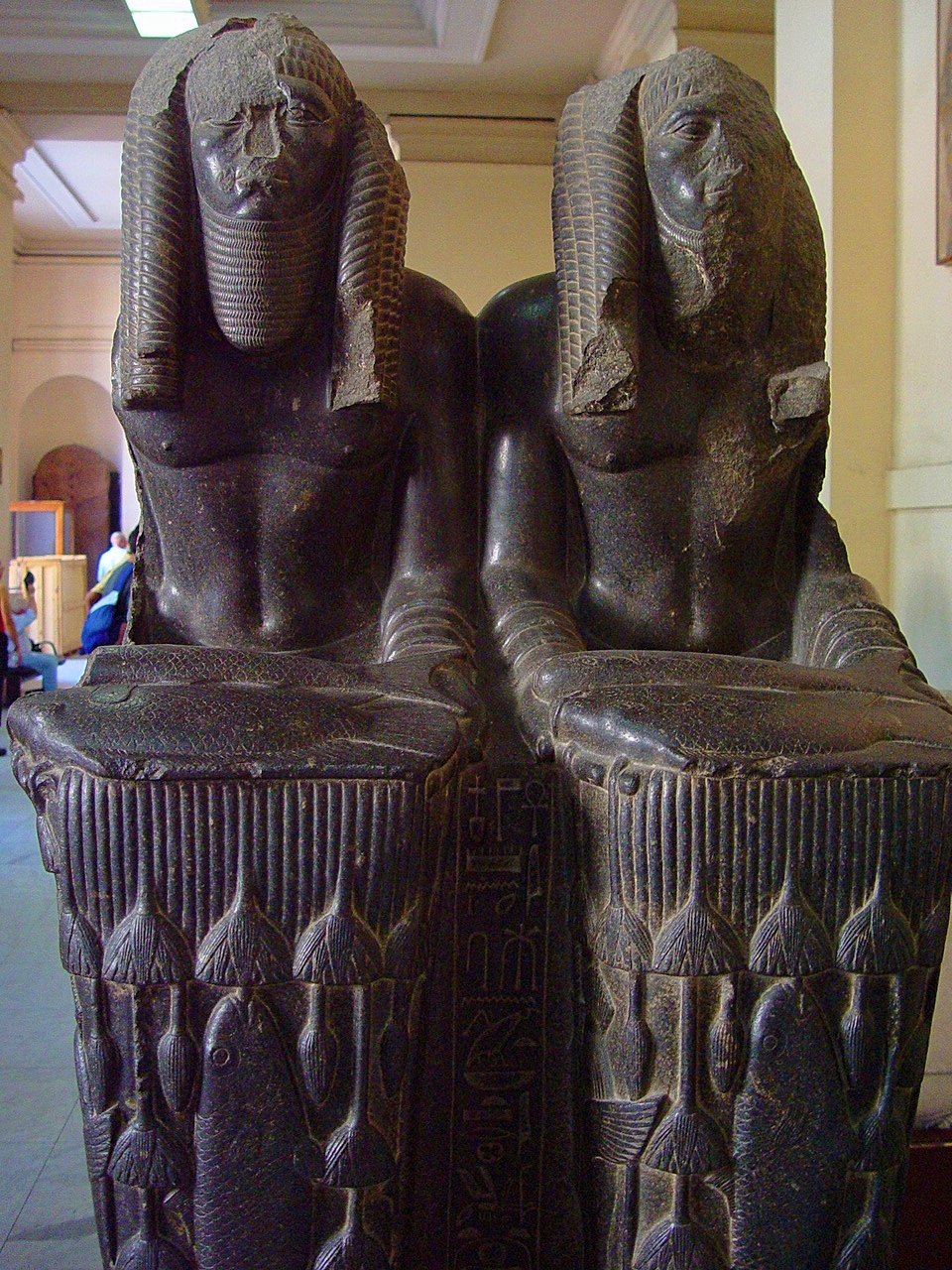
In this double statue, Amenemhat III is represented as the Nile god bearing all the nourishment indispensable to life. One explanation of the doubling of the king is that the two figures represent him as ruler of both Upper and Lower Egypt. Others suggest that one image depicts the reigning king and the other his deified counterpart.
During his long reign, Amenemhet III had almost continual turquoise mining expeditions in the Sinai. More than fifty rock inscriptions have been found there referencing this. He was the last great ruler of the Middle Kingdom.
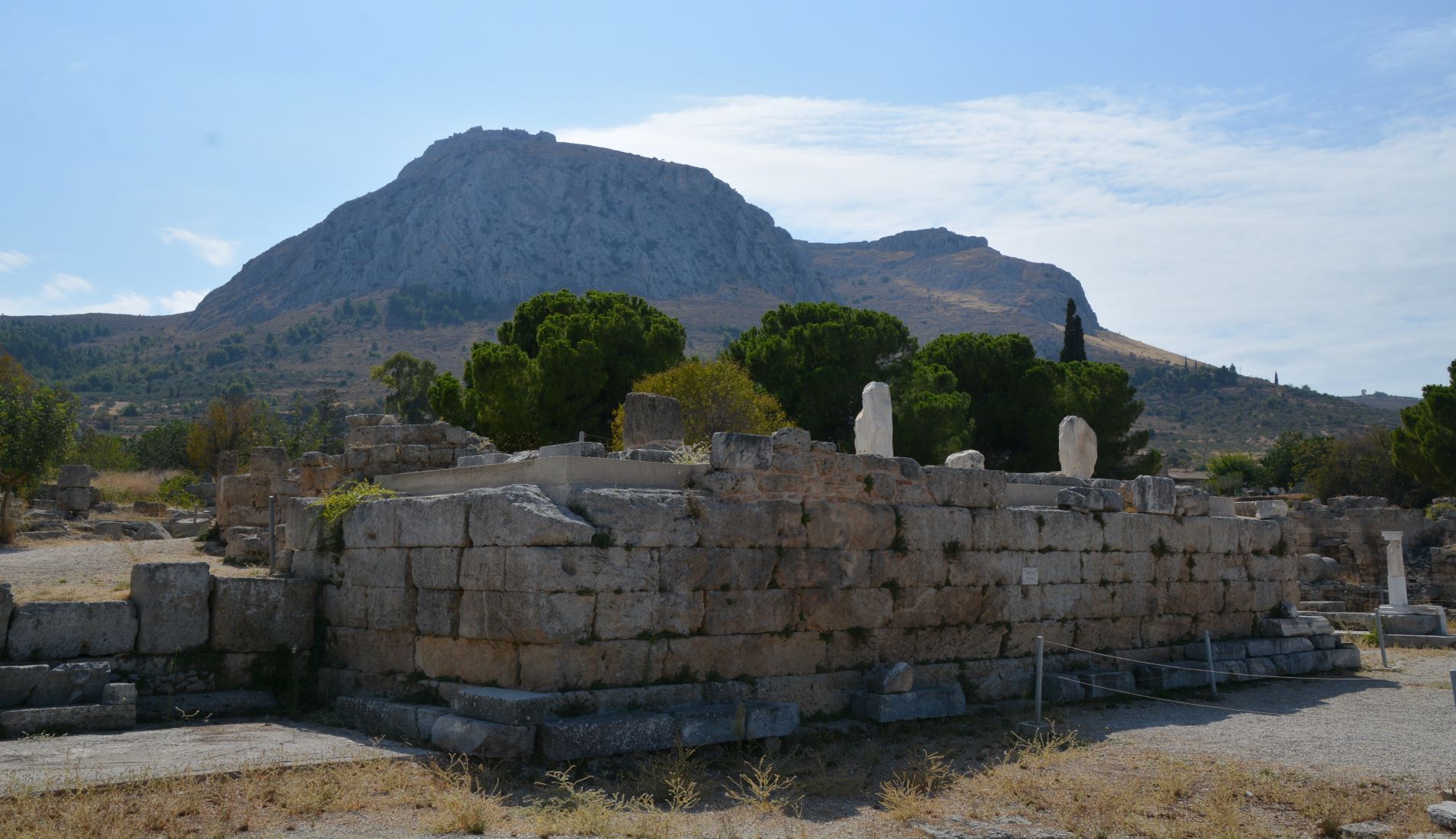
Among the sites our group was able to visit in Corinth was the bema, the judgment seat, mentioned in Acts 18:12-17:
When Gallio was proconsul of Achaia, the Jews with one accord rose up against Paul and brought him to the judgment seat, 13 saying, “This fellow persuades men to worship God contrary to the law.” 14 And when Paul was about to open his mouth, Gallio said to the Jews, “If it were a matter of wrongdoing or wicked crimes, O Jews, there would be reason why I should bear with you. 15 “But if it is a question of words and names and your own law, look to it yourselves; for I do not want to be a judge of such matters.” 16 And he drove them from the judgment seat. 17 Then all the Greeks took Sosthenes, the ruler of the synagogue, and beat him before the judgment seat. But Gallio took no notice of these things.
The Bema, Judgment Seat of Galillo at Corinth where charges against Paul were dismissed. Acrocorinth is in background. Photo by Leon Mauldin.
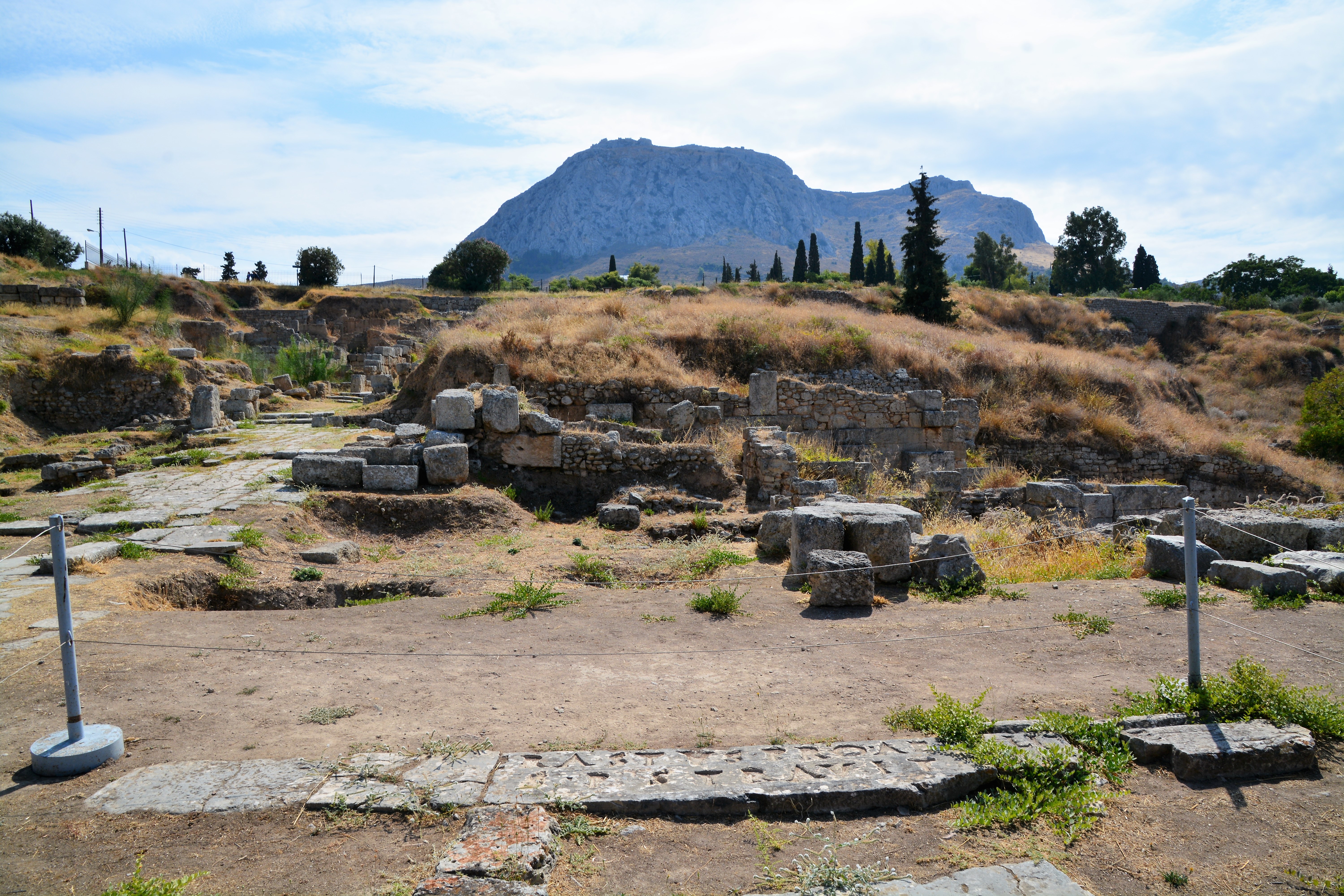
We also saw the Erastus inscription:
Erastus Inscription in foreground. Many identify this Erastus with Paul’s host at Corinth mentioned in Romans 16:23. Photo by Leon Mauldin.
Paul wrote the New Testament letter of Romans from Corinth, 3rd Missionary Journey. In Romans 16:23 we read, “Gaius, my host and the host of the whole church, greets you. Erastus, the treasurer of the city, greets you, and Quartus, a brother.”
In 1929 an inscription was discovered at Corinth naming an Erastus as the one who paid for the paving of the street. The inscription reads “ERASTVS. PRO. AED. S. P. STRAVIT” which is translated, “Erastus in return for his aedilelship laid [the pavement] at his own expense.” It would seem that the Erastus of the inscription is the same as the one mentioned in the biblical text.
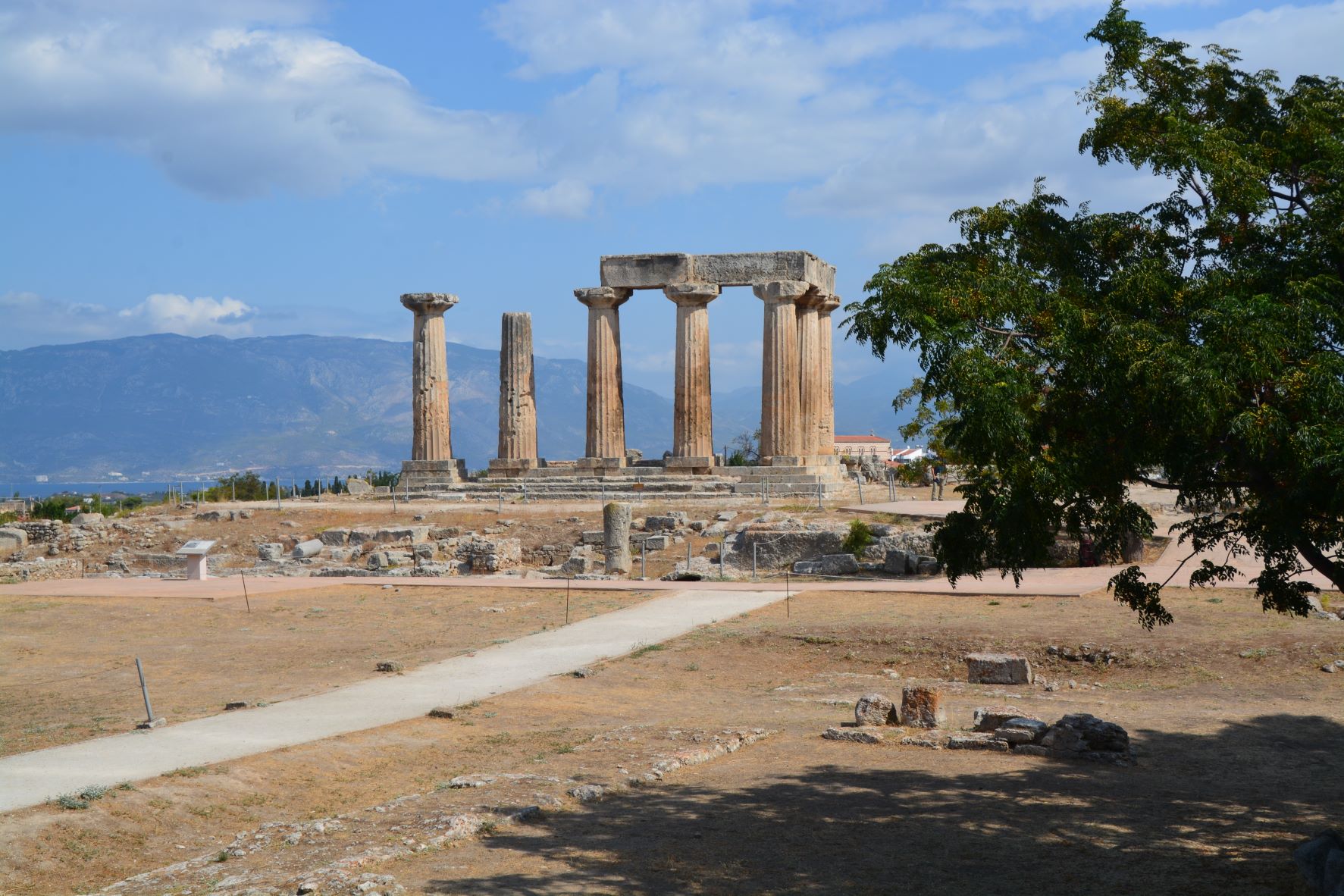
We also saw the famous ruins of the temple of Apollo.
Temple of Apollo at Corinth. Photo by Leon Mauldin
Regarding this site BAS says,
The Temple of Apollo at Corinth was 700 years old by Paul’s time. On the hill directly overlooking the Roman city’s main forum, its sturdy Doric columns served as a dramatic reminder of Corinth’s ancient grandeur. But the temple was already in ruins; to Paul it would have served merely as a sermon illustration of the impotence of the Greeks’ “pagan” gods.
As noted above, the temple was in ruins in the days of Paul, but the centuries of pagan idolatrous influence was still very much there.
The Apollo temple originally had 38 columns of the Doric order. Today seven are standing.
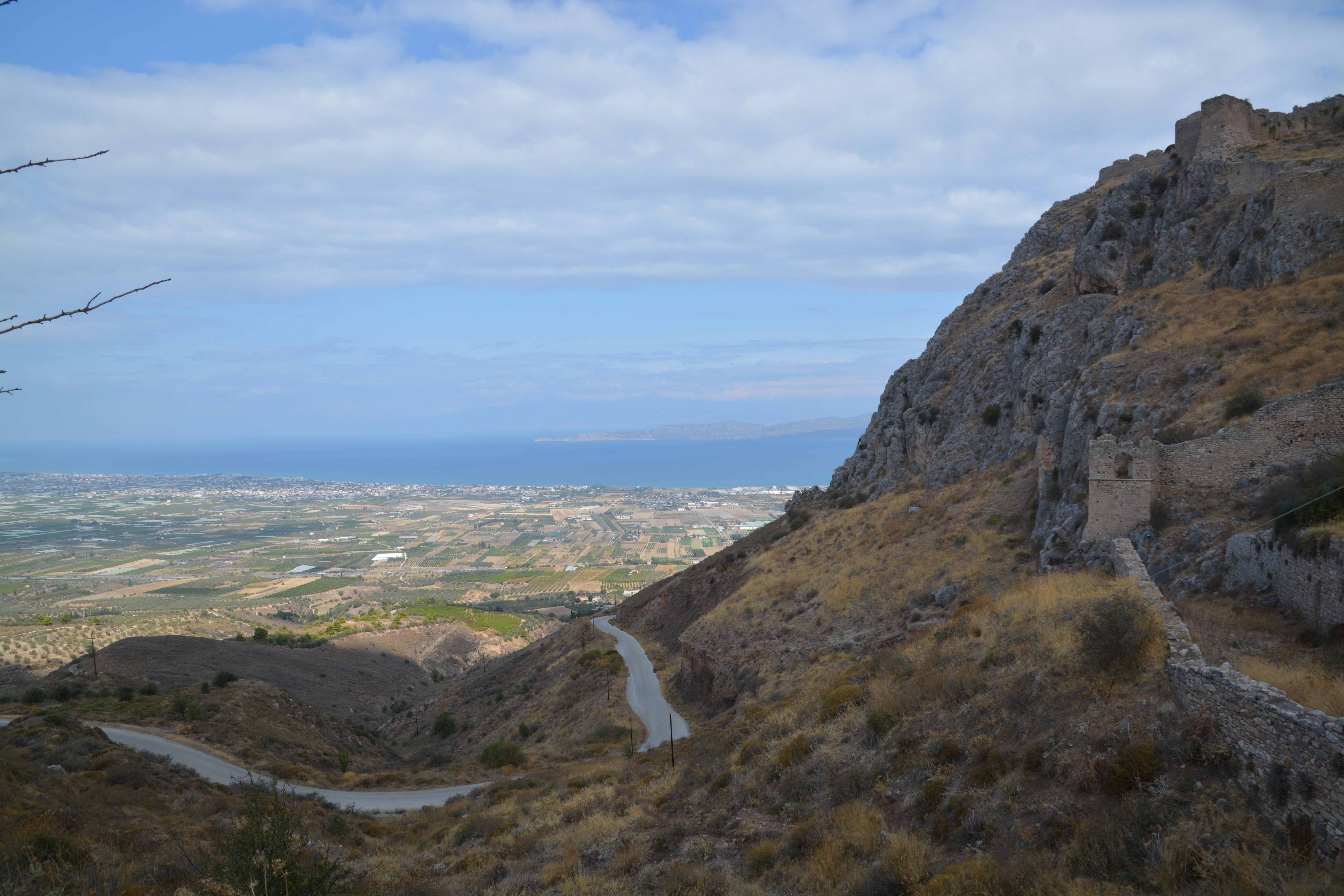
We also drove to the base of the Acrocorinth. What a view!
Acrocorinth. Photo by Leon Mauldin.
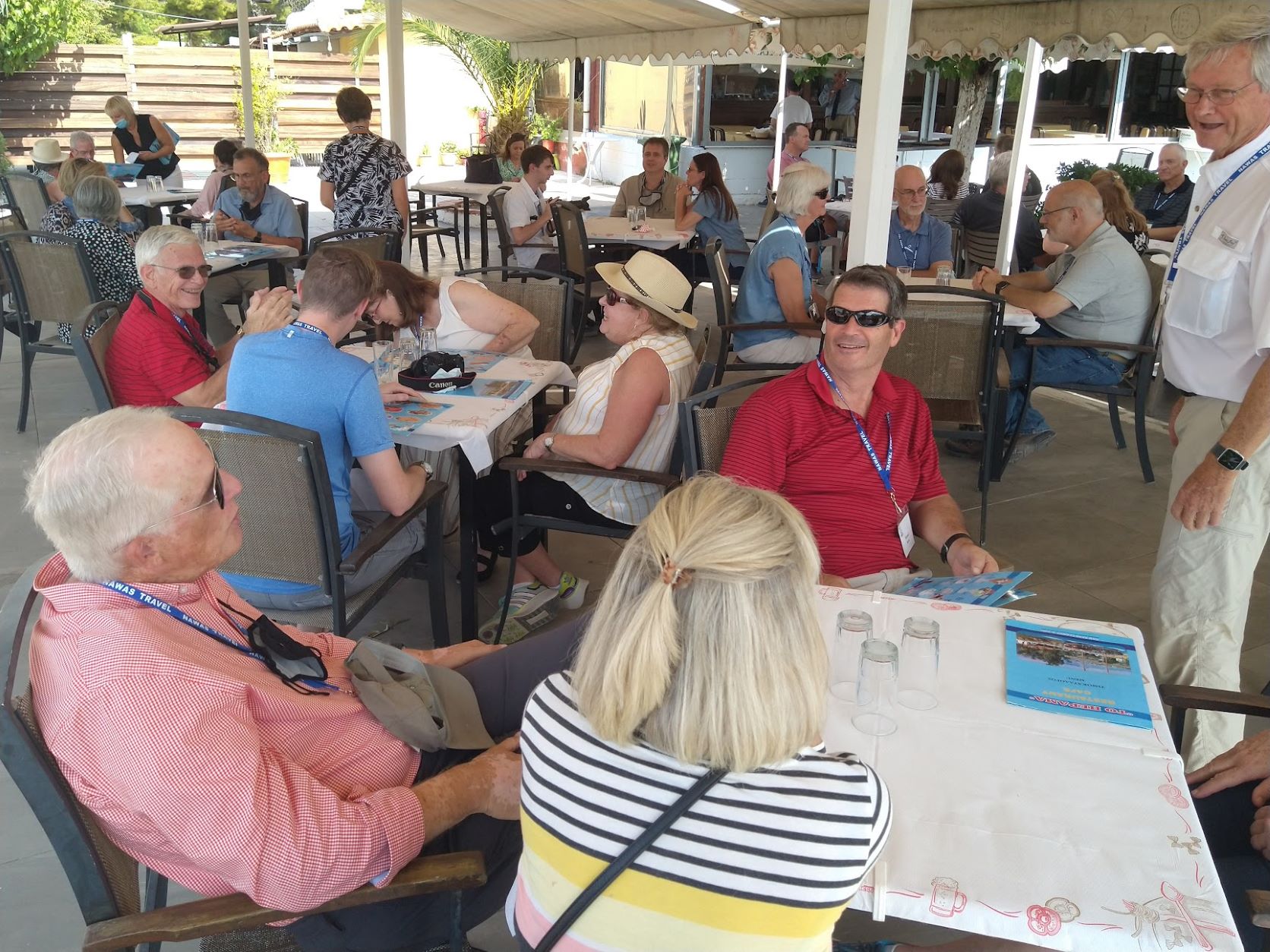
Finally, time for lunch at the Corinth Canal.
Some of our group sitting down to lunch at the Corinth Canal. Photo by Leon Mauldin.
This nice restaurant is on the eastern side of the Corinth Canal. You might see someone you know.


 Posted by Leon Mauldin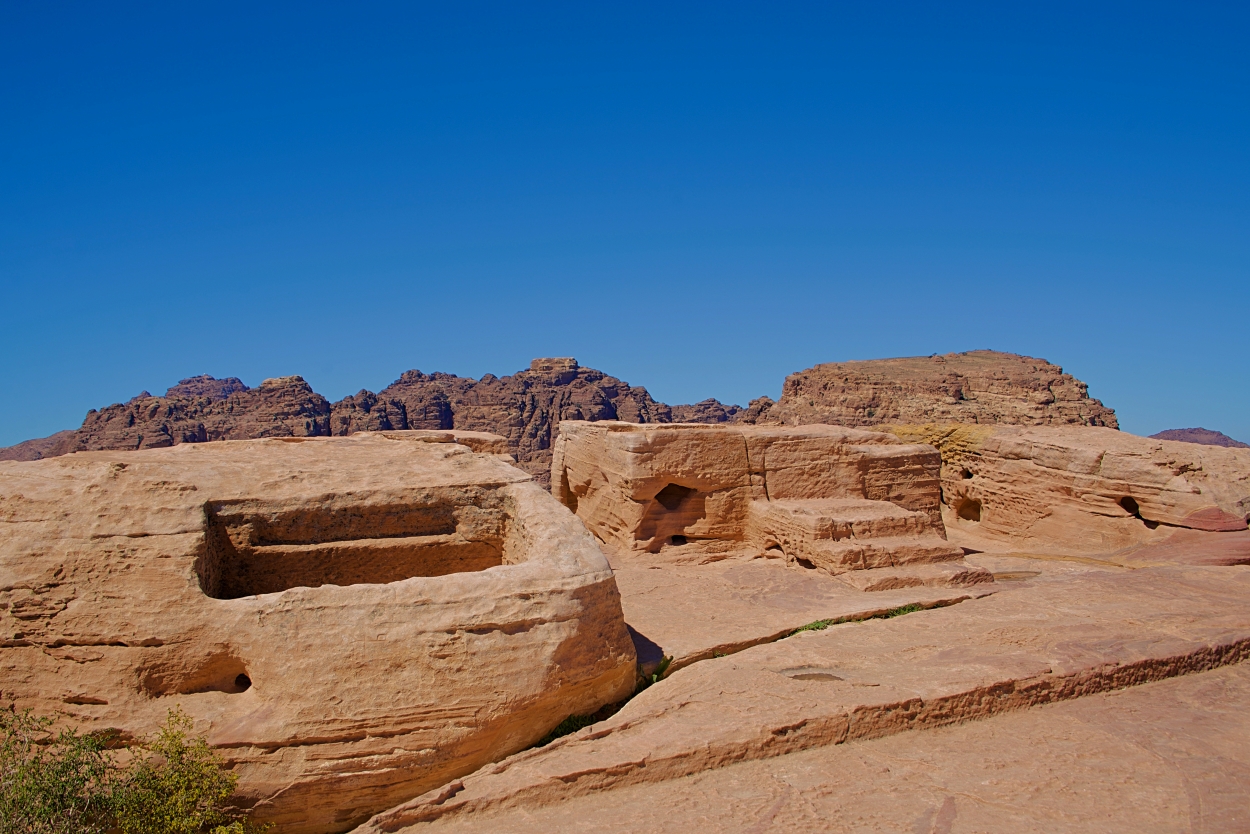



 leonmauldin.blog