“Then Solomon went to Ezion Geber and Elath on the coast of Edom. And Hiram sent him ships commanded by his own officers, men who knew the sea. These, with Solomon’s men, sailed to Ophir and brought back four hundred and fifty talents of gold, which they delivered to King Solomon (2 Chronicles 8:17,18).
Let’s first get the geographical setting of Elath (also spelled Eloth, Eilat):
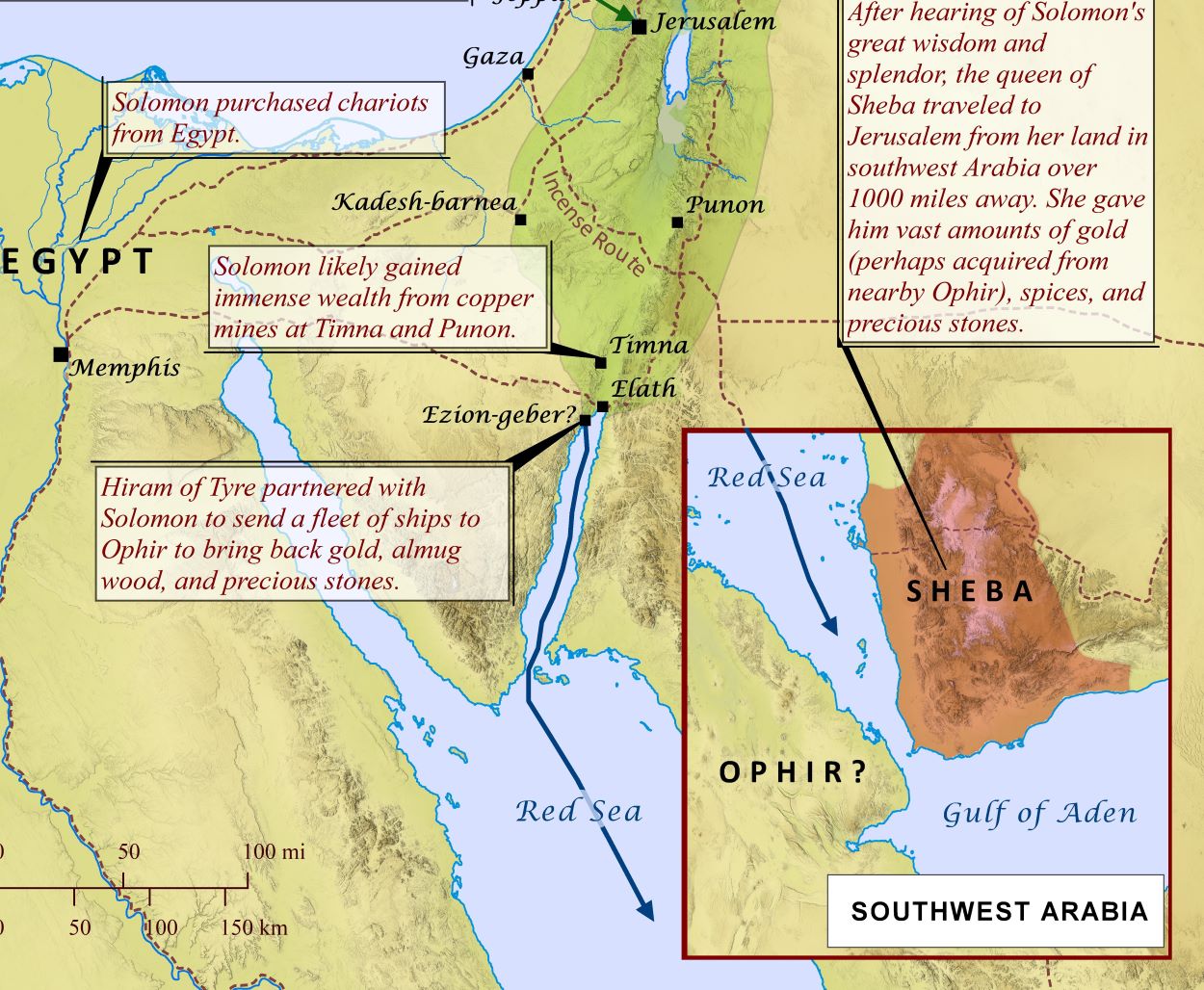
Map courtesy of biblemapper.com
The location of Elath was at the southern tip of the Arabah, and the north eastern tip of the Red Sea, at the Gulf of Aqaba. This allowed Solomon’s fleet of ships access to the Red Sea and of course, south from there into the Indian Ocean. It would seem that through this means of commerce the Queen of Sheba (see map inset) learned of Solomon, and made the journey to see for herself the incredible reports she had heard (related in the next chapter, 2 Chron. 9:1-12).
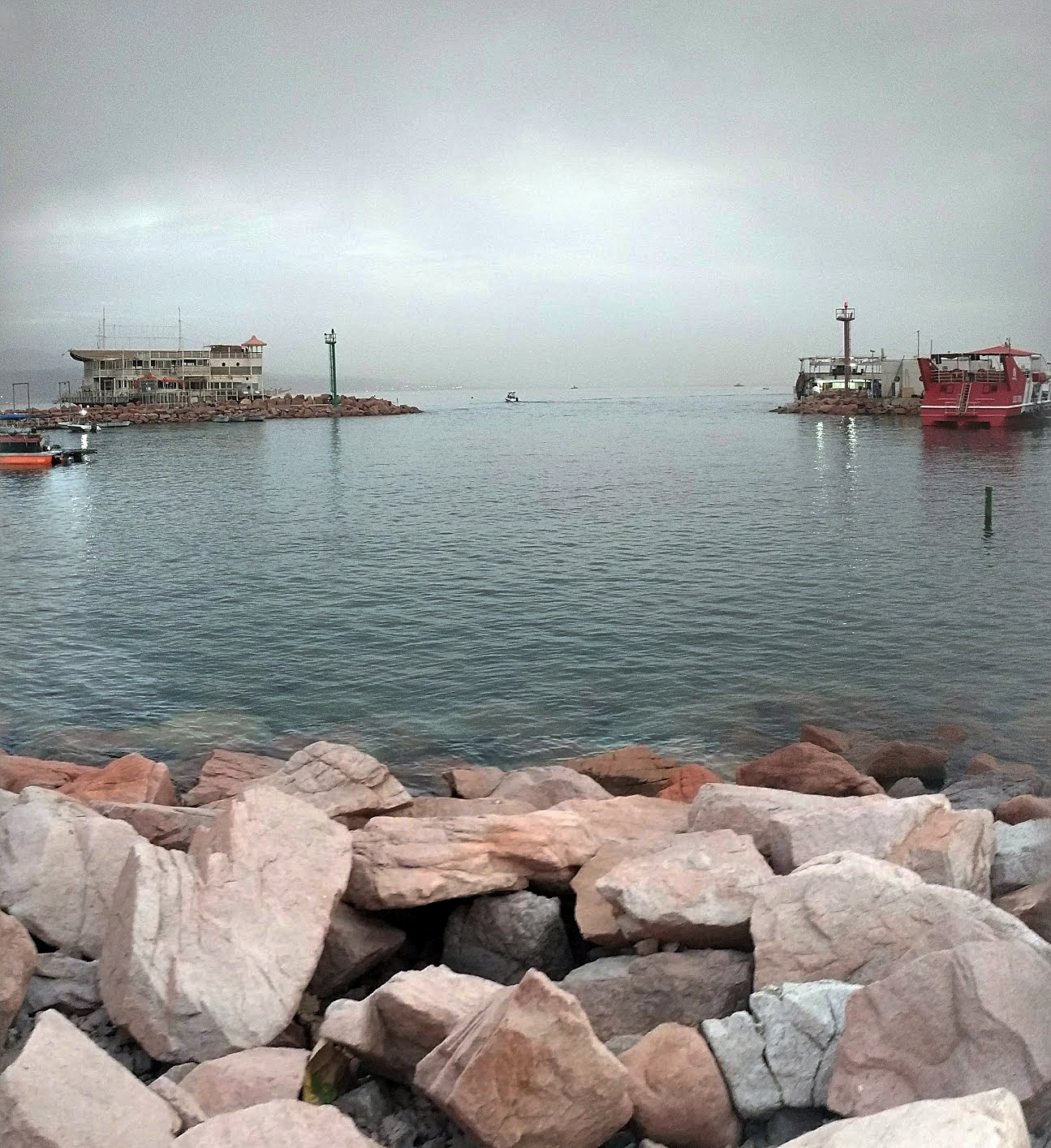
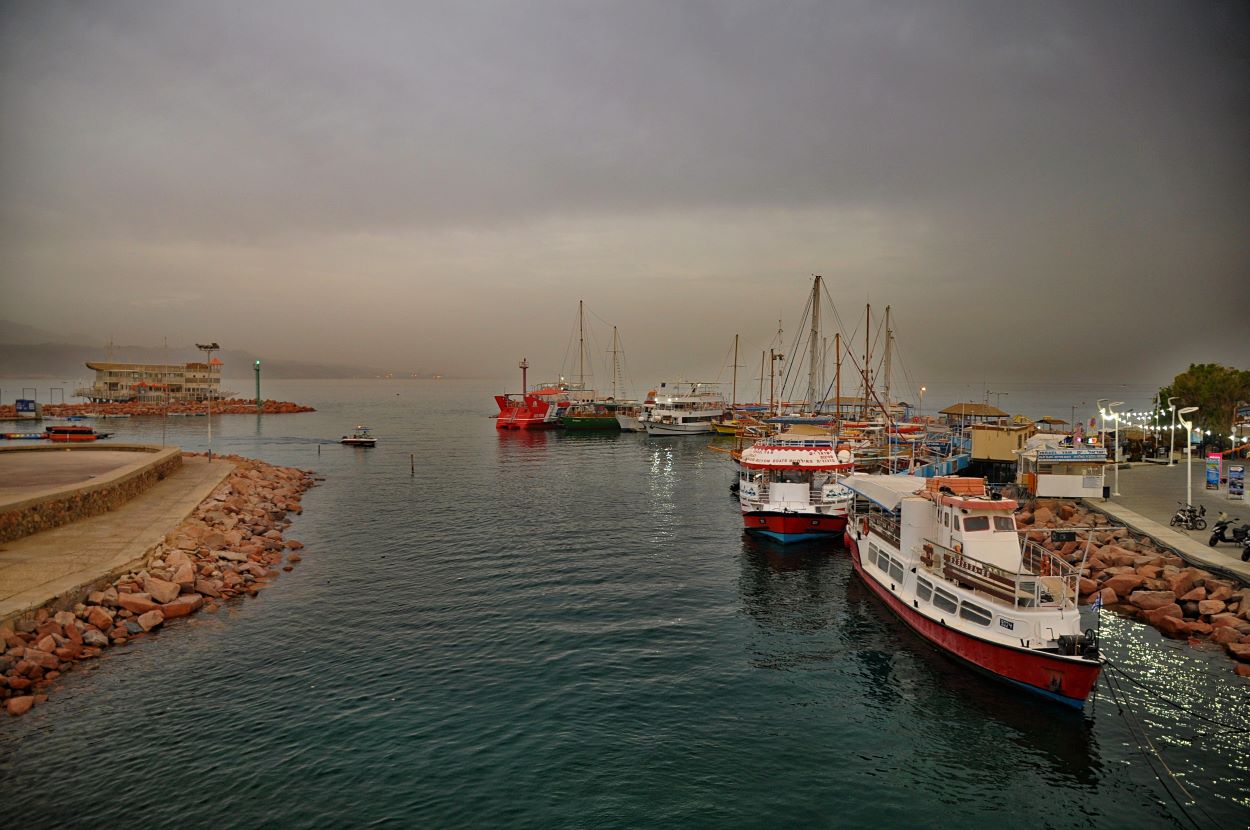
In March 2018, Ferrell Jenkins and I made a personal study trip which included this area. In this photo I am at Elath looking south.
B. S. Hummel has the following information regarding Elath:
A city and harbor at the head of the Gulf of Aqabah. Elath’s strategic position made it an important gateway for caravan and naval commerce with Arabia and eastern Africa. In the OT Elath is frequently placed in close proximity to Ezion-geber. Some scholars consider Tell el-Kheleifeh (147884), which lies between modern Elath and Aqabah, as Elath, others as Ezion-geber, and still others as the site for both Elath and Ezion-geber. The site was also known as El-paran (Gen. 14:6). The Ptolemies changed its name to Bernice. Elath was originally Edomite, possibly taking its name from the Edomite chief Elah (Gen. 36:41 = 1 Chr. 1:52; Eloth). Toward the end of the Exodus, the Israelites passed through Elath before turning north toward Edom and Moab (Deut. 2:8). David probably captured it during his campaign against the Edomites (2 Sam. 8:13–14). Solomon then established a navy of ships in Ezion-geber near Elath (1 Kgs. 9:26 = 2 Chr. 8:17). Apparently the Edomites had regained control, but Uzziah (Azariah, 2 Kgs. 14:22; 2 Chr. 26:2) recaptured and restored it (ca. 780 B.C.). However, under Aramean (Syrian) pressure during the Syro-Ephraimite War (ca. 735), Ahaz lost it to the Edomites permanently (2 Kgs. 16:6).
Hummel, B. S. (2000). Elath. In D. N. Freedman, A. C. Myers, & A. B. Beck (Eds.), Eerdmans Dictionary of the Bible (p. 388). W.B. Eerdmans.
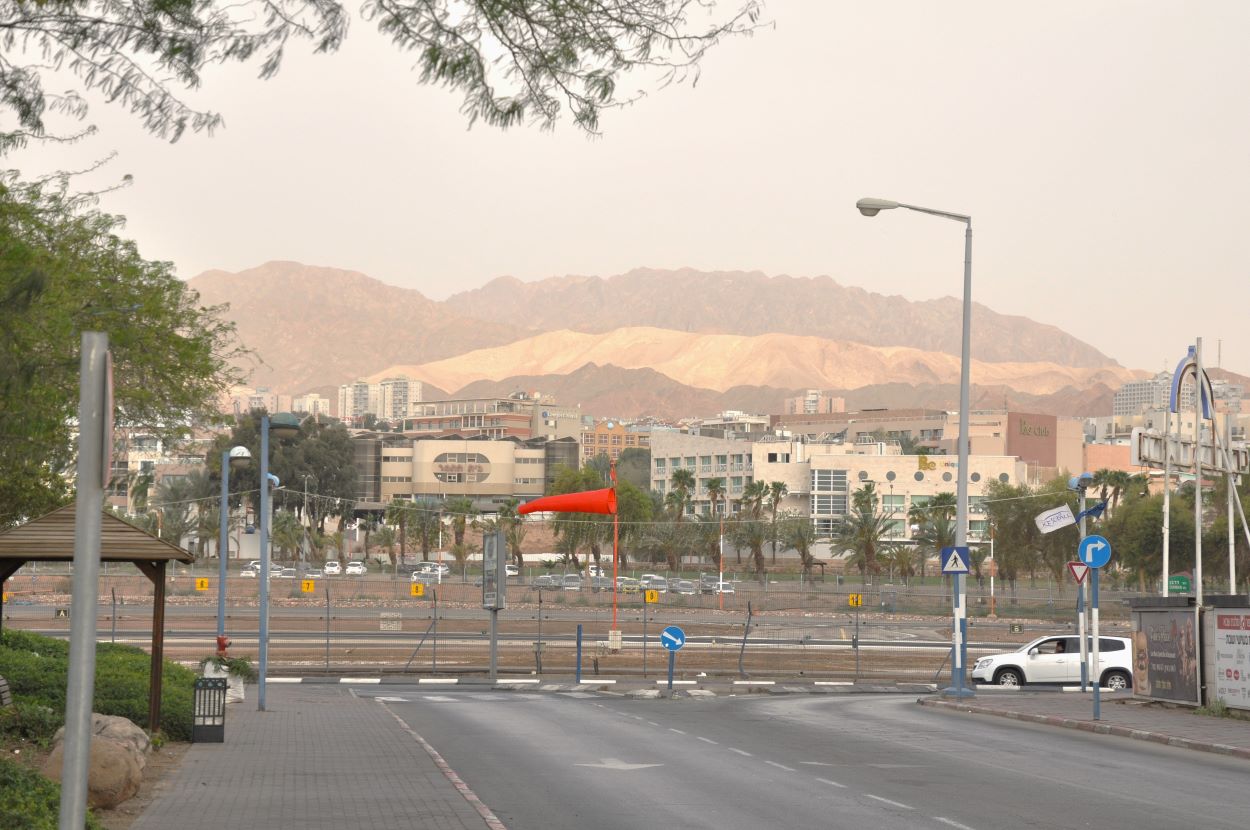
At Elath, looking east. We are of course in the Great Rift Valley here.
Acts 27:39-Acts 28:1 describes the shipwreck on which the Apostle Paul was a prisoner en route to Rome:
When it was day, they did not recognize the land; but they observed a bay with a beach, onto which they planned to run the ship if possible. And they let go the anchors and left them in the sea, meanwhile loosing the rudder ropes; and they hoisted the mainsail to the wind and made for shore. But striking a place where two seas met, they ran the ship aground; and the prow stuck fast and remained immovable, but the stern was being broken up by the violence of the waves. And the soldiers’ plan was to kill the prisoners, lest any of them should swim away and escape. But the centurion, wanting to save Paul, kept them from their purpose, and commanded that those who could swim should jump overboard first and get to land, and the rest, some on boards and some on parts of the ship. And so it was that they all escaped safely to land. Now when they had escaped, they then found out that the island was called Malta.
Acts 27:39-Acts 28:1
Here is the site proposed by many scholars of that area, known as St. Paul’s Bay:
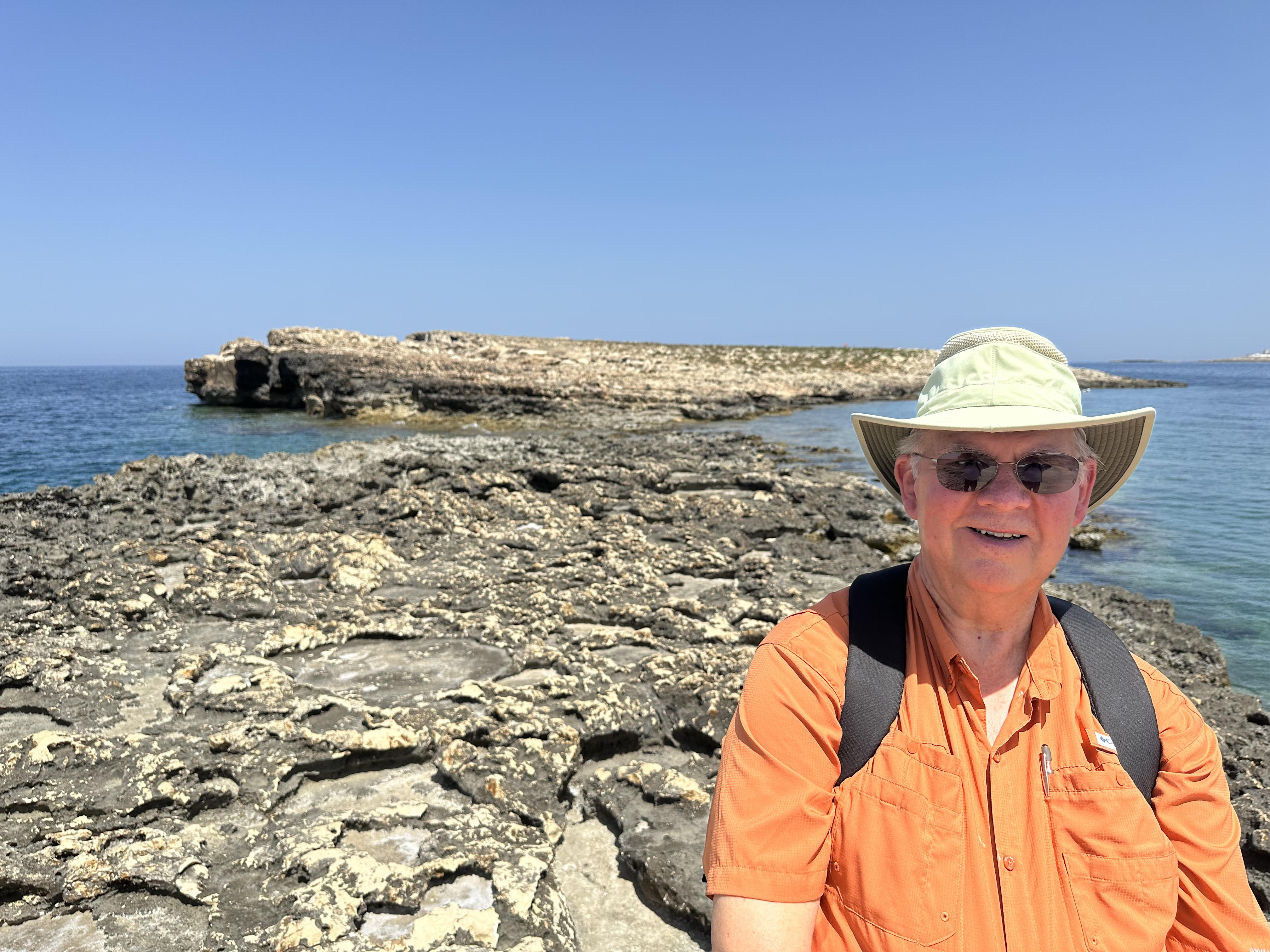
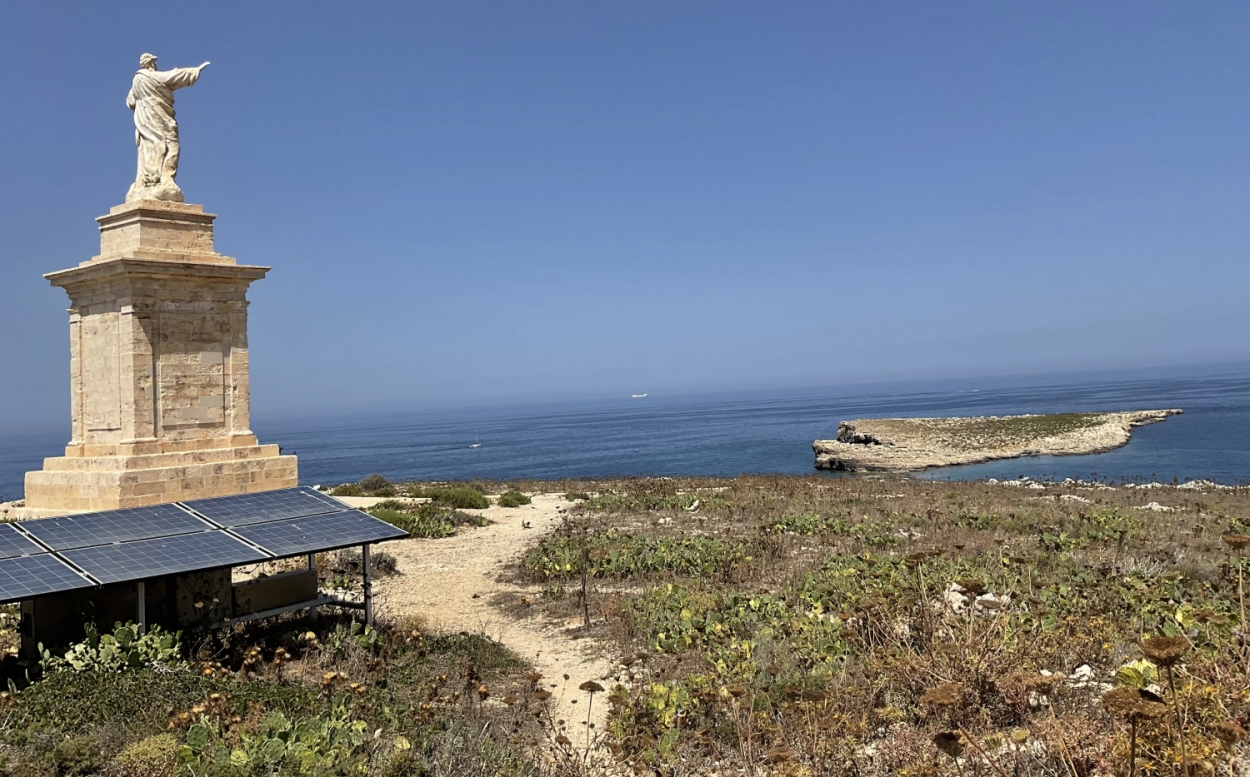
Having just returned from a personal study trip to Malta, I hope to share some of the sites and artifacts we were able to photograph in upcoming posts.
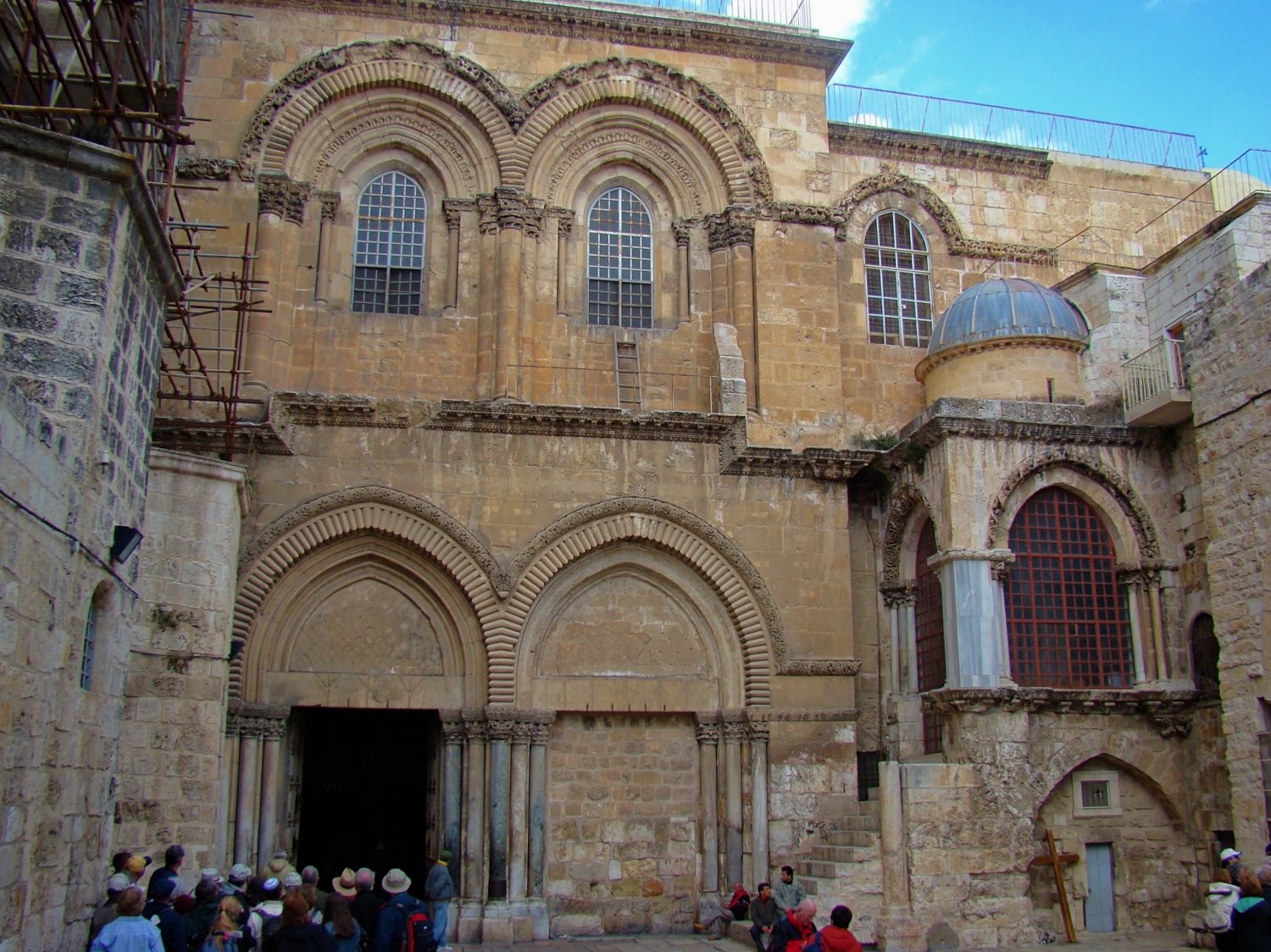
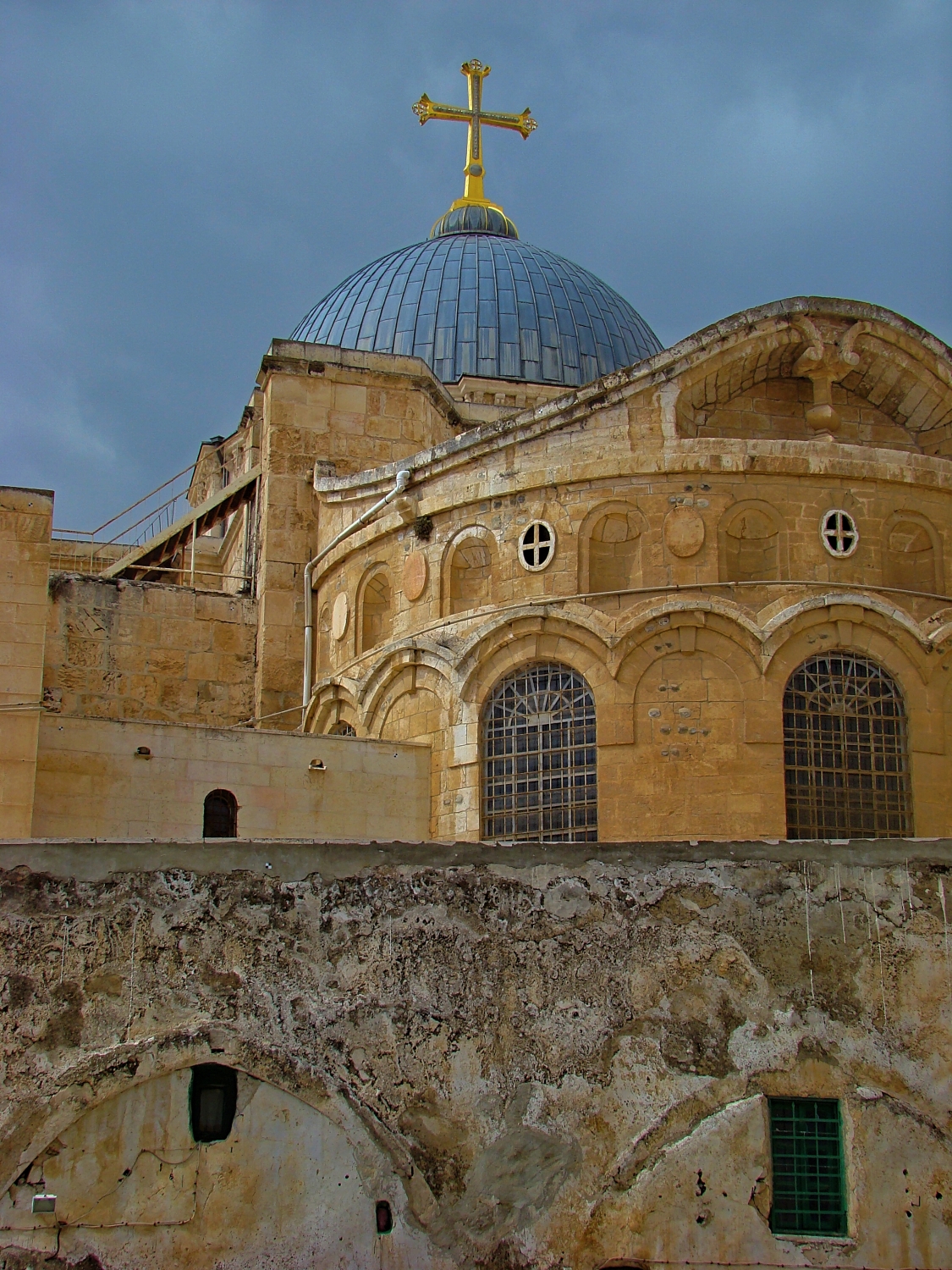
The Roman Emperor Hadrian (r. 117-138 AD) built a temple devoted to Jupiter over the site venerated as Jesus’ tomb. Later Constantine (r. 306-337 AD) ordered Hadrian’s temple to be destroyed and ordered that a church be built over Jesus’ tomb. Despite the years of destruction and rebuilding, enough remains from earlier structures to provide a plan of Constantine’s buildings.
The site of the crucifixion itself is thought to be very near the place of Jesus’ entombment. Previously Hadrian had erected a Venus statue over Golgotha, ironically marking the spot! Constantine constructed the Martyrium Church over the site of the crucifixion itself.
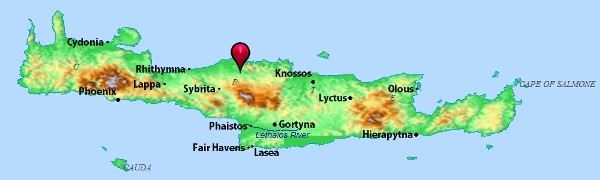
After the Apostle Paul left the younger evangelist Titus at Crete, he wrote, “For this reason I left you in Crete, that you should set in order the things that are lacking, and appoint elders in every city as I commanded you” (Titus 1:5). There were many cities (Greek polis) on the island of Crete, as can be seen from this map by bibleatlas.org:
In each of these cities where congregations of Christians were established, qualified men were to be appointed to serve as elders (bishops, pastors are biblically interchangeable terms). The list of qualifications was given as follows:
if a man is blameless, the husband of one wife, having faithful children not accused of dissipation or insubordination. For a bishop must be blameless, as a steward of God, not self-willed, not quick-tempered, not given to wine, not violent, not greedy for money, but hospitable, a lover of what is good, sober-minded, just, holy, self-controlled, holding fast the faithful word as he has been taught, that he may be able, by sound doctrine, both to exhort and convict those who contradict.
Titus 1:6-9
The archaeological excavations of Arthur Evans at Knossos got underway in 1900. He is credited with inventing the term “Minoan,” naming the civilization after King Minos, who ruled the island of Crete, according to legend.
A deity worshiped by the Minoans was the bull. In the Biblical Archaeology Society publication (2008), Island Jewels: Understanding Ancient Cyprus and Crete, we read:
Again, we rely on the evidence of frescoes and gems that show how the Minoans practiced an astonishing ritual that consisted of grasping a bull by its horns and leaping over its back. When we add this to the ubiquity of stylized bulls’ horns, so-called “horns of consecration,” as well as the bull’s head rhyta (drinking vessels; singular, rhyton) and vivid portraits of individual beasts, there can be no doubt that the Minoans treated the bull with deep reverence…The bull may well have represented the young male consort of the goddess of love, a pattern that recurs throughout the ancient near east from Tammuz and Ishtar to Venus and Adonis, although if this is the case we cannot even give names to the Cretan versions of the divine couple (pp. 49-59).
BAS
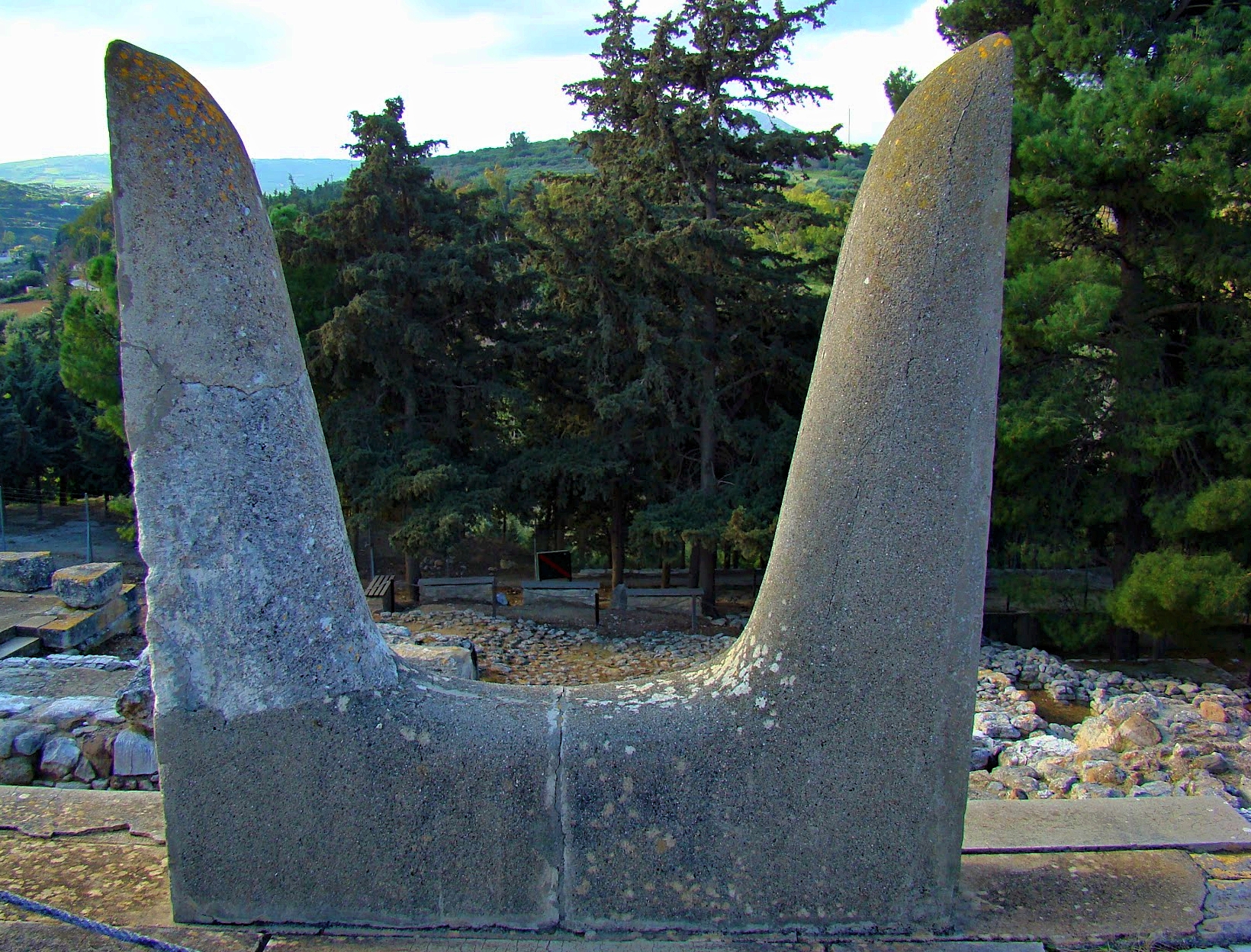
In keeping with this information, note our photo of the gigantic bull’s horns below:
It is thought by many that these restored horns symbolized the sacred bull, and that they once adorned the top of the palace at Knossos, Crete.
The palace at Knossos was the largest of the Minoan palaces and served as the home of the legendary king Minos. This palace complex was named and excavated in 1900 by the Englishman Arthur Evans. Arthur Evans is also responsible for naming this sculpture-like object which resembles the horns of a bull, as “”horns of consecration.”” The horns in this slide, which are located outside the South Propylaea at the Knossos complex, are a 20th century reconstruction. Different depictions of horns of consecration can be found throughout Minoan culture, such as on Minoan sarcophagi. Overall, the bull was considered to be a sacred animal in ancient Crete, playing a large role in religious rituals. Since Evans, scholars and archaeologists have debated the true function and meaning of the horns of consecration. One scholar has suggested that these horns were used as seats of honor for nobility or gods. Other scholars have thought that the horns originally served as a pot-support in a hearth. Today, there is still a lack of consensus among scholars as to the function of these horns.
2 Kings 23 records the zealous reforms of good king Josiah (r. 640-609 BC), who had been the object of prophecy some 300 years earlier (1 Kings 13). Josiah destroyed/defiled the sites and objects of idolatry both in Jerusalem as well as throughout the land of Israel. This included the desecration of the site Solomon had constructed for the worship of foreign gods (which had resulted from the influence of the pagan wives he accumulated, cf. 1 Kings 11).
The text states: “Then the king defiled the high places that were east of Jerusalem, which were on the south of the Mount of Corruption, which Solomon king of Israel had built for Ashtoreth the abomination of the Sidonians, for Chemosh the abomination of the Moabites, and for Milcom the abomination of the people of Ammon” (2 Kings 23:13).
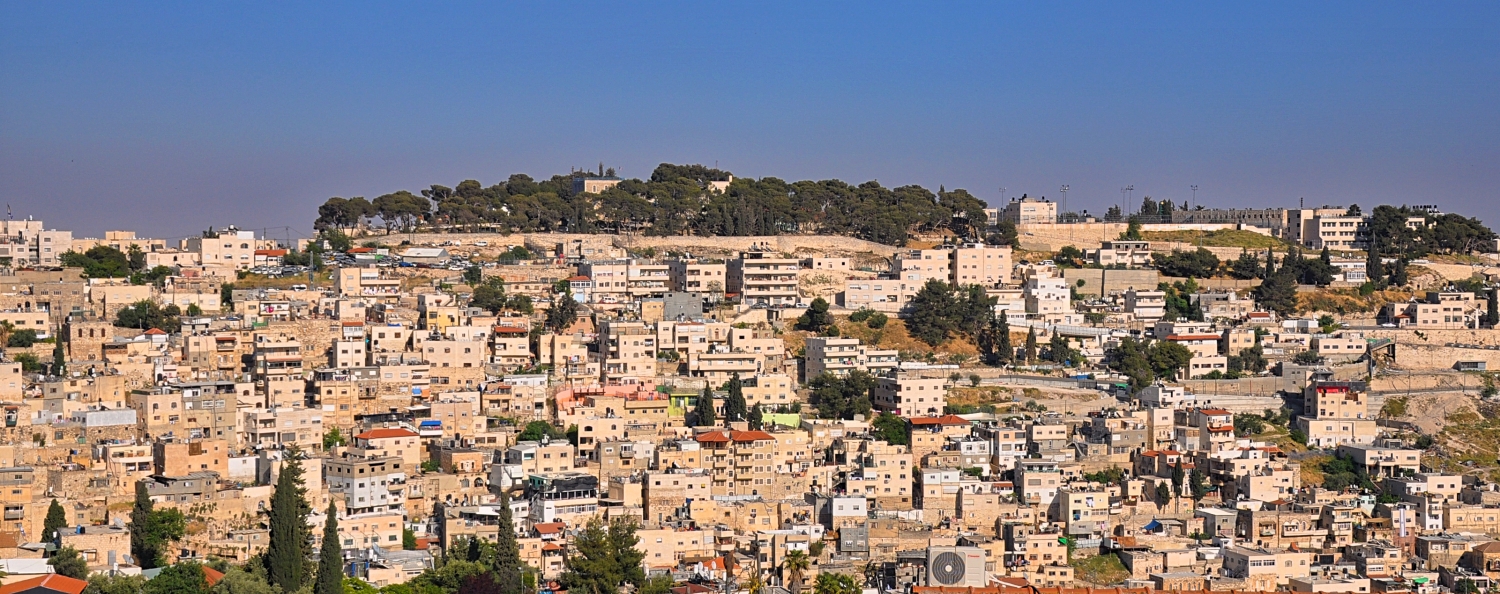
Here is the location of har hammašḥı̂t (הַר הַמַּשְׁחִית
The “Mount of Corruption” is a “derogatory name for the Mount of Olives, where Solomon had built shrines to Ashtoreth, Chemosh, and Molech. Josiah, king of Judah is described as defiling and destroying these temples in 2 Kgs 23:13” (The Lexham Bible Dictionary).
This site also came to be known as the “Mount of Offense” as well as the “Mount of Scandal.”
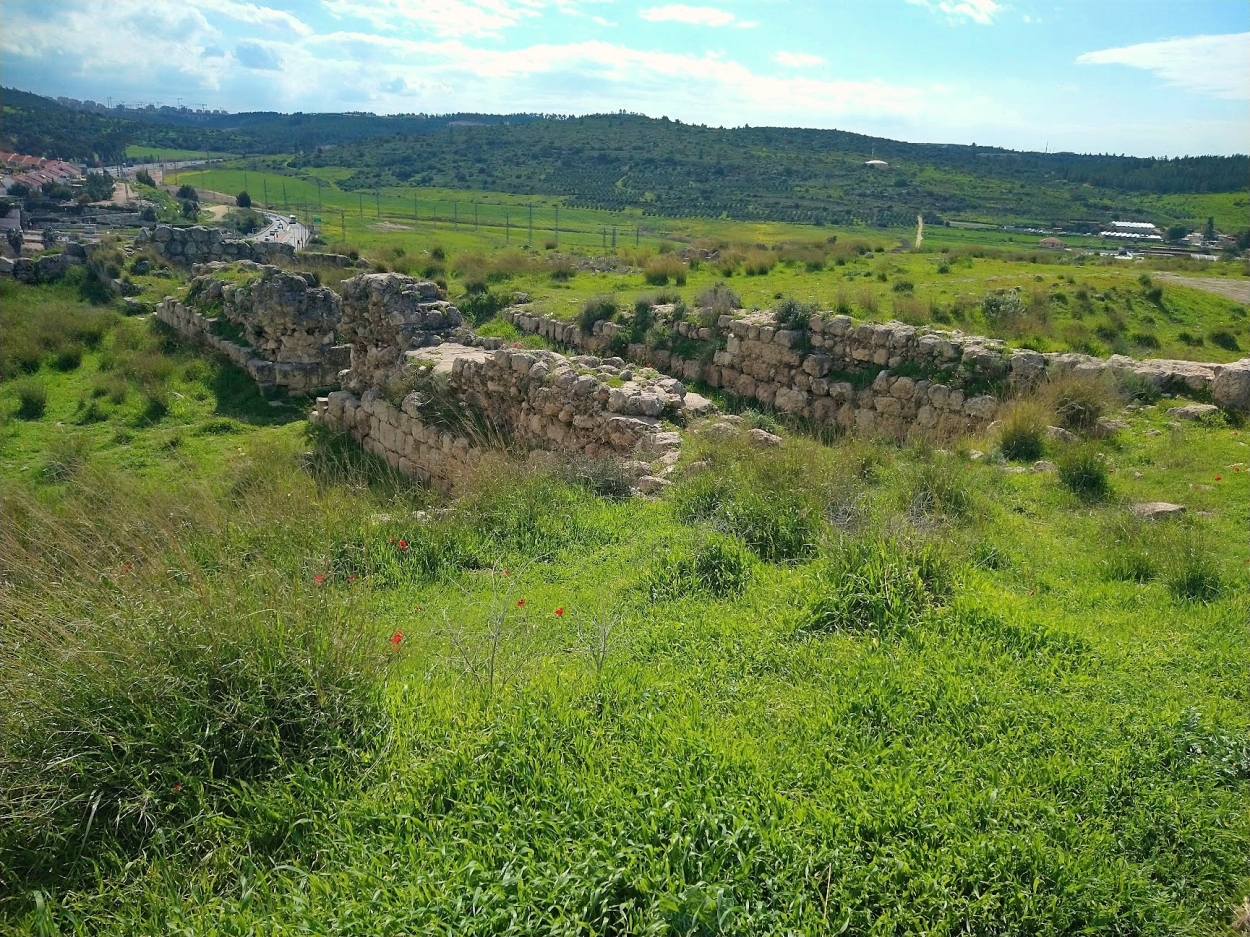
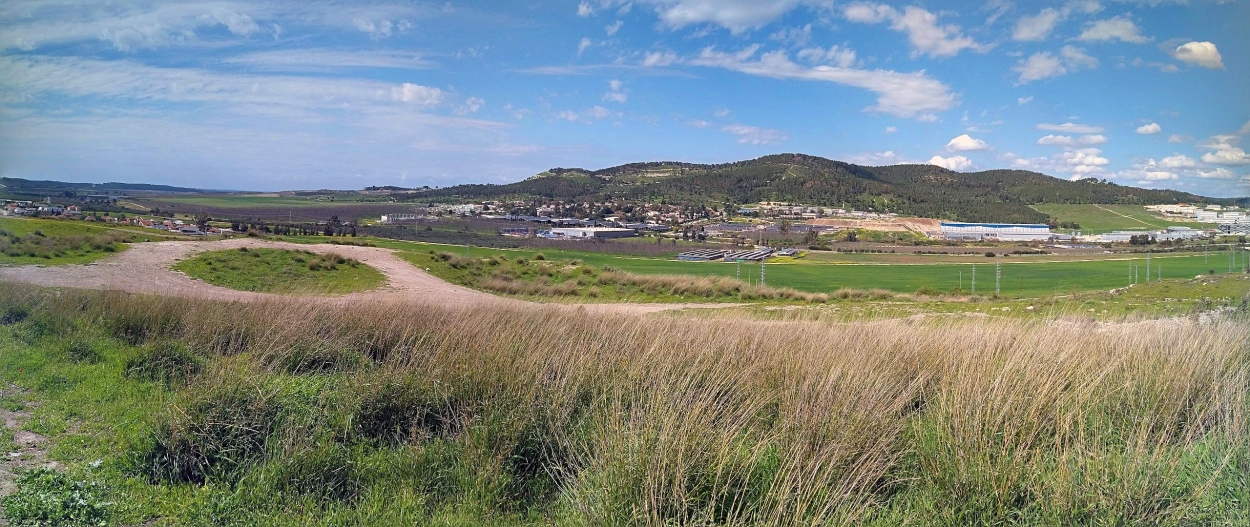
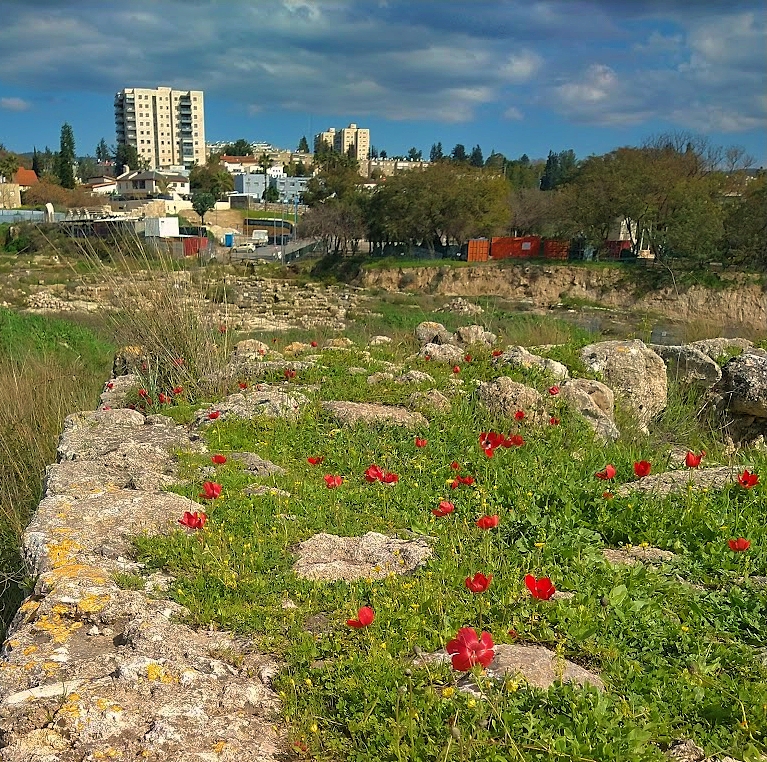
The city of Beth-shemesh was given to the Levites when they were given their possession by lot in the days of Joshua, following the Conquest of Canaan (Josh. 21:16). Years later, during the days of the Judges, the Philistines captured the ark in battle with Israel (1 Sam. 4), but when they were divinely punished they allowed the ark to return. The two cows pulling the cart from Philistian Ekron “headed straight for the road to Beth-shemesh” (1 Sam. 6:12).
Later, in the days of the Divided Kingdom, King Amaziah (Judah) challenged King Jehoash (Israel) to battle. This may have been in retaliation for the destruction and looting carried out by the Israelite mercenaries Amaziah had hired, but then sent back home (2 Chron. 25:6-13). Beth-shemesh was the meeting point of the two armies, which resulted in Amaziah being soundly defeated. The theological reason is given by the inspired historian: “But Amaziah would not listen, for it was from God, that He might deliver them into the hand of Joash because they had sought the gods of Edom.” It was because of Amaziah’s idolatry that God orchestrated events to punish Amaziah. Ironically, it was after God had given Amaziah victory in battle against Edom that Amaziah then decided to worship the gods of Edom!
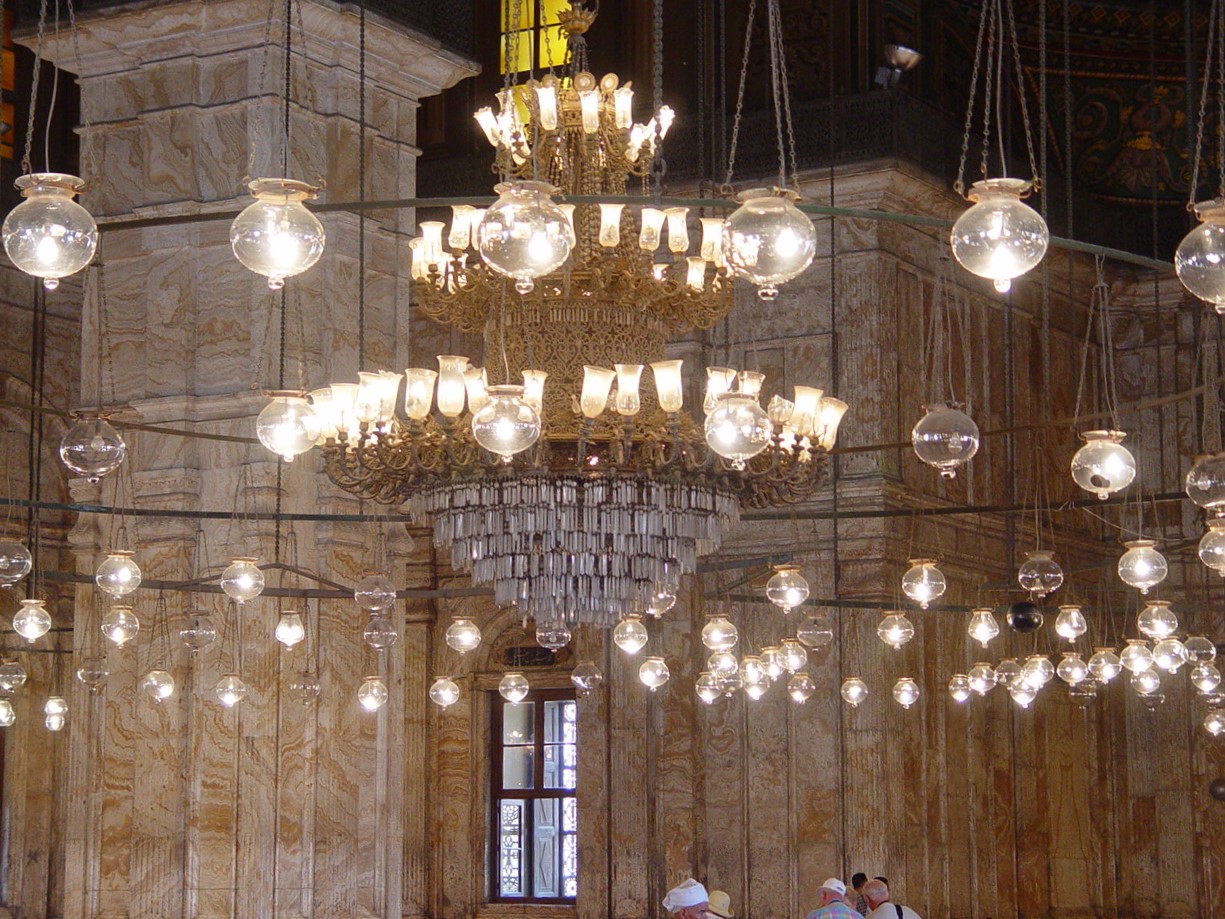
One of the most visible mosques in Cairo is the Mosque of Muhammad Ali Pasha, located in the Citadel. Muhammad Ali, who reigned in Egypt 1805-1849, built the mosque. At the height of his power, he controlled Egypt, Sudan, Hejaz and the Levant. He permanently ended the Mamluk hold over Egypt.
The mosque is located inside the Citadel of Saladin. This mosque is also called the “Alabaster Mosque” due to its marble paneling on both its interior and exterior walls. It is built on the Turkish style, specifically the architectural style of the Ottomans, and consists of an open court and prayer hall. The main building material is limestone, likely “recycled” from the Great Pyramids of Giza.
Our photo here shows the interior courtyard and the fountain for washing:
We recently began a class study of Paul’s letter “to the saints and faithful brethren in Christ who are of Colossae” (Col. 1:2) in our local congregation. Knowing somewhat of the geographical setting helps one to enter the biblical world as the text is studied.
Colossae (also spelled Colosse) was a city in the Roman province of Asia, located in the Lycus River Valley about 100 miles east of Ephesus. It was situated near the cities of Hierapolis and Laodicea (see map here).
Location of Colossae. Map curtesy of BibleMapper.com.
I took a group to biblical sites in Greece/Turkey this past October, and Colossae was included on our itinerary.
During the Persian period, Colossae was a prosperous city, but by the time of the 1st century, it declined in importance, being eclipsed by Laodicea and Hierapolis. “Though commercially less successful, Colossae continued to be a place of importance in the Roman imperial period, as is shown by an inscription of this time and by second and third century A.D. coins that depict the usual city officials, showing that it had the rights of a city under the Romans” (Mare, W. H. (1976). “Archaeological Prospects at Colossae.” The Near East Archaeological Society Bulletin, 7, 43).
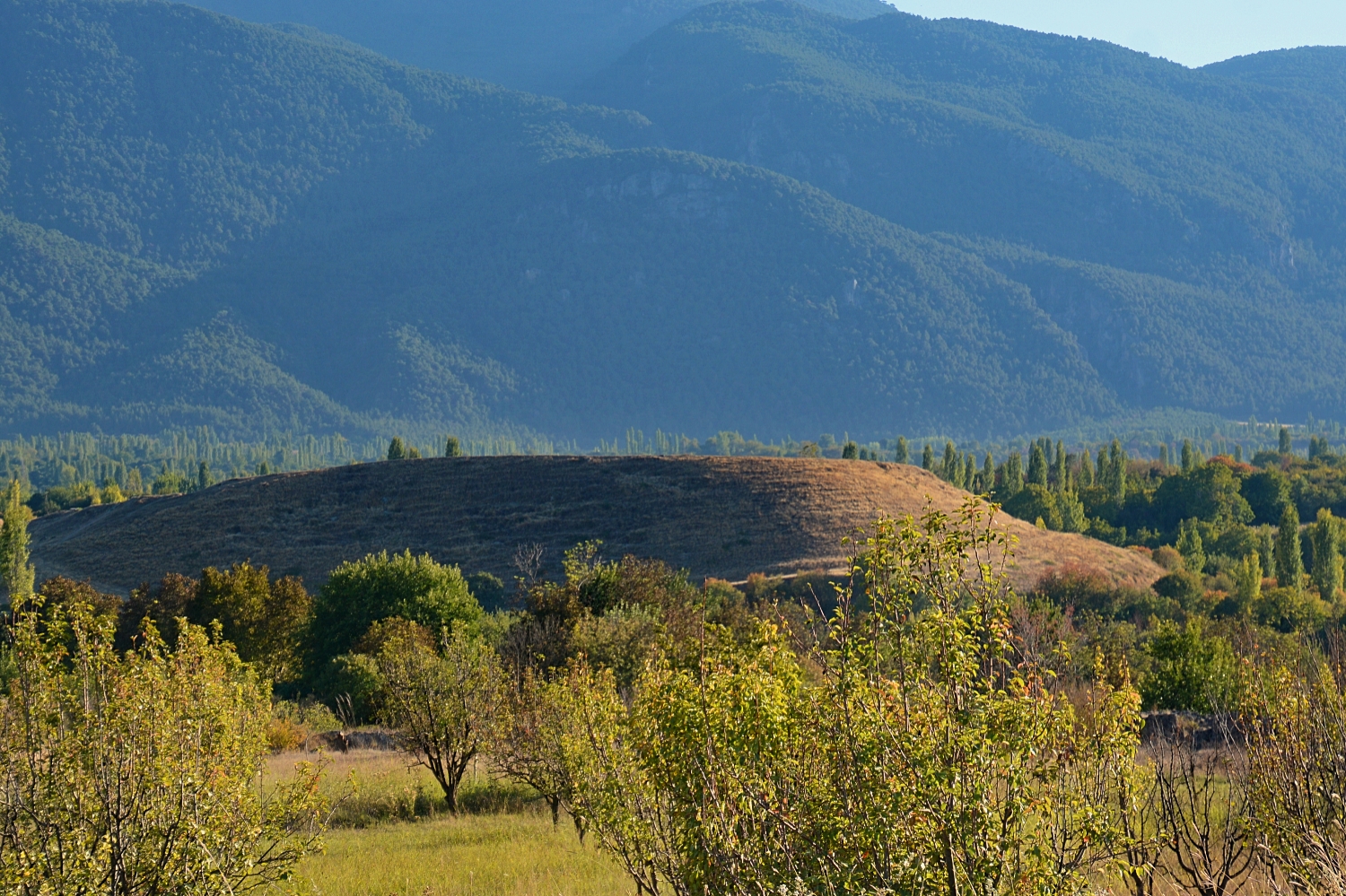
Back in 2006, Ferrell Jenkins and I made a personal study trip that included this site. Here is a photo from that occasion, giving a more distant shot than that above.
Unlike many of the recipients of Paul’s letters, Paul had not personally established the Colossian church, but apparently those who learned the truth of the Gospel during Paul’s stay at Ephesus (Acts 19:10), had taught and converted the Colossians.
Further, a comparative reading of Colossians with the personal letter to Philemon will show that Philemon was a Colossian also, so in reality two of the New Testament books were directed initially to this location.
Both letters were written when Paul was in chains.
Timothy joined Paul in both.
Epaphras, Mark, Aristarchus, Demas & Luke joined in salutations.
Onesimus was one of the messengers by whom Colossians was sent.
Archippus is addressed in both.
Colossae has not been excavated as of yet. Click on photos for larger view.
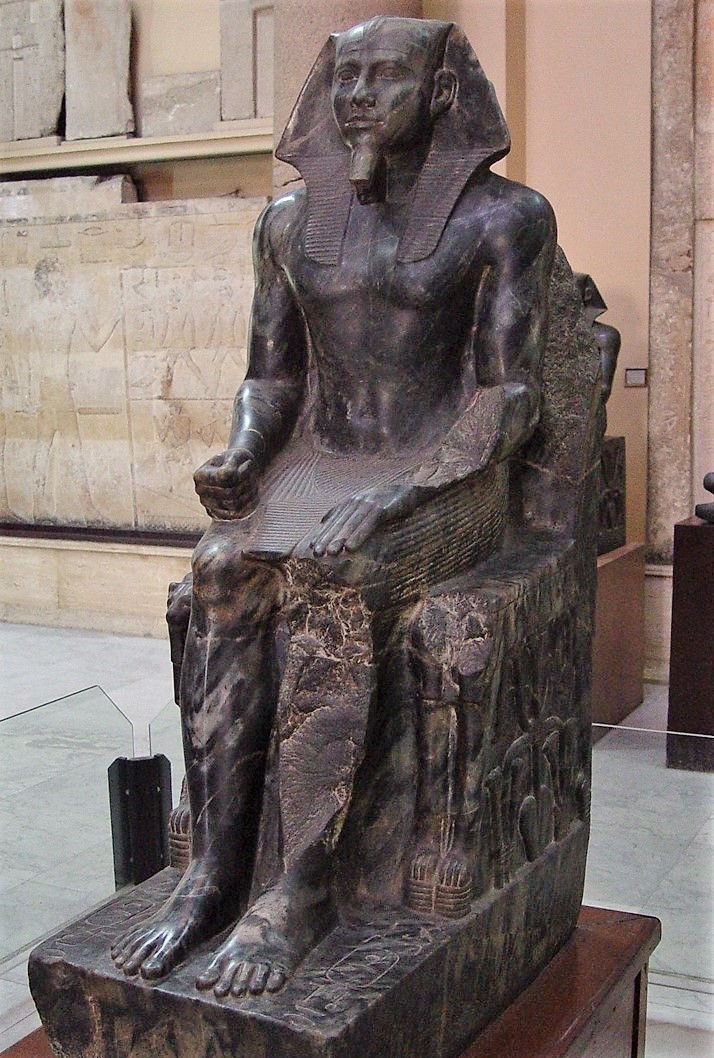
Chephren was pharaoh during Egypt’s 4th dynasty, reigning ca. 2520-2494 BC. He was the son of Cheops (builder of the Great Pyramid), and builder of the second pyramid at Giza. He is also the creator of the Great Sphinx.
This life-sized statue is housed in the Egyptian Museum in Cairo, having been discovered by Auguste Mariette in 1860, in Chephren’s valley temple at Giza. It is made of diorite, a high quality stone. On the stature throne are carved symbols of royalty, the lion paws on the front, and on the sides are displayed the symbol of the sema-tauy, representing the uniting of Upper and Lower Egypt.
Chephren’s feet are bordered by his cartouche. On the back of the royal headdress is the falcon god Horus, god of dynastic divinity in Egyptian mythology. It was believed that Pharaoh was the representative of Horus on earth, while the god manifested himself in the person of the Pharaoh, the living Horus.
I have received the Photo Companion to the Bible on 1 & 2 Kings, from Dr. Todd Bolen. This is a portion of scripture on which I’m currently focused in study and writing, so it is a very welcome resource to me personally. I’ve made use of the BiblePlaces library for almost 20 years now, and am glad to highly recommend this most recent addition. More info and how to order is found here: https://www.bibleplaces.com/june-2022-newsletter/
The Books of Kings has long been an area of specialized study for Dr. Bolen, as explained in his newsletter.
This new resource has PowerPoint presentations on all 47 chapters of 1 & 2 Kings, with more than 7,400 slides! But this is not just a collection of photos–the descriptive text and explanatory notes are most helpful.
This type of resource is most helpful in giving the text of scripture its cultural and geographical context, and thus enhancing ones understanding of the Bible.
Thanks to Dr. Bolen and his colleagues for yet another great resource in this series!


 Posted by Leon Mauldin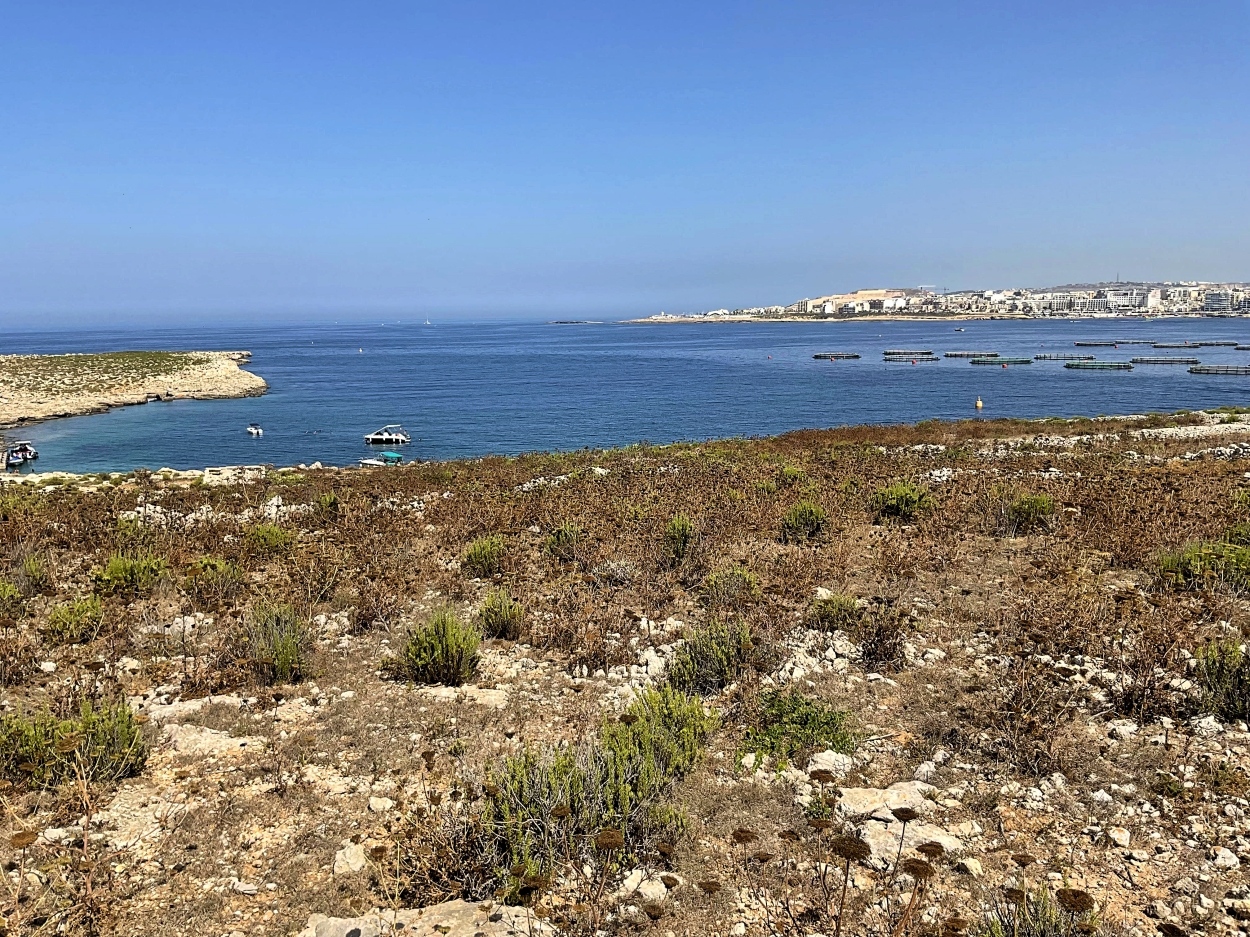







 leonmauldin.blog