At Pergamum: The Library

May 15, 2010

During the reign of Eumenes, Pergamum and Alexandria were competing for the biggest and best library in the world.  Egypt controlled the paper industry, made from the papyrus plant.  Bible and Spade quotes Pliny the Elder:

…when owing to the rivalry between King Ptolemy and King Eumenes about their libraries Ptolemy suppressed the export of paper, parchment was invented at Pergamum; and afterwards the employment of the material on which the immortality of human beings depends spread indiscriminately. (Vol. 5, Num. 2, p.51).

Parchment was made from the skins of goats and sheep.  It is much more durable than papyrus.  Biblical manuscripts were written on both parchment and papyrus, but the parchment tends to fair better with the passing of time.

The Latin pergamena means “paper of Pergamum.”  Paul wrote Timothy, “When you come, bring with you the cloak I left in Troas with Carpas and the scrolls, especially the parchments” (2 Tim. 4:13, NET).

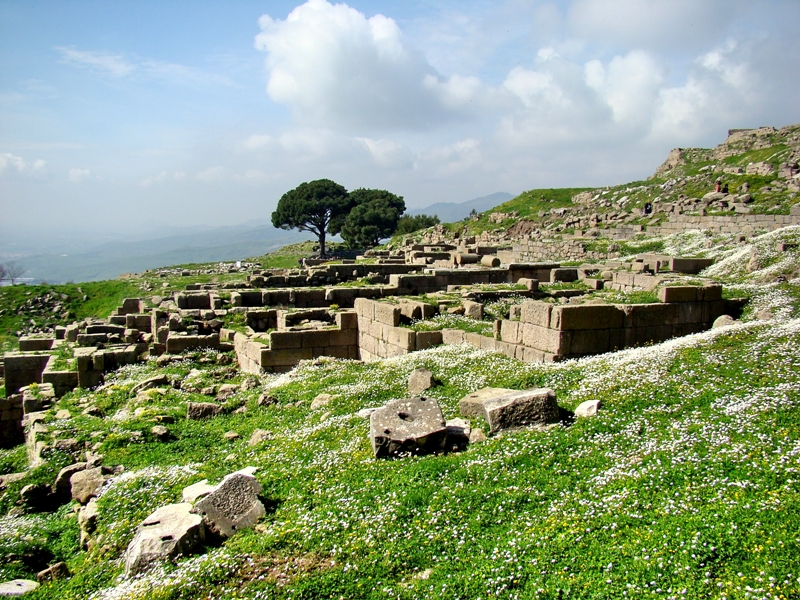
Today’s posts features two photos of the site of the famous library of Pergamum.  In this first photo we are standing with the sanctuary of the temple of Athena at our back; the foreground captures part of the court of the temple.
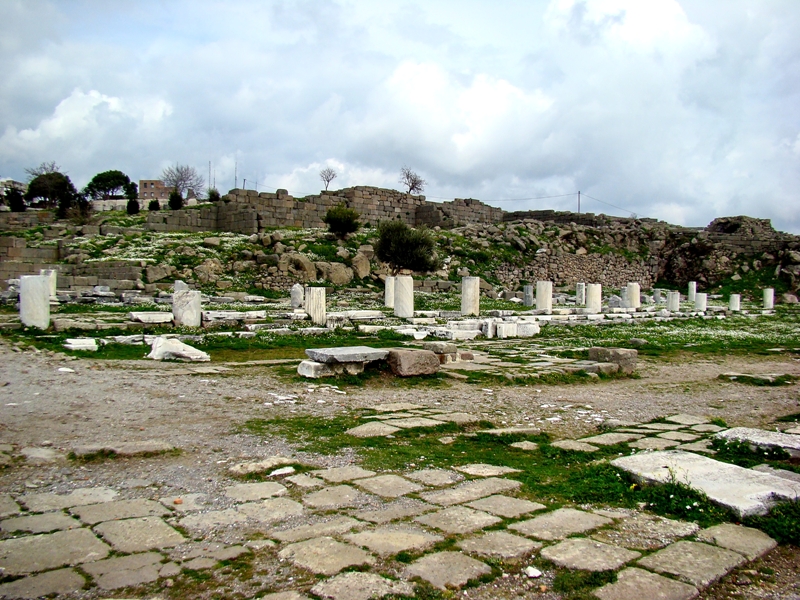
Pergamum Library. Photo by Leon Mauldin

The legend is that Mark Antony gave the 200,000 volumes housed in this library to Cleopatra in 41 B.C.
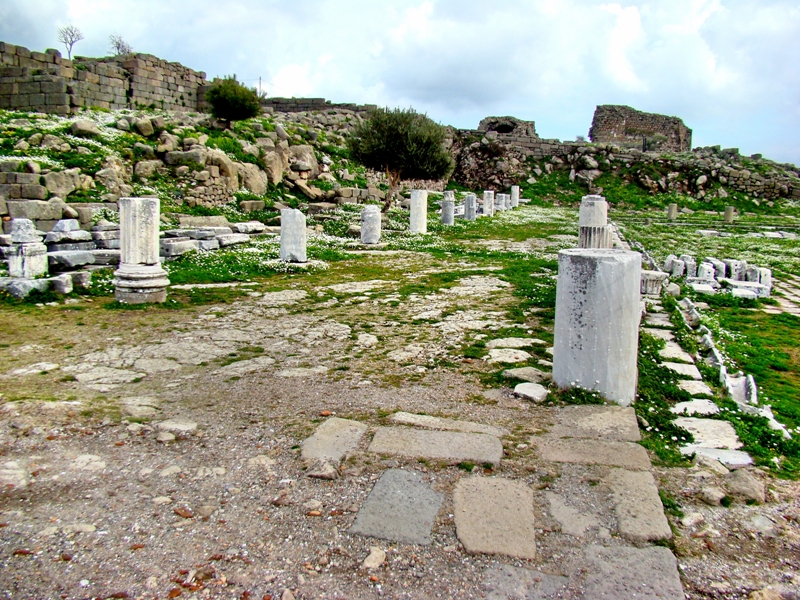
Pergamum Library close up. Photo by Leon Mauldin.

Click on image for higher resolution.


At Pergamum: The Heroon

May 14, 2010

As we continue to view the ruins at biblical Pergamum, today we look at the Heroon. Fatih Cimok, whom we referenced in our previous post, explains that the heroon was “a shrine dedicated to a deified or semideified dead person” (Pergamum, p.7). The heroon at Pergamum was built to honor the Pergamene kings, including Attalus I (241-197 B.C.) and Eumenes II (197-159 B.C.).

Heroon at Pergamum. Photo by Leon Mauldin.

The Heroon pictured above is on your left as you walk up from the parking area, making your way to the acropolis.  In the distance of our photo where the trees are located (top, center) you are seeing the site of the altar of Zeus.

If you lived in Pergamum in the first century, you would have some choices to make.  Could you burn incense to the emperor at the imperial temple, and say “Caesar is Lord,” or would you say that there is one Lord, the Lord Jesus Christ?  Would you worship these deified kings at the Heroon, or would you take the stand that Jesus did: “You shall worship the Lord your God, and Him only you shall serve” (Matt. 4:10)?  Neutrality then, as now, was and is impossible (Matt. 12:30).

More to come!


At Pergamum, Trajan’s Temple

May 11, 2010

As we continue to look at biblical sites, especially in Turkey, we want to call attention to some points of interest in Pergamum, located at modern Bergama.  Fatih Cimok writes, “The word Pergamum is thought to have been from a pre-Hellenistic tongue and meant ‘citadel’ or ‘stronghold'” (Pergamum, 2009 ed., p.7).

Pergamum has an interesting history.  In ancient times, it wasn’t just the city of Pergamum, it was actually the kingdom of Permamum, which extended from Bythinia to Cappodoccia.

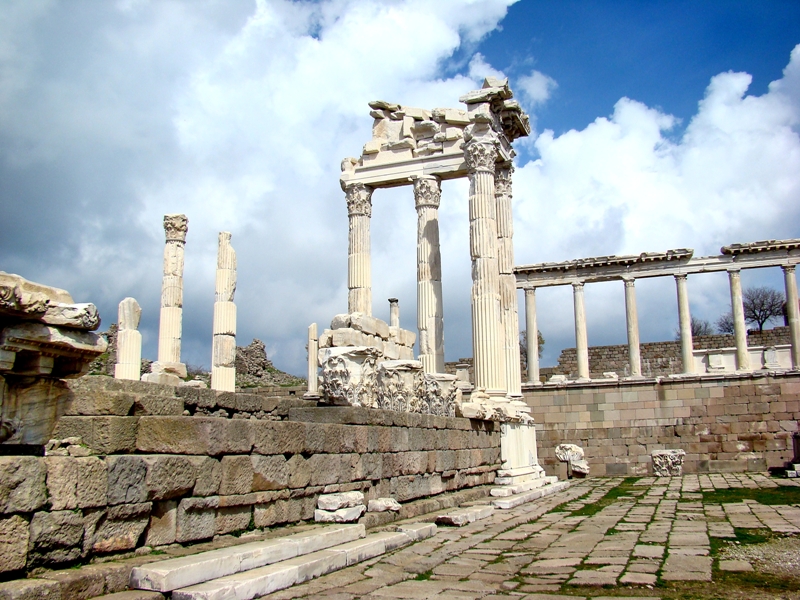
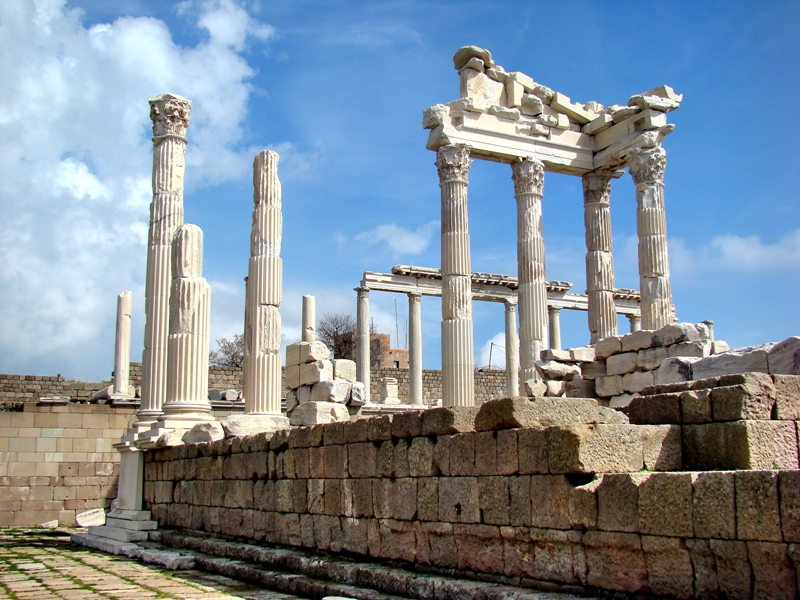
Pergamum came under Roman rule in 133 B.C., when King Attlos II died. He had bequeathed Pergamum to Rome in his will. It was during Roman times that a temple was built and dedicated to Emperor Trajan and his adopted son Hadrian. Todd Bolen observes, “The Trajan temple was the jewel of Pergamum.”

Today’s photos depict some of the ruins of the Trajan temple. Restoration has been done by the German Archaeological Institute.  Click on images for higher resolution.

Tragan Temple in Pergamum. Photo by Leon Mauldin.

Trajan reigned A.D. 98-117, and Hadrian reigned A.D. 117-138.

Tragan Temple in Pergamum. Photo by Leon Mauldin.

Pergamum became a center for the Imperial Cult, for emperor worship. Cimok writes:

Having an imperial temple would also bring many visitors to a city like Pergamum during the festivals held for the imperial cult, and consequently economic benefits; thus the cities on Roman soil (including Pergamum and Ephesus) competed over building imperial temples. (Ibid.17).

More to come on Pergamum. See also our previous posts on Emperor Worship at Ephesus April 10,11, and 14.


Haran, of Aram Naharaim (Mesopotamia)

May 7, 2010

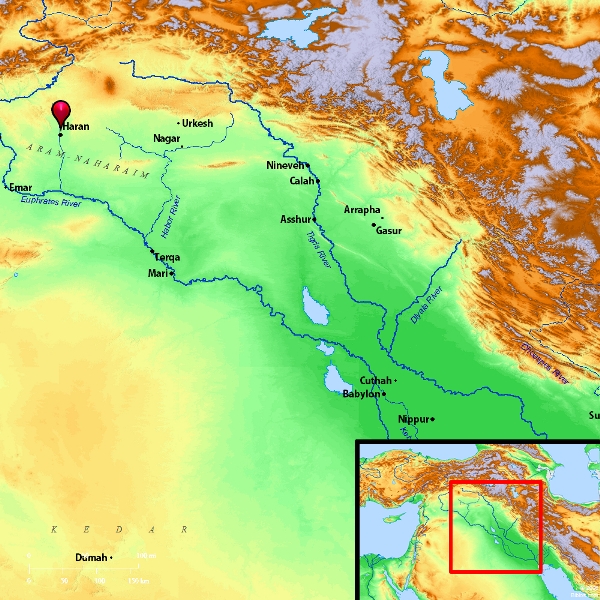
Our previous post pertained to the patriarchal home of Beersheba, located in the South (Negev) in OT Canaan. We saw that Jacob fled from Beersheba and traveled to Haran, “between the rivers;” hence, Mesopotamia (Greek) or Aram Naharaim (Hebrew).  The rivers, of course, are the Tigris and Euphrates. See map below:

Map, Haran. Courtesy http://bibleatlas.org

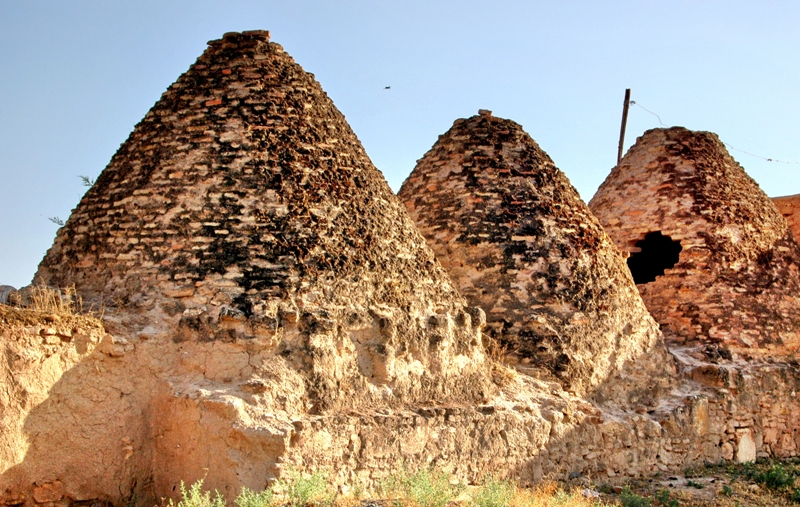
At Haran one can see “bee-hive” shaped houses that are 200 or so years old, which are said to be built along the same style of Patriarchal times.  If that is so, Jacob (and before him Abraham) would have seen houses like these below during his stay there.

Haran, Bee-hive shaped houses. Photo by Leon Mauldin.

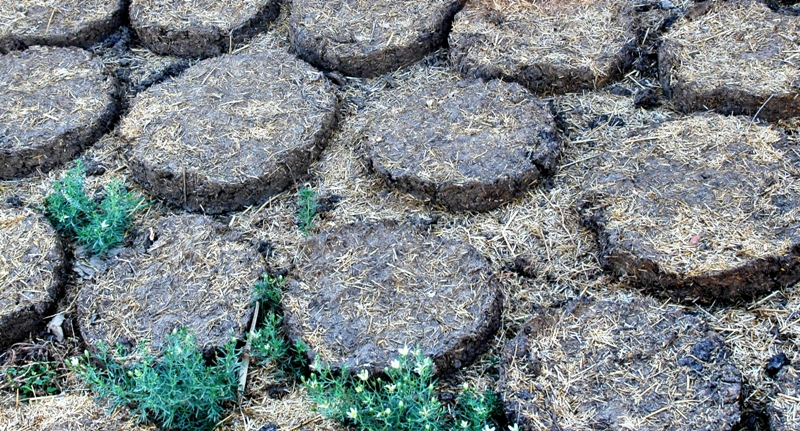
Dung mixed with straw is shaped into “cakes” and allowed to dry.  This is commonly used as fuel for cooking in what is today eastern Turkey.

Haran, Dung Cakes for Fuel. Photo by Leon Mauldin.

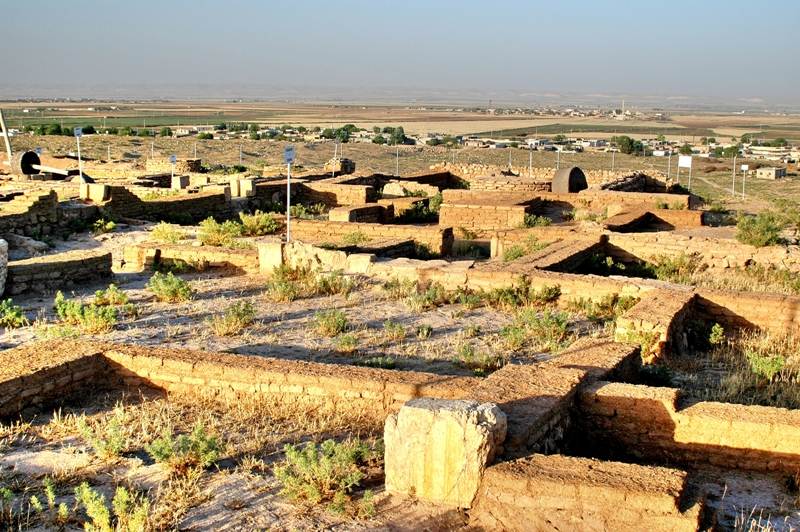
In the photo below we show some of the excavations that have taken place at Haran.  Remember this area would have been home to Jacob for 20 years, as he worked 7 years for Leah, and 7 more for Rachel, whom he wanted in the first place, plus 6 more years for wages, thus 7+7+6=20 years.

Haran, Excavations. Photo by Leon Mauldin


Ephesus Curetes Street

April 11, 2010

We continue to share some photos from the biblical city of Ephesus, the focal point of Paul’s 3rd journey, and one of the seven churches of Asia addressed by the Lord through the Apostle John in the book of Revelation.

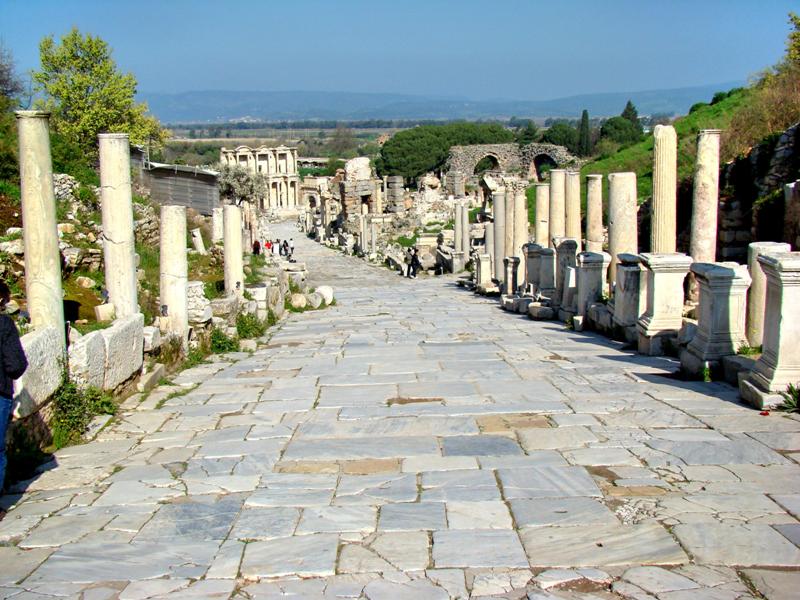
When you travel to Turkey in March as my group just did, you take some risk of rain and cold, and we had some of both the first portion of our trip.  On the other hand, usually the sites are not as crowded.  Ephesus is one of the most frequented sites in Turkey, and can be very crowded at times.  Our photo of Curetes Street gives you a good view without throngs of people.

Ephesus Curetes Street. Photo by Leon Mauldin.

Curetes Street received its name for the inscriptions  naming the curetes, that is, the priests, of Artemis.  Fountains, monuments, statues and shops would have lined the street.  The street itself measured 11 meters wide.  In the distance in our photo you can see the Celsus Library.

In yesterday’s post we mentioned how Ephesus was named as the Neokoros, the temple keeper.  Ephesus was a center of the Imperial Cult, Caesar worship.  Note the inscription below.

Ephesus Neokoros Inscription. Photo by Leon Mauldin.

In the center of this Grecian inscription in the 3rd line down are the words “Neokoroi” and “Ephesion” (Left click on image for larger view).  Sometimes people think if they could have lived back when Jesus was on earth, or in the days of the apostles, it would have been easier then to be faithful to the Lord.  The reality is that those who lived in the first century and the years immediately following had some very difficult and challenging times, including the pressure to cave in to the worship of the Imperial Cult.

I mentioned previously there is so much to see at Ephesus.  More photos to come!


Domitian’s Temple in Ephesus

April 10, 2010

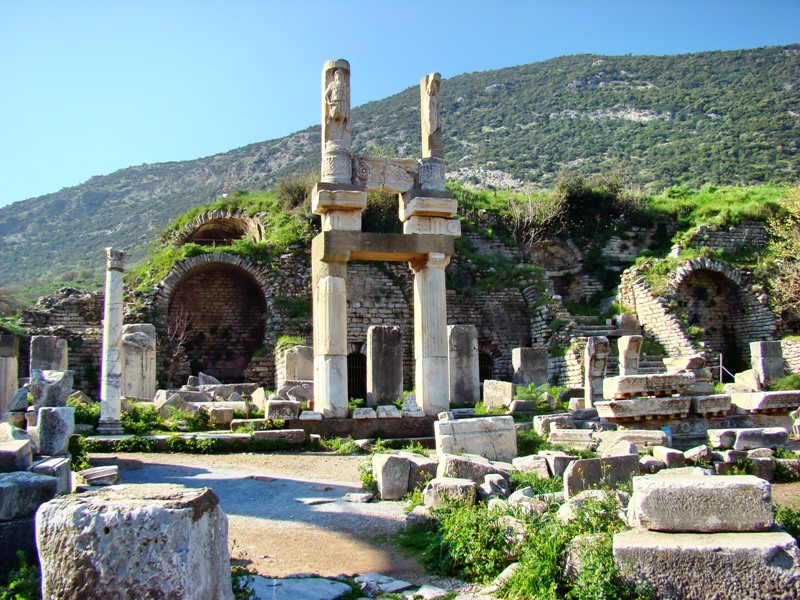
Today’s photo features the emperor Domitian’s temple in Ephesus.  It was considered a high honor for a city to be designated as the neokoros, the temple warden, and Domitian, Roman emperor A.D. 81-96, granted Ephesus that great “privilege.”

Domitian Temple and Square in Ephesus. Photo by Leon Mauldin.

M. Bredin writes, “The imperial cult in Ephesus became particularly prominent in Domitian’s reign.” (Jesus, Revolutionary of Peace: A Nonviolent Christology in the Book of Revelation p.122). I hope to write more in the future regarding the imperial cult and its implications for early Christians.

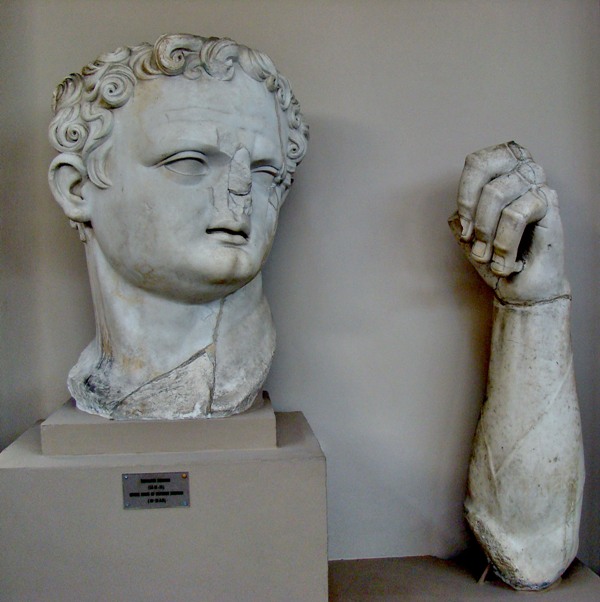
To show their gratitude for being designated as the Temple Warden, the Ephesians built a statue of Domitian which stood five meters tall, portions of which may be seen at the Ephesus Museum.

Domitian Statue. Ephesus Museum. Photo by Leon Mauldin

The time of writing of the book of Revelation seems to be during the latter part of the reign of Domitian.  Christians were severely persecuted during his regime.  Each of the seven churches were promised great blessings, if they would “overcome.”


Scenes from Ephesus

April 8, 2010

Ephesus was the most important city of the Roman province of Asia.  The Apostle Paul preached here longer than any other city, working here three years during the Third Missionary Journey (Acts 20:31).  The message of the gospel radiated out from this principle city: “…so that all who lived in the province of Asia, both Jews and Greeks, heard the word of the Lord” (Acts 19:10).

The church in Ephesus was one of seven churches specified in Revelation 2-3 as recipients of letters from the Lord.  It is sobering to realize that a church that had such a promising beginning, and continued to have such good traits, had in fact left its first love (Rev. 2:4).

Ephesus today is a remarkable site; so much excavation has been done, and there is so much to see. We want to share some photos in today’s post, as well as others to follow, from last month’s visit to Ephesus.

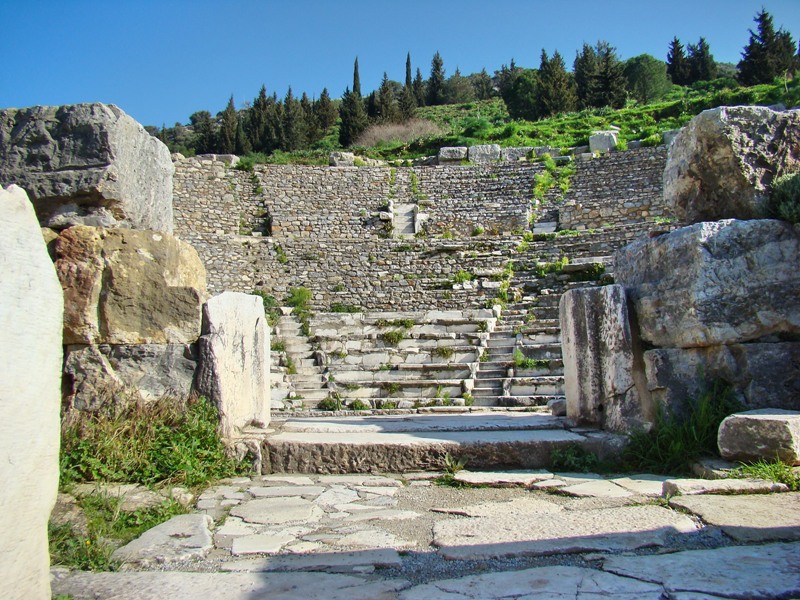
Ephesus Odeion. Photo by Leon Mauldin

The seating of this small theater, the odeion, is 1400-1500. It was built by Publius Vedius Antoninus ca. A.D. 150.  It was used for concerts, and as a meeting place for the city council meetings.

Next we make our way to the prytaneion.

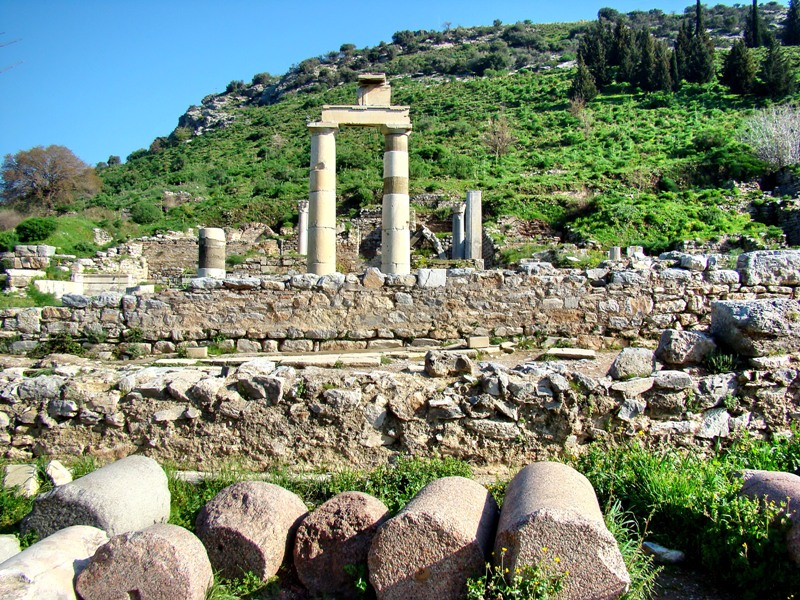
Ephesus Prytaneion_Town Hall. Photo by Leon Mauldin.

The prytaneion was the government agora, the town hall.  There was a courtyard in front of the building. There is evidence of a former temple of the Egyptian god Isis on the western side. Lance Jenott, University of Washington, says further of this site, “This Agora (usually translated as “market place” but in this case more of a “town square”) was built in the first century CE under the Flavian Emperors as the site of the Roman state cult. In the middle of the State Agora sat the temple of Divius Julius (Divine Julius Caesar) and Dea Roma (the divine personification of the Roman Empire).”

More to come!


The Egyptian god Bes

April 5, 2010

Many of our recent posts have featured biblically related artifacts which are housed in Istanbul’s Archaeology Museum.

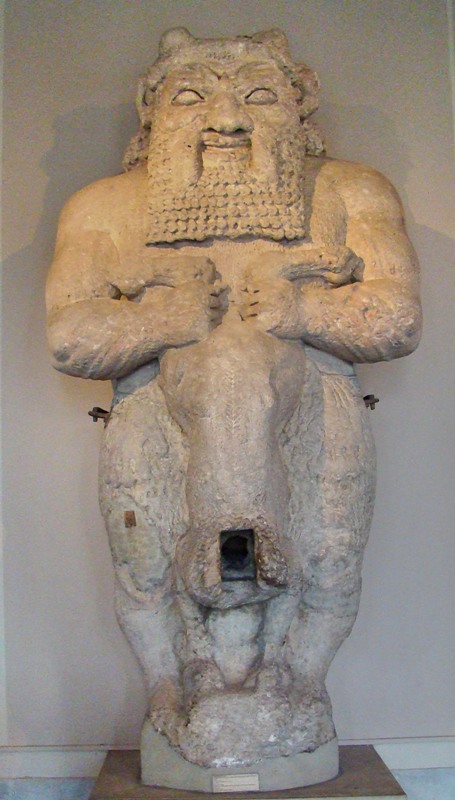
As you enter the main entrance of the museum, you are “greeted” by a 3.5 meter statue of the Egyptian god Bes, depicted as holding a lion by its hind legs.

Image of Bes. Istanbul Archaeology Museum. Photo by Leon Mauldin.

It was believed that Bes protected the individual from evil. BAR editor Hershal Shanks writes, “An Egyptian god adopted into the Canaanite-Phoenician pantheon, Bes served as the ordinary person’s chief talisman against evil. He had already assumed a prominent role by the ninth century B.C.” (15:04 July/August 1989).  It was especially thought that Bes was the protector of pregnant women.

The Biblical World in Pictures notes, “Bes was a household Egyptian deity responsible for the welfare of pregnant women, happiness in the home and prevention of disease. Like many other Egyptian motifs, he was adopted in the Levant, especially in Phoenicia.”

travellinkturkey.com states that the statue of Bes in the Istanbul Archaeology Museum was brought from the island of Cyprus.

Belief in a god such as Bes was only the proverbial “drop in a bucket” of the pervasive idolatry of the ancient world.  In giving the Ten Commandments God called His people to leave all forms of idolatry and be devoted exclusively to Him:

I am the LORD your God who brought you out of the land of Egypt, out of the house of slavery. You shall have no other gods before Me. You shall not make for yourself an idol, or any likeness of what is in heaven above or on the earth beneath or in the water under the earth. You shall not worship them or serve them; for I, the LORD your God, am a jealous God. (Deut. 5:5-9).

The world of the 1st century in which the church was established was permeated by idolatry.  The call of the Gospel is summarized by Paul in 2 Cor. 6:16-2 Cor 7:1:

And what agreement has the temple of God with idols? For you are the temple of the living God. As God has said: “I will dwell in them And walk among them. I will be their God, And they shall be My people.” Therefore “Come out from among them And be separate, says the Lord. Do not touch what is unclean, And I will receive you.” “I will be a Father to you, And you shall be My sons and daughters, Says the LORD Almighty.” Therefore, having these promises, beloved, let us cleanse ourselves from all filthiness of the flesh and spirit, perfecting holiness in the fear of God.


An Empty Tomb

April 4, 2010

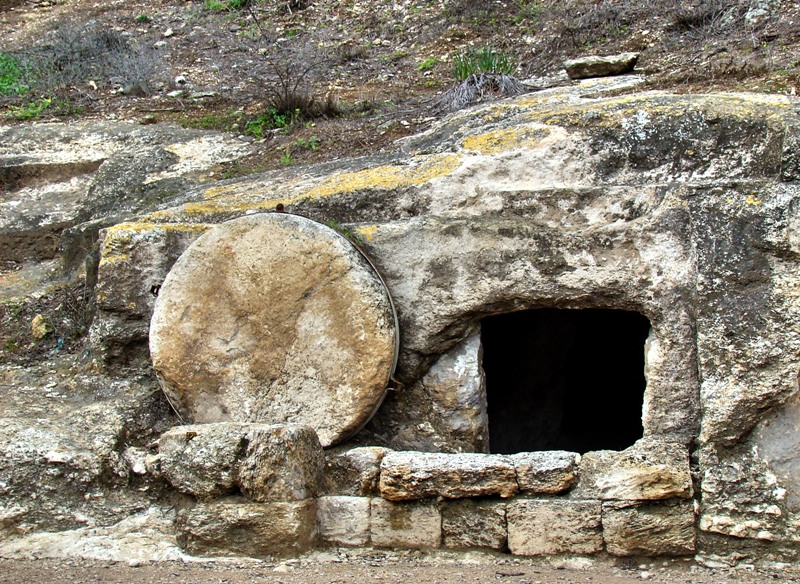
As one descends Mt. Carmel going toward Megiddo, there is a rolling stone tomb whose usage dates back to the first century.

Rolling Stone Tomb Near Carmel. Photo by Leon Mauldin.

This tomb was discovered during road construction.  It so well illustrates the biblical texts that narrate the burial of Jesus.  Joseph of Arimathea had a new tomb (one which had not been previously used, John 19:38-42).  Assisted by Nicodemus, Joseph wrapped Jesus’ body in a clean linen cloth, “and laid it in his new tomb which he had hewn out of the rock; and he rolled a large stone against the door of the tomb, and departed” (Mt. 27:59-60). The tomb in our photo was hewn out of the rock, and you can see the large stone positioned to the left of the opening.

On Sunday, the 1st day of the week when Jesus was raised from the dead, the text says this about Peter and “the other disciple:”

So they both ran together, and the other disciple outran Peter and came to the tomb first. And he, stooping down and looking in, saw the linen cloths lying there; yet he did not go in. Then Simon Peter came, following him, and went into the tomb; and he saw the linen cloths lying there, and the handkerchief that had been around His head, not lying with the linen cloths, but folded together in a place by itself. Then the other disciple, who came to the tomb first, went in also; and he saw and believed. (John 20:4-8).

Note the record says the disciple stooped down to look in.  The tomb in our photo shows how this would of necessity be true.

Rolling Stone Tomb. Stooping to Look Inside. Photo by Ferrell Jenkins.

Note that we are not suggesting that this is the tomb in which Jesus was buried; it does however illustrate the type of tomb that would have been used.

For New Testament Christians, each first day of the week is significant.  Christians assemble in the name of Jesus Christ to partake of His memorial feast, the Lord’s Supper.  That Supper points back to His death, His body and His blood.  But we serve a risen Savior!  We proclaim His death till He comes (1 Cor. 11:26).


The Siloam Inscription

April 2, 2010

Another treasure in the Istanbul Archaeology Museum is the Siloam Inscription. Here is its history:

The Old Testament records the Assyrian threat to Judah in the days of good King Hezekiah (715-686 B.C.).  The Assyrians had already taken much of Judah’s territory (the Sennacherib Prism states Assyrian had taken forty-six fortified cities) and were advancing upon Jerusalem (701 B.C).  But Hezekiah had made wise preparation in anticipation of this fearsome foe. Hezekiah had two teams of tunnelers working from opposite directions; one starting from outside the city wall at the Gihon Spring, the other starting from inside the city, chiseling through 1750 feet of solid rock.  As a result, the “gently flowing waters of Shiloah” (Isa. 8:6) were channeled inside the city (2 Kings 20:20-21; 2 Chron. 32:30).

Thus Jerusalem had water inside the city walls, whereas Hezekiah “blocked the outlet of the water of the Upper Gihon” (2 Chron. 32:20, CSB). I.e., they would have water inside the city, but the enemy would not have ready access to water outside the city.

We hope the following photos will help illustrate the text for you:

Siloam Inscription. Istanbul Archaeology Museum. Photo by Leon Mauldin.

The inscription tells the story of when the two groups of workers met. The inscription reads:

“This is the story of the boring through. While [the tunnelers lifted] the pick-axe each toward his fellow and while 3 cubits [remained yet] to be bored [through, there was heard] the voice of a man calling his fellow—for there was a split [or overlap] in the rock on the right hand and on [the left hand]. When the tunnel was driven through, the tunnelers hewed the rock, each man toward his fellow, pick-axe against pick-axe. And the water flowed from the spring toward the reservoir for 1200 cubits. The height of the rock above the head of the tunnelers was a hundred cubits.”

Of course, more was involved than Hezekiah’s engineering feat of constructing the tunnel.  There was divine intervention as God delivered Jerusalem from the Assyrians: 2 Kings 19:35 records, “And it came to pass on a certain night that the angel of the LORD went out, and killed in the camp of the Assyrians one hundred and eighty-five thousand; and when people arose early in the morning, there were the corpses — all dead.”

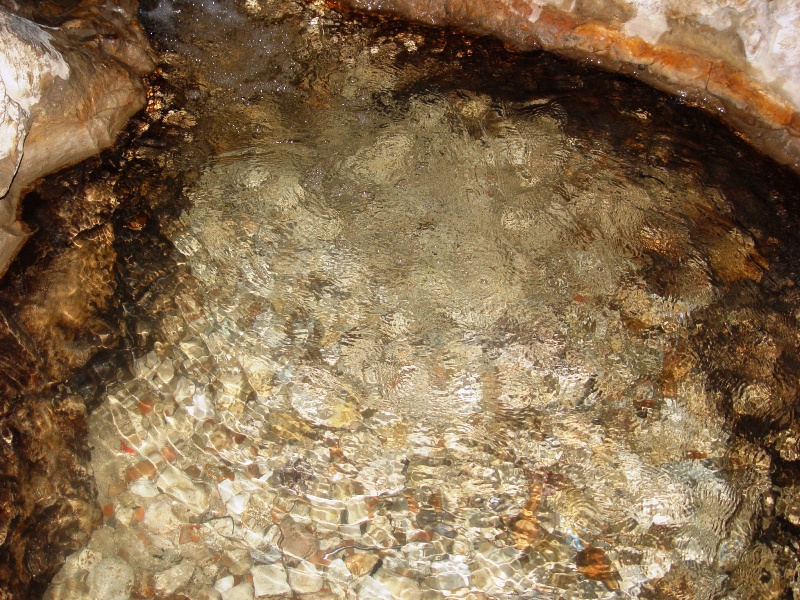
This photo shows the Gihon Spring, the source of the water supply.

Gihon Spring. Jerusalem. Photo by Leon Mauldin.

The water still flows inside the tunnel.

Inside Hezekiah's Tunnel. Photo by Leon Mauldin.

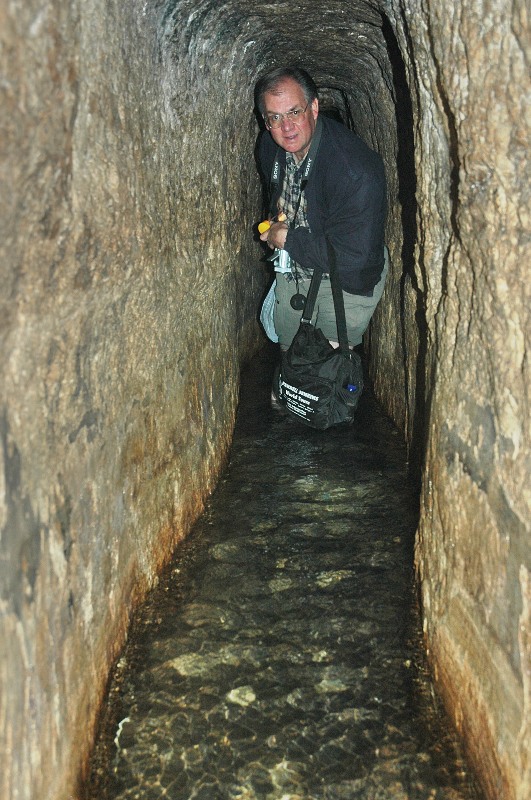
It’s a tight squeeze in places:

Leon Mauldin inside Hezekiah's tunnel. Photo by Ferrell Jenkins.

Finally, here is a photo of the location where the Siloam Inscription was chiselled out:

Siloam Inscription Location Inside Tunnel. Photo by Leon Mauldin.