Delphi, Greece

February 17, 2015

Though Delphi is not a biblical city, this site was of great importance in antiquity. The

Seat of an important oracle and temple of Apollo at least as early as the seventh century, Delphi received pilgrims from all over Greece. She was enriched, too, as numerous city-states sent their votive gifts and erected shrines there. The Pythian Games, in honor of Apollo, were held at Delphi every four years. (Pfeiffer, The Wycliffe Historical Geography of Bible Lands).

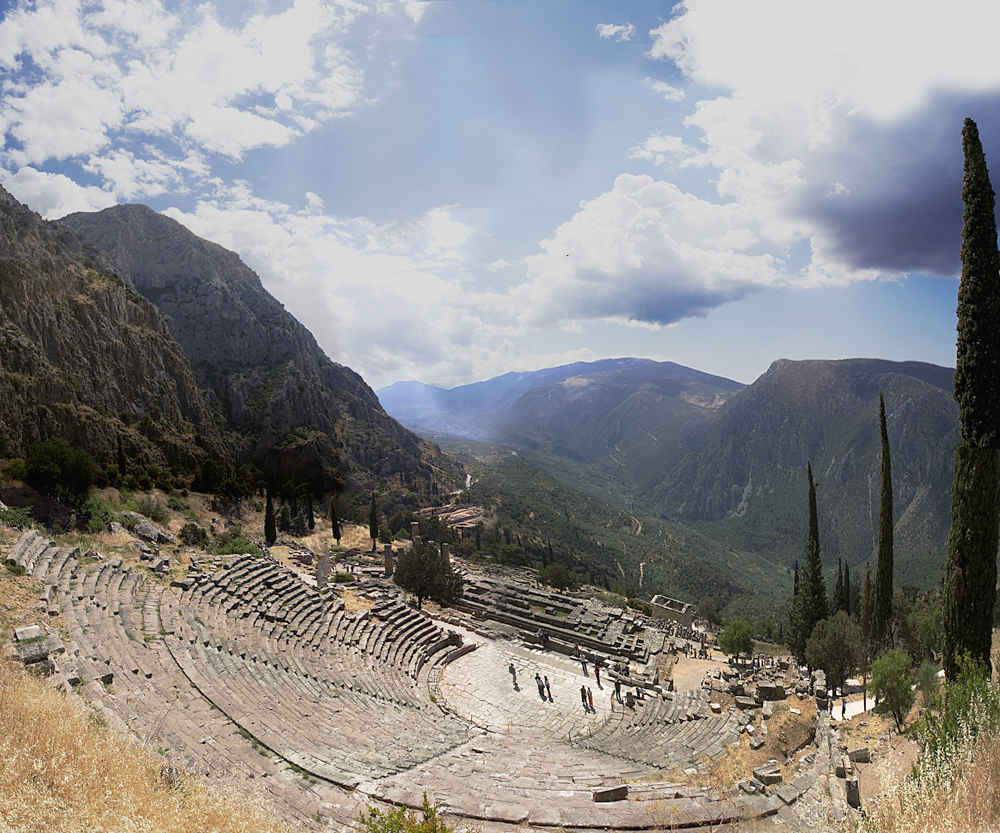
This photo shows the theater of Delphi. At bottom center is the temple of Apollo.

Delphi Theater. Photo by Leonidtsvetkov at en.wikipedia

Delphi Theater. Photo by Leonidtsvetkov at en.wikipedia

Fant and Reddish point out,

When it is surrounded by blooming almond trees in the spring, Delphi is surely one of the most beautiful places in the world. The ancient Greeks agreed and described it as the center (literally, the navel, omphalos) of the world.

The Sacred Precinct of Delphi comprises, in addition to the temple of Apollo, an impressive theater, the Bouleuterion (council chamber) of the city, numerous treasuries of Greek cities that held valuable offerings to Apollo, and many monuments and altars. From the entrance, the Sacred Way leads uphill between the bases of monuments that celebrated military victories and more than twenty treasuries that held votive offerings. The Treasury of the Athenians (510 B.C.E.) has been reerected in the form of a Doric temple. The Temple of Apollo itself was originally built in the 7th century B.C.E.; it burned to the ground in 548 B.C.E. and was rebuilt in 531 B.C.E.  

This later temple collapsed from an earthquake in 373 B.C.E. Only the foundations of the third temple (346–320 B.C.E.) remain today.

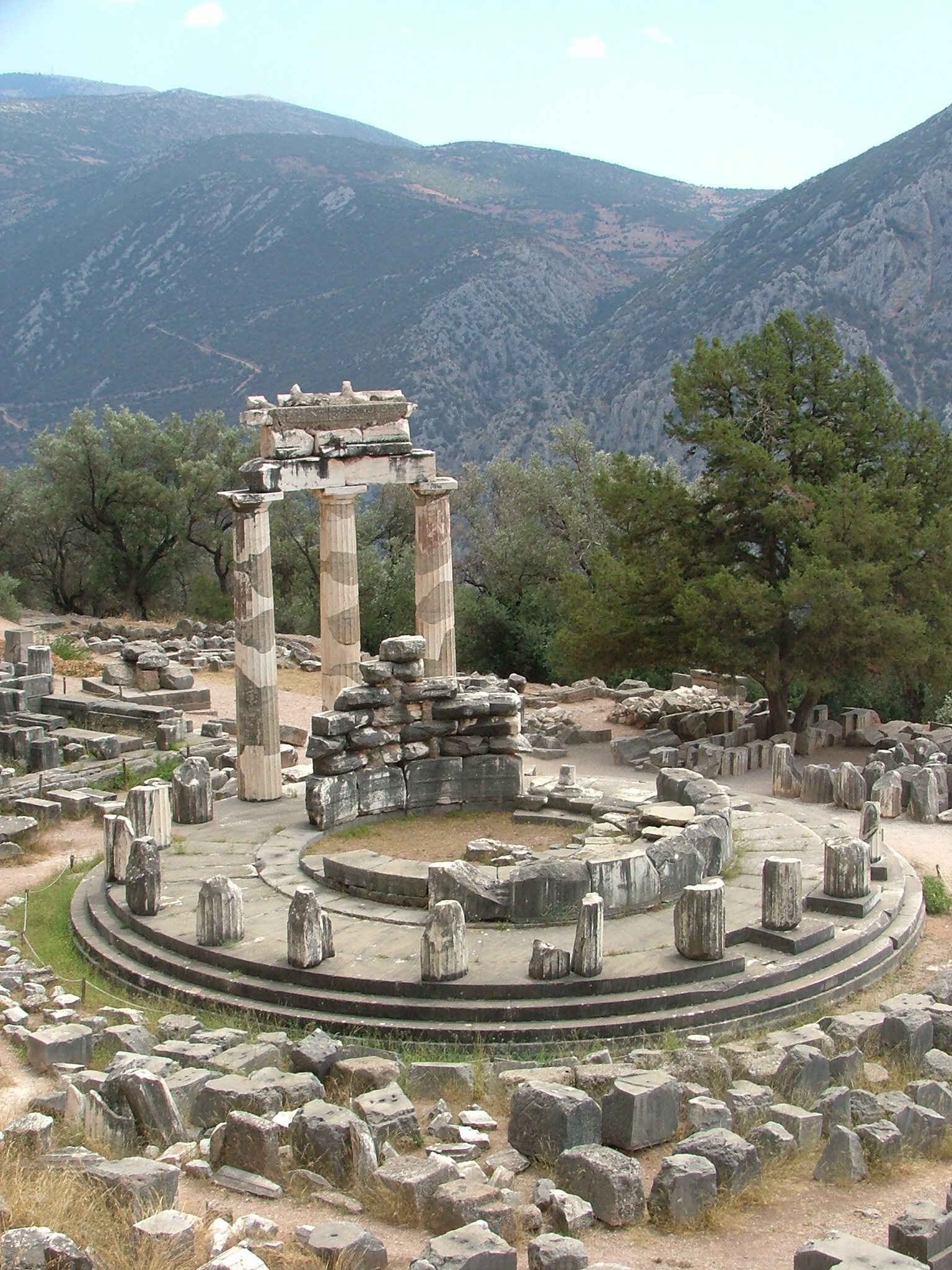
Here is a photo of the Sanctuary of Athena. This tholos, or rotunda, was build early 4th century BC.

Sanctuary of Athens at Delphi. Photo by By KufoletoAntonio De Lorenzo and Marina Ventayol. Wikipedia.

Sanctuary of Athens at Delphi. Photo by By KufoletoAntonio De Lorenzo and Marina Ventayol. Wikipedia.

One very important artifact in the Delphi Museum is the Gallio inscription. Gallio is the Proconsul of Achaia before whom Paul stood for trial at Corinth as related in Acts 18:12ff. For a photo of this inscription click here.

Click images for larger view.


Seneca the Younger, Gallio’s Brother, Column at Corinth

February 12, 2015

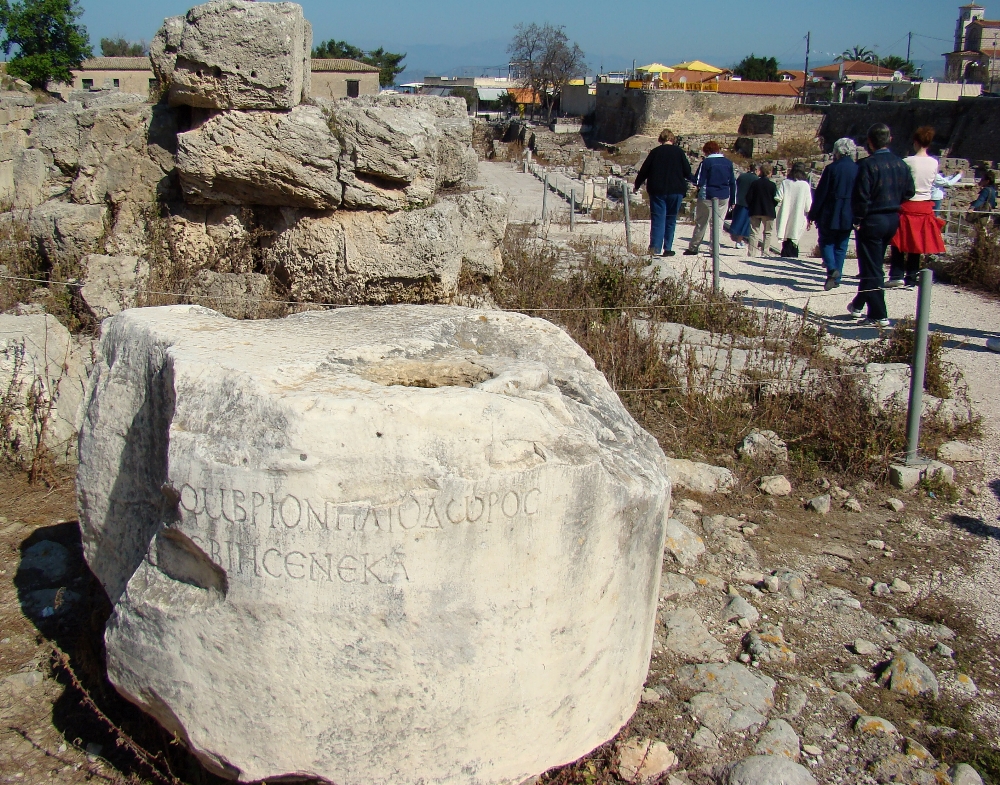
Among the ruins visible today as one visits biblical Corinth, is a portion of a column bearing the name of Seneca.

Column fragment at Corinth bearing Seneca's name (Latin Ceneka). Photo by Leon Mauldin.

Column fragment at Corinth with Seneca’s name (Latin CENEKA). Photo by Leon Mauldin.

Seneca is of interest to students of Acts, because he is the brother of the Proconsul Gallio, before whom Paul stood trial at Corinth (Acts 18:12-17). Usually when Paul was brought before rulers for his gospel teaching he was promptly beaten and often imprisoned (2 Cor. 11:23-27). However here at Corinth Gallio could see that Paul was not a law-breaker, and threw the case out.

Wikipedia has this info on Seneca:

Lucius Annaeus Seneca (often known simply as Seneca /ˈsɛnɪkə/; c. 4 BC – AD 65) was a Roman Stoic philosopher, statesman, dramatist, and in one work humorist, of the Silver Age of Latin literature.

He was a tutor and later advisor to emperor Nero. While he was forced to commit suicide for alleged complicity in the Pisonian conspiracy to assassinate Nero, he may have been innocent. His father was Seneca the Elder, his elder brother was Lucius Junius Gallio Annaeanus, called Gallio in the Bible, and his nephew was the poet Lucan.

The mention of Gallio in the text (Acts 18) is helpful in dating the events at that point in the ministry of Paul.

Gallio was the proconsul [Grk. anthupatos] of the Roman senatorial province of Achaia (Acts 18:12). Proconsuls generally served two-year terms, and such appointments offered potentially great financial rewards. Achaia’s administrative center was Corinth, a newly rebuilt city at the time and a busy commercial and transport center. The city had as many as 200,000 residents, and the province of Achaia may have had several million subjects. . .

An inscription at the Temple of Apollo in Delphi indicates that Gallio’s time in Corinth may be dated to AD 51–53. Thus, Paul’s appearance before Gallio probably occurred in the spring or summer of AD 51. (The Lexham Bible Dictionary).

In an article entitled “Paul, Dating, and Corinth: The Gallio Inscription and Pauline Chronology,” Gardner Gordon wrote:

Gallio’s younger brother, Seneca, was a philosopher, and apparently an inflammatory one. In AD 41, Emperor Claudius exiled this young thinker to the isle of Corsica. Usually, such disgrace tarnished the entire family. Whatever political ambitions Gallio may have had were effectively derailed by his brainy brother’s banishment. But in AD 49, Seneca was ushered back to Rome with a grand purpose: he was placed in the imperial court as the tutor to Claudius’ nephew and royal successor, a young, impetuous Roman named Nero. Undoubtedly, it was at this time that Seneca was instrumental in helping to secure a political post of proconsul for his older brother, Gallio.

That article may be read in its entirety by clicking here.

I have several posts on biblical Corinth, with photos and brief articles. Use search box at upper right.

Click image for larger view.


View from Roman Forum in Athens Greece

February 10, 2015

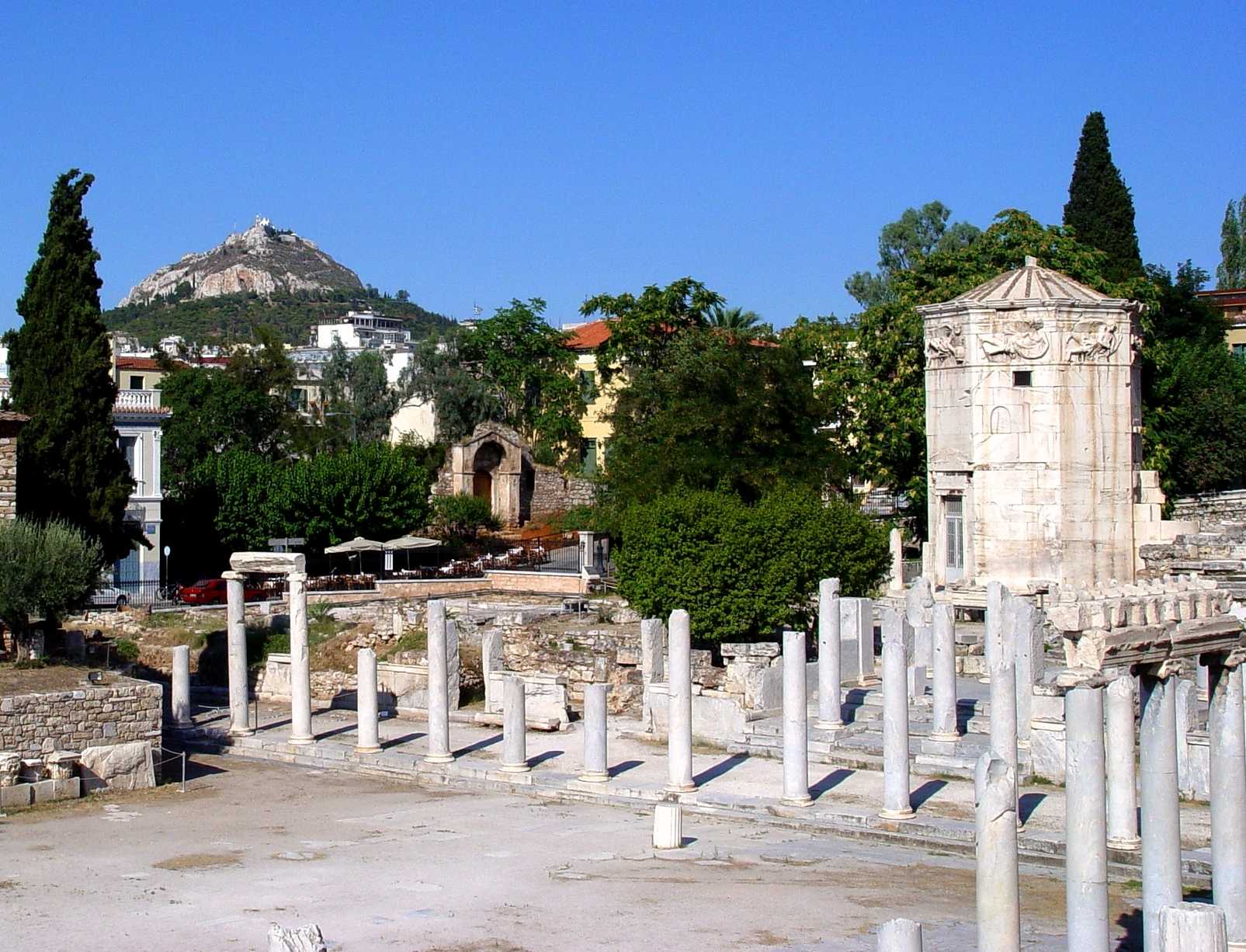
Yesterday we had another view down the south side of the acropolis in Athens, Greece. Now we move to the north side, down below the acropolis, to the Roman Forum. In our photo here you can see a portion of the forum, the Tower of the Winds (right), and to your distant left Mount Lykavittos.

Roman Forum, Tower, and Mt. Lykavittos in Athens, Greece. Photo by Leon Mauldin.

Roman Forum, Tower, and Mt. Lykavittos in Athens, Greece. Photo by Leon Mauldin.

The Tower of the Winds has an interesting history:

The Tower of the Winds stands in the Pláka below the north side of the Acropolis. In the planning of the modern city of Athens in the 19th century. Eólou Street, named after the wind god Ailos, was aligned directly on the tower, which forms a landmark at its southern end.

Built about 40 B.C., the tower is an octagonal structure 12m/40ft high, with sundials on the external walls; it originally housed a water-clock.

Around the top runs a frieze with reliefs representing the eight wind gods – the beardless Notos, pouring out rain from an urn (south); Lips, holding the stern ornament of a ship (southwest); Zephyros, a youth scattering flowers (west); Sykron the bringer of snow (northwest); the bearded Boreas, blowing into a shell (north); Kaikias, also bearded, the bringer of hail (northeast); Apeliotes, a young man bearing ears of corn and fruit (east); and Euros, wrapped in a cloak (southeast).

To the south of the tower is a building of the Roman period (first century A.D.) with the springing points of arches. Its function is uncertain (office of the market police, Caesareum?).

Adjoining the entrance to the excavated area is a marble latrine with seating for nearly 70.

The water-clock is located outside the western entrance to the Roman Market. It served as a form of meteorological station by combining a sundial, a waterclock and a weathervane showing the direction of the wind.

The clock is commonly known as “Aerides” (the winds) (Planetware.com).

A highly visible landmark, Lykavittos, also known as Lykabettos, stands 227 meters/909 feet in altitude. It was:

once well outside Athens but now surrounded by the city on all sides, is the dominant hill in the plain of Attica. It is a hill of cretaceous chalk, covered with various species of plant life, and is a popular place to go to escape from the hurly-burly of city life. At the top stands the chapel dedicated to St George, from where there are extensive views of the whole city (Planetware.com).

Click photo for larger view. Use search box at upper right for more posts on Athens, as well as other biblical sites.


Odeon of Herodes Atticus

February 9, 2015

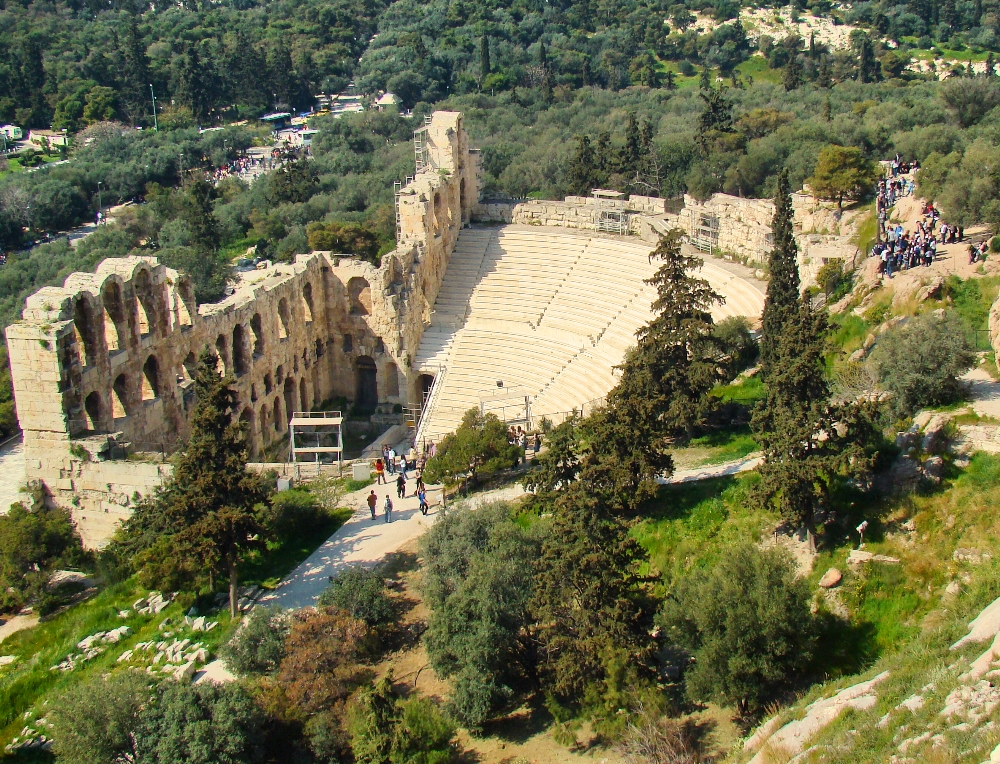
On the south slope of the Athenian Acropolis you can view the Odeon of Herodes Atticus. An odeon was a theater built for musical performances and poetry competitions. This structure post-dates the apostle Paul and his preaching here (Acts 17) by about a century.

Odeum of Herodes Atticus. Athens, Greece. Photo by Leon Mauldin.

Odeon of Herodes Atticus. Athens, Greece. Photo by Leon Mauldin.

From Wikipedia:

It was built in 161 AD by the Athenian magnate Herodes Atticus in memory of his wife, Aspasia Annia Regilla. It was originally a steep-sloped amphitheater with a three-story stone front wall and a wooden roof made of expensive, cedar of Lebanon timber. It was used as a venue for music concerts with a capacity of 5,000. It lasted intact until it was destroyed and turned into a ruin by the Heruli in 267 AD.

The Odeon (AD 161) was a gift from Herodes Atticus:

whose life reads like something out of the Arabian Nights; he inherited his extraordinary wealth from his father, who found a treasure outside Rome. Famous in its time for having no interior columns to support its long-gone cedar wood roof, the 6,000 seat Odeion hosts the excellent Festival of Athens, where modern European and ancient Greek cultures meet in theatre, ballet and classical concerts performed by companies from all over the world. (Greece by Dana Facaros & Linda Theodorou. Cadagan Guides. p.119).

Click image for larger view. For other posts on Athens, Greece use search box at upper right.


Paul’s Acts 17 Sermon, Greek Text, at Aeropagus, Athens Greece

February 5, 2015

In Acts 17 Luke narrates how Paul was invited to speak to the men of Athens in the midst of the Areopagus, at Mars Hill. Among the listeners were Epicurean and Stoic philosophers (v.17). He began his address by referencing an altar in their city with this inscription: “TO THE UNKNOWN GOD.” Using that as his starting point, he contrasted the true God with the idols they worshiped. The true God made all things, including us. He gives unto us life, breath, and all things. Because He is the Creator, and we are His creatures, we must seek after Him and find Him. He commands all men everywhere to repent; a day is coming in which He will judge the world in righteousness by the One whom He raised from the dead (summary of vv. 23-31).

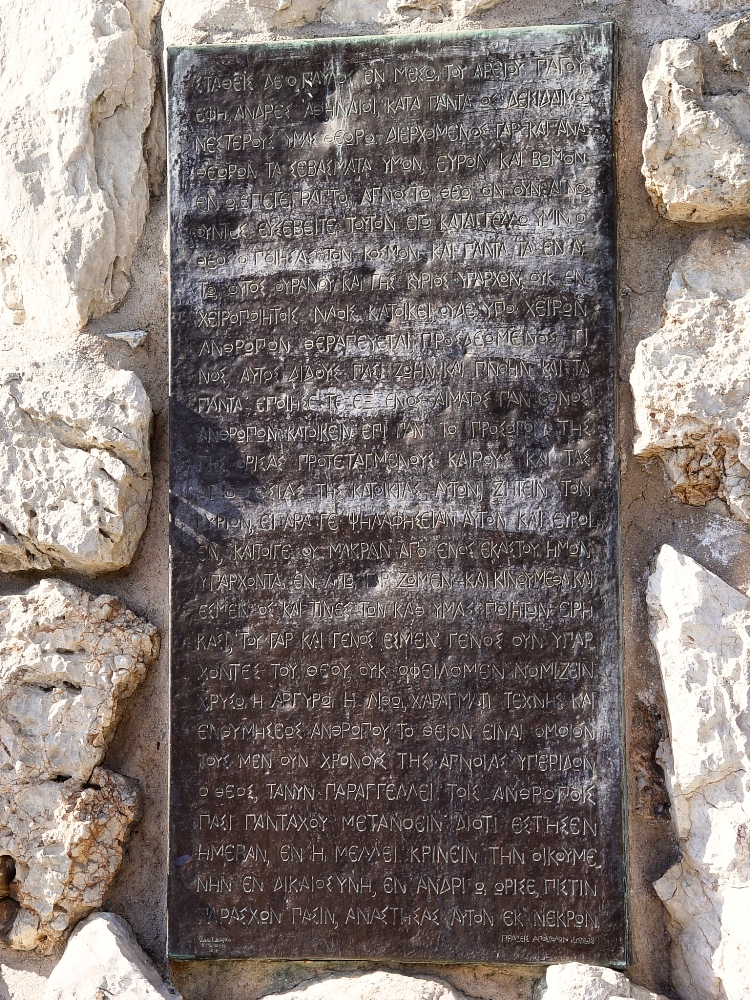
Today at the site of Mars Hill there is a bronze plaque with the text of Paul’s sermon engraved in the Greek language.

Paul's Acts 17 sermon, on bronze plaque at base of Mars Hill, Athens, Greece. Photo by Leon Mauldin.

Paul’s Acts 17 sermon, on bronze plaque at base of Mars Hill, Athens, Greece. Photo by Leon Mauldin.

The Greeks did not believe in a resurrection, so as soon as Paul mentioned that, many of his audience stopped listening (v.32). Others procrastinated (v.32). But there were some converts to Christ there: Dionysius the Areopagite, a woman named Damaris, and others with them” (v.34).

We have numerous other posts on Athens. Use search box at above right.

Click image for larger view.


Sanctuary of Asclepius at Athens

January 31, 2015

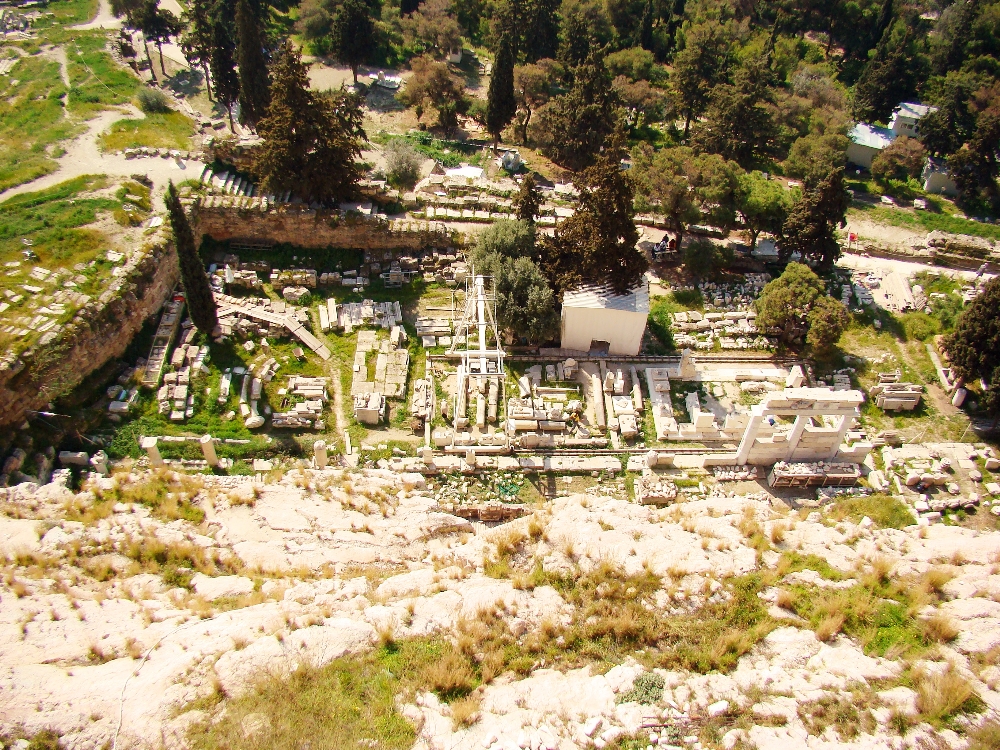
In biblical times, Asclepius was widely worshiped as the god of healing. As we continue our view down the southern slope of the Athenian acropolis, we can see the remains of the sanctuary of Asclepius.

Athen's Sanctuary of Asclepius, the god of healing. Photo by Leon Mauldin.

Sanctuary of Asclepius, the god of healing. Athens, Greece. Photo by Leon Mauldin.

Fant and Reddish observe, “Above the Stoa of Eumenes, and to the left (west) of the Theater of Dionysus, can be seen the scant remains of the Asclepeion, a center for healing run by the priests of Asclepius. The sacrificial altar remains, but it is difficult to discern amid the various stones currently being stored there” (A Guide to Biblical Sites in Greece and Turkey, p.26). (We should note that when they say “left” it is from the perspective of one who is down from the acropolis. When you’re on the acropolis looking down, the sanctuary would be to your right of the theater of Dionysus–LM). 

We have previous written on Asclepius here and here  regarding the famous healing center at Pergamum. Even in Israel there was a temple devoted to this god.

Planetware.com has this info:

On a narrow terrace above the Stoa of Eumenes, directly under the steep south face of the Acropolis, is the Asklepieion, the sanctuary of the healing god Asklepios, whose cult – initiated largely by Sophocles – was brought to Athens from Epidauros in 420 B.C. The sanctuary is centered on two sacred springs.

The earliest part of the sanctuary lay at the western end of the precinct, where there are the foundations of a stoa and a small temple. A number of herms have been brought together in the stoa. At the west end of the complex is a rectangular system with polygonal walls dating from the same period. To the south is a later cistern.

The buildings in the eastern part of the precinct were erected about 350 B.C. Immediately under the Acropolis rock, here hewn into a vertical face, is a stoa 50m/165ft long, originally two- storyed, designed to accommodate the sick who came here to seek a cure. Associated with it is the cave containing a spring which is still credited with healing powers; and accordingly the cave is now used as a chapel.

Parallel to this stoa, which was rebuilt in Roman times, another stoa was constructed, also in Roman times, on the southern edge of the precinct; of this second stoa some remains survive.
Both stoas faced towards the center of the precinct, in which stood the temple. This was oriented to the east and had four columns along the front (prostylos tetrastylos). The foundations of the temple and the altar which stood in front of it are still to be seen.
In early Christian times a basilica was built over the remains of the temple and the altar, and some architectural fragments from this can be seen lying about the site.

(http://www.planetware.com/athens/asklepieion-gr-ath-askle.htm)

Click on image for larger view.


Athens Temple of Themis

January 30, 2015

Many of the sites in ancient Athens are world renown. The Parthenon, for example, was one of the Seven Wonders of the World (see our previous post here).

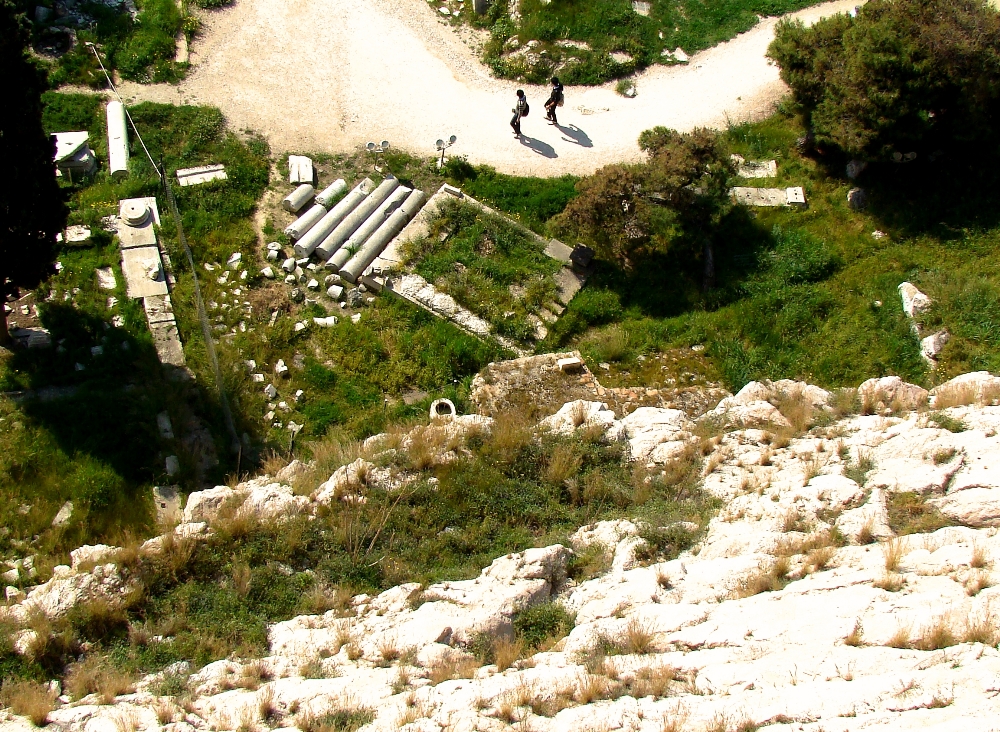
Other sites are not as well known. Looking down the south slope of the acropolis you can see the remains of the small temple of Themis, seen here at center of photo.

Temple of Themis in Athens, Greece. Photo by Leon Mauldin.

Temple of Themis in Athens, Greece. Photo by Leon Mauldin.

In Greek mythology,

Themis was the Titan goddess of divine law and order–the traditional rules of conduct first established by the gods. She was also a prophetic goddess who presided over the most ancient oracles, including Delphoi. In this role, she was the divine voice (themistes) who first instructed mankind in the primal laws of justice and morality, such as the precepts of piety, the rules of hospitality, good governance, conduct of assembly, and pious offerings to the gods. In Greek, the word themis referred to divine law, those rules of conduct long established by custom. Unlike the word nomos, the term was not usually used to describe laws of human decree.

Themis was an early bride of Zeus and his first counsellor. She was often represented seated beside his throne advising him on the precepts of divine law and the rules of fate.

Themis was closely identified with Demeter Thesmophoros (“Bringer of Law”). Indeed Themis’ six children, the spring-time Horai and death-bringing Moirai, reflect the dual-functions of Demeter’s own daughter Persephone. Themis was also identified with Gaia (Earth) especially in the role of the oracular voice of earth. http://www.theoi.com/Titan/TitanisThemis.html

This temple is mentioned by Pausanias (ca. AD 110-180), a Greek traveler and geographer, in his Description of Greece. This lengthy work describes ancient Greece from firsthand observations. His brief notation on this temple was, “After the sanctuary of Asclepius, as you go by this way towards the Acropolis, there is a temple of Themis.”
We have several other posts on ancient Athenian temple and other sites, here, here and here. Use the search box at top of home page. Click image for larger view.

Propylaea of Athens

January 23, 2015

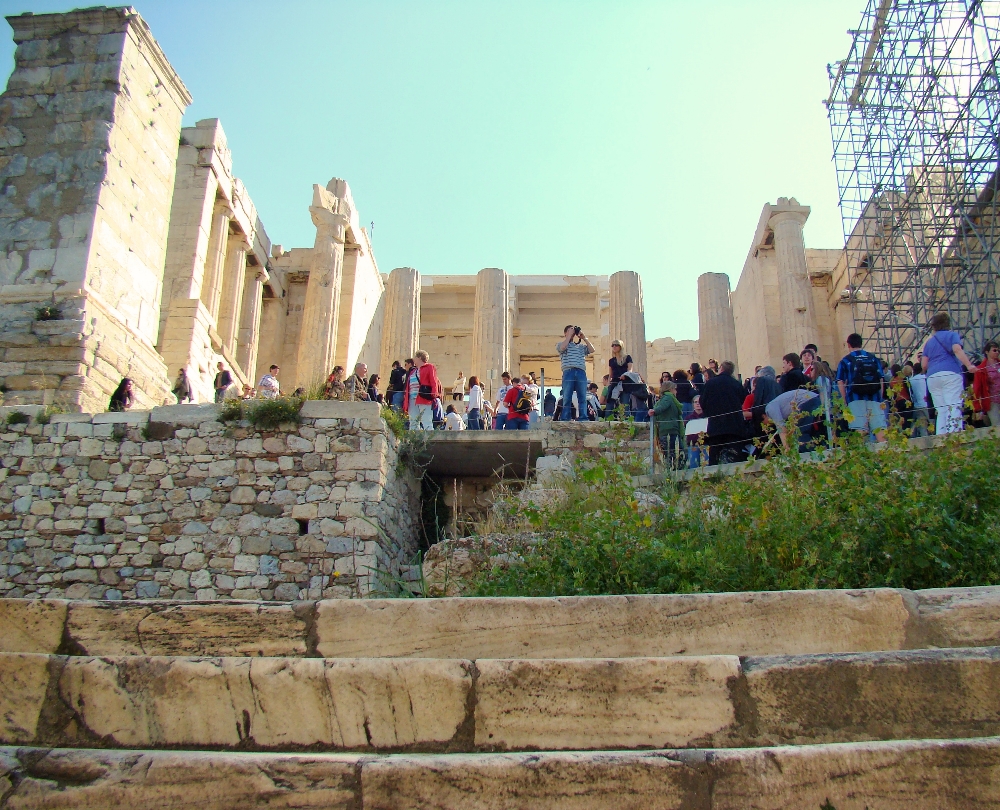
The Propylaea (entrance before the gate) still stands as the access to the Acropolis today. This monumental entrance gate was commissioned by the great statesman and builder of the Acropolis, Pericles. Construction was begun in 437 B.C.

Propylaea leading to Athens Acropolis. Photo by Leon Mauldin.

Propylaea leading to Athens Acropolis. Photo by Leon Mauldin.

Fant and Reddish have this information:

The Propylaea (“before the gate”) visible today is the fourth of such structures to be built at this site; earlier ones were destroyed in various wars. The road from the agora below, the Panathenaic Way, led up to this point. A flight of marble steps ascends to the hall of the Propylaea. One step is of gray Eleusinian marble; the others are of white Pentelic marble. The monumental pedestal (25 feet tall) on the left of the steps originally was designed for a statue with a chariot and four horses to honor King Eumenes II of Pergamum for his contribution of the Stoa of Eumenes. Later it was reinscribed with a dedication to Marcus Agrippa in honor of the odeion he contributed to the agora. Designed by the architect Mnesicles and begun upon the completion of the Parthenon (437 B.C.E.), the Propylaea consisted of a central section with five doorways, originally fitted with wooden doors, and projecting wings on either side. The wing on the left side, the north wing, was known as the Pinakotheke, or art gallery, because of the magnificent collection of paintings inside. In 150 C.E. Pausanius named a number of the paintings he could recognize, including some by Polygnatus of Homer (5th century B.C.E.). The room was used for official banquets by dignitaries who reclined on couches in the Greek fashion. The wing on the right side, the south wing, could not match the other in design because of the Temple of Athena Nike and other buildings that impinged upon it. This wing was never completed due to the start of the Peloponnesian War (431 B.C.E.). (A Guide to Biblical Sites in Greece and Turkey).

We are looking forward to seeing Athens again in a couple of months.

Click image for larger view.


Aphek, Setting of 1 Samuel 4

December 31, 2014

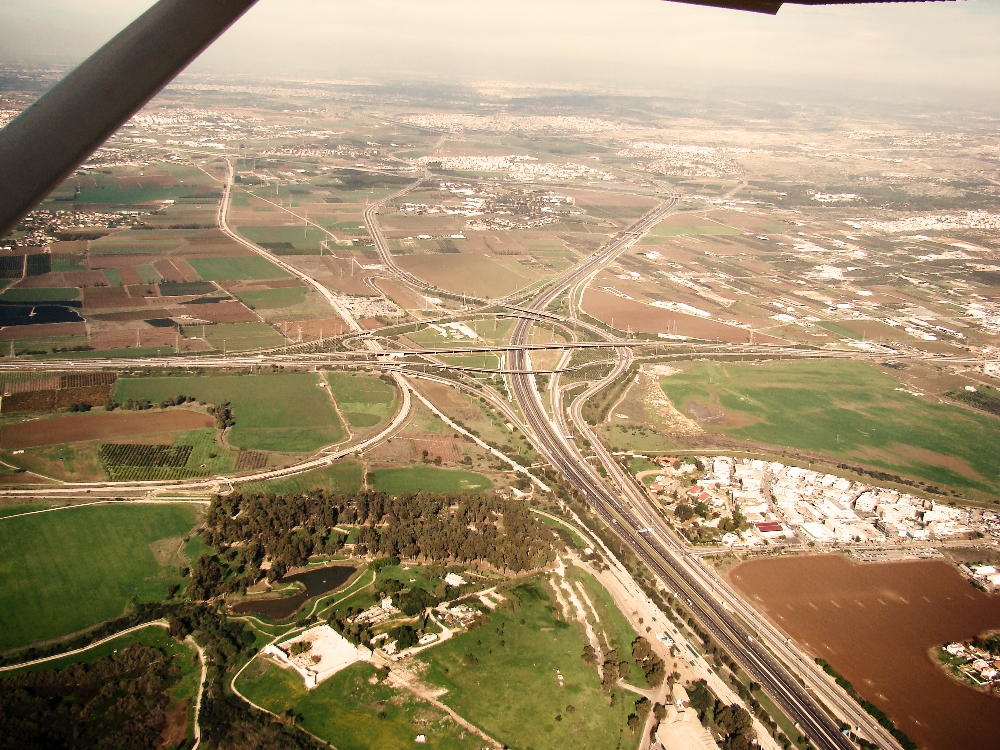
1 Sam. 4:1 mentions a Philistine encampment at Aphek, when the Philistines drew up in battle array to meet Israel. Apparently the site of the battle itself was between Ebenezer and Aphek. Israel was defeated soundly in two back-to-back battles there. Our photo shows Aphek at bottom and left; view is from the south. As you look to the north you are seeing the Sharon plain. The modern highway at this point is following the route of the ancient Via Maris.

Aphek at lower left. View from south. Photo by Leon Mauldin.

Aphek at lower left. View from south. Photo by Leon Mauldin.

I earlier posted on Aphek here. Aphek became Antipatris by NT times (Acts 23:31). See also Ferrell Jenkins’ post here.

In Todd Bolen’s Pictorial Library of Bible Lands (#2, Samaria and the Center), Todd summarizes the History of the excavations at Aphek in his PowerPoint notes on “Sharon Plain” (slide 15): (BTW, I highly recommend this set!)

Aphek: History of the Excavation

1.In 1923, Albright’s survey confirmed identification of the site as Aphek.

2.From 1935 to 1936, J. Ory, an employee of the British Department of Antiquities, dug two test pits in two areas on the north side of the site, in connection with the British pumping station.

3.The Palestine Department of Antiquities excavated in 1946.

4.In 1961, A. Eitan excavated for the Israel Department of Antiquities.

5.From 1972 to 1985, a major excavation was carried out by Moshe Kochavi of Tel Aviv University.

Aphek has a fascinating history. The Archaeological Encyclopedia of the Holy Land (3rd ed.) has this info on Aphek/Antipatris:

An important station on the ancient Via Maris, mentioned in the list of Pharaoh Tuthmosis III. The King of Aphek was one of the 31 rulers of Canaan vanquished by Joshua (Josh. 12:18). The Philistines gathered their armies there to go into battle against Israel (1 Sam. 4:1; 29:1). Scholars believe that in both cases Aphek in the Sharon is referred to. In a later period the place is mentioned in one of the inscriptions of Esarhaddon, and also in a letter written in Aramaic that was sent to Pharaoh before the Babylonian conquest of Palestine.

Early in the Hellenistic period a fort on the border between the districts of Samaria and the Sharon was built at this place, then known as Pegai. John Hyrcanus I conquered it in about 132 BC. At that period it was also known as Arethusa, both names implying that it was built near rich sources of water, as indeed it was. After the conquest by Pompey in 63 BC the town of Arethusa was rebuilt. When Herod the Great ascended to the throne he built a new city at Arethusa, renaming it Antipatris, after his father Antipater. This new city became the center of a district with many prosperous villages. In the later Roman period it was named Antipatris Antoniniana, probably after Elagabalus. The Mishna mentions it under the name of Mei Piga, the Waters of Piga.

Aphek-Antipatris is identified with Tell Ras el-Ain, which is rich in springs and vegetation. The sizeable mound is now occupied by a large Turkish citadel, built on the remains of a Crusader castle. Trial digs unearthed remains from the Bronze Age to the Roman period, including a large Roman mausoleum.

Extensive excavations were carried out on the site in the years 1974–84 by M. Kochavi on behalf of Tel Aviv University and American archaeological institutions. The earliest remains on the site are those of a city wall of the Early Bronze Age found in the northern part of the mound. On the acropolis on the western part of the mound were discovered a series of palaces. The earliest of these palaces belongs to the Middle Bronze Age IIA. Its walls are 4 feet thick, and are still standing to a height of 5 feet. The palace consists of a central hall with a roof supported by two columns. Numerous rooms are grouped around this spacious hall. It was destroyed by a fierce fire in the middle of the 16th century BC. Two city walls also belong to this period. Above this palace another, larger palace was built in the Late Bronze Age. This spacious building contained numerous rooms; a staircase tower gave access to the rooms on the upper story, where the princes of Aphek lived. North of the palace was a spacious court, and another service building east of it. Wine presses discovered nearby and numerous grape pips uncovered in the ruins of the palace attest to the existence of a wine industry. In the ruins of the palace were discovered Egyptian, Hittite and Accadian documents, among them a cuneiform bilingual, Sumerian-Accadian dictionary, and a fragment of a trilingual Sumerian-Accadian-Canaanite dictionary. This is the only known multilingual dictionary which includes the Canaanite language. Most of these documents date from the 14th–13th centuries BC. The acropolis was destroyed at the end of the 13th century BC. Scanty occupation remains are found from the end of the Late Bronze Age. A small faience plaque discovered in the Early Iron Age level bears the names of Pharaoh Rameses II written in ink and a dedication to the goddess Isis, indicating the possible existence of a temple dedicated to this goddess. In the 12th century BC Aphek was occupied by the Philistines. The new city consisted of various quarters each built according to a different plan and different standard of construction, and each apparently inhabited by a different class of citizens. The houses were almost square and consisted of a large front hall with smaller rooms in the rear. The poorer houses were oblong structures, set closely together, and built with thin walls. In this quarter were discovered fishing-net weights, copper fishing hooks and tortoise shells. Numerous storage bins from the 10th century BC, the Israelite period, testify to the conquest of the site by David. Two levels containing dwellings were found from the time of the United Kingdom. Above the ruins of the Middle Bronze Age II palace were discovered two Israelite houses of the four-room type, from the 10th and 8th centuries BC.

In the higher levels of the mound Ptolemaic, Seleucid, Hasmonean and Herodian levels were encountered. In the Herodian period the city was laid out along a new plan. At the junction of the main streets was the forum; it was rebuilt in the Late Roman period. One of the streets leading to the forum was lined with shops. In the time of Herod Agrippa I the street was repaved and workshops were built along it. The city declined after the fall of the Second Temple and was not rebuilt before the 2nd century AD. From the Roman period large sections of the cardo, the main street, were discovered. A theater stood at the southern end of the street. From this period a market and a quarter for the wealthier citizens were also found. In AD 363 the entire city was destroyed in an earthquake.

Click image for larger view. Happy New Year!

Ekron, a City of the Philistine Pentapolis

December 30, 2014

I love to study 1 Samuel, though there is much sadness in it. For example, in the days of the Judges when the Philistines defeated Israel at Aphek, God allowed the Philistines to take the Ark of the Covenant (1 Sam. 4:11). Contextually, God permitted this because of Israel’s apostasy.

Meanwhile the Philistines triumphantly took the Ark to the house of their god Dagon at Ashdod. The god was providentially broken, and the residents of Ashdod became sick, so they moved it to Gath, with the same results there; tumors broke out on them (1 Sam. 5:1-9). Next it was moved to Ekron: “So they sent the ark of God to Ekron. And as the ark of God came to Ekron the Ekronites cried out, saying, ‘They have brought the ark of the God of Israel around to us, to kill us and our people'” (v.10).

The next chapter (1 Sam. 6) narrates how the Philistines had kept the Ark to their full satisfaction (!), and thus returned it to Israel’s territory.

I had the opportunity (along with Ferrell Jenkins) to make a personal study trip to Israel in 2009 that included Ekron, Tel Miqne.

Ekron info sign at site. Photo by Leon Mauldin.

Ekron info sign at site. Photo by Leon Mauldin.

Though originally in Israel’s territory at the time of the Conquest led by Joshua (Josh. 15:11, 45-56), Ekron was later in the hands of the Philistines by the time of the Judges. Ekron was one of five cities of the Philistine Pentapolis: Ashdod, Gaza, Ashkelon, Gath and Ekron (1 Sam. 6:16).

Map here shows location of Ekron:

Ekron. Map by BibleAtlas.Org.

Ekron. Map by BibleAtlas.Org.

Ekron is a large tel, composed of about 50 acres. It was known for its olive oil industry.

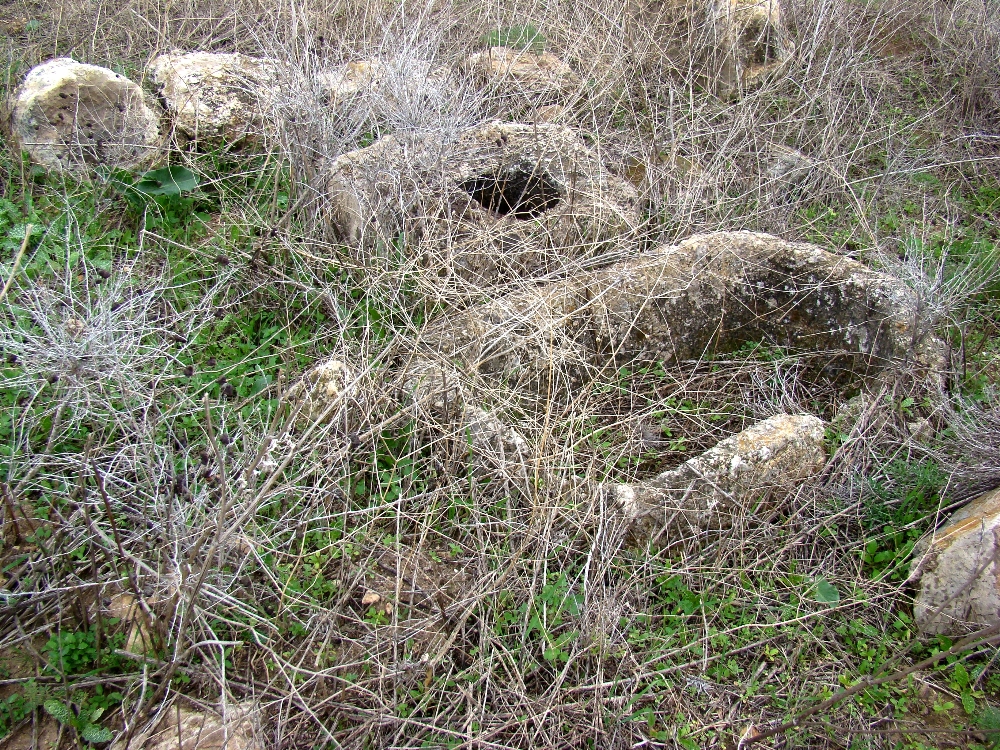
Remnants of olive presses at Ekron. Photo by Leon Mauldin.

Remnants of olive oil industry at Ekron. Photo by Leon Mauldin.

Holman Illustrated Bible Dictionary has this information on Ekron:

Northernmost of the five major Philistine cities known as the Pentapolis. The site of ancient Ekron has been much debated but now is generally agreed to be modern Tell Miqne, about 14 miles inland from the Mediterranean Sea and 10 miles from Ashdod. The site is one of the largest in Palestine, covering some 50 acres. Ekron lies on the road leading from Ashdod into the Judean hill country and up to Jerusalem through the Sorek Valley.

Ekron was assigned to both Judah (Josh. 15:11, 45–46) and Dan (Josh. 19:43) in the tribal allotments. It probably lay on the border between the tribes. Judges 1:18 reports that Judah captured Ekron along with other parts of the Philistine coast, but Ekron was certainly in Philistine hands at the time the ark was captured (1 Sam. 5:10). It was also the place to which the Philistines retreated after David slew Goliath (1 Sam. 17:52). Ahaziah, the son of King Ahab of Israel, called on the god of Ekron, Baal-zebub, when he was sick (2 Kings 1:2–16).

Excavations at Tell Miqne have discovered much pottery that is typically Philistine. From the last period before Tell Miqne was destroyed by the Babylonians, the excavators found an important industrial complex near the city gate. A hoard of iron agricultural tools was found. Hundreds of whole pottery vessels were present. Perhaps most importantly, a well-preserved olive press was discovered. This press is the largest and best preserved known in Israel. A horned altar was also found during the excavations. (pp. 469–470).

Click on images for larger view. Happy New Year!