The Tabularium

May 15, 2012

We continue to explore the Roman Forum. In our photo below we see the Tabularium, the large building in the back.
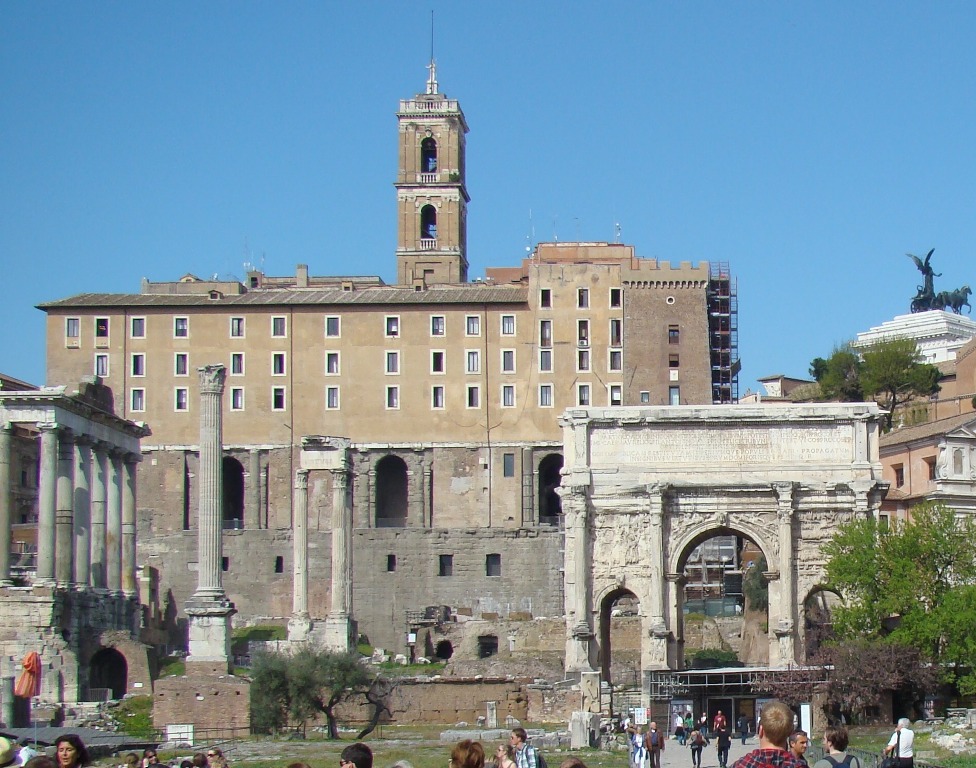
Tabularium in Roman Forum. Photo by Leon Mauldin.

“Tabularium” is a term for a record building. A number of other tabularia were scattered around Rome and other ancient Roman cities, but this article is about the prototype example.

The Tabularium was the official records office of ancient Rome, and also housed the offices of many city officials. Situated within the Roman Forum, it was on the front slope of the Capitoline Hill, below the Temple of Jupiter Optimus Maximus, to the southeast of the Arx and Tarpeian Rock.

Within the building were the remains of the temple of Veiovis. In front of it were the Temples of Vespasian & Concord, as well as the Rostra and the rest of the forum. Presently the Tabularium is only accessible from within the Capitoline Museum, although it still affords an excellent panoramic view over the Forum.

The Tabularium was first constructed around 78 BC, by order of M. Aemilius Lepidus and Q. Lutatius Catulus. It was later restored and renovated during the reign of the Emperor Claudius, about 46 AD. (Wikipedia).

The lower level, the gray portion, is the Roman period; upper level was built later.

In a entry entitled “Obtaining Citizenship,” (Roman citizenship) F.F. Bruce is referenced as stating

that legislation at the turn of the first century A.D. called for a legitimately born child of Roman citizens to be registered within thirty days of birth. Children born in the provinces would be legally acknowledged (professio) before the Roman provincial authority at the public record office (tabularium publicum). The professio was then entered in the register (album professionum). We do not know if Paul’s birth was before or after this legislation, but some such formal procedure had to have been in effect earlier. At regular intervals a citizen’s name, age, status and property holdings would thereafter be recorded by census. (Dictionary of New Testament Background: A Compendium of Contemporary Biblical Scholarship.)

At right in the photo you can see the Arch of Septimius Severus, dedicated in AD 203.

*******

At present I am en route to Cyprus to join Ferrell Jenkins for a few days of photographing biblical sites, and biblically related sites, in Cyprus and Turkey.

Click on image for larger view.


Temple of Vespasian and Titus

May 4, 2012

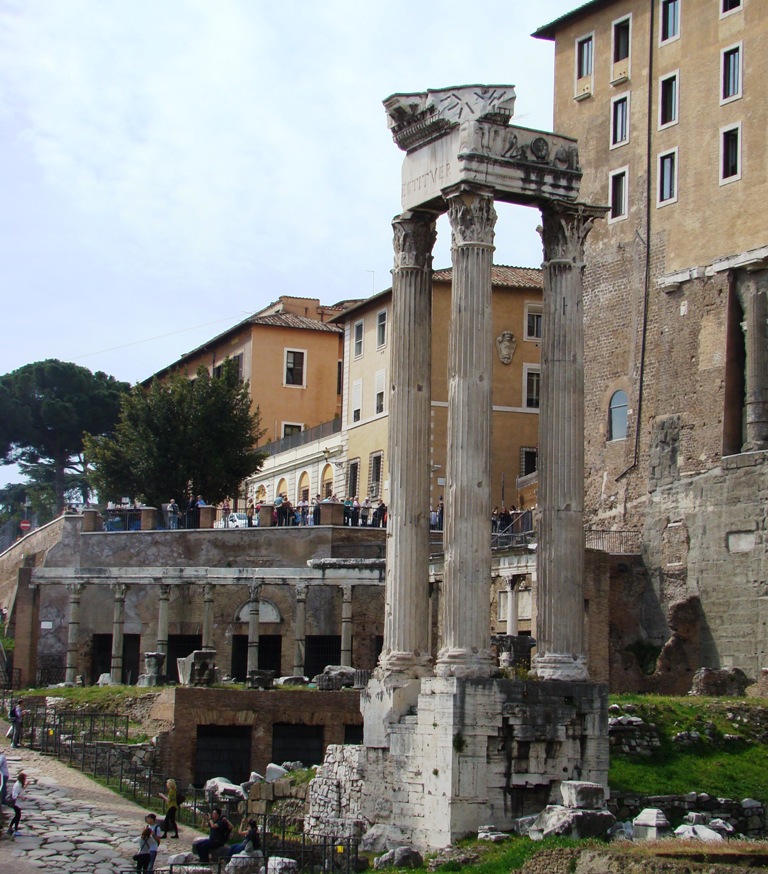
In our post today we continue to share some photos of sites of signifance in the Roman Forum. Today’s photo features the Temple of Vespasian and Titus.

Temple of Vespasian and Titus in Roman Forum. Photo by Leon Mauldin.

Wikipedia has some helpful generic info:

The Temple of Vespasian and Titus (Latin: Templum divi Vespasiani, Italian: Tempio di Vespasiano) is located in Rome at the western end of the Roman Forum between the Temple of Concordia and the Temple of Saturn. It is dedicated to the deified Vespasian and his son, the deified Titus. It was begun by Titus in AD 79 after Vespasian’s death and Titus’s succession. Titus’ brother, Domitian, completed and dedicated the temple to Titus and Vespasian in approximately AD 87.

Throughout Roman history, there was an emphasis on increasing the fame and glory of a family name, often through monuments commemorating the deceased. Therefore, the temple was constructed to honor the Flavian Dynasty, which comprised the emperors Vespasian (69-79), Titus (79-81), and Domitian (81-96). Historians question whether or not Titus and Domitian had a good relationship; however, Domitian ensured the deification of his brother into the imperial cult in order to exalt the prominence of the Flavian name. Titus and Vespasian were each deified through the ceremony of apotheosis. In doing so, tradition guaranteed that Roman citizens and subjects would honor Vespasian and Titus (or at least honor their genius) as Roman deities. This imperial cult worship was as much a sign of allegiance to the emperor of Rome, or as a political and diplomatic gesture, as it was a formal religion.

Structure. The Temple of Vespasian was in the Corinthian order, hexastyle (i.e., with a portico six columns wide), and prostyle (i.e., with free standing columns that are widely spaced apart in a row).[4] It was particularly narrow due to the limited space, measuring 33 meters long and 22 wide. In a constricted space between the temple and the Concord, a small, two story vaulted room made of brick and concrete, and lined with marble, was built against the wall of the Tabularium, and apparently was dedicated to Titus.

Construction and Renovation. Titus began construction and presumably finished the foundations, made of tufa concrete, and the core of the podium, made of white marble. Domitian, however, completed the interior work after Titus’ death. The cella (inner) walls were in travertine, lined with marbles imported at great expense from the eastern provinces. The interior is highly ornate and the frieze depicts sacred objects that would have been used as the symbols, or badges, of the various priestly collegia in Rome. Around 200 to 205, Emperors Septimius Severus and his son, Caracalla, conducted renovations on the temple.

Click on image for larger view.


Temple of Vesta, Roman Forum

May 2, 2012

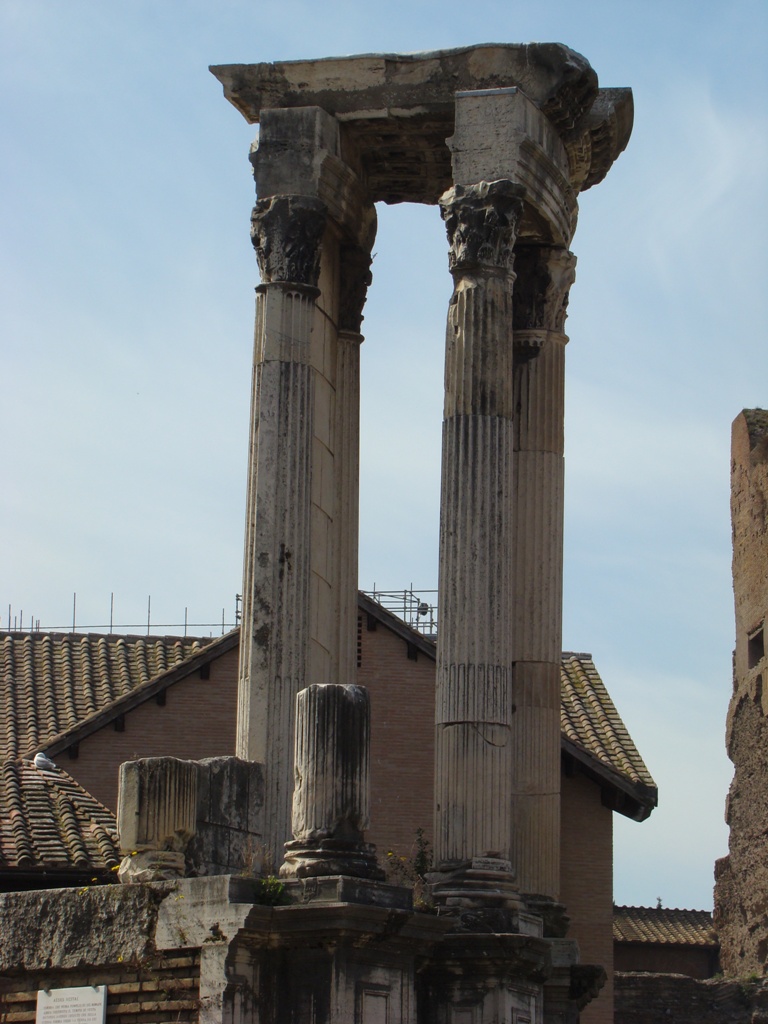
The Roman goddess Vesta was the goddess of the hearth. She

was considered the patron of the fire that symbolized the perpetuity of the state. It was the responsibility of the priestesses to maintain this sacred fire and to renew it each year on March 1, the first day of the Roman year (The Wycliffe historical geography of Bible lands).

We photographed the remains of the Temple of Vesta in the Roman Forum a few weeks ago.

Temple of Vesta in Roman Forum. Photo by Leon Mauldin.

 Vos, in his work, Nelson’s New Illustrated Bible Manners & Customs: How the People of the Bible Really Lived, asks the reader to suppose that when Paul’s trial was conducted in Rome that he entered the Forum on the east side:

As Paul came into the Forum area down the Sacred Way from the east, the first building he would have passed was the house of the vestal virgins. He might have observed that the house was rather large for a sisterhood of only six priestesses. But such an objection is erased with the observation that the vestals were held in high esteem and that their house was chosen by private citizens and by the state as a safe deposit for documents.

Adjacent to this house was the Temple of Vesta, considered the goddess of the hearth and the patron of the fire that symbolized the perpetuity of the state. It was the responsibility of the priestesses to maintain this sacred fire and to renew it each year on March 1, the first day of the Roman year (p.606).

Wikipedia has this additional info:

The extant temple used Greek architecture with Corinthian columns, marble, and a central cella. The remaining structure indicates that there were twenty Corinthian columns built on a podium fifteen metres in diameter. The roof probably had a vent at the apex to allow smoke release.

***********

My friend Ferrell Jenkins is currently directing a biblical study tour in Turkey & Greece. He will be posting as time permits on Ferrell’s Travel Blog.

Click on image for larger view.


The Twin Brothers, Castor and Pollux

May 1, 2012

After Paul had suffered shipwreck on the island of Malta (Acts 27:39-44; 28:1), and wintered there, he continued his trip (as a prisoner) to Rome. Luke writes, “After three months we sailed in an Alexandrian ship whose figurehead was the Twin Brothers, which had wintered at the island” (Acts 28:11, NKJV). The Twin Brothers were the mythical Greek gods (assimilated by the Romans) Castor and Pollux, sons of the god Zeus.

The NIV renders the text, “After three months we put out to sea in a ship that had wintered in the island. It was an Alexandrian ship with the figurehead of the twin gods Castor and Pollux” (cf. KJV).

The NET Bibles notes:

tn Or “the ‘Twin Gods'”; Grk “the Dioscuri” (a joint name for the pagan deities Castor and Pollux). sn That had the “Heavenly Twins” as its figurehead. The twin brothers Castor and Pollux, known collectively as the Dioscuri or “Heavenly Twins,” were the twin sons of Zeus and Leda according to Greek mythology. The Alexandrian ship on which Paul and his companions sailed from Malta had a carved emblem or figurehead of these figures, and they would have been the patron deities of the vessel. Castor and Pollux were the “gods of navigation.” To see their stars was considered a good omen (Epictetus, Discourses 2.18.29; Lucian of Samosata, The Ship 9).

Remains of the temple of Castor and Pollux may be seen in the Roman Forum.

Temple of Castor and Pollux in Roman Forum. Photo by Leon Mauldin.

The temple was built in gratitude for victory at the Battle of Lake Regillus (495 BC). This site furnishes yet another link between surviving archaeological artifacts and references in the biblical text.

Click image for larger view.


Temple of Venus Genetrix

April 23, 2012

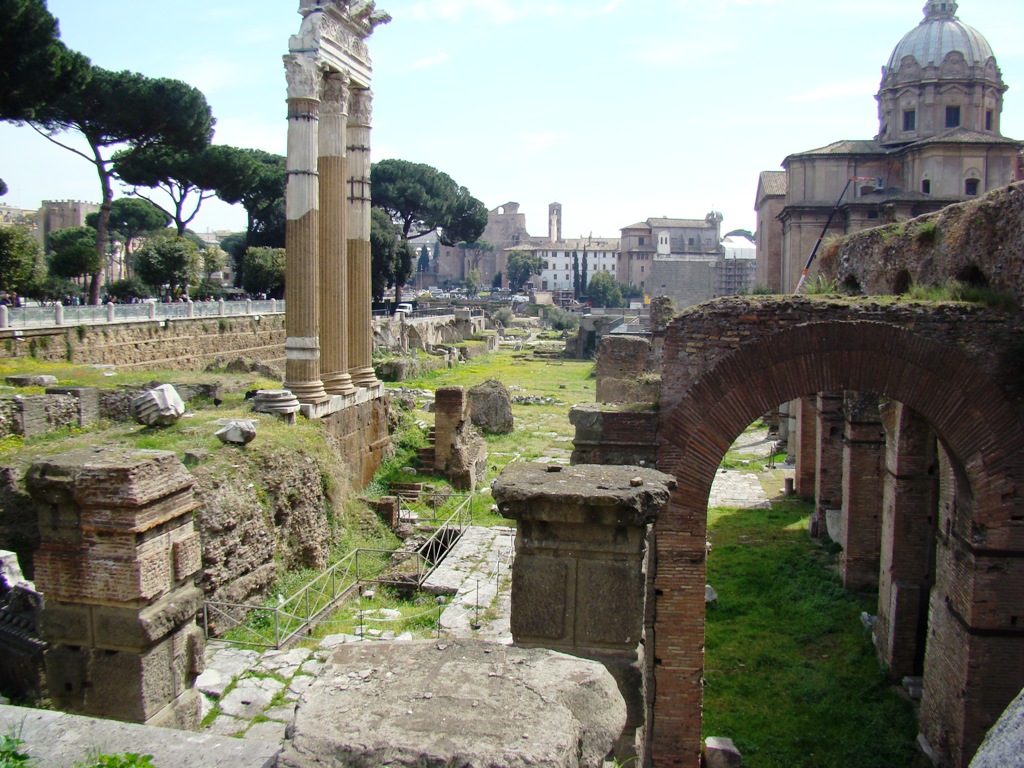
Our photo today shows the Forum of Caesar, located in the north-east corner of the Roman Forum. Construction of Caesar’s Forum was begun in 54 BC. Three remaining columns indicate the location of the Temple of Venus in Caesar’s Forum.

Temple of Venus Genetrix, located in Forum of Caesar, Rome. Photo by Leon Mauldin.

The temple was introduced at a slightly later stage, having been vowed by Caesar the night before the Battle of Pharsalus in 48 BC, during  his civil war with Pompey, to win over Pompey’s favored goddess Venus Victrix, though when inaugurated in 46 BC (while still unfinished) it actually honored Venus as Venus Genetrix, “universal mother,’ from which Julius Caesar’s family (and thus all the emperors from August to Nero) claimed descent. (Rome: An Oxford Archaeological Guide, p.150).

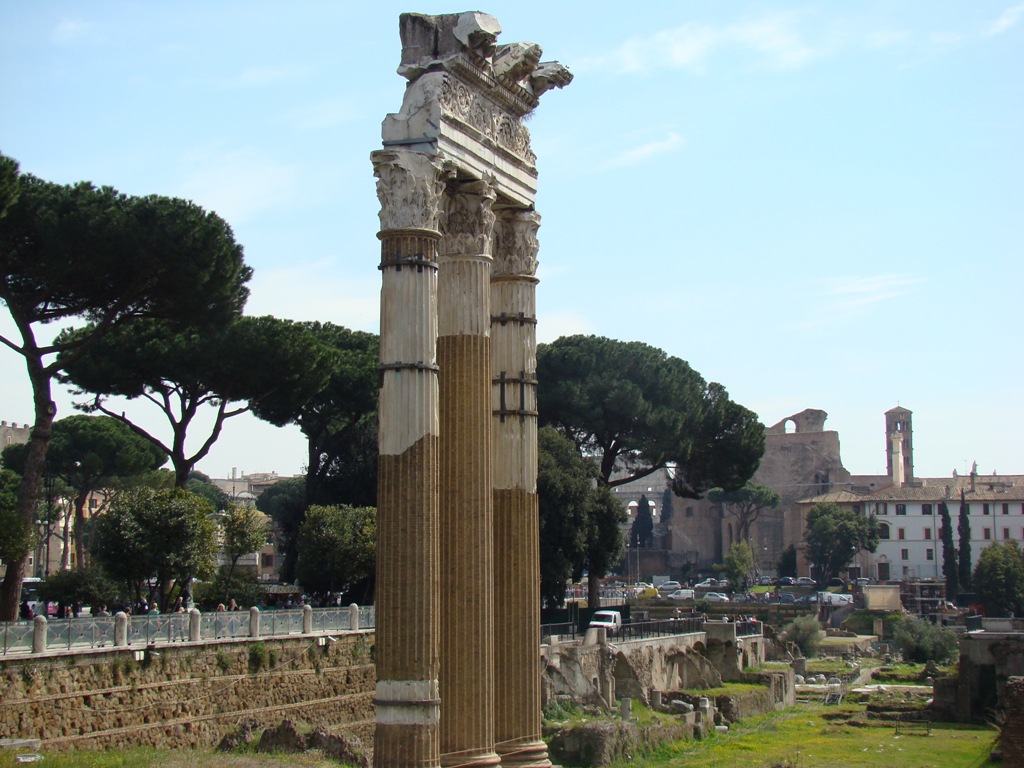
Here is a close-up of the columns:

Temple of Venus Genetrix, close-up of columns. Photo by Leon Mauldin.

The Temple of Venus Genetrix contained an important collection of statues, paintings and engravings. A gilded statue of Cleopatra VII was erected, setting a precedent for dedications to notable women in the precinct. Paintings in the forum included one of Medea, mythological Greek hero of Euripides’ play Medea, as well as one of Ajax, mythological Greek hero of Sophocles’ Ajax, done by Timomachus. Perhaps more personal to Caesar were six collections of engraved gems. These surpassed in number the collection of Mithridates dedicated by Caesar’s rival Pompey. It is not known where or how Caesar obtained these six collections. (Wikipedia).

The location of a temple at the end of a long enclosure was a practice borrowed by the Romans from the Etruscans. This area suffered fire damage in AD 80; the temple was later rebuilt by Domitian and subsequently restored by Trajan.

Click on images for larger view.


The Roman Forum

April 18, 2012

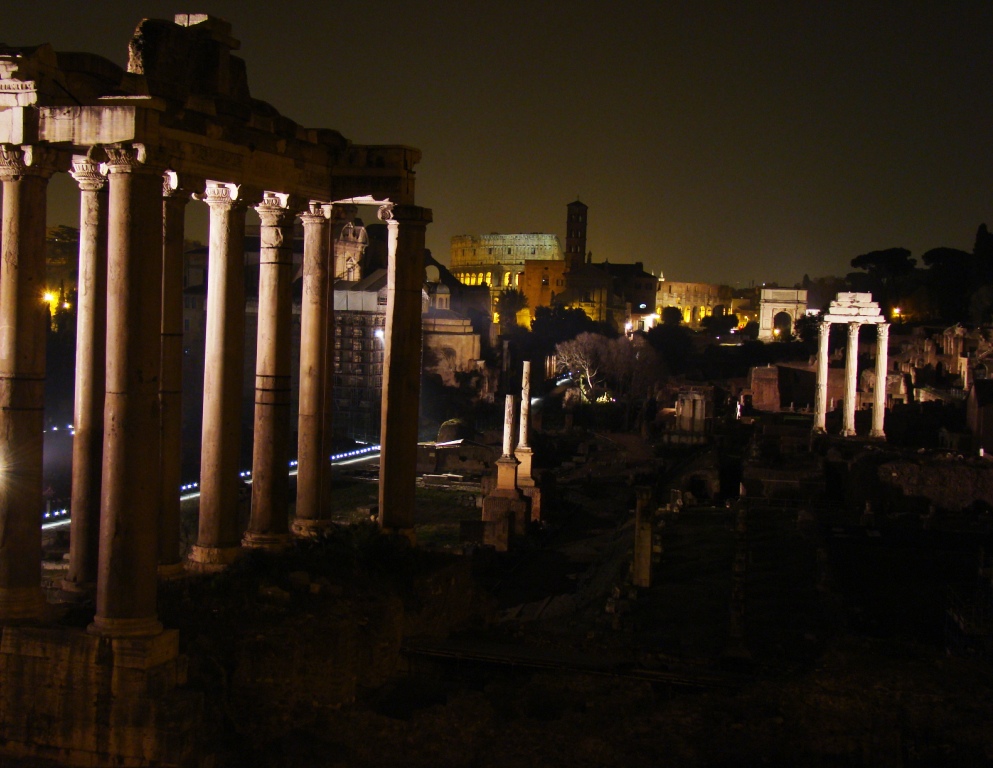
The Roman Forum was in ancient times at the very hub of western civilization.

Roman Forum At Night. Photo by Leon Mauldin.

The Roman Forum (Latin: Forum Romanum, Italian: Foro Romano) is a rectangular forum (plaza) surrounded by the ruins of several important ancient government buildings at the center of the city of Rome. Citizens of the ancient city referred to this space, originally a marketplace, as the Forum Magnum, or simply the Forum. It was for centuries the center of Roman public life: the site of triumphal processions and elections, venue for public speeches, criminal trials, and gladiatorial matches, and nucleus of commercial affairs. Here statues and monuments commemorated some of the city’s most notable figures. Located in the small valley between the Palatine and Capitoline Hills, the Forum today is a sprawling ruin of architectural fragments and intermittent archeological excavations attracting numerous sightseers (Wikipedia).

It was here at the Forum, located between the Capitoline and Palatine hills, that justice was dispensed during the days of the Roman Republic and Empire (509 BC – AD 476). It is thought by some scholars that Paul’s appeal before Caesar would have been heard at the Basilica Julia.

Click image for larger view.


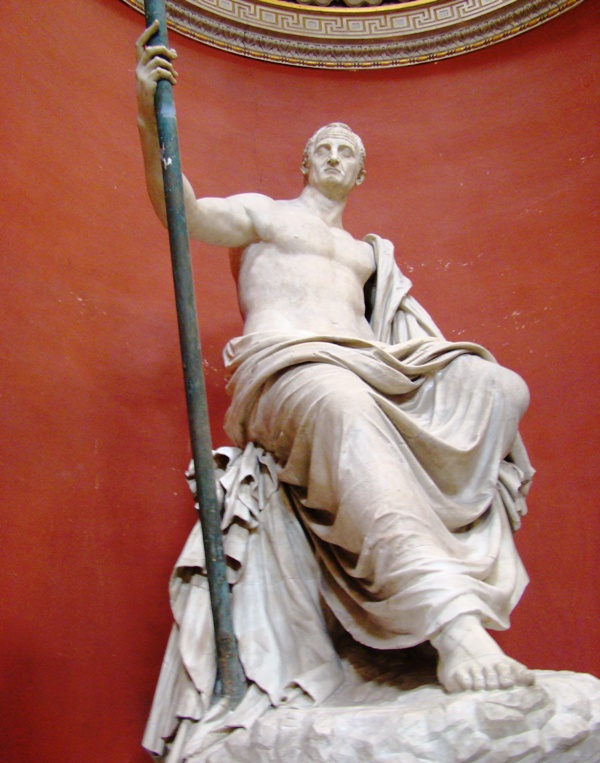
Emperor Galba: The Year of the Four Emperors

April 12, 2012

Numerous factors came into play that resulted in Galba’s becoming Rome’s sixth emperor. When Nero died in AD 68, the senate pronounced Galba emperor. Nymphidius Sabinus, prefect of the praetorian guard, had bribed his men to abandon their loyalty to Nero. Galba thought the bribe to the guardsmen had been extreme, and refused to pay the promised bonuses.  This of course alienated the soldiers from Galba.

Roman Emperor Galba. Reigned June 68-January 69. Photo by Leon Mauldin.

Our photo was taken last month at the Vatican Museum.

On January 15, 69, Galba was murdered by soldiers in the Roman Forum. The historian Tacitus stated that Galba “possessed the makings of a ruler–had he never ruled.” His is a study of what might have been.

AD 69 was the Year of the Four Emperors: Galba, Otho, Vitellius and Vespasian.

********

We are currently doing our Visualized Survey of the Bible in historic Jonesboro, TN, the oldest town in Tennessee. David Wheeler is the preacher here. We are close to North Carolina and to Virginia. Beautiful country.

********

Dr. James Hodges passed away this past Tuesday night, April 10. He had been a professor of biblical studies at Florida College in Temple Terrace, FL., for many years. Forty years ago I studied archaeology under him; at that time there were two semesters: Old Testament and New Testament Archaeology. I appreciated his scholarship, and thought highly of him.


Arch of Titus

April 6, 2012

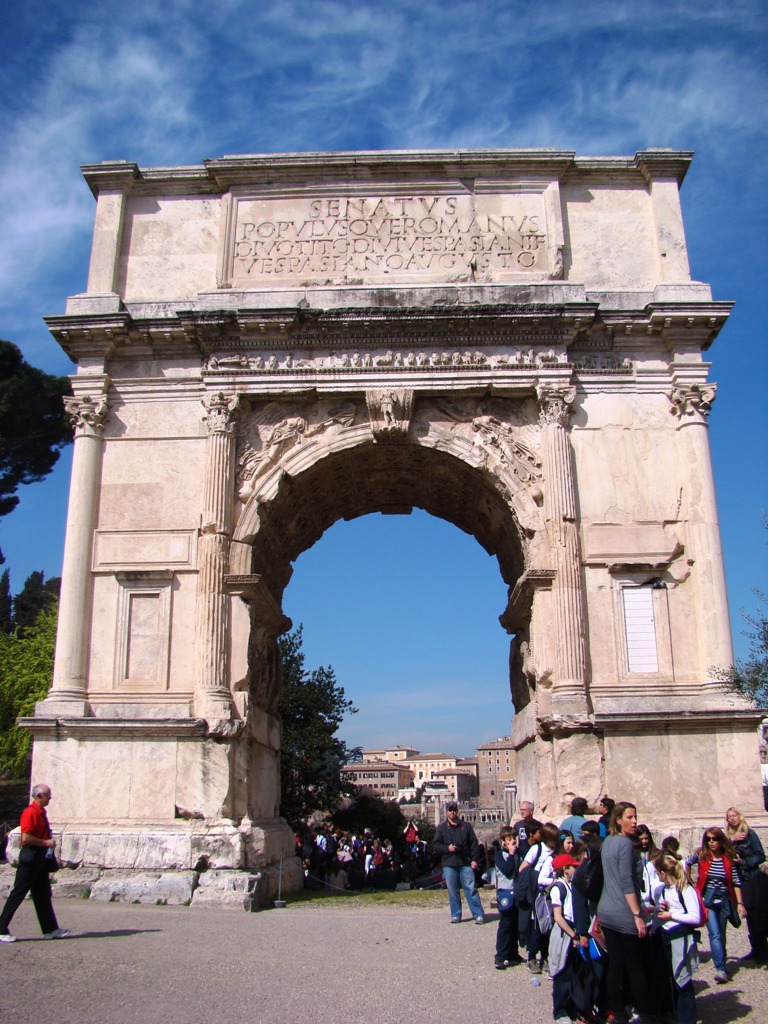
The Arch of Titus was built to commemorate Titus’ defeat of Jerusalem which took place in AD 70.

Arch of Titus. Photo by Leon Mauldin.

The Latin inscription at the top reads, “The Senate and People of Rome, to Divus Titus, son of Divus Vespasian, Vespasian August.” (The title Divus indicates that the arch was erected after Titus’ death).

Inscription on Arch of Titus. Photo by Leon Mauldin.

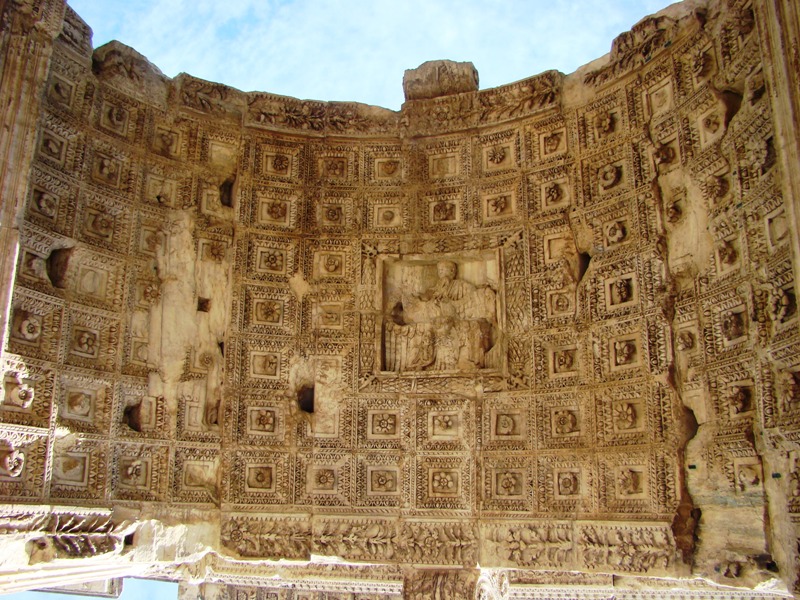
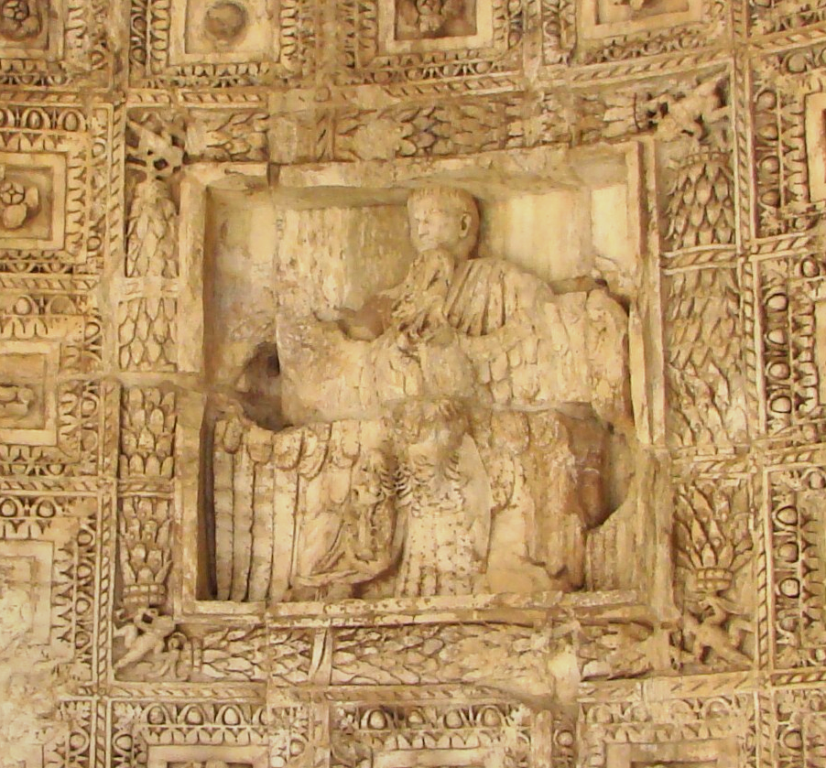
Titus died at the young age of 50 in AD 81. Deification of the Roman Emperors took place after death. His deified figure is depicted on the underside of the archway. He is portrayed flying heavenward on the back of an eagle.

Underside of Arch of Titus. Photo by Leon Mauldin.

Note the detail of the center coffer of the coffering.

Detail of deified figure of Titus. Photo by Leon Mauldin.

The arch was built in AD 81-82 by Titus’ brother, the Emperor Domitian.

A previous post on the Arch of Titus appeared here.

Click on images for larger view.


Link to Italy Tour Photos

March 30, 2012

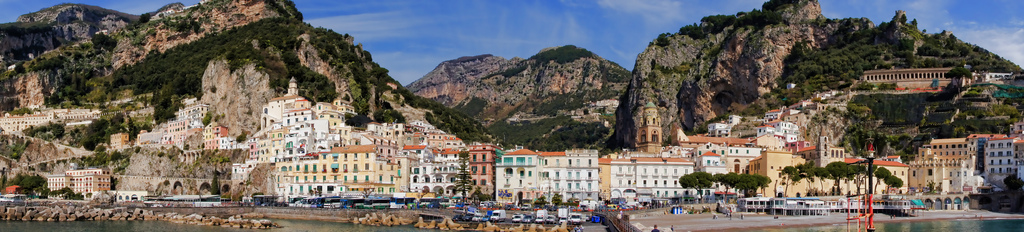
One of our tour members, Jared Hagan, of Colorado, has posted a great representative sampling of his photos from our recent Italy tour.

Panorama of Amalfi Coast. Photo by Jared Hagan.

You may see Jared’s photos here. These photos are outstanding; many of these would be useful in biblical teaching. Included are several panoramic views, such as that above of the Amalfi Coast, as well as night shots. This view is of the town of Amalfi as seen from the pier; the Amalfi Cathedral is in the right center.

Click image for larger view.


Emperor Claudius, cont’d.

March 29, 2012

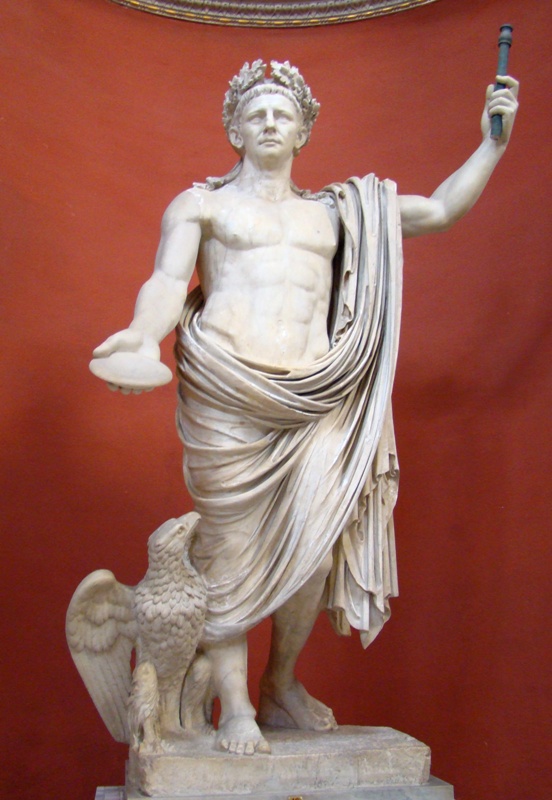
Our photo today features a statue of the Emperor Claudius, taken last week at the Vatican Museum in Rome.

Statue of Emperor Claudius. Vatican Museum. Photo by Leon Mauldin.

Museum info placard: “Found at Lanuvio in 1865, this piece originally decorated the theatre in this Roman settlement. Claudius, emperor from  37 (sic) to 54 AD, is shown as Jupiter, wearing the civil crown of oak leaves and with the eagle at his feet.”

Claudius,

(1 August 10 BC – 13 October AD 54), was Roman Emperor from 41 to 54. A member of the Julio-Claudian dynasty, he was the son of Drusus and Antonia Minor. He was born at Lugdunum in Gaul and was the first Roman Emperor to be born outside Italy. Because he was afflicted with a limp and slight deafness due to sickness at a young age, his family ostracized him and excluded him from public office until his consulship, shared with his nephew Caligula in 37. Claudius’ infirmity probably saved him from the fate of many other nobles during the purges of Tiberius and Caligula’s reigns; potential enemies did not see him as a serious threat. His survival led to his being declared Emperor by the Praetorian Guard after Caligula’s assassination, at which point he was the last adult male of his family.

Despite his lack of experience, Claudius proved to be an able and efficient administrator. He was also an ambitious builder, constructing many new roads, aqueducts, and canals across the Empire. During his reign the Empire conquered Thrace, Noricum, Pamphylia, Lycia and Judaea, and began the conquest of Britain. He took a personal interest in law, presided at public trials, and issued up to twenty edicts a day. However, he was seen as vulnerable throughout his reign, particularly by the nobility. Claudius was constantly forced to shore up his position; this resulted in the deaths of many senators. These events damaged his reputation among the ancient writers, though more recent historians have revised this opinion. After his death in 54, his grand-nephew and adopted son Nero succeeded him as Emperor (Wikipedia).

Scroll down and read our previous post to see some scriptural reverences to Claudius in the NT book of Acts.

Click on image for larger view.