Paul’s Acts 17 Sermon, Greek Text, at Aeropagus, Athens Greece

February 5, 2015

In Acts 17 Luke narrates how Paul was invited to speak to the men of Athens in the midst of the Areopagus, at Mars Hill. Among the listeners were Epicurean and Stoic philosophers (v.17). He began his address by referencing an altar in their city with this inscription: “TO THE UNKNOWN GOD.” Using that as his starting point, he contrasted the true God with the idols they worshiped. The true God made all things, including us. He gives unto us life, breath, and all things. Because He is the Creator, and we are His creatures, we must seek after Him and find Him. He commands all men everywhere to repent; a day is coming in which He will judge the world in righteousness by the One whom He raised from the dead (summary of vv. 23-31).

Today at the site of Mars Hill there is a bronze plaque with the text of Paul’s sermon engraved in the Greek language.
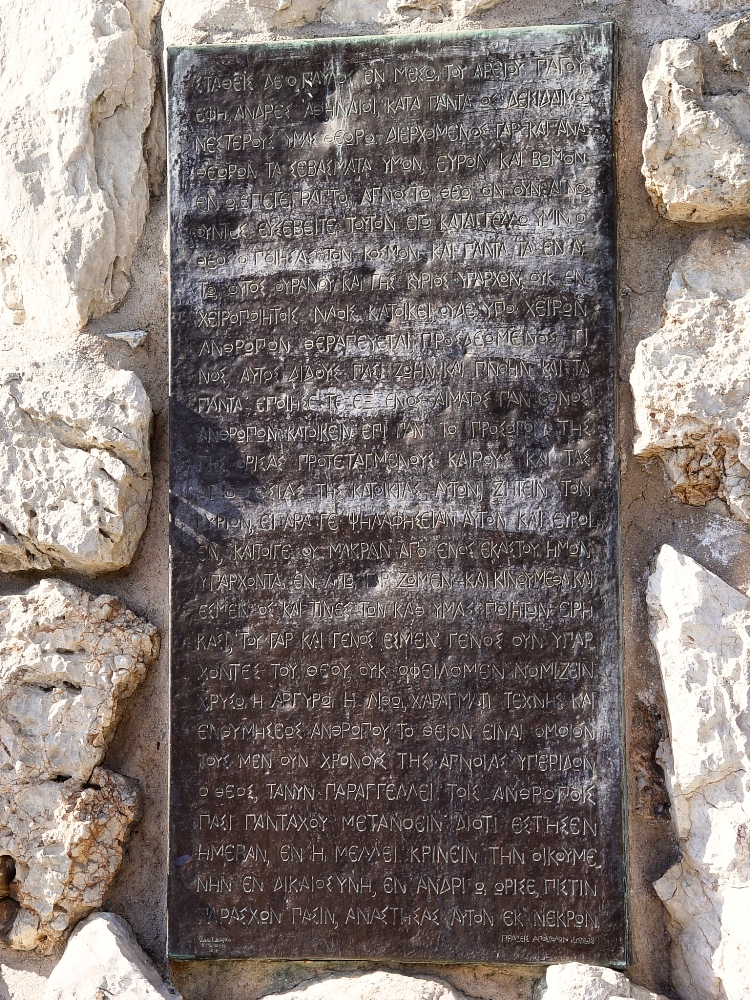
Paul's Acts 17 sermon, on bronze plaque at base of Mars Hill, Athens, Greece. Photo by Leon Mauldin.

Paul’s Acts 17 sermon, on bronze plaque at base of Mars Hill, Athens, Greece. Photo by Leon Mauldin.

The Greeks did not believe in a resurrection, so as soon as Paul mentioned that, many of his audience stopped listening (v.32). Others procrastinated (v.32). But there were some converts to Christ there: Dionysius the Areopagite, a woman named Damaris, and others with them” (v.34).

We have numerous other posts on Athens. Use search box at above right.

Click image for larger view.


Sanctuary of Asclepius at Athens

January 31, 2015

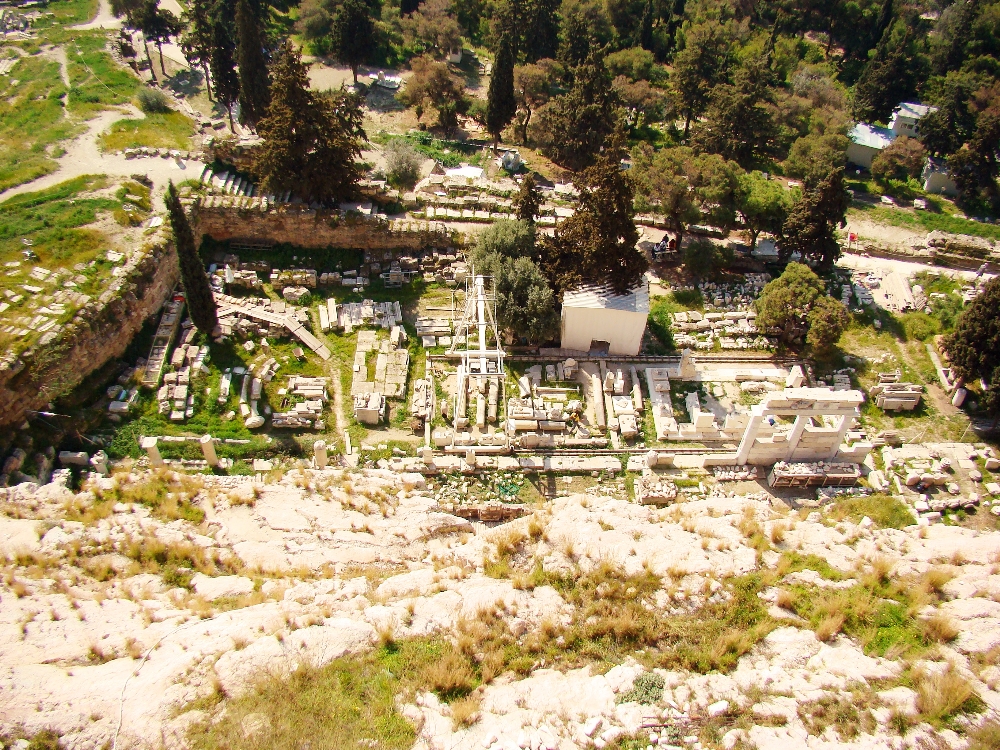
In biblical times, Asclepius was widely worshiped as the god of healing. As we continue our view down the southern slope of the Athenian acropolis, we can see the remains of the sanctuary of Asclepius.

Athen's Sanctuary of Asclepius, the god of healing. Photo by Leon Mauldin.

Sanctuary of Asclepius, the god of healing. Athens, Greece. Photo by Leon Mauldin.

Fant and Reddish observe, “Above the Stoa of Eumenes, and to the left (west) of the Theater of Dionysus, can be seen the scant remains of the Asclepeion, a center for healing run by the priests of Asclepius. The sacrificial altar remains, but it is difficult to discern amid the various stones currently being stored there” (A Guide to Biblical Sites in Greece and Turkey, p.26). (We should note that when they say “left” it is from the perspective of one who is down from the acropolis. When you’re on the acropolis looking down, the sanctuary would be to your right of the theater of Dionysus–LM). 

We have previous written on Asclepius here and here  regarding the famous healing center at Pergamum. Even in Israel there was a temple devoted to this god.

Planetware.com has this info:

On a narrow terrace above the Stoa of Eumenes, directly under the steep south face of the Acropolis, is the Asklepieion, the sanctuary of the healing god Asklepios, whose cult – initiated largely by Sophocles – was brought to Athens from Epidauros in 420 B.C. The sanctuary is centered on two sacred springs.

The earliest part of the sanctuary lay at the western end of the precinct, where there are the foundations of a stoa and a small temple. A number of herms have been brought together in the stoa. At the west end of the complex is a rectangular system with polygonal walls dating from the same period. To the south is a later cistern.

The buildings in the eastern part of the precinct were erected about 350 B.C. Immediately under the Acropolis rock, here hewn into a vertical face, is a stoa 50m/165ft long, originally two- storyed, designed to accommodate the sick who came here to seek a cure. Associated with it is the cave containing a spring which is still credited with healing powers; and accordingly the cave is now used as a chapel.

Parallel to this stoa, which was rebuilt in Roman times, another stoa was constructed, also in Roman times, on the southern edge of the precinct; of this second stoa some remains survive.
Both stoas faced towards the center of the precinct, in which stood the temple. This was oriented to the east and had four columns along the front (prostylos tetrastylos). The foundations of the temple and the altar which stood in front of it are still to be seen.
In early Christian times a basilica was built over the remains of the temple and the altar, and some architectural fragments from this can be seen lying about the site.

(http://www.planetware.com/athens/asklepieion-gr-ath-askle.htm)

Click on image for larger view.


Athens Temple of Themis

January 30, 2015

Many of the sites in ancient Athens are world renown. The Parthenon, for example, was one of the Seven Wonders of the World (see our previous post here).

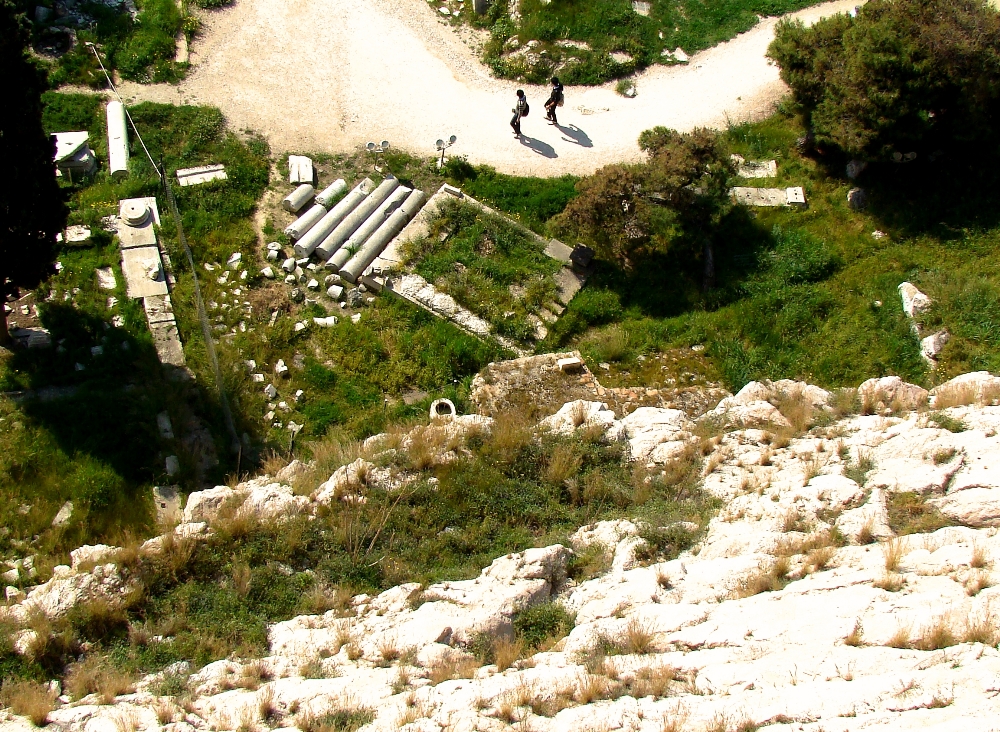
Other sites are not as well known. Looking down the south slope of the acropolis you can see the remains of the small temple of Themis, seen here at center of photo.

Temple of Themis in Athens, Greece. Photo by Leon Mauldin.

Temple of Themis in Athens, Greece. Photo by Leon Mauldin.

In Greek mythology,

Themis was the Titan goddess of divine law and order–the traditional rules of conduct first established by the gods. She was also a prophetic goddess who presided over the most ancient oracles, including Delphoi. In this role, she was the divine voice (themistes) who first instructed mankind in the primal laws of justice and morality, such as the precepts of piety, the rules of hospitality, good governance, conduct of assembly, and pious offerings to the gods. In Greek, the word themis referred to divine law, those rules of conduct long established by custom. Unlike the word nomos, the term was not usually used to describe laws of human decree.

Themis was an early bride of Zeus and his first counsellor. She was often represented seated beside his throne advising him on the precepts of divine law and the rules of fate.

Themis was closely identified with Demeter Thesmophoros (“Bringer of Law”). Indeed Themis’ six children, the spring-time Horai and death-bringing Moirai, reflect the dual-functions of Demeter’s own daughter Persephone. Themis was also identified with Gaia (Earth) especially in the role of the oracular voice of earth. http://www.theoi.com/Titan/TitanisThemis.html

This temple is mentioned by Pausanias (ca. AD 110-180), a Greek traveler and geographer, in his Description of Greece. This lengthy work describes ancient Greece from firsthand observations. His brief notation on this temple was, “After the sanctuary of Asclepius, as you go by this way towards the Acropolis, there is a temple of Themis.”
We have several other posts on ancient Athenian temple and other sites, here, here and here. Use the search box at top of home page. Click image for larger view.

Propylaea of Athens

January 23, 2015

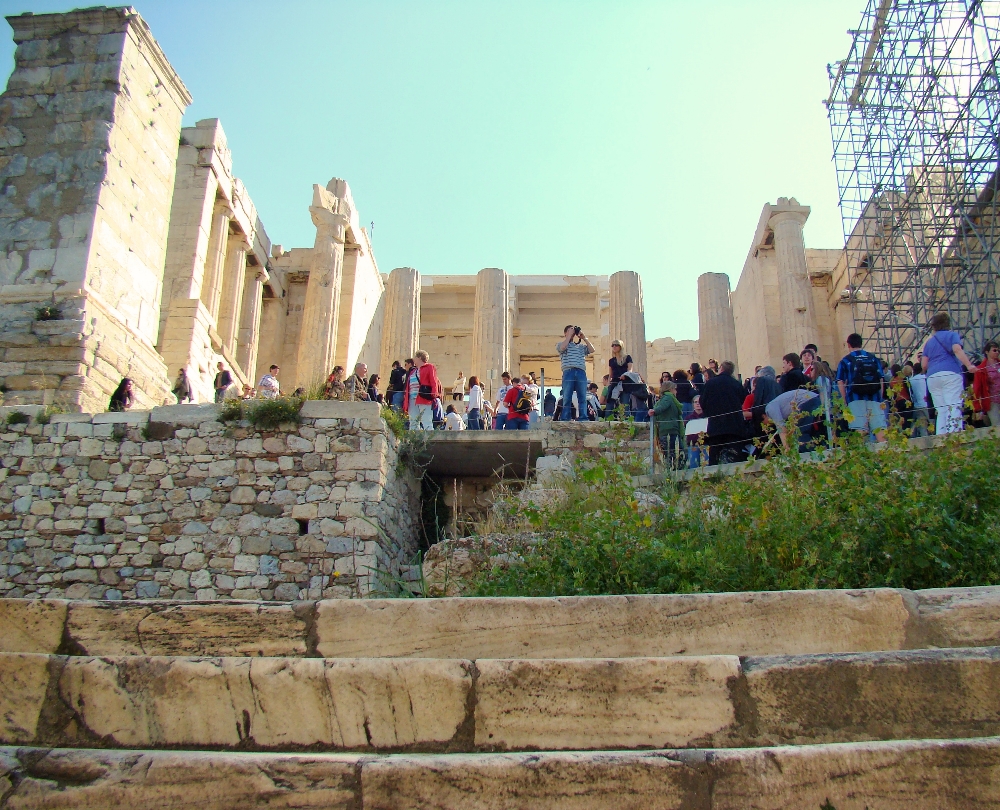
The Propylaea (entrance before the gate) still stands as the access to the Acropolis today. This monumental entrance gate was commissioned by the great statesman and builder of the Acropolis, Pericles. Construction was begun in 437 B.C.

Propylaea leading to Athens Acropolis. Photo by Leon Mauldin.

Propylaea leading to Athens Acropolis. Photo by Leon Mauldin.

Fant and Reddish have this information:

The Propylaea (“before the gate”) visible today is the fourth of such structures to be built at this site; earlier ones were destroyed in various wars. The road from the agora below, the Panathenaic Way, led up to this point. A flight of marble steps ascends to the hall of the Propylaea. One step is of gray Eleusinian marble; the others are of white Pentelic marble. The monumental pedestal (25 feet tall) on the left of the steps originally was designed for a statue with a chariot and four horses to honor King Eumenes II of Pergamum for his contribution of the Stoa of Eumenes. Later it was reinscribed with a dedication to Marcus Agrippa in honor of the odeion he contributed to the agora. Designed by the architect Mnesicles and begun upon the completion of the Parthenon (437 B.C.E.), the Propylaea consisted of a central section with five doorways, originally fitted with wooden doors, and projecting wings on either side. The wing on the left side, the north wing, was known as the Pinakotheke, or art gallery, because of the magnificent collection of paintings inside. In 150 C.E. Pausanius named a number of the paintings he could recognize, including some by Polygnatus of Homer (5th century B.C.E.). The room was used for official banquets by dignitaries who reclined on couches in the Greek fashion. The wing on the right side, the south wing, could not match the other in design because of the Temple of Athena Nike and other buildings that impinged upon it. This wing was never completed due to the start of the Peloponnesian War (431 B.C.E.). (A Guide to Biblical Sites in Greece and Turkey).

We are looking forward to seeing Athens again in a couple of months.

Click image for larger view.


Corinthian Helmet

October 30, 2014

From an entry entitled, “Weapons” in the Harper’s Bible Dictionary we read:

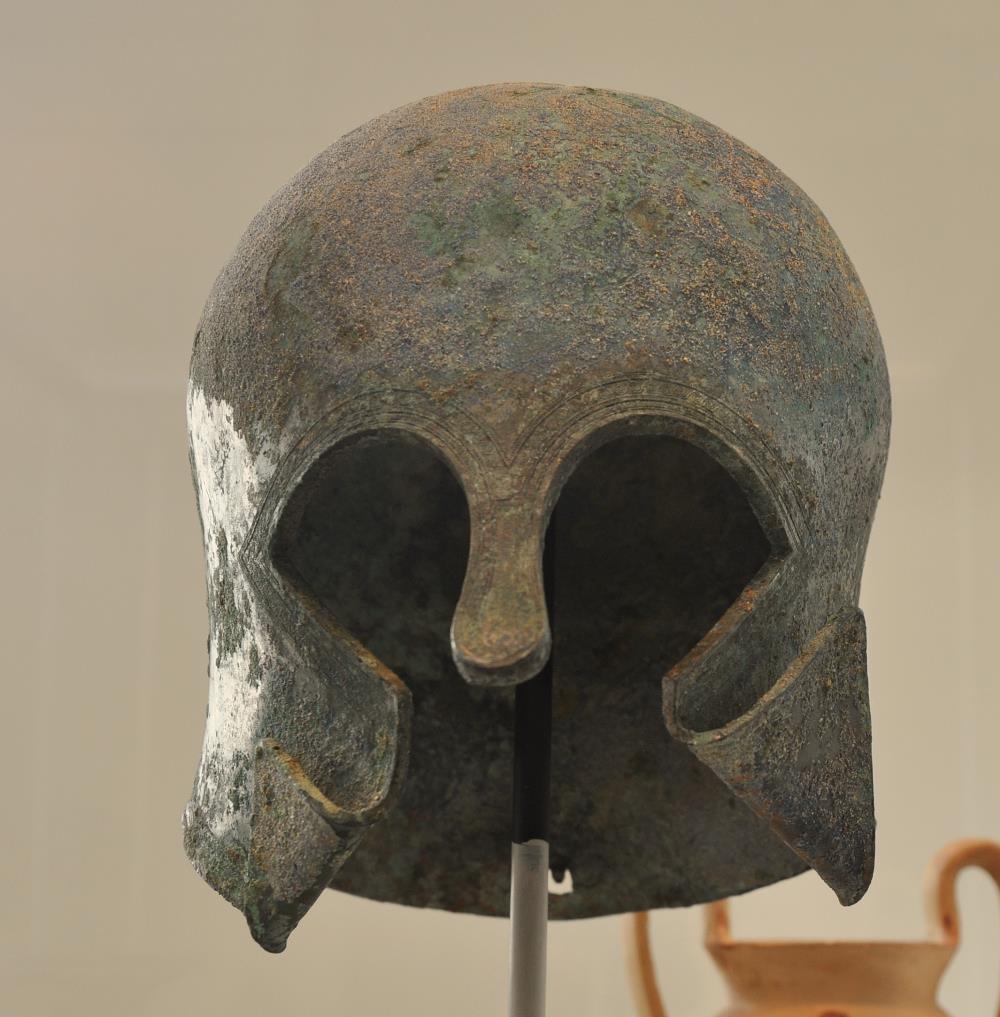
As in the modern world, advancements in ancient technology were quickly adapted for use in instruments of war. One of the most important steps in the history of weapons was the development of carburized iron, a phenomenon that occurred in the eastern Mediterranean toward the end of the second millennium B.C., but earlier improvements in metallurgy (i.e., the production of copper and bronze) had been applied to arms production for nearly two thousand years before the Iron Age. Naturally, the shape, size, and overall durability of dagger and sword blades and spearheads and arrowheads were affected by such improvements in copper, bronze, and iron technology. Another important weapon that improved over time was the chariot, whose speed and maneuverability were increased by changes in design and construction materials, including metals. Other major steps in the development of ancient weaponry include the invention of the composite bow, piercing battle-ax, “Corinthian” helmet, and siege engines (pp. 1123-1124).

The Metropolitan Museum in NY has several such helmets on display.

Corinthian Style Helmet. Photo by Leon Mauldin. Metropolitan Museum, NY.

Corinthian Style Helmet. Photo by Leon Mauldin. Metropolitan Museum, NY.

This Grecian helmet, made of bronze and dating back to 7th-6th century BC, put me in mind of some biblical texts:

–Isaiah 59:17:  He put on righteousness like a breastplate, And a helmet of salvation on His head; And He put on garments of vengeance for clothing And wrapped Himself with zeal as a mantle. (Reference here is to the Lord, YHWH).

–Ephesians 6:17: And take THE HELMET OF SALVATION, and the sword of the Spirit, which is the word of God. The above Isaiah text provides background for this Ephesians passage. The New American Standard Bible uses all caps to indicate a quotation from the OT. The helmet is a vital part of the Christian’s armor listed in Eph. 6:10-17.

–1 Thessalonians 5:8: But since we are of the day, let us be sober, having put on the breastplate of faith and love, and as a helmet, the hope of salvation. A helmet protects the head. Here the hope of salvation possessed by Christians is said to be a helmet. Keep your helmet on. Keeping the hope of salvation constantly in the forefront of the mind serves to protect one against Satan’s devices.

I believe I’ll keep my helmet on!


Theater of Dionysus, Athens

February 8, 2011

Greetings from Tampa, where we are currently attending the Florida College lectures. This year’s theme is, “Trembling at My Word,” God’s Power for Restoration. It is great to see so many friends, many of whom we’ve known for so long now, and to be able to sing, study, pray and visit together.

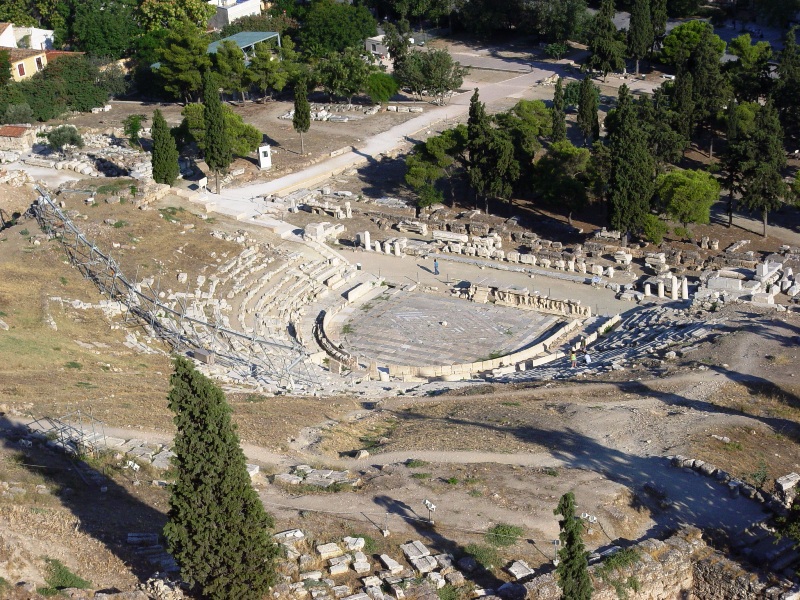
Another site we wish to share from ancient Athens is the theater of Dionysus, a major open-air theater and one of the oldest to be preserved. The theater was used in festivals in honor of the wine god Dionysus (same as Greek Bacchus).

Theater of Dionysus in Athens Greece. Photo by Leon Mauldin.

This theater was built in the 6th century BC, then rebuilt in the 4th century BC. It seated between 14,000 and 17,000 occupants.

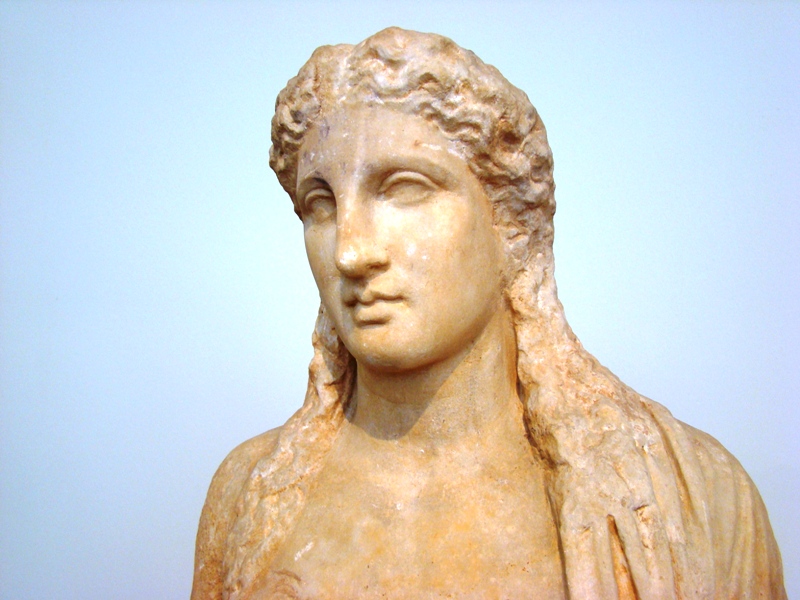
Dionysus the wine god. Athens Museum. Photo by Leon Mauldin.

This statue of the wine god Dionysus was discovered at Eleusina, located 18 km northwest of the city center of Athens.

This puts me in mind of 1 John 5:21: “Little children, keep yourselves from idols.”


Temple of Zeus, Athens

February 1, 2011

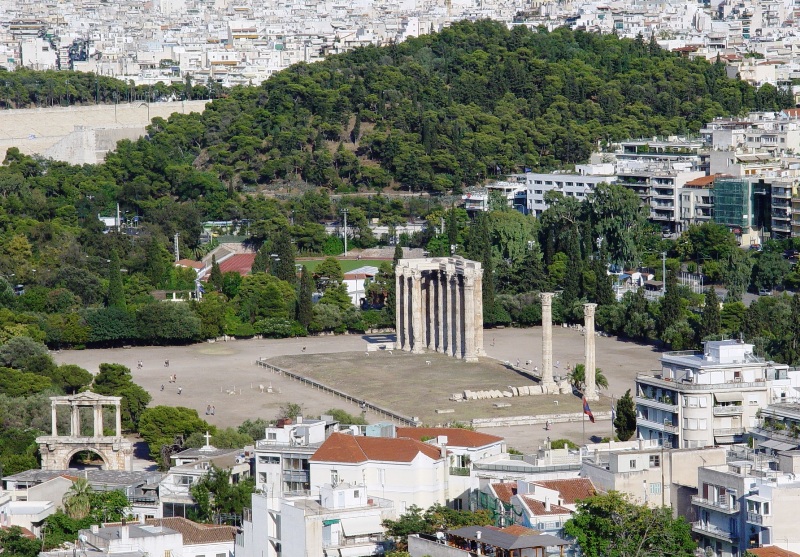
The Temple of Zeus in Athens is located southeast of the Acropolis.

Temple of Zeus in Athens. Photo by Leon Mauldin

Wikipedia has the following general info:

The temple of Olympian Zeus . . . is a colossal ruined temple in the centre of the Greek capital Athens that was dedicated to Zeus, king of the Olympian gods. Construction began in the 6th century BC during the rule of the Athenian tyrants, who envisaged building the greatest temple in the ancient world, but it was not completed until the reign of the Roman Emperor Hadrian in the 2nd century AD some 638 years after the project had begun. During the Roman periods it was renowned as the largest temple in Greece and housed one of the largest cult statues in the ancient world.

Originally there were 104 Corinthian columns. Today 15 of those remain standing. A 16th column can be seen lying on the ground.

In the early 1800s a stylite made his dwelling on the top of one of the columns. The Greek word for column is stylos; the stylites were ascetics who spent long periods (sometimes years) on the tops of columns.

In the NT book of Acts, when Paul was preaching at Lystra, he healed a lame man. The pagan residents thought the gods had come down in human form. “They began to call Barnabas Zeus and Paul Hermes, because he was the chief speaker. The priest of the temple of Zeus, located just outside the city, brought bulls and garlands to the city gates; he and the crowds wanted to offer sacrifices to them” (Acts 14:12-13). Paul and Barnabas were just barely able to persuade them not to do so.

Right after that, Jews came from Pisidian Antioch, and persuaded those same residents of Lystra to stone Paul and drag him out of the city! (Acts 14:19).

Click on image for higher resolution.


Temple of Hephaestus, Athens

January 31, 2011

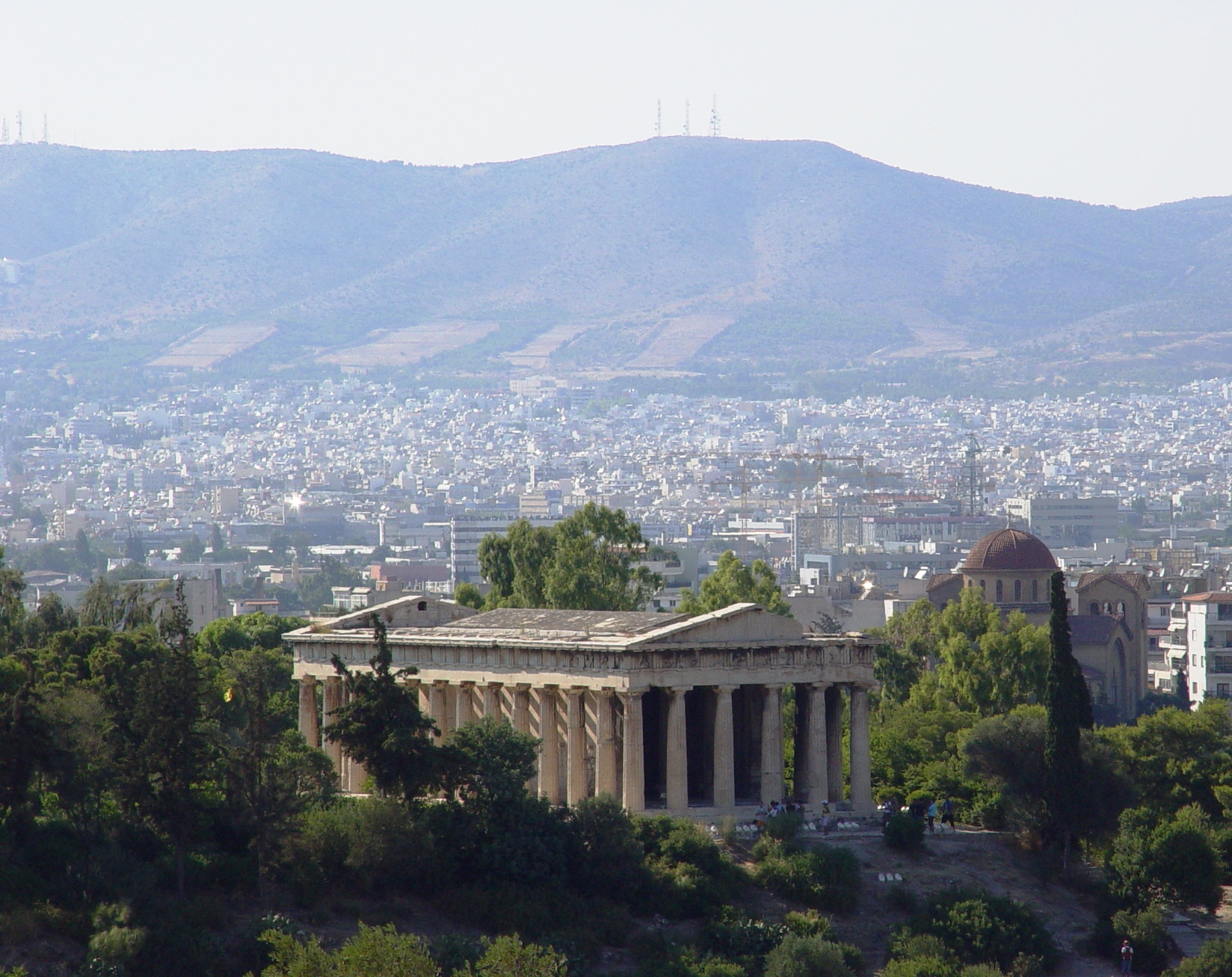
Today’s post features the Athens Temple of Hephaestus. Hephaestus was the mythical god of forging and metal working, the god of blacksmiths. Construction on the temple was begun in 449 BC, and was completed 415 BC. It is a Doric style temple, made of Pentelic marble, and is located on the northwest side of the agora.

Athens Temple of Hephaestus. The god of forging. Photo by Leon Mauldin.

This temple is said to be the best preserved ancient Greek temple in the world. It would have been prominently overlooking the agora when Paul preached in Athens (Acts 17).

In Birmingham, AL., known in the past as a major steel producer, the Vulcan stands atop Red Mountain (largest cast iron statue in the world). Vulcan is the Roman equivalent to the Greek Hephaestus. The word vulcanize comes from his name.

Click on image for high resolution.


At Athens, Gate of Athena Archegetis

January 25, 2011

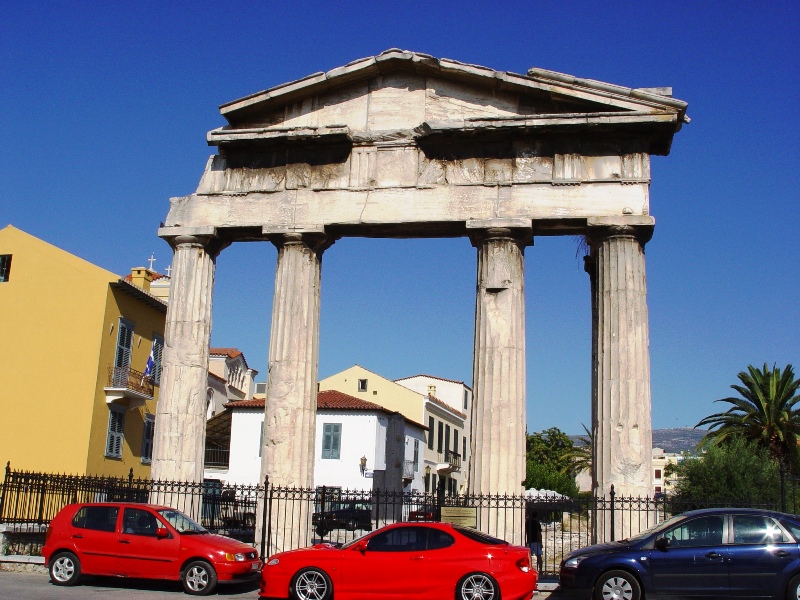
Situated on the west side of the agora in Athens is the Roman forum Gate of Athena. It was constructed in 11 BC. It has four Doric columns, with a base of Pentelic marble. According to the inscription on the architrave, the gate was dedicated by the Athenians to their patroness Athena Archegetis with funding by Julius Caesar and later Augustus.

Gate of Athena Archegetis in Athens. Photo by Leon Mauldin.

It is amazing to see ancient ruins surrounded by modern buildings, not to mention the vehicles!


Stoa of Attalus at Athens

January 20, 2011

Paul sent word for his traveling companions Silas and Timothy at Beroea to join him “as soon as possible” at Athens (Acts 17:15). Meanwhile, as Paul waited for them, he made effective use of the time. Acts 17:16,17 states,

Now while Paul was waiting for them at Athens, his spirit was being provoked within him as he was observing the city full of idols. So he was reasoning in the synagogue with the Jews and the God-fearing Gentiles, and in the market place every day with those who happened to be present.

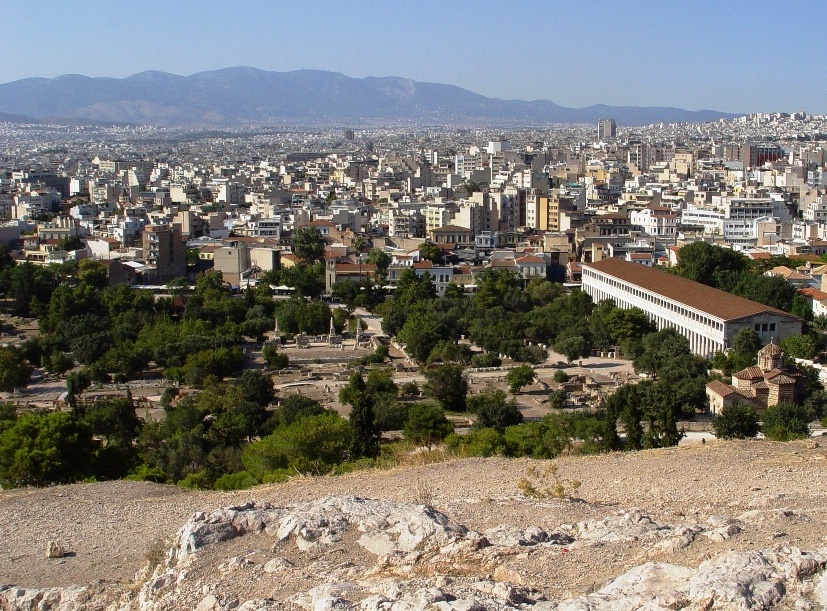
Note that Paul reasoned in the market place those who happened to be present. The market place, or agora, was the civil center of Athens. This would have included the Stoa (porch), a colonnaded structure on the east side of the market place.  Social, political, legal meetings and religious and philosophical discussions took place there. Paul made use of this setting as an opportunity to teach and reason about the true God, and His will for all men.

Stoa of Attalos and Market Place (Agora) from the Areopagus. Photo by Leon Mauldin.

In our photo, taken from the Areopagos (Mars Hill) you can see the Stoa of Attalos at right center.  The ancient agora sprawled to your left. This gives the geographical context to Paul’s discussions in the Athenian marketplace, with “those who happened to be present.”

Attalos II was king of Pergamum 159-138 BC. It was he who first built the Stoa.

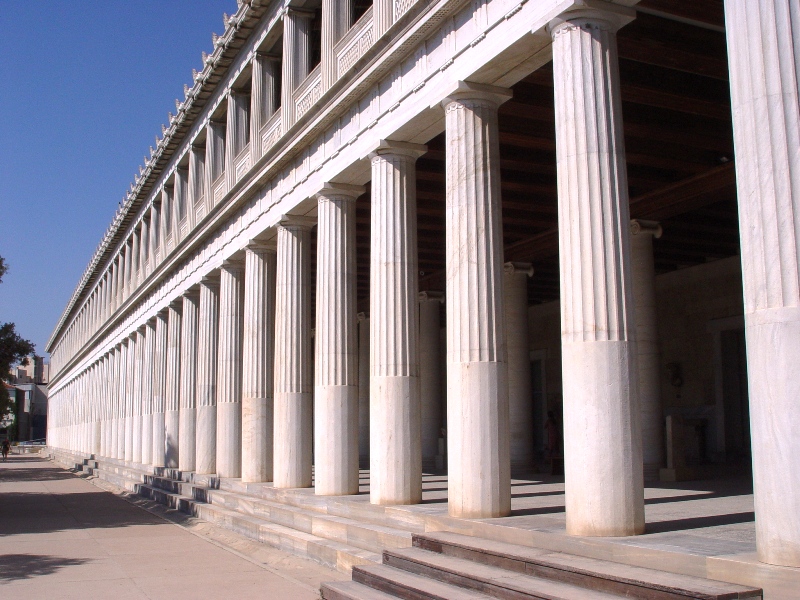
Stoa of Attalos. Consisted of two stories. Photo Leon Mauldin.


The Stoa was 385 feet in length and consisted of two stories. It housed 21 shops on each floor. Again, this would have been the site for Athenians to meet, walk, and to do business.

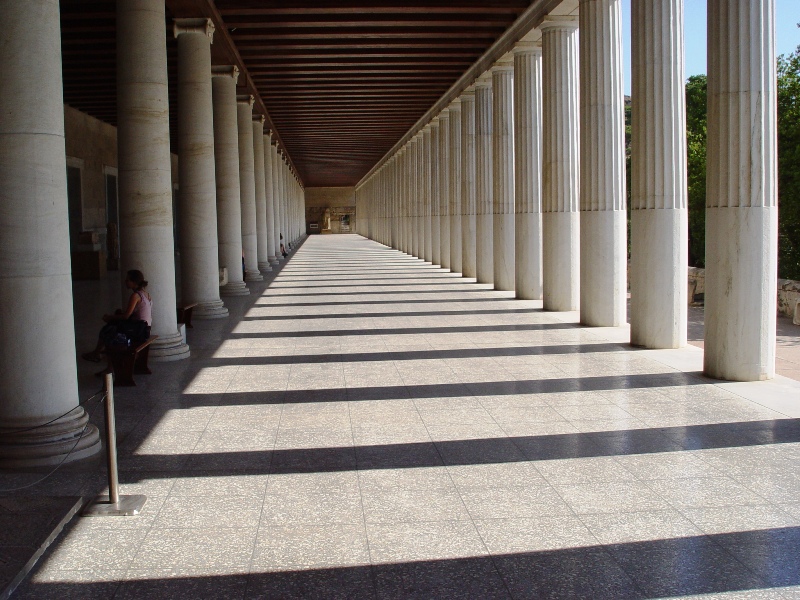
Stoa of Attalos at Athens. Photo by Leon Mauldin.

Here is a view of the Stoa showing first floor level. Restoration of the Stoa was carried out in 1953-1956 by the American school of Classical Studies with the financial support of John D. Rockefeller, Jr.

Click on images for higher resolution.