New Resource: Captivity and Return

September 19, 2012

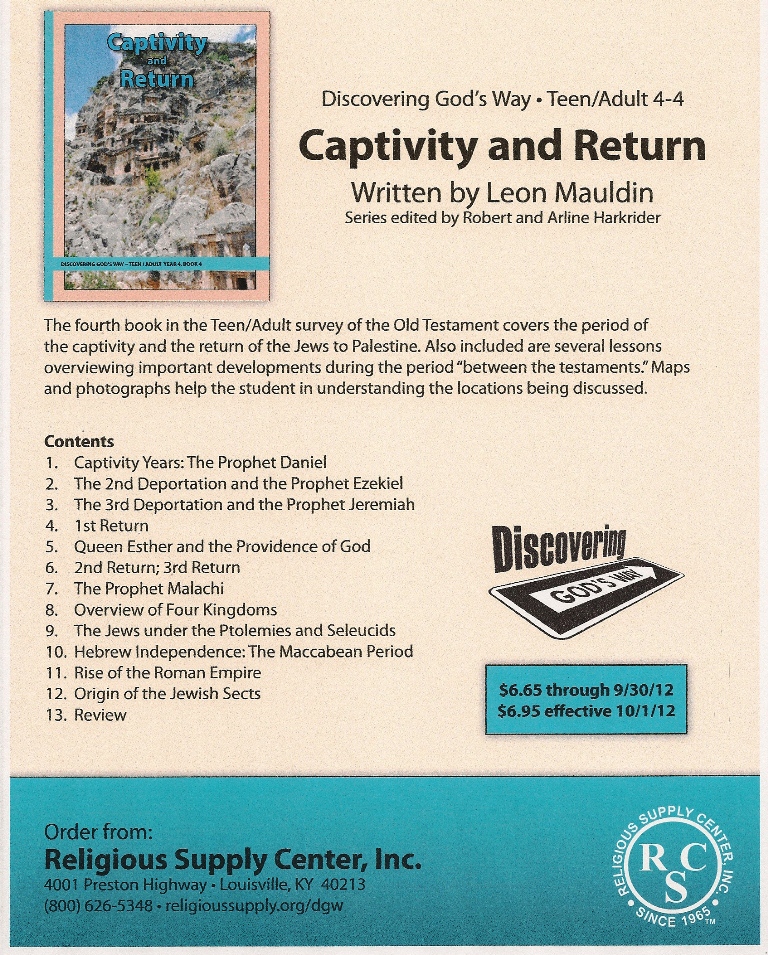
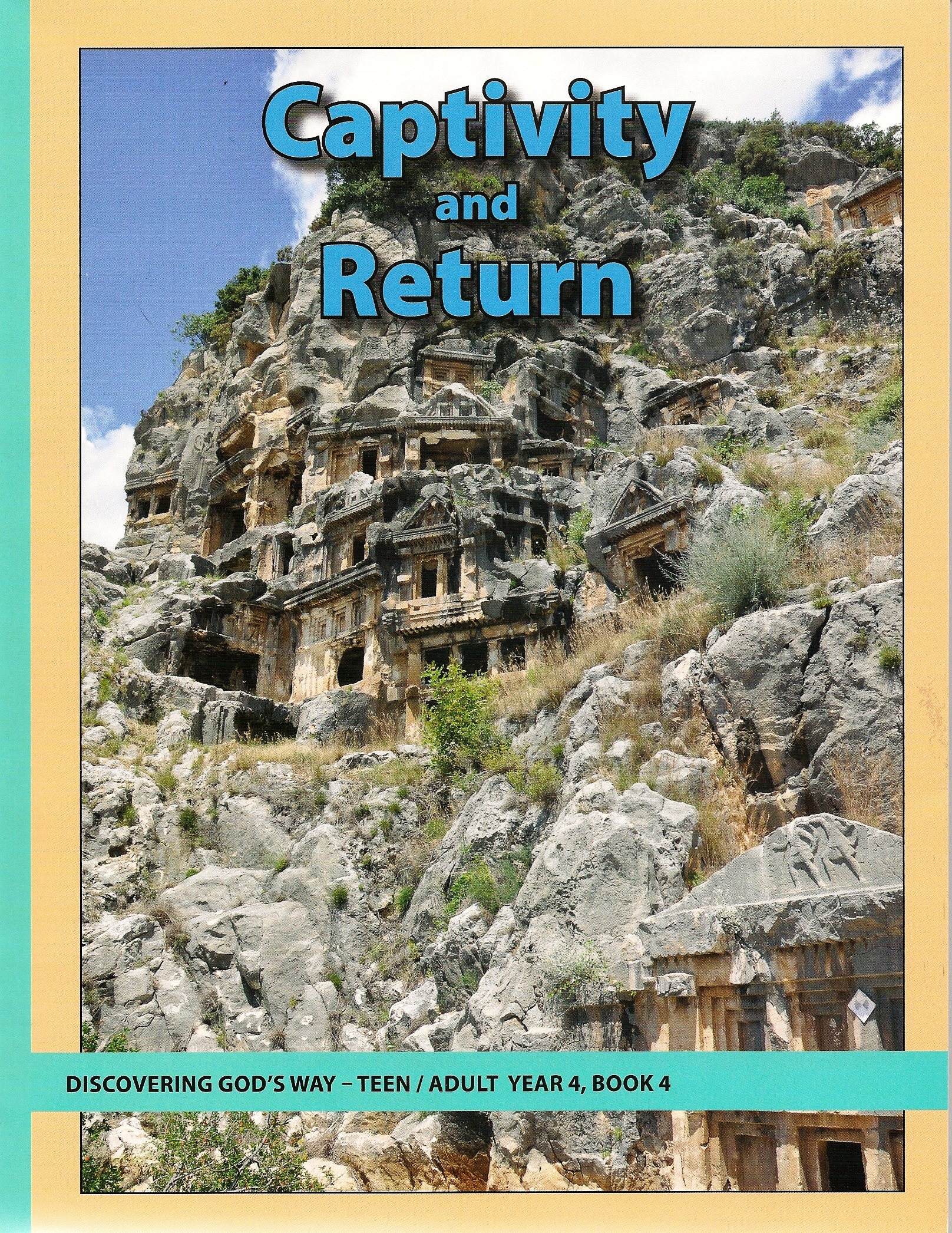
Discovering God’s Way is a Bible class curriculum for ages nursery through adult, edited by Robert Harkrider, and published by Religious Supply Center of Louisville, KY. I have written two books for the teen/adult level, Divided Kingdom, and Captivity and Return, the latter of which has just now been printed. Here is the cover:

Cover, Captivity and Return, authored by Leon Mauldin.

The book is 118 pages, and has 13 lessons. It is illustrated with maps, as well as color photos of biblical places and artifacts relating to the places and periods studied. Here is the table of contents:

Table of Contents for Captivity and Return, by Leon Mauldin.

The captivity and return can be a challenging period of biblical history. It is hoped that this book will help contribute to a better understanding of these times, as well as provide some background for New Testament studies.

Toll free number for orders is 1-800-626-5348. It is $6.65 through 9/30/2012, and then $6.95. Price does not include shipping.


Q&A re: Persian Chronology in Ezra 4

May 3, 2012

A friend writes to ask that I help with the following question:

In Ezra 4-5, we read of the opposition that the Jews faced in the rebuilding of the temple. We read of Cyrus, Darius, Ahasuerus and Artaxerxes as the kings in Persia.

When Ezra jumps from Darius to Ahasuerus, is he jumping forward in history to the Ahasuerus and Artaxerxes that reigned from about 486-424, or are those titles for the son of Cyrus, Cambyses, who reigned immediately following Cyrus? Clarke suggests that these were titles for Smerdis, who reigned between Cambyses and Darius.

Is there any way to figure it out conclusively?

Here is what I believe to be the best explanation to the text:

Ezra 4:5 states that the enemies “hired counselors against them to frustrate their counsel all the days of Cyrus king of Persia, even until the reign of Darius king of Persia.”  At that point the record goes on to mention Ahasuerus (v.6), who is to be identified as Xerxes (see NAS ft. nt.).  This is the Persian king who took Esther as queen (Xerxes reigned 486-464 B.C.).  The next verse, Ezra 4:7, then says, “And in the days of Artaxerxes..,” who is the Persian king in the days of Nehemiah, cupbearer to the king (reigned 464-423 B.C.).   Ezra 4:23 makes reference to a document of King Artaxerxes. So why are these kings who reigned after Darius (522-486 B.C., under whose reign the temple was rebuilt) mentioned here?  It seems the best answer is that the current opposition which stopped (for several years) the rebuilding of the temple furnished the occasion for the writer to list similar efforts made by enemies of God’s people to hurt and halt His work including the rebuilding of the walls of Jerusalem.  As Fensham noted, the author “is referring in this chapter in chronological order to the hindrances placed in the way of the Jews to rebuild the temple and the wall of Jerusalem.  When he discussed the problems of the building of the temple in 4:1-5, it reminded him of later similar troubles with the rebuilding of the wall of Jerusalem, and so 4:6-23 has been inserted, almost parenthetically, before the argument of the building of the temple has again been taken up in 4:24ff) (The New International Commentary on the Old Testament: The Books of Ezra and Nehemiah, p.70).  “…the author of this chapter enumerated the different hostile actions against the Jews…” (ibid.71).   This explanation was earlier given by Keil in the 19th century (Vol.4, p.46), who went on to say, “v.24, so far, then, as its [subject] matter is concerned, belongs to the following chapter, to which it forms an introduction (ibid.47).

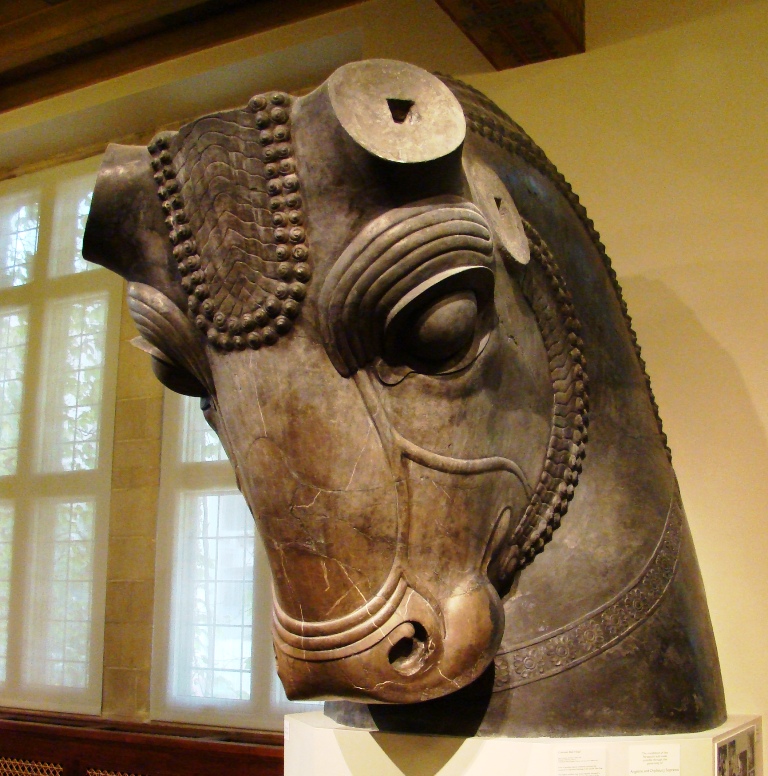
The Oriental Institute Museum has an impressive collection of Persian artifacts which relate to the biblical period.

Bull from Palace at Persepolis. Dates to Persian Kings Xerxes and Artaxerxes I. Photo by Leon Mauldin.

The accompanying info sign dates this bull to the reigns of Xerxes and Artaxerxes (Xerxes married Esther and made her queen; Artaxerxes was king during the days of Nehemiah) and goes on to state:

Paris of guardian figures commonly protected the entrance to important buildings in the ancient Near East.

This highly polished stone head originally belonged to one of two guardian bulls flanking the portico of the hundred-column hall at Persepolis.

[This head] which weights approximately ten tons, was transported to Chicago and restored by Mr. Donato Bastiani, a member of the Oriental Institute Museum technical staff.

The two bulls were carved in the court style typical of the Achaemenid Empire. The ears and horns, which had been added separately, were not found.

Click image for larger view.


More on Azazel

February 18, 2012

Our previous entry was on Azazel, the Scapegoat. See here. I wanted to follow-up with a bit more information on the word Azazel from The Theological Wordbook of the Old Testament (Eds. Harris, Archer, and Waltke):

The actual use and meaning of this word in Lev 16 is at best uncertain. However, regardless of its precise meaning, the significant dimension is the removal of the sins of the nation by the imposition of them on the goat. In this passage sin seems to be hypostatized [to treat or represent as concrete reality] and therefore readily transferable to the goat. Indeed vss 21 and 22 state that this goat is to bear away the sin of the people. Such a ritual would illustrate vividly the physical removal of defilement from the camp to a solitary place where it would no longer infest the nation.

A parallel to the scapegoat can be seen in the ritual for a recovered leper. Two birds were selected. One was to be killed and both the leper and the living bird were to be touched with its blood. Then the living bird was released. This bird carried away the evil, the leprosy itself, into the open field and then the leper was pronounced clean (Lev 14:1–9). . .

This concept of the removal of guilt can be seen in Ps 103:12 where God “removes” our transgressions from us.

In the NT John the Baptist identified Jesus as the Lamb of God which takes away the sins of the world (Jn 1:29, 36). This language is sacrificial, yet nowhere in the Law is a lamb spoken of as a bearer of the people’s sins. The paschal lamb is not a sin offering. The description of the Savior as a lamb is unknown to late Judaism. Furthermore, the phrase “the lamb of God” is an unparalleled genitive combination. John may have had in mind that Christ as the paschal lamb bespeaks our great deliverance from the bondage of sin. However, what seems more likely is that he had a complex of ideas in mind. Some words of Isa 53 are discernible here: “as a sheep led to the slaughter, and a lamb dumb before his shearers … whose soul was made a guilt offering … and who bore the sin of many.” But also discernible here is an allusion to the scapegoat. This fact is clearly seen in the words “taketh away” (cf. I Jn 3:5). In Christ are consummated all the atonement concepts of the OT (pp.657-658).

The instructions of Leviticus 16 were given while Israel was encamped at the foot of Mt. Sinai. In our photo here you can see traditional Mt. Sinai, Jebel Musa, as you look to upper right in photo.

Mt. Sinai, Jebel Musa, upper right of photo. Photo by Leon Mauldin.

Click on image for larger view.


As a Hen Gathers Her Chicks

February 2, 2012

On the last day of Jesus’ public ministry, the Tuesday before He was betrayed on Thursday night, when Jesus left the temple courts He said,

O Jerusalem, Jerusalem, the one who kills the prophets and stones those who are sent to her! How often I wanted to gather your children together, as a hen gathers her chicks under her wings, but you were not willing! 38 See! Your house is left to you desolate; 39 for I say to you, you shall see Me no more till you say, “Blessed is He who comes in the name of the LORD!” (Matthew 23:37-39).

The imagery of a mother hen shielding her chicks may need explaining to those (city dwellers) who have not seen this display of instinctive protection. It is not “learned behavior;” it is God-given and natural. When danger is perceived, the chicks run to the hen for safety and security.

I could not help but think of the above passage when I saw this scene in Galilee.

Chicks going to the mother hen. Photo by Leon Mauldin.

When I initially approached to take the photo the chicks were a bit scattered. But as I advanced closer, they all went right to the mother hen.

Jesus wanted the inhabitants of Jerusalem to come to Him, for safety, security and for salvation. But sadly, they were not willing. Man is unique to creation. We don’t merely act instinctively. God has given us freedom of choice. He appeals to our heart, He beckons through the Gospel, but He will not force.

For a related post, “Not One Stone Upon Another,” see here.

Click on image for larger view.


The Continuity of God’s Plan

January 23, 2012

During most of the decade of the ’80’s we lived and preached in Lexington, AL., a small town in northwest Alabama just below the Tennessee state line. When we moved there we soon heard of a church member, Mr. Beavers (already deceased), whose “gift for gab” was legendary. It was about a 40 minute ride from Lexington to Florence. A company van provided transportation so he and other area workers rode back and forth every day.

It was said that when Mr. Beavers got in the van he started talking. And he talked all the way to work. Then nine hours later at the end of the workday when they loaded up to return home, he start talking again–without fail taking up at the very point he left off that morning! I always thought that was amazing. If my train of thought is interrupted I might have to ask, “Now what was I saying?” But Mr. Beavers could remember consistently, with the passing of nine hours.

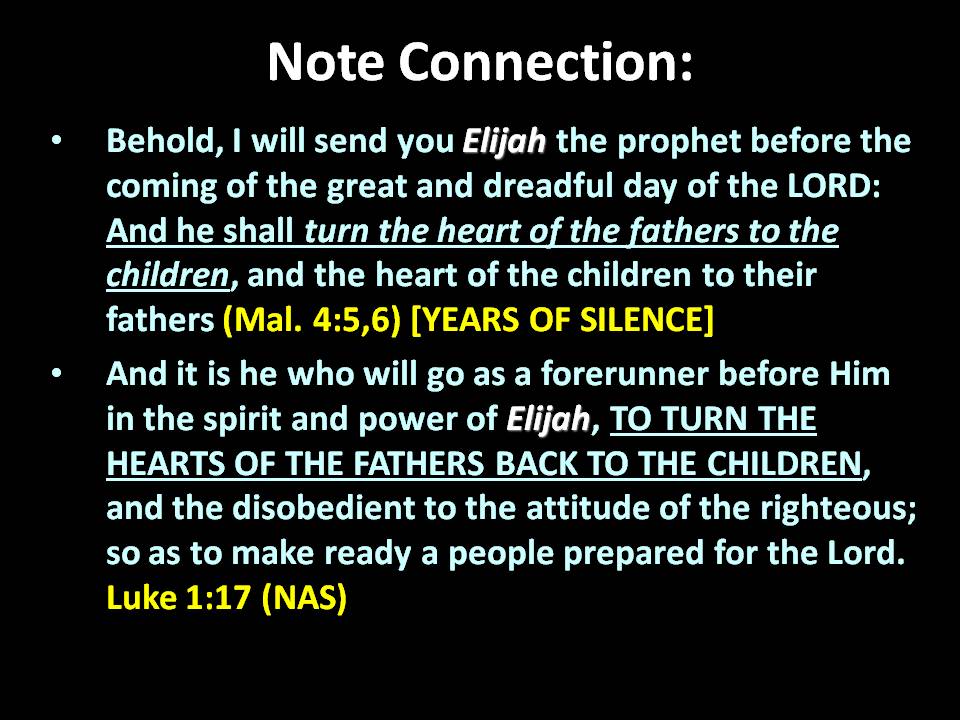
But then I think of God’s redemptive plan, which in His eternal wisdom he formulated before the foundation of the earth. He began to reveal that plan in Gen. 3:15, with the first promise of Christ, when sin first entered the world. Little by little through the Old Testament there is the unfolding of God’s plan. Then we come to the book of Malachi, the final prophet in our Old Testament. Malachi prophesied ca. 432 BC. There would be more than 400 years of biblical silence, that is, where there would be no more revelation from God, until that silence is broken as the Gospel records report. But God never forgot His plan. Note the connection between Malachi and Luke (Luke goes back the farthest in his record re: the birth of John), when the angel Gabriel told the aged priest Zacharias that he and his barren wife Elizabeth were to have a son:

The Continuity of God's Plan. Chart by Leon Mauldin.

The Old Testament concluded with a prophecy of John’s birth, figuratively referenced here as Elijah the prophet. He would be the forerunner to prepare the people for Jesus’ coming. But although 400+ passed after Malachi’s prophecy, when God renewed revelation, He took up right where He left off, thus continuing the unfolding of His plan to bring Christ into the world. Amazing!


Lessons from Leviticus?

December 30, 2011

In his preface to his commentary on Leviticus in the New International Commentary on the Old Testament, Gordon Wenham wrote,

Leviticus used to be the first book that Jewish children studied in the synagogue.  In the modern Church it tends to be the last part of the Bible anyone looks at seriously (vii).

The first time I read that statement I did a double-take. Studying Leviticus first in synagogue? What did they see back then that might be overlooked today?

In my lecture at Florida College (entitled “Trusting in gods that Cannot Save,” 2010) I made reference to the above quote and then observed,

The real heart of Leviticus is contained in verses such as 20:26: “Thus you are to be holy to Me, for I the LORD am holy; and I have set you apart from the peoples to be Mine.” Everything about how to approach God in worship, what to eat, wear, plant, along with all the other laws, had to do with that one principle: by all of these things God was teaching them that they were different from the world; they were His special people; they were to partake of His holiness.  Do you agree that this is not a bad idea, to teach a child from infancy that he is special to the Lord; that we are different from the world; that our concern is to be seeking and doing God’s will? (p.76).

The book of Leviticus was not just for the priests. In the opening verses, God said,

Speak to the sons of Israel and say to them, ‘When any man of you brings an offering to the LORD, you shall bring your offering of animals from the herd or the flock (Lev. 1:2, NASB).

The instructions are to the sons of Israel. Re: “Any man of you” the NET notes,

It is the Heb “a man, human being” (‘adam), which in this case refers to any person among “mankind,” male or female, since women could also bring such offerings.

So here is a book that was for everyone during that dispensation, whether priests or other Israelites, men or women.

We are not contending that we are under the specific legislation of that time, but Romans 15:4 teaches,

For whatever was written in former days was written for our instruction, that through endurance and through the encouragement of the Scriptures we might have hope (ESV).

Perhaps you would like a brief outline and chapter content for the book of Leviticus:

Leviticus Outline and Chapter Content

I.          LAWS OF SACRIFICE 1-7

II.        HISTORICAL 8-10

III.       LAWS OF PURITY 11-15

IV.       ANNUAL DAY OF ATONEMENT

V.        HOLINESS OF PEOPLE 17-20

VI.       HOLINESS OF PRIESTS & LAWS RE: SACRIFICES 21-22

VII.     LAWS CONCERNING FEASTS 23-25

VIII.    PROMISES & WARNINGS 26

IX.       LAWS CONCERNING VOWS 27

1. Burnt offering

2. Meal offering

3. Peace offering

4. Sin offering

5. Trespass offering

6-7 Laws of Sacrifice given to priests

8. Consecration of priests

9. Priests begin to serve

10. Death of Nadab & Abihu

11. Clean & unclean foods

12. Purification after childbirth

13-14. Laws concerning Leprosy

15. Laws concerning normal & abnormal issues

16. Day of Atonement

17. Eating of blood forbidden

18. Laws of moral purity

19. Miscellaneous laws

20. Punishment for disobedience

21-22. Laws of holiness for priests; laws re: sacrifices

23. Sabbath, 3 annual feasts, day of atonement

24. Lamps, showbread; punishment for blasphemy

25. Year of Jubilee

26. Blessings of obedience; consequences of disobedience

27. Laws concerning vows

The Census of Numbers 1:46: 603,550 Men of War

December 3, 2011

While Israel was still encamped at Mt. Sinai a census was taken the men of war with a view of the Conquest of Canaan. Numbers 1:46 states, “all who were numbered were six hundred and three thousand five hundred and fifty.” Only those age twenty and older were counted (1:45), and the tribe of Levi was excluded.

That high number has been dismissed as improbable or even impossible by many and has given rise to numerous explanations of what is meant other than a literal reading. For example, R.D. Cole in the New American Commentary explores six possible explanations of the passage and then writes,

More recently D. Fouts has suggested that the hyperbolic use of numbers in the Book of Numbers presents a parallel to ancient Near Eastern texts from Mesopotamia that utilize large hyperbolic numbers in military conscription texts and other population counts.

Israel’s power was not in the size of their armies or their enormous population but in their God. He would send angels before them to fight their battles and confuse their enemies. The hyperbolic use of numbers was not for misrepresentation but for powerful demonstration of Yahweh’s continuing blessing upon Israel in the past, multiplying seventy persons into more than sixty thousand or six hundred thousand or three million, and the numbers were a statement of confidence in a God who would continue to multiply his people like the stars of the heaven.

I have several problems with this kind of explanation:

1. There is nothing within the text or context of Numbers 1:46 to indicate that there is a hyperbolic or poetic usage of numbers.

2. There are related passages that have a bearing on the matter. For example, each man age 20 and upward was required to pay 1/2 shekel as an offering to the Lord (Ex. 38:26). Exodus 38:25 states, “The silver of those of the congregation who were numbered was 100 talents and 1,775 shekels, according to the shekel of the sanctuary.” 1 talent equals 3,000 shekels, thus 100 talents equals 300,000 shekels. That plus the additional 1,775 shekels listed would total 301,775 shekels. Since each paid 1/2 shekels, 301,775 shekels would be payment for exactly 603,550 men. Must we now find Mesopotamian parallels or conclude that this passage also make hyperbolic usage of the numbers in this text?

3. Months earlier when the Exodus occurred, the record states, “Then the children of Israel journeyed from Rameses to Succoth, about six hundred thousand men on foot, besides children” (Ex. 12:37).

4. When the rebellion occurred, the refusal of the men to conquer Canaan, all of them died in the wilderness. In the 40th year it was necessary to take another census. That total was 601,730 (Num. 26:51), which is slightly less but for all practical purpose approximately the same as the first numbering.

Conclusion: What we see is that the numbering of Num. 1:46 is consistent with the total for the 1/2 shekel offering, the record in Ex. 12:2, as well as the second numbering. My conclusion is that the Numbers census of Num. 1:46 should be taken at face value.