Pompeii, the Odeum (Small Theater)

August 25, 2023

We are looking forward to again touring Sicily/Italy in March 2024, the Lord willing. I was recently reviewing some photos from previous trips and wanted to share a few of these. Pompeii was covered with volcanic ash by the eruption of Mount Vesuvius (August AD 79).

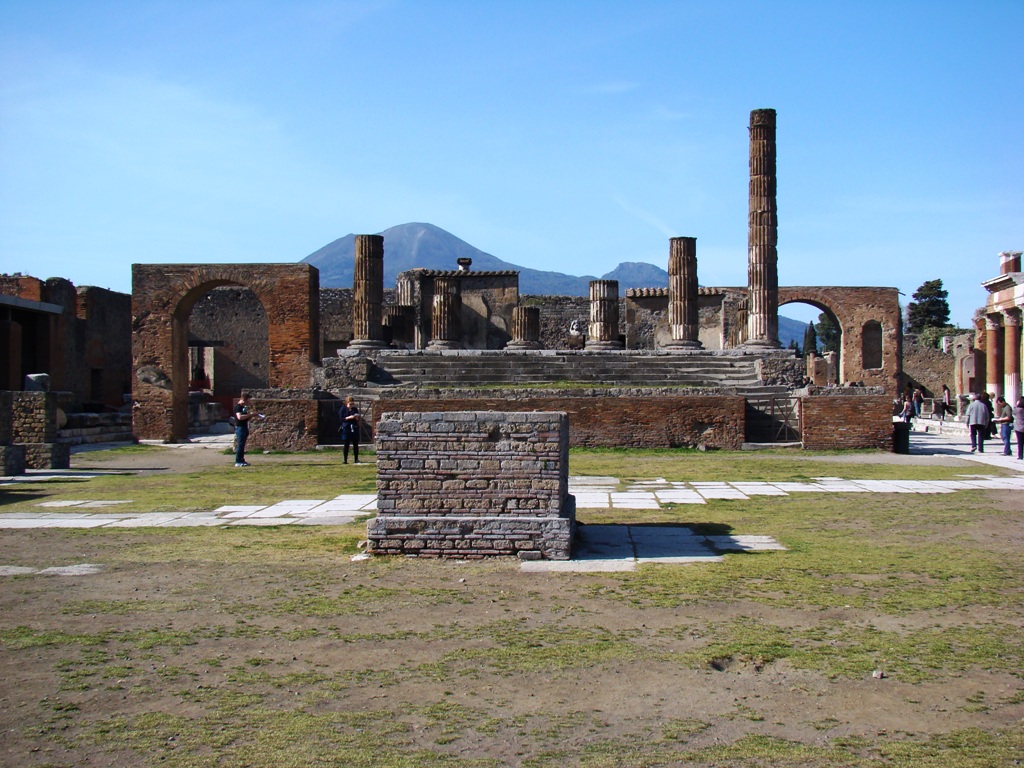
In this post we will look at the Odeum at Pompeii. Here is the view of Pompeii just inside the entrance (Mt. Vesuvius is in the background):

One’s initial view of Pompeii at entrance. Mt. Vesuvius is in the background. Photo ©Leon Mauldin.

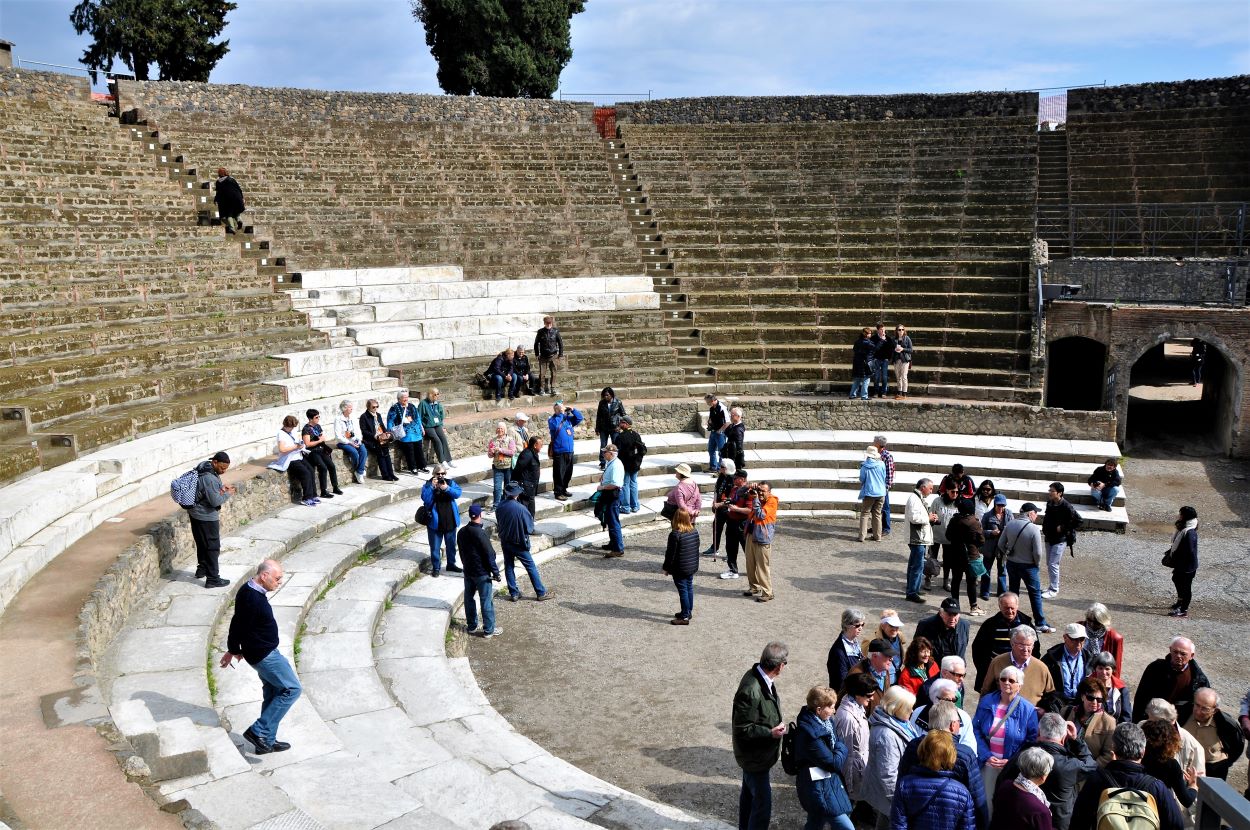
The city had two theaters, the large theater, which seated about 5,000 spectators, and the small theater, the odeon. The seating capacity of this small theater was about 1,000 people. A pyramid-shaped roof would have covered it. It would have been used for musical performances and mime.

Odeum at Pompeii. Photo ©Leon Mauldin.

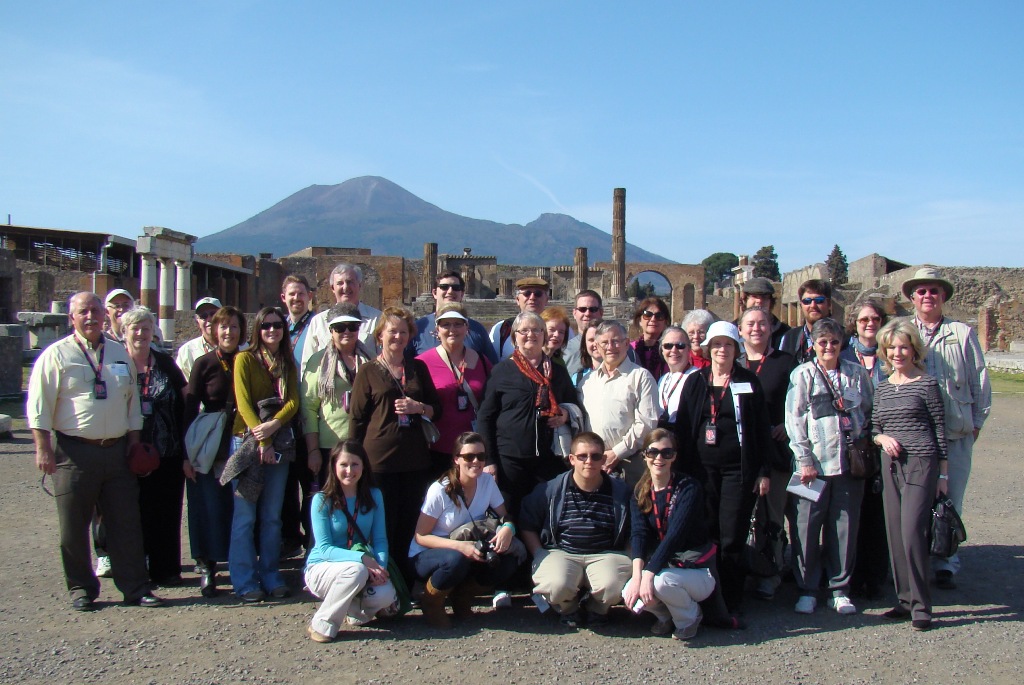
Here is a photo of my group in the Odeum, March 2016.

Mauldin group photo, 2016. Photo ©Leon Mauldin.

An inscription at the site states that the duumviri C. Quintius Valgus and M. Porcius, two leading citizens of Pompeii, financed the construction of the theater. In 80 BC Pompeii became a Roman colony with the name of Colonia Cornelia Veneria Pompei.

Inscription at Odeon in Pompeii. Photo ©Leon Mauldin.

Temples in Pompeii, Italy

January 27, 2017

The Roman city of Pompeii, as was generally the case in the world of the 1st century, was a city of many gods.

Pompeii–as you might expect, given its many gods–had many temples, though by no means one for every god or goddess who might intervene in the lives of its inhabitants. They came in all sizes, in varying degrees of prominence and with very different histories. Some stretched back to the earliest years of the city. The temple of Apollo next to  the Forum was established by the sixth century BCE at the latest. (The Fires of Vesuvius.281-282).
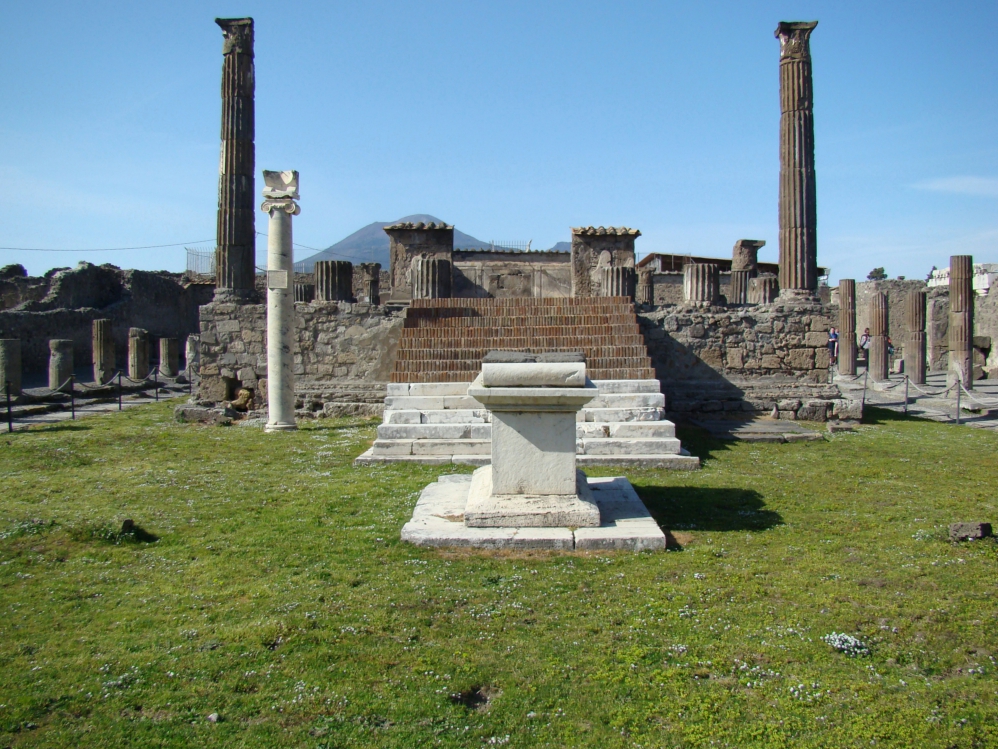
Temple of Apollo, Pompeii, Italy. Photo by Leon Mauldin. Mt. Vesuvius may been seen the the background.

Temple of Apollo, Pompeii, Italy. Photo by Leon Mauldin. Mt. Vesuvius may been seen the the background.

Most of the rest [of the temples] date to the second century BCE or later. The Small Temple of Fortuna Augusta was dedicated to an almost untranslatable combination of the goddess of Good Fortune or Success (Fortuna) and the power of the emperor (the adjective Augusta can confusingly, or conveniently, refer either to the first emperor Augustus himself, or to imperial power more generally–for subsequent emperors used “Augustus” as part of  their titles too)  (Ibid.)
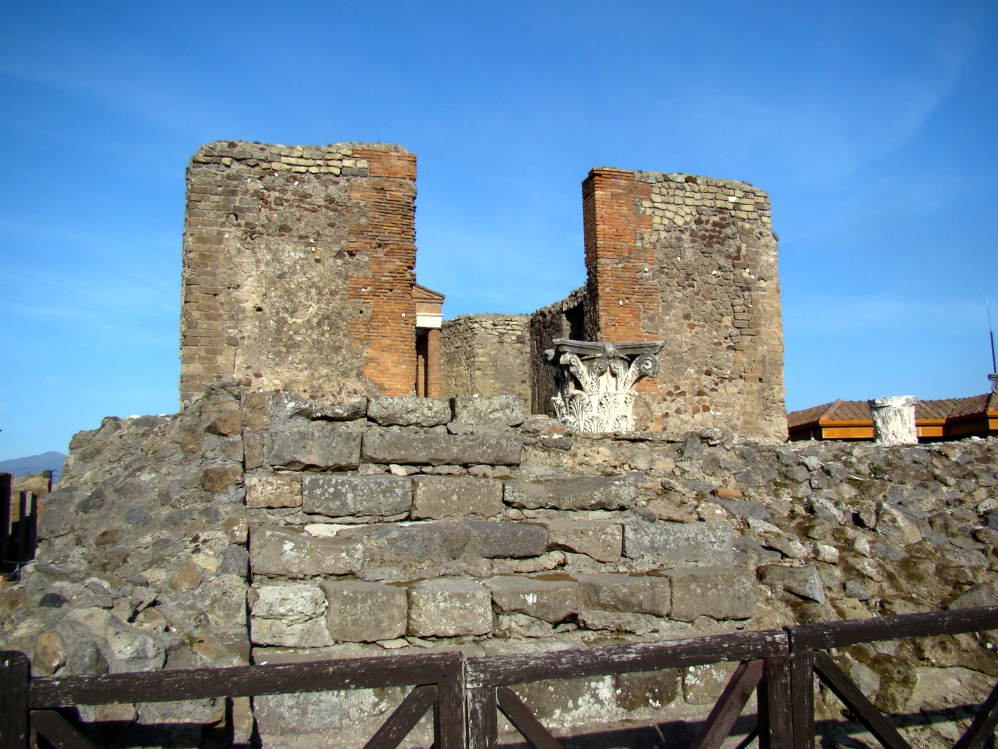
Temple of Fortuna Augusta, Pompeii. Photo by Leon Mauldin.

Temple of Fortuna Augusta, Pompeii. Photo by Leon Mauldin.

Pompeii is a city “frozen” in time by the eruption of Mt. Vesuvius, AD 79. Though this is not a “biblical city” it preserves scenes from a Roman city in the AD 1st century, and thus has tremendous value to us. Thus it helps us to see the setting for the biblical world in the early New Testament era.

When contemplating the widespread idolatry of the biblical world, I often think of Paul’s statement to the Corinthians, many of whom had themselves formerly been idolaters:

we know that “an idol is nothing in the world,” and that “there is no God but one.” For even if there are so-called gods, whether in heaven or on earth– as there are many “gods” and many “lords”– yet for us there is one God, the Father, from whom are all things, and we for Him; and one Lord, Jesus Christ, through whom are all things, and we through Him. However, not everyone has this knowledge. (1 Cor. 6:4-7, HCSB).

Click images for larger view.


Temple of Jupiter at Pompeii

March 21, 2012

Today completes our tour of Italy. We have been blessed in so many ways throughout this trip. The weather has been ideal. Tomorrow we are to leave the hotel about 3:00 AM for the airport at Rome. In the days ahead I hope to sort through the photos and share some on this blog.

Sunday afternoon we had the occasion to visit Pompeii. Pompeii is a city “frozen” in time by the eruption of Mt. Vesuvius, AD 79. Though this is not a “biblical city” it preserves scenes from a Roman city in the AD 1st century, and thus has tremendous value to us. Thus it helps us to see the setting for the biblical world in the early New Testament era.

Temple of Jupiter at Pompeii

Our photo shows the Temple of Jupiter in Pompeii at the north end of its forum.  You can see Mt. Vesuvius in the background.

Jupiter was the most important divinity in Ancient Rome.
While at this site we had a group photo made.

Group Photo at Pompeii.

The eruption  began about midday on August 24, AD 79. It was a catastrophe for the inhabitants of the small cities who had lived for hundreds of years in the fertile lands under Mt. Vesuvius. Apparently no one had suspected the mountain of being a potential volcano. Though some escaped, thousands were killed when the vast eruption blew off the top of the mountain. Pompeii was covered with 17 feet of volcanic matter, and nearby Herculaneum was covered to a depth of up to 70 feet!

Vesuvius’ eruption has proved an immense blessing to posterity, for it has preserved—almost ghoulishly—intact the houses, artifacts and corpses of two prosperous, fashionable towns as the Roman Empire neared its zenith. Bread has been left preserved in ovens, meals left ready on tables, scurriloius election notices for the forthcoming curia (council) elections—“Thieves support Vatius for aedile!”—survive on the walls. Inside the houses the bodies of lovers have been found in doomed embrace, while in the streets looters were overwhelmed with their booty. Without that terrible day, our knowledge of ordinary Roman life would be far less vivid (Nigel Rodgers, Roman Empire, p.356).

More to come!

Click on images for larger view.