Babylon’s King Belshazzar

July 24, 2025

Daniel 8 gives the chronological notation of Daniel’s vision as the third year of the reign of King Belshazzar. Because it was known that Nabonidus (r. 556-539 BC) was Babylon’s last king, many “scholars” thought that Belshazzar was just a figment of the author’s imagination. But archaeologists uncovered clay cylinders in southern Iraq, written in cuneiform, which shed light on this matter. The answer turned out to be that Belshazzar shared a co-regency with his father Nabonidus.
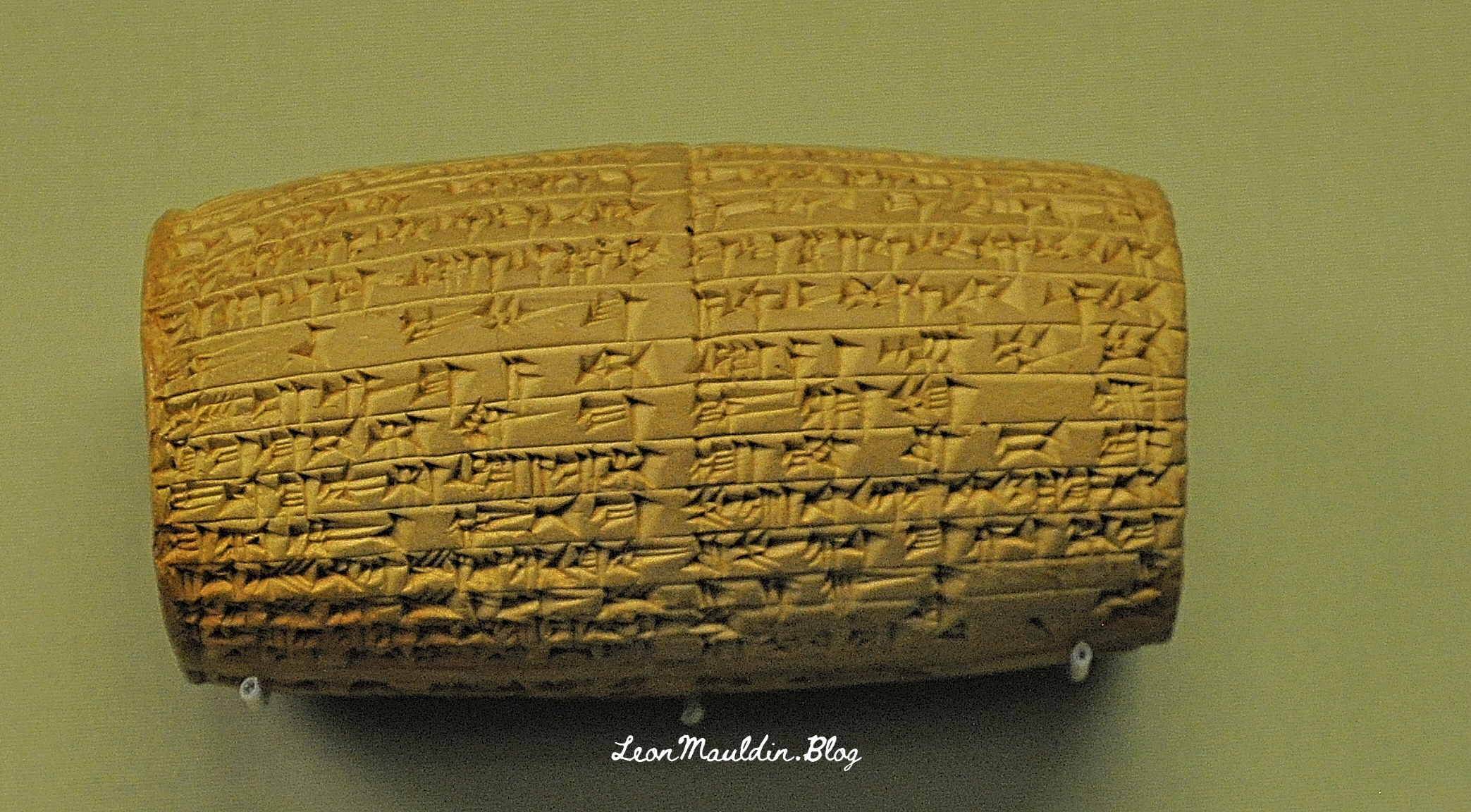
Clay cylinder mentions both Nabonidus and his son Belshazzar. Photo ©Leon Mauldin. British Museum.

This cylinder records the restoration of Sin’s ziggurat at Ur. Sin was the Babylonian moon god. The inscription also includes the request that the god would protect Nabonidus and his son, Belshazzar.

It was this king, Belshazzar, that saw the “handwriting on the wall” (Dan. 5). Note that the events of Daniel 5 are after those of chapter 8.
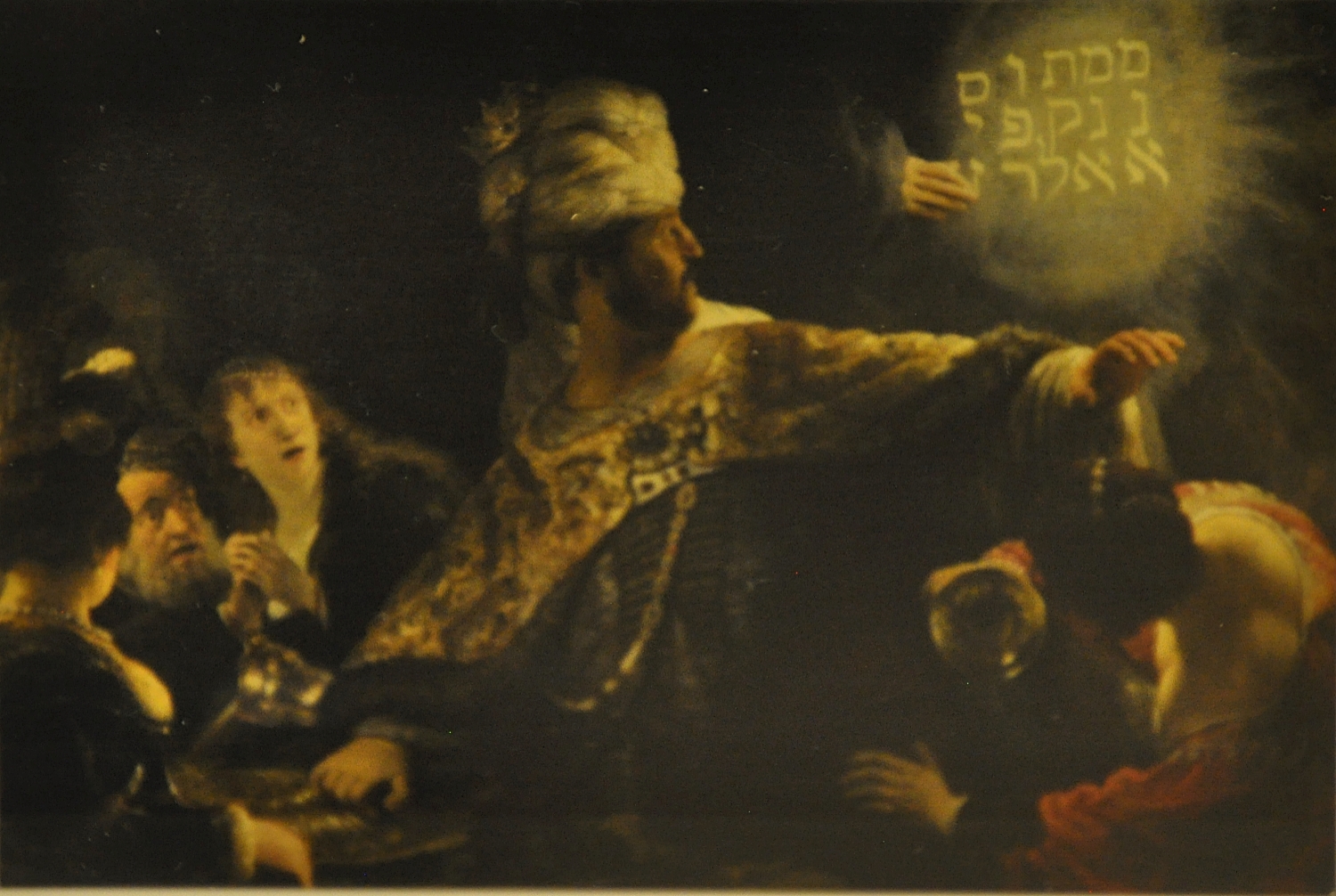
Rembrandt’s painting captures the moment of the handwriting on the wall. Photo ©Leon Mauldin.

The writing depicted in Rembrandt’s artwork is from Daniel 5:25 (he painted the Hebrew letters vertically) “Mene, Mene, Tekel, Upharsin.” מְנֵ֥א מְנֵ֖א‬ תְּקֵ֥ל וּפַרְסִֽין God has numbered your kingdom, and finished it. You have been weighed in the balances, and found wanting. Your kingdom has been divided, and given to the Medes and Persians. (Dan. 5:26-28).

Belshazzar had promised Daniel that he would be “third ruler in the kingdom” if he could interpret the writing (Dan. 5:16). Why third? That makes perfect sense since we now know that Belshazzar had “second place” as co-regent with his father; the next highest position would be third place. Though Daniel interpreted the writing, he cared nothing for the king’s reward: “Let your gifts be for yourself, and give your rewards to another” (v.17).

Here below we see a stele of King Nabonidus, father of King Belshazzar:
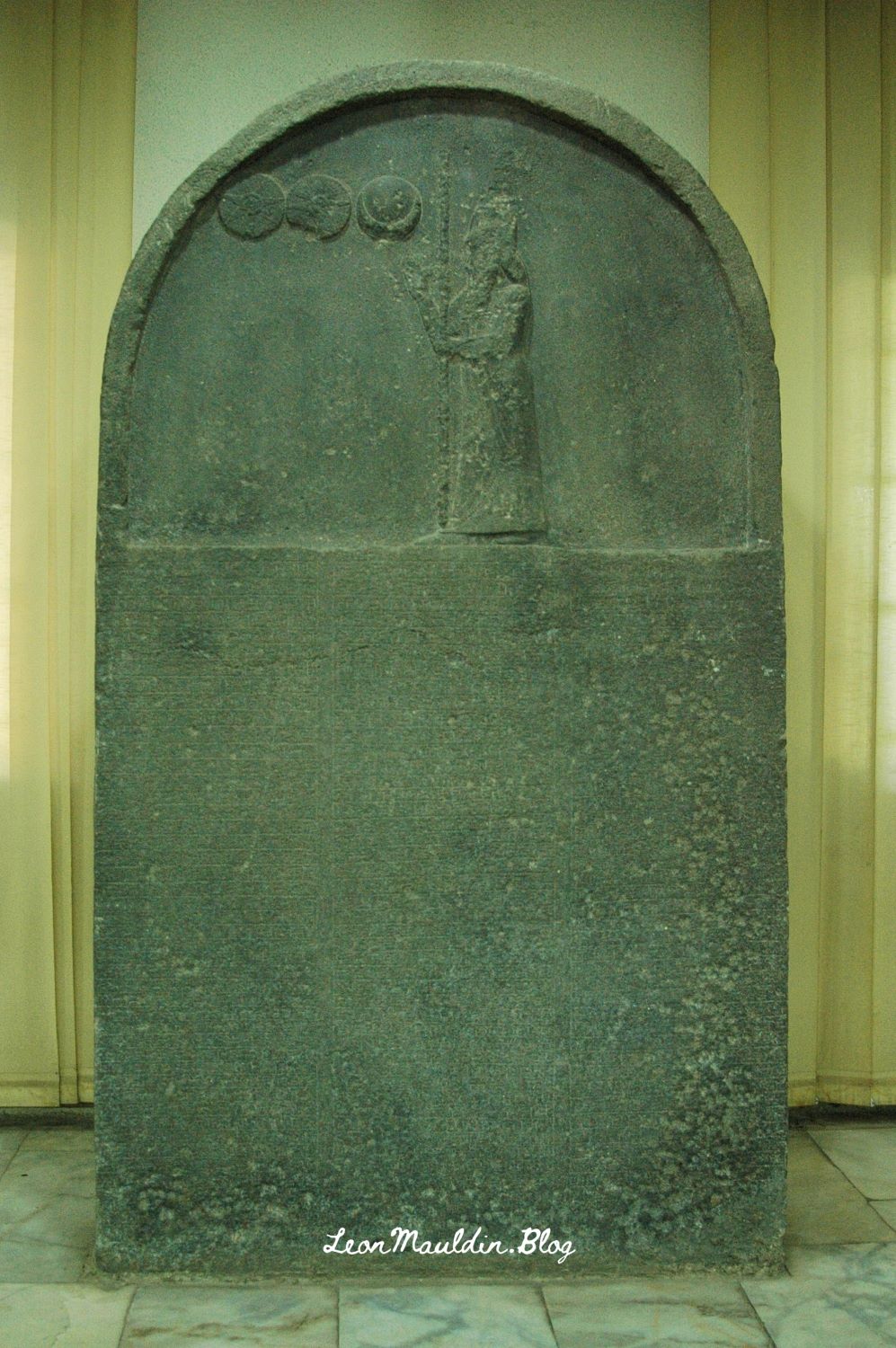
Nabonidus, with Sin, Samas, and Ishtar. Photo ©Leon Mauldin. Sanliurfa Museum.

The Bible is rooted in genuine history. It is not fiction. You can trust your Bible!


Weighed in the Balances

April 18, 2010

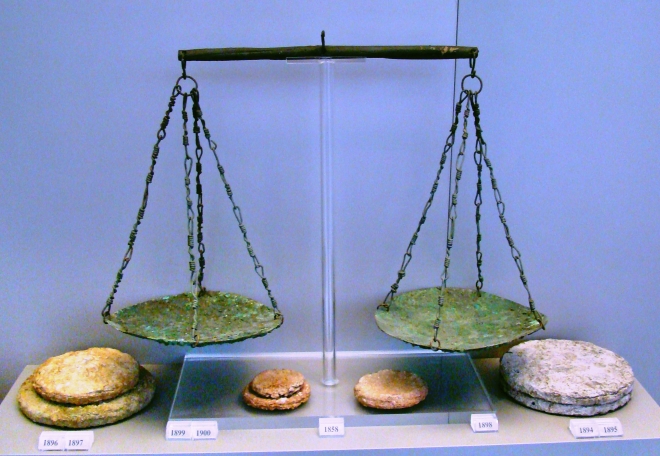
One artifact of interest (among hundreds of others!) in the Athens Museum is a set of scales, which according to the accompanying info sign, dates back to the 15th century B.C., and was among some items belonging to the Vapheio Tholos tomb, Lakonia.

Set of Scales. Athens Museum. Photo by Leon Mauldin.

Perhaps because this set of scales was found in a tomb, the sign states further, “Bronze scales and lead weights either for practical use, or symbolic of the weighing of the souls in the after-life.”

These scales put me in mind of several passages, including Dan. 5, which tells of King Belshazzar of Babylon, who literally saw the “handwriting on the wall.”  Belshazzar was co-regent with his father Nabonidus, who was more interested in the arts and culture than administration, and consequently spent most of his time in the latter years of his reign outside Babylon.  Belshazzar had called for the vessels which Nebuchadnezzar had taken from the temple (586 B.C), and along with his officials was drinking wine, praising “gods of silver and gold, bronze and iron, wood and stone.” It was at this point that the king saw the fingers of a man’s hand writing on the plaster of the wall of the king’s palace, and subsequently Daniel, at this point an old man, was called to interpret the writing. The text reads,

And this is the inscription that was written: MENE, MENE, TEKEL, UPHARSIN. This is the interpretation of each word. MENE: God has numbered your kingdom, and finished it; TEKEL: You have been weighed in the balances, and found wanting; PERES: Your kingdom has been divided, and given to the Medes and Persians (vv. 25-28).

The NASB renders v. 27, “…you have been weighed on the scales and found deficient.” That very night King Belshazzar died, marking the end of the Babylonian Empire, and the beginning rule of its successor, the Medo-Persian Empire (539 B.C.).

Other Passages. There are numerous passages which speak of God’s delight in honest scales. Proverbs 16:11: “Honest weights and scales are the LORD’s; All the weights in the bag are His work.” The NET Bible notes, “The law required that scales and measures be accurate and fair (Lev. 19:36; Deut. 25:13). Shrewd dishonest people kept light and heavy weights to make unfair transactions.” Amos the prophet rebuked the Israelites who were saying, “When will the new moon festival be over, so we can sell grain? When will the Sabbath end, so we can open up the grain bins? We’re eager to sell less for a higher price, and to cheat the buyer with rigged scales!” (Amos 8:5, NIV).

Isaiah the prophet eloquently spoke of the incomparable greatness of Yahweh in contrast to the idols. “Who has measured out the waters in the hollow of his hand, or carefully measured the sky, or carefully weighed the soil of the earth, or weighed the mountains in a balance, or the hills on scales?” (Isa. 40:12).

One final and sobering passage:  “Every way of a man is right in his own eyes, But the LORD weighs the hearts” (Proverbs 21:2).

  • On a local note, we are looking forward to David Thomley’s special series, “Fighting For Our Families.”  This series of lessons will be presented at the meeting house of the Hanceville Church of Christ, 812 Commercial St NE, Hanceville AL. Services will be nightly Mon-Fri, April 19-23, at 7:00 PM.  Everyone is invited!