At Nicaea of Bithynia

May 21, 2014

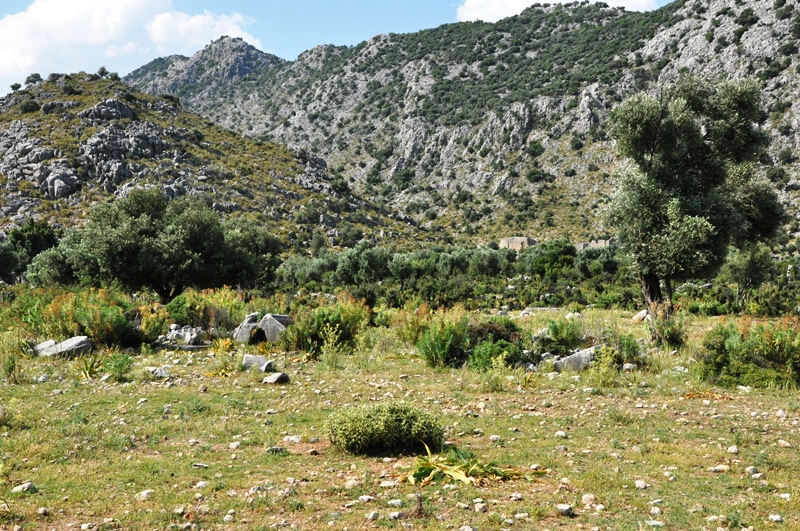
I am thankful for safe arrival yesterday at Istanbul, meeting up with Ferrell Jenkins who had just concluded a tour in Turkey. Today we crossed the Sea of Marmara by ferry to save driving time on our way to Nicaea, called Iznik today. Nicaea was one of the important cities in New Testament times in the Roman Province of Bithynia. Peter addressed Christians over a widely scattered area (covering much of what is the country of Turkey today): “Peter, an apostle of Jesus Christ, To the pilgrims of the Dispersion in Pontus, Galatia, Cappadocia, Asia, and Bithynia” (1 Pet. 1:1). Dr. Mark Wilson writes that Nicaea “vied with Nicomedia for the distinction of being the principle city of Bithynia” (Biblical Turkey: A Guide to the Jewish and Christian Sites of Asia Minor,  p.369).

It was a great opportunity to be in Nicaea today. The weather was very pleasant, and the lighting was excellent for most of the photos we made. Plus it’s just great to be in what was biblical Bithynia. The gospel made inroads there, as evidenced from 1 Peter (most conservative scholars believe that Peter’s second letter was written to the same audience). That means it was highly likely that the messenger with Peter’s letter would have contacted brethren there. Dr. Wilson says it a bit more emphatically, “. . . the messenger caring 1 Peter would certainly have visited Nicaea” p.370).

Nicaea is characterized by an ancient city plan which makes use of the decumanus maximus running east and west and the cardo maximus north and south. Nicaea was a walled city with four gates. Wilson says of the walls and gates that they are the most unique in western Turkey” (v.371). The Roman walls were built on Hellenistic walls, but the Roman walls then were reconstructed by the Goths after the Goths destroyed them (AD 268-270).

In AD 325 the first of the Ecumenical Councils (as well as the seventh) were held in Nicaea. It has been long-standing to date church history as pre-Nicaean and post-Nicaean.

Nicaea is situated on the east side of a beautiful lake which had commercial importance. We drove along side of it at times en route to Nicaea. This city was established under the Greek rule during the intertestamental period, 316 BC).

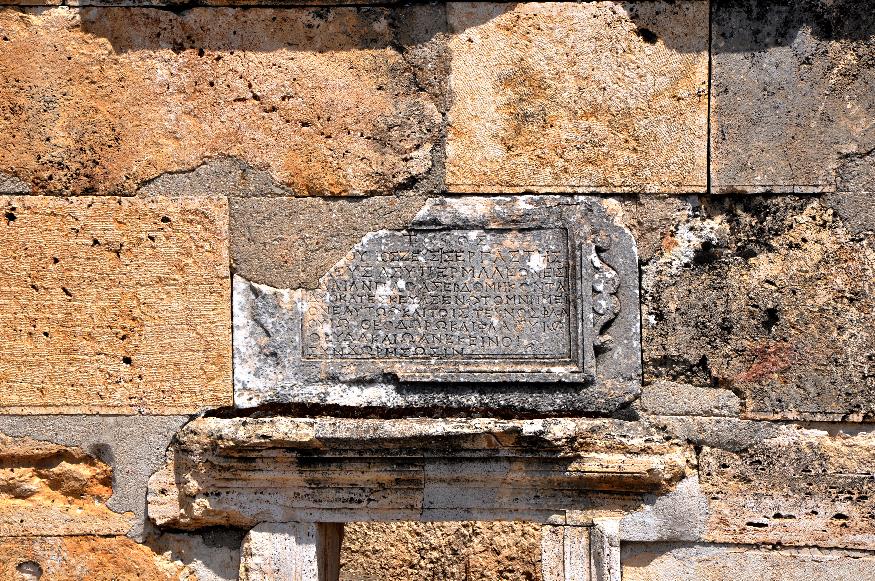
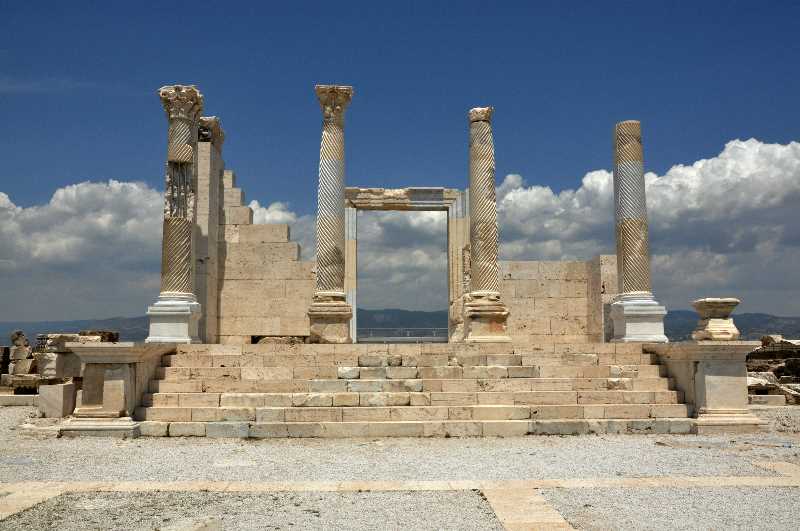
So Bithyna for sure and Nicaea almost certainly was important to the church in the first century, and Nicaea became very important in church history for time to come. Tonight we share a photo of Nicaea’s east gate.

Nicea East Gate. Photo  ©Leon Mauldin.

Nicaea East Gate. Photo ©Leon Mauldin.

Neither Mr. Jenkins nor I had been to Nicaea before today. We agreed it was really a good day. We got to the ferry with 5 minutes to spare.

Tomorrow we are to fly east to Gaziantep and see such sites as Zeugma and Haran. Haran, today spelled Harran, was Abraham’s home for a time, at of family that are prominent in the biblical Narrative.


Achzib on the Mediterranean

May 16, 2014

I love to study the book of Joshua. After Joshua led Israel in the Conquest of Canaan, the book bearing his name lists two biblical cities known as Achzib.

Josh. 15:44 lists Achzib among the cities with their villages designated as Judah’s tribal inheritance. The prophet Micah also mentions Achzib (Mic. 1:14), referencing this same southern city.

The other Achzib (featured in this post) was on the Mediterranean coast, and was included in the inheritance given to the tribe of Asher. “Then the boundary turns to Ramah, reaching to the fortified city of Tyre. Then the boundary turns to Hosah, and it ends at the sea; Mahalab, Achzib” (Josh. 19:29, ESV). Of course the “sea” mentioned in this verse is the Mediterranean Sea.

Note the location on the map:

Achzib. Map by BibleAtlas.org.

Achzib. Map by BibleAtlas.org.

Achzib was a significant settlement dating back to the Middle Bronze age (approximate time of Abraham), when it was a fortified harbor town.

Information Sign at Achzib. Photo ©Leon Mauldin.

Information Sign at Achzib. Photo ©Leon Mauldin.

But this city with its coastal access, and location on a major international route, was unfortunately not retained by Israel. Achzib is listed among seven cities not possessed within Asher’s inheritance: ” Asher did not drive out the inhabitants of Acco, or the inhabitants of Sidon or of Ahlab or of Achzib or of Helbah or of Aphik or of Rehob” (Judges 1:31). For much of its history Achzib was a Phoenician city.

Achzib was listed in Assyrian records as one of the cities during Sennacherib’s campaign in Syria and Palestine in 701 BC. In Roman times it was a thriving coastal town known as Ecdippon or Ecdippa.

Today it is just barely south of Israel’s border with Lebanon. Our photo here below was taken at Achzib looking south toward Acco (see above Judges text).

At Achzib looking south toward biblical Acco. Photo ©Leon Mauldin.

At Achzib looking south toward biblical Acco. Photo ©Leon Mauldin.

Click on images for larger view.


Imperial Cult Worship

April 11, 2014

A book I have found helpful in understanding the background of Revelation is Imperial Cults and the Apocalypse of John: Reading Revelation in the Ruins, by Steven J. Friesen (pub Oxford). Friesen states:

The signal development, first manifest in the dedications of the Temple of the Sebastoi but reflecting broader trends in society was the use of neokoros as a technical title for a city with a provincial temple of the emperors. The power of this innovation was explosive. In a matter of years it changed the public rhetoric of empire in Asia. Within a century it had transformed the discourse of Roman imperialism in the eastern Mediterranean. From the late first century onward, the most prestigious self-designation that could be employed by a city in Asia was neokoros, indicating the presence of a provincial temple where the emperors and their relatives were worshipped (p.150).

Neokoros literally means one who sweeps and cleans a temple; one who has charge of a temple, to keep and adorn it. It came to designate a city which maintained a temple for imperial worship. It is a historical fact that cities competed for this “honor.”

G. K. Beale observes, “Revelation presupposes that Christians were being required to participate to some degree in the imperial cult (e.g., 13:4-8,15-17; 14:9-11; 15:2; 16:2; 19:20; 20:4). . . in the Apocalypse persecution arises because of refusal to worship the ungodly king” (NIGTC Revelation, p.5).

Smyrna Inscription, designating it neokoros. Photo by Leon Mauldin.

Smyrna Inscription, designating it neokoros. Photo by Leon Mauldin.

This inscription found in biblical Smyrna (see Revelation 2:8-11; Smyrna was one of the seven churches of the Roman province of Asia addressed in Rev. 2-3), in lines 3 and 4 designates Smyrna as neokoros of Sebaston [Greek equivalent to Latin Augusti]. Dr. David McClister says, “This inscription is known in the scholarly literature as Smyrna 162. It is an honorary inscription for Cl(audius) Aristophanes Aurelianus,  dated AD 193/235” [lines 1 and 2), and further, “It appears to me to have been a statue base honoring this individual for his leadership in the emperor cult.”


Battle at Michmash (1 Samuel 13-14)

March 27, 2014

Last evening a grandson, along with my wife & me, were reading his daily Bible reading which was in 1 Samuel 13-15. Chapters 13-14 record a battle between Israel and the Philistines, which was initiated by the faith of King Saul’s son Jonathan. A site repeatedly mentioned in the text is that of Michmash.

Michmash. Map by BibleAtlas.org.

Michmash. Map by BibleAtlas.org.

Michmash is about seven miles north and slightly east of Jerusalem. Consider how far into Israel’s territory the coastal Philistines had advanced at this point. Further, Israel’s forces were greatly outnumbered. The Philistines had 30,000 chariots and 6,000 horsemen, and “people as the sand which is on the seashore in multitude,” and were also “encamped in Michmash (1 Sam. 13:5). Jonathan had 1,000 men with him (at Gibeah at the point of 1 Sam. 13:2). Saul had only 2,000 men (ibid.) but as the chapter continues that number had shrunk down to a mere 600 men (v.15).

But Jonathan’s faith was not in numbers, but in YHWH. He told his armorbearer, “Come, let us go over to the garrison of these uncircumcised; it may be that the LORD will work for us. For nothing restrains the LORD from saving by many or by few” (1 Sam. 14:6). The two of them climbed up the steep pass to Michmash on hands and knees, attacked the Philistines, and “that first slaughter which Jonathan and his armorbearer made was about twenty men within about half an acre of land” (1 Sam. 14:14). The Philistine camp went into confusion. “So the LORD saved Israel that day” (v.23). Israel drove “back the Philistines that day from Michmash to Aijalon” (v.31).

Michmash. Area of battle between Israel and Philistines. Photo by Leon Mauldin.

Michmash. Area of battle between Israel and Philistines. Photo by Leon Mauldin.

After we read the biblical narrative, I showed my grandson some photos of the Michmash area, such as the one here above, and was able to say that what we just read took place in this area. He responded, “Have they found any skeletons there?” “Wouldn’t it be cool if they found skeletons there?” Also, “Do they still fight battles there?”

While I don’t know of any skeletal remains, this area was the site of an important battle between Britain and the Turks during WWI. Major Vivian Gilbert, in his book The Romance of the Last Crusade, “relates the story of an unnamed brigade major who was reading his Bible while contemplating the situation against the Ottoman forces. The brigade major remembered a town by the name of Michmash mentioned somewhere in the Bible. He found the verses, and discovered that there was supposedly a secret path around the town. He woke the brigadier general, and they found that the path still existed and was very lightly guarded. The British forces used this path to outmaneuver the Ottomans, and so took the town” (Wikipedia, referencing pp. 183-186).

The use of maps and photos of biblical sites helps children (and the rest of us) to better visualize and understand the biblical events.


Recommended Resource: “With the Bible in the Israel Museum” DVD by Ferrell Jenkins

March 14, 2014

It is only in the last two years that photos have been permitted in the Israel Museum in Jerusalem. There are so many wings with so many artifacts, it is helpful to have some sort of guideline to serve as a starting point to make the most of a visit to the museum.

Ferrell Jenkins delivered a lecture entitled, “With the Bible in the Israel Museum” during the 2014 lecture series at Florida College, Temple Terrace, FL. In the lecture he selectively (because of so much to choose from) makes use of recent photos to deal with artifacts beginning with time of the patriarchs, continuing through Old Testament history (United Kingdom, Divided Kingdom, Captivity, Persian Period) and concluding with the Roman and Early Christianity. Included are numerous examples from various sites of Israel’s propensity to engage in idolatrous worship. Also there is insightful information on burial customs for different periods.

Ferrell Jenkins' DVD on biblical artifacts in the Israel Museum.

Ferrell Jenkins’ DVD on biblical artifacts in the Israel Museum. Photo by Leon Mauldin.

I recommend the DVD both as helpful to prepare for a visit to the museum, as well as to review and restudy if you have had opportunity already to go to.

You can place your order here with the FC Bookstore. Use the search box to enter keywords. Cost is $5.00 plus shipping.


Out of the Wilderness and into Canaan

February 28, 2014

The book of Joshua transitions the reader from Israel’s wilderness wandering to their entrance into Canaan, the Promised Land. Upon their crossing the Jordan, and before taking the city of Jericho, they encamped at Gilgal.

Israel's encampment at Gilgal. BibleAtlas.org

Israel’s encampment at Gilgal. BibleAtlas.org

At Gilgal all the men were circumcised who during the 40 years of wilderness wandering had neglected (i.e., their parents had neglected) this special covenant token.

So Joshua made flint knives and circumcised the Israelite men at Gibeath-haaraloth.  This is the reason Joshua circumcised them: All the people who came out of Egypt who were males– all the men of war– had died in the wilderness along the way after they had come out of Egypt.  Though all the people who came out were circumcised, none of the people born in the wilderness along the way were circumcised after they had come out of Egypt.  For the Israelites wandered in the wilderness 40 years until all the nation’s men of war who came out of Egypt had died off because they did not obey the LORD. So the LORD vowed never to let them see the land He had sworn to their fathers to give us, a land flowing with milk and honey.  Joshua raised up their sons in their place; it was these he circumcised. They were still uncircumcised, since they had not been circumcised along the way.  After the entire nation had been circumcised, they stayed where they were in the camp until they recovered.  The LORD then said to Joshua, “Today I have rolled away the disgrace of Egypt from you.” Therefore, that place has been called Gilgal to this day (Josh. 5:3-9).

The Peninsula of Sinai was Israel’s home for that period referenced in this text.

Area of Wilderness Wandering.  Museum of Bedouin Culture. Photo ©Leon Mauldin.

Area of Wilderness Wandering. Museum of Bedouin Culture. Photo ©Leon Mauldin.

The photo of this artwork was taken in the Museum of Bedouin Culture at Kibbutz Lahav in the Israel’s Negev.

Museum of Bedouin Culture at Kibbutz Lahav. Photo ©Leon Mauldin.

Museum of Bedouin Culture at Kibbutz Lahav. Photo ©Leon Mauldin.

It was also at Gilgal that Israel observed the Passover at the appointed time, the 1st month, 14th day. It was at this time that the manna stopped, and Israel began to eat the produce of the land. This was at harvest season. The 40 years of wandering were over; a new era had dawned!

Click on images for larger view.


All the Land of the Hittites

February 26, 2014

Following the death and 30-day period of mourning for Moses (Deut. 34), Yahweh spoke words of encouragement to his successor, Joshua:

After the death of Moses the LORD’s servant, the LORD spoke to Joshua son of Nun, who had served Moses: “Moses My servant is dead. Now you and all the people prepare to cross over the Jordan to the land I am giving the Israelites. I have given you every place where the sole of your foot treads, just as I promised Moses.  Your territory will be from the wilderness and Lebanon to the great Euphrates River– all the land of the Hittites— and west to the Mediterranean Sea” (Joshua 1:1-4, CSB).

Holman’s Christian Standard Bible (Study Bible) has the following notation regarding the expression, “land of the Hittites”:

The land of the Hittites seems not to refer to the Hittite Empire of modern Turkey but the Egyptian and later Assyrian usage of this term to describe the region controlled by the Hittites in the western part of modern Syria. These lands and boundaries identify Canaan as it was known both to the Bible (Gn 10:19; Nm 13:17,21-22; 34:3-12) and to Egyptian writers of the second millennium B.C.

In numerous passages the Hittites are mentioned as one of several groups populating the land of Canaan. For example, Joshua told the Israelites, “You will know that the living God is among you and that He will certainly dispossess before you the Canaanites, Hittites, Hivites, Perizzites, Girgashites, Amorites, and Jebusites” (Joshua 1:10; cf. Gen. 15:20; Deut. 7:1, and etc.).

The Ankara (Capitol of modern Turkey) Museum is of international renown for its collection of Hittite artifacts. The relief below shows three Hittite warriors.

Hittite Warriors. Ankara Museum. Photo ©Leon Mauldin.

Hittite Warriors. Ankara Museum. Photo ©Leon Mauldin.

The accompanying placard entitled The Warriors  says, “Three figures with curly hair, and dressed in long tunics with wide belts. The figure at the front holds a spear, which is broken at one end, in his left hand and a leafed tree branch in the right. The figure in the middle clenches his left fist and holds up a tool at head level in his right hand. They are followed by a figure that carries a staff in the left hand. All three wear long swords at the waist.”

The Bible is not a book of fiction. When it mentions people, they were real people, living in real places, participating in real events as recorded in Scripture.


The Conquest: Crossing Jordan

February 17, 2014

Joshua 3 records Israel’s crossing Jordan from the eastern side, to set up camp temporarily at Gilgal, and from there to take the city of Jericho. See our map in previous post.

The timing at this point was just prior to Passover (Josh. 5:10), meaning this was the early harvest season.  When Israel was crossing the notation is made, “Now the Jordan overflows its banks throughout the harvest season” (Josh. 3:15, CSB). The text records divine intervention: the priests were carrying the ark, and when their feet touched the Jordan,

. . . the water flowing downstream stood still, rising up in a mass that extended as far as Adam, a city next to Zarethan. The water flowing downstream into the Sea of the Arabah (the Dead Sea) was completely cut off, and the people crossed opposite Jericho. The priests carrying the ark of the LORD’s covenant stood firmly on dry ground in the middle of the Jordan, while all Israel crossed on dry ground until the entire nation had finished crossing the Jordan (Josh. 3:16-17, CSB).

The study note in the Holman Christian Standard Bible states:

At spring flood, after the winter rains and during the barley harvest, the Jordan River could reach a width in excess of 100 feet and a depth of 10 feet. The priests as the leaders of the people were the first to step down into the water. Doing so was a risky activity with the river at flood stage. Carrying the ark could easily have caused them to be swept away by the current unless the promised miracle took place.

Note that the people crossed “opposite Jericho.” Our photo below is at the Jordan at Qasr el-Yahud, opposite and a little south of Jericho. It would be somewhere near here that the crossing of Joshua 3 took place. Our photo looks to the north.

Jordan River at  Qasr el-Yahud. Photo by Leon Mauldin.

Jordan River at Qasr el-Yahud. Photo by Leon Mauldin.

In their introduction to the book of Joshua, the HCSB Study Bible has an interesting note about the change in volume of the flow of the Jordan:

The Jordan River was at flood stage when God commanded Joshua to lead the people across. Just as when God opened the Red Sea, He provided a dry path through the Jordan when the priests, bearing the ark of the covenant, touched the edge of the river. . . Up until the 1950’s, more than 3 billion cubic feet flowed through the southern Jordan annually. with construction of a number of dams on the Jordan north of the Sea of Galilee and on rivers that feed the Jordan, that volume of water has been reduced to 300 million cubic feet a year (p.338).

Qasr el-Yahud is a site on the Jordan thought by some to be across from the Bethany referenced in John 1:28, where John the Baptist did some of his baptizing. We had the opportunity to visit here in October.

Baptism in the Jordan River. Photo by Leon Mauldin.

Baptism in the Jordan River. Photo by Leon Mauldin.

Click images for larger view.


Jericho, First City of the Conquest of Canaan

February 15, 2014

The book of Joshua has one dominant theme: God was fulfilling His promise to the patriarchs Abraham, Isaac and Jacob, that He would give unto their descendants the land of Canaan (Gen. 12:6-7). As Joshua begins, Israel had recently conquered the transjordan territories of Sihon and Og, which would become the possession of Reuben, Gad, and half the tribe of Manasseh (Num. 21:21-35). Though the eastern territory was given to Israel by God, the land of Canaan proper did not include the transjordan, but rather was the land west of the Jordan River. (See discussion on this by Todd Bolen here

The book of Joshua is named after its prominent character, Joshua, the successor of Moses. Following Moses’ death (Deut. 34) and a 30-day period of mourning (v.8), Joshua sent out two spies across the Jordan. They were told “Go, view the land, especially Jericho” (Josh. 2:1).

Conquest of Canaan. Map by Marc Hinds.

Conquest of Canaan. Map by Marc Hinds.

One can see that from their location in Shittim (Acacia Grove, NKJV, CSB) that the first city that must be taken in the Conquest was Jericho, believed to be the world’s most ancient city. It was a fortress city and guarded entrance into Canaan from the east. Located in the Jordan Valley, it is 670 feet below sea level, and was one the first cities in Israel to be excavated. The record of Jericho’s destruction by Israel is found in Joshua 6.

From the standpoint of military strategy, Israel would first conquer the central territory (Josh. 7-8), then the southern (Josh. 10), and finally the northern territory (Josh. 11).

Jericho. Map by BibleAtlas.org.

Jericho. Map by BibleAtlas.org.

I always enjoy seeing Jericho. This past October Jericho was included on our itinerary for my group, though it was later in the day than what is ideal for photos.

Excavations at Jericho. Photo by Leon Mauldin

Excavations at Jericho. Photo by Leon Mauldin.

Recommended reading: see Biblical Archaeology Review, “Did the Israelites Conquer Jericho? A New Look at the Archaeological Evidence,” by Dr. Bryant G. Wood (16:02, March/April 1990).

Click images for larger view.


House of David Inscription

February 12, 2014

The current issue of Biblical Archaeology Review has an article entitled, “Archaeology Confirms 50 Real People in the Bible,” by Lawrence Mykytiuk. The first in his list is King David, whose name was found in the Tel Dan Stela, found in Tel Dan in July, 1993. Mykytiuk writes:

According to the Bible, David ruled in the tenth century B.C.E., using the traditional chronology. Until 1993, however, the personal name David had never appeared in the archaeological record, let alone a reference to King David. That led some scholars to doubt his very existence. According to this speculation David was either a shadowy, perhaps mythical, ancestor or a literary creation of later Biblical authors and editors. In 1993, however, the now-famous Tel Dan inscription was found in an excavation led by Avraham Biran. Actually, it was the team’s surveyor, Gila Cook, who noticed the inscription on a basalt stone in secondary use in the lower part of a wall. Written in ninth-century B.C.E. Aramaic, it was part of a victory stele commissioned by a non-Israelite king mentioning his victory over “the king of Israel” and the “House of David.” [See BAR 20:02, Mar-Apr 1994] Whether or not the foreign king’s claim to victory was true, it is clear that a century after he had died, David was still remembered as the founder of a dynasty.

This past October I had the occasion to photograph this important stela, which is housed in the Israel Museum in Jerusalem.

"House of David" Inscription. Discovered 1993. Photo by Leon Mauldin

“House of David” Inscription. Discovered 1993. Photo by Leon Mauldin

Gary Byers suggests that the stela “most likely memorializes the victory of Hazael, king of Aram, over Joram, king of Israel, and Ahaziah, king of Judah, at Ramoth Gilead recorded in 2 Kings 8:28–29” (Bible and Spade 16:4, p. 121).

For more information on the House of David see Ferrell Jenkins’ post illustrating Isaiah 7 here.

Click image for larger view.