“What is this you have done to me?” This was Jacob’s question to Laban, when he discovered in shock and disbelief, not to mention panic, that he had married Leah, Rachel’s sister, instead of Rachel, with whom he was in love, and for whom he had worked for seven years for her father Laban. The deceiver was himself deceived.
Jacob left Beersheba to journey to Haran to obtain a wife; that’s the reason his mother Rebekah presented to his father Isaac (Gen. 27:46). The more pressing reason for the trip was really so that Esau his brother would not kill him. Esau was bitterly angry because Jacob had deceived Isaac, who was blind at the time, into blessing Jacob who pretended to be his older brother Esau. Jacob was acting in compliance with his mother’s instructions; she wanted her “favorite” to receive the patriarchal blessing.
When Rebekah learned of Esau’s intention to kill Jacob, she sent Jacob away some 400+miles north to Haran, where they had relatives. She instructed Jacob to stay with her brother Laban “a few days, until your brother’s fury turns away” (Gen. 27:45). It turned out that “a few days” became twenty years! As far as the record indicates, Jacob never saw his mother Rebekah again.
When he met Rachel he immediately fell in love with her. He reached an agreement with her father Laban that he would work seven years for her. The time passed quickly for Jacob because of his great love for Rachel. Then came the much-anticipated wedding night. But Laban himself was less than honest. Everyone gathered for the wedding feast. “Now it came to pass in the evening, that he took Leah his daughter and brought her to Jacob; and he went in to her” (Gen. 29:23). Leah was Rachel’s older sister. “So it came to pass in the morning, that behold, it was Leah. And he said to Laban, “What is this you have done to me? Was it not for Rachel that I served you? Why then have you deceived me?” (Gen. 29:25).
The NET Bible translates, “What in the world have you done to me! Didn’t I work for you in exchange for Rachel? Why have you tricked me?” The NET translator note on this text reads, The use of the pronoun “this” is enclitic, adding emphasis to the question: “What in the world have you done to me?”
Laban’s answer was essentially this: “Oh I forgot to tell you one small detail; around here it is not customary for the younger daughter to marry before the older; go ahead and let Leah have her wedding celebration (lasted one week) then you can marry Rachel and work seven more years for her.” Dave Ramsay would never have approved of this “installment plan,” but Jacob consented.
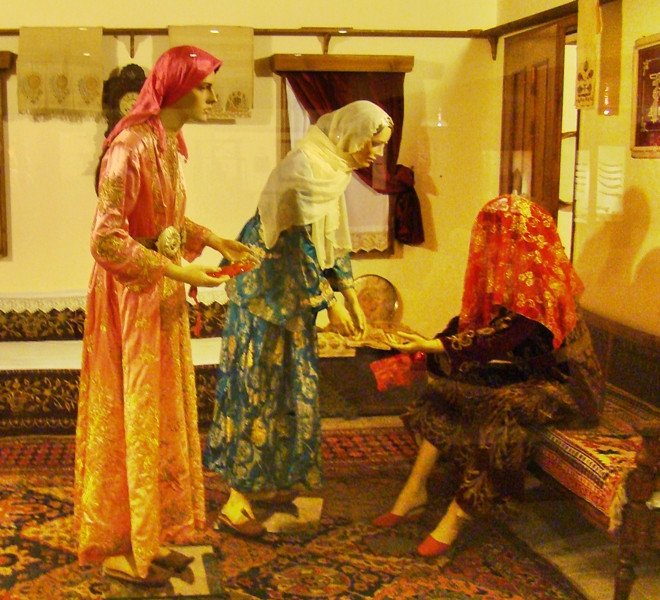
Wedding Night_Turkish Wedding. Bergama Museum (Pergamum). Photo by Leon Mauldin.
Our photo depicts the wedding night for a Turkish wedding. These figures are posed in the Bergama Museum. The veiled bride is seated while her attendants help. This scene may help us to understand why Jacob did not recognize Leah. Truly the deceiver was deceived.
We have photos of Beersheba as well as Haran which we plan to share in future posts.
PostScript. On a personal note, last week I had a very enjoyable meeting with the Perry Hill congregation in Montgomery, AL., speaking on the theme, “Becoming More Like Jesus.” On Mon-Fri we had morning services and in those lessons I covered the Letters to the Seven Churches (Rev. 2-3), using photos from our recent trip to Turkey, as well as photos from previous trips. The lessons were well received, and it was great to be at Perry Hill again. This was my third meeting with the folks there.
That schedule made me a bit behind on posting to the blog, but we hope to be back on schedule now. Thanks for checking in. Remember to click on photo for higher resolution.



 Posted by Leon Mauldin
 leonmauldin.blog