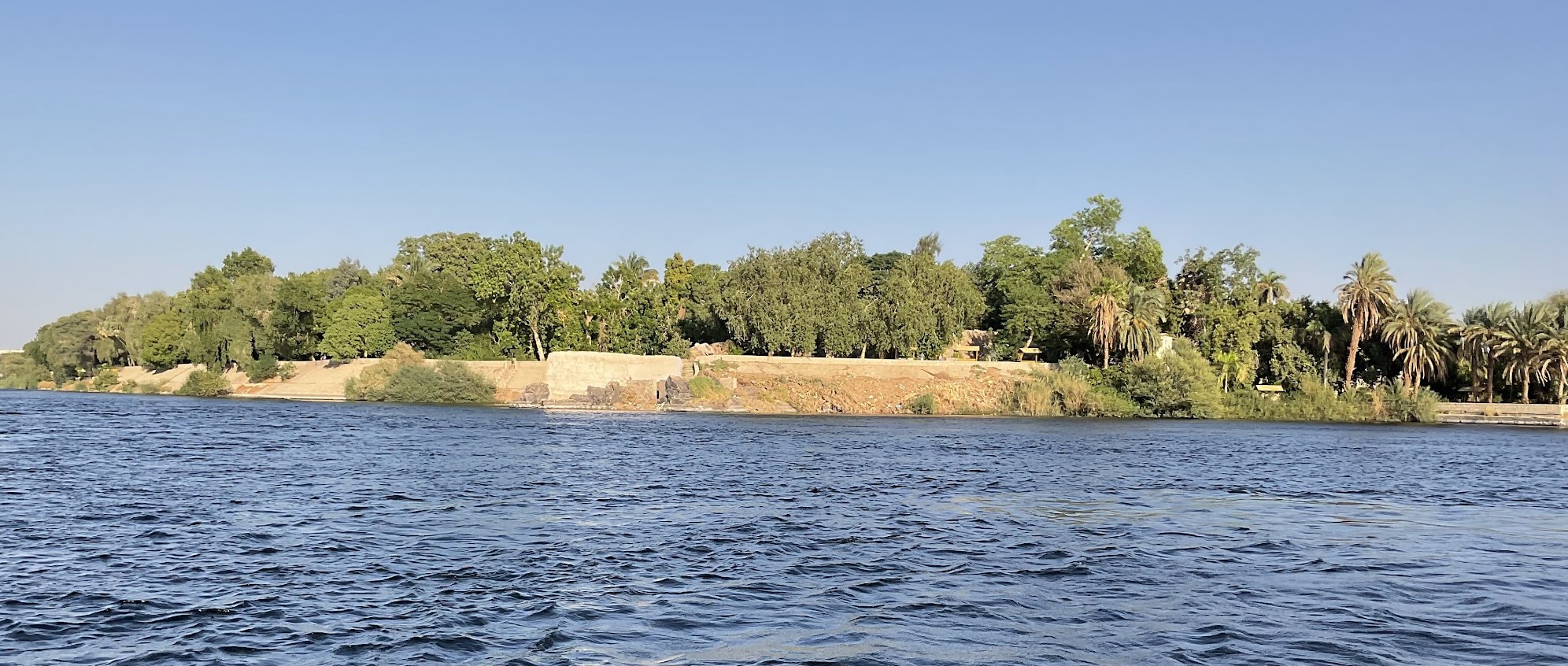
Having just returned from a 13-day tour of Greece & Turkey, I plan to share some of those photos asap. But for now, as I’m preparing for a study on Nehemiah, I wanted to post a photo of Elephantine Island, on the Nile River, as papyri discovered there has a bearing on the timeframe of the book of Nehemiah.
The Lexham Bible Dictionary has this informative entry:
An island located along the Nile in upper Egypt, opposite modern-day Aswan. The island was named Elephantine in Greek, either because it was the center of the ivory trade between Egypt and Nubia or because it is surrounded by black rocks shaped like elephants.
Location and Dates
Elephantine is located along the first cataract of the Nile in upper Egypt. The island was important for trade and as a Persian military garrison. Jewish residents lived on the island, and there is evidence that a temple existed for Yahweh worship.
Little documentation about the island exists apart from fifth-century BC literary and legal texts—there are also inscriptions and letters documenting Elephantine correspondence with Jerusalem. Excavations of the island have revealed a Persian period complex of multistoried, mud-brick houses with earthen floors. An area with tiled flooring was also discovered and determined to be part of the temple courtyard.
It is uncertain how long the Jewish community existed at Elephantine. There are texts that claim the community arrived prior to Cambyses’ arrival in Egypt in 525 BC, but, according to MacLaurin, the community may even date back to Moses’ time (MacLaurin, “Date of the Foundation of the Jewish Colony at Elephantine,” 93–95). Porten argues for a mid-seventh century BC arrival date (Porten, “Settlement of the Jews at Elephantine,” 456–462). Documentation is limited to 495–398 BC, indicating that the community existed on the island during the height of the Persian Empire.Biblical Relevance
The site of Elephantine is not mentioned in the Bible, but the community that lived there during the Persian period provides us with insights about Judaism. The garrison at Elephantine and neighboring Syene—ultimately controlled by Persian imperial officials—was a multicultural colony of Jews, Aramaeans, Egyptians, and Persians. Much like Jews in other parts of the empire, the inhabitants at Elephantine would have interacted with other peoples of the empire while continuing to identify with other Jews. Although they were geographically separated from Jerusalem and Judaea, they called themselves Judaeans (יהודין, yhwdyn)—the Aramaic form of the biblical word for Judaeans or Jews (יְהוּדִים, yehudim). This suggests a desired identification with other Jews and with Judaea.
In Elephantine, the temple to the Jewish deity Yahu (a variant form of the biblical names for the God of Israel, Yah and Yahweh) was destroyed in the fifth century BC. According to correspondence with the priests in Jerusalem, the destruction was caused by priests of the Egyptian ram god Khnum—to whom a temple was built on Elephantine during the 18th–19th centuries BC (or the 16th–13th centuries BC). The Jewish community responded by praying, fasting, and putting on sackcloth, which were common biblical responses to disaster. The leaders petitioned Jerusalem to permit the rebuilding of the temple, pointing out that they had made no oil, incense, or burnt offerings in the temple since it had been destroyed—indicating both an awareness of the authority of the Jerusalem priesthood and a shared practice of presenting offerings at an authorized temple. The temple was apparently never rebuilt.(Source: Whitcomb, K. A. (2016). Elephantine. In J. D. Barry, D. Bomar, D. R. Brown, R. Klippenstein, D. Mangum, C. Sinclair Wolcott, L. Wentz, E. Ritzema, & W. Widder (Eds.), The Lexham Bible Dictionary. Lexham Press.).


 Posted by Leon Mauldin
 leonmauldin.blog