Roman Theater in Trieste

July 15, 2014

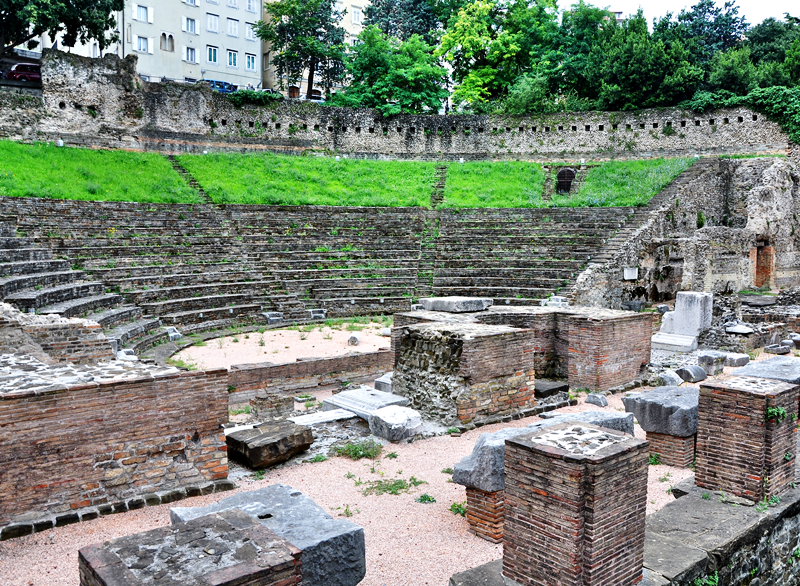
It is an understatement to say that the Roman Empire really left its mark. There are many sites where theaters which date back to Roman times may be seen. When we were leaving Trieste yesterday morning, we went by the Roman theater there.

Roman Theater at Trieste, Italy. Photo by Leon Mauldin.

Roman Theater at Trieste, Italy. Photo by Leon Mauldin.

Yesterday we made our way on to Venice, where we had an afternoon to visit. Then today was an all-day tour of Venice (walking; they do not intend for you to sit anywhere here, at least not for long). Our wake up call is in a few hours at 3:00 AM; then a quick transfer to the airport to make our way home.

More photos to share later. Click on image for larger view.


Florence, Capital of the Province of Tuscany.

July 11, 2014

As we continue our tour of “The Highlights of Italy,” leaving Rome we’ve traveled north to Florence, home of Michelangelo and the birth of the Renaissance. Florence is the capital city of the Italian region of Tuscany and its 370,000 inhabitants makes it the most populous city in Tuscany.

Shortly after we checked into our rooms (late afternoon) there was thunder, rain and some small hail. Afterward the sun came out and much of the cloud cover left. Before time for dinner we had some time to walk to the historic square.

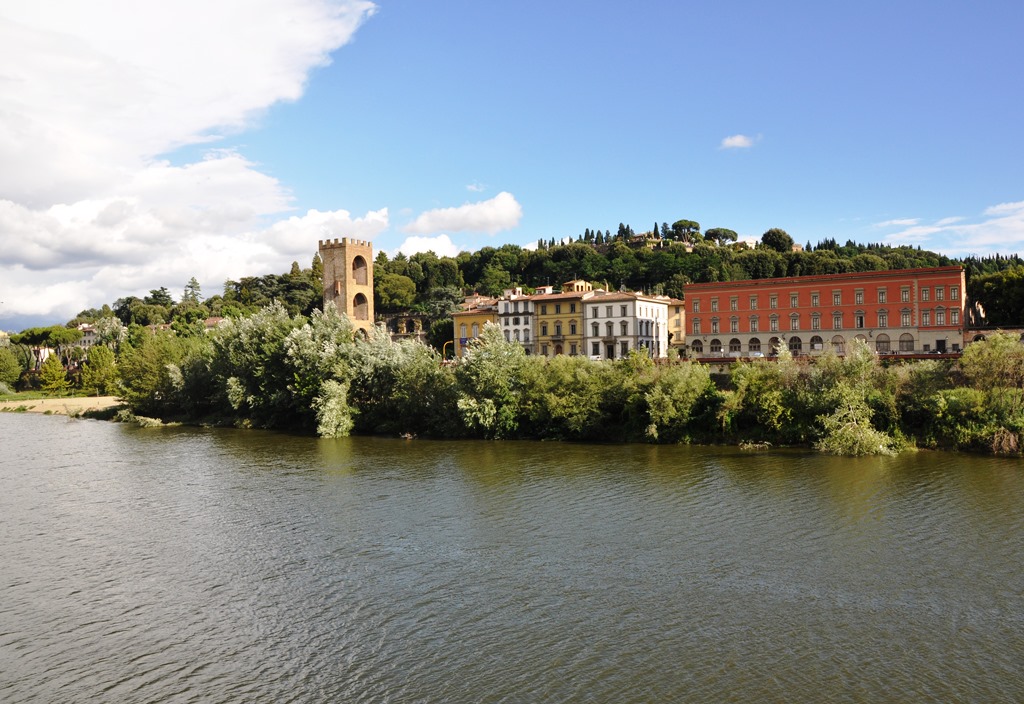
Florence is situated along the banks of  the Arno River.

Arno River in Florence. Photo by Leon Mauldin

Arno River in Florence. Photo by Leon Mauldin


A Good Day in Rome

July 9, 2014

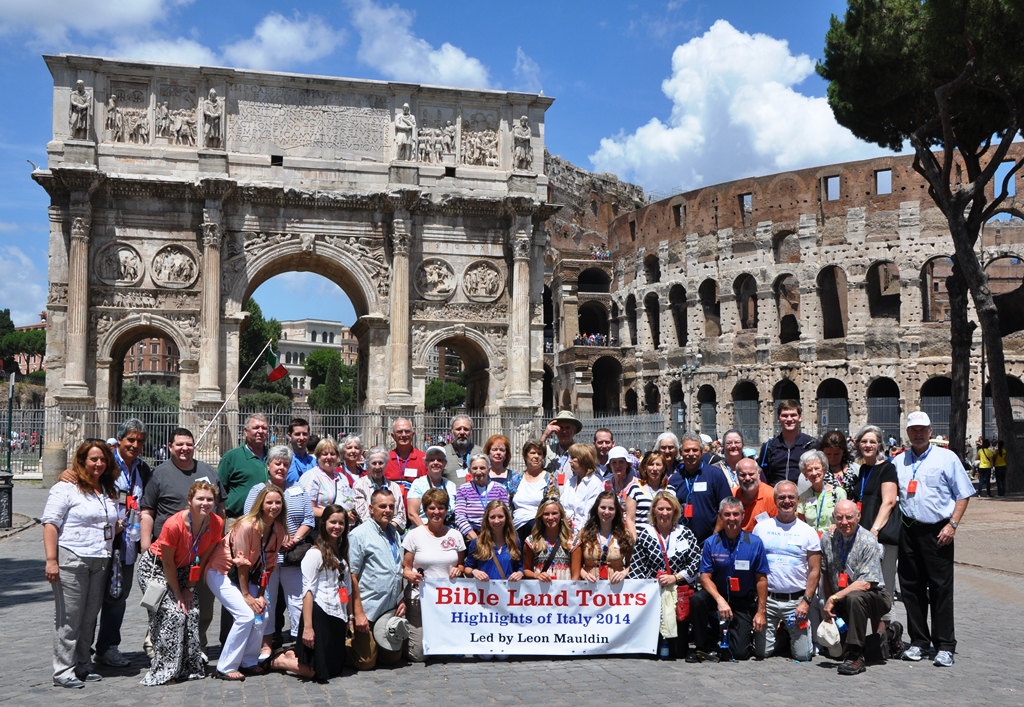
Today’s activities included a tour of the Vatican, the Colosseum, the Roman Forum and the Mamertine Prison. We had a group shot made in front of the Arch of Constantine, the largest and best preserved of Rome’s triumphal arches.

Italy Group Shot.

Italy Group Shot.


In the Heart of Rome

July 8, 2014

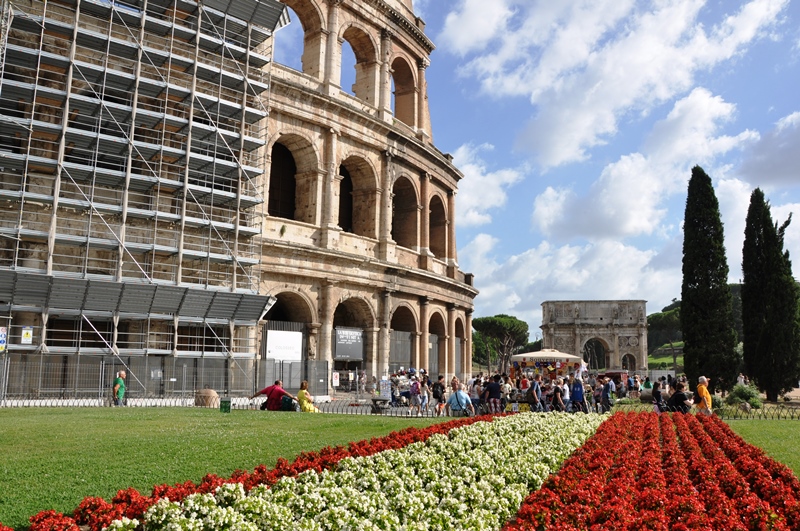
Greetings from Rome. My group all arrived safely today, and everyone’s luggage arrived also! The afternoon was designated as free time, which allowed for lots of walking and seeing many sites of ancient Rome. A familiar landmark, the Colosseum, is on your left. It was completed by Emperor Titus in 80 AD. In the distance is the Arch of Constantine, erected in 315 AD.

Colosseum and Arch of Constantine in Rome. Photo by Leon Mauldin.

Colosseum and Arch of Constantine in Rome. Photo by Leon Mauldin.

Click image for larger view.

Will post more as time permits.


King Eumenes, Brother of Attalus II

July 1, 2014

The biblical city of Philadelphia, one of the seven churches of Asia Minor (Rev. 3:7-13) was founded by Attalus II, king of Pergamum (159–138 BC).

W.M. Ramsay tells us that Attalus II’s “truth and loyalty to his brother Eumenes won him the epithet Philadelphus” (The Letters to the Seven Churches of Asia, p. 391). Hence the name of the city, Philadelphiawhich means brotherly love.

“Because of its strategic location, it [Philadelphia] served as a vital link in communication and trade between Sardis and Pergamum to the west and Laodicea and Hierapolis to the east. It was a center of agriculture, leather production, and textile industry” (Harper’s Bible Dictionary). Today Philadelphia is called Alaşehir.

Attalus II was also the founder of Attalia, mentioned in Acts 14:25-26 in connection with Paul’s return trip on his 1st Missionary Journey. This is the site of today’s Antalya, one of Turkey’s largest cities.

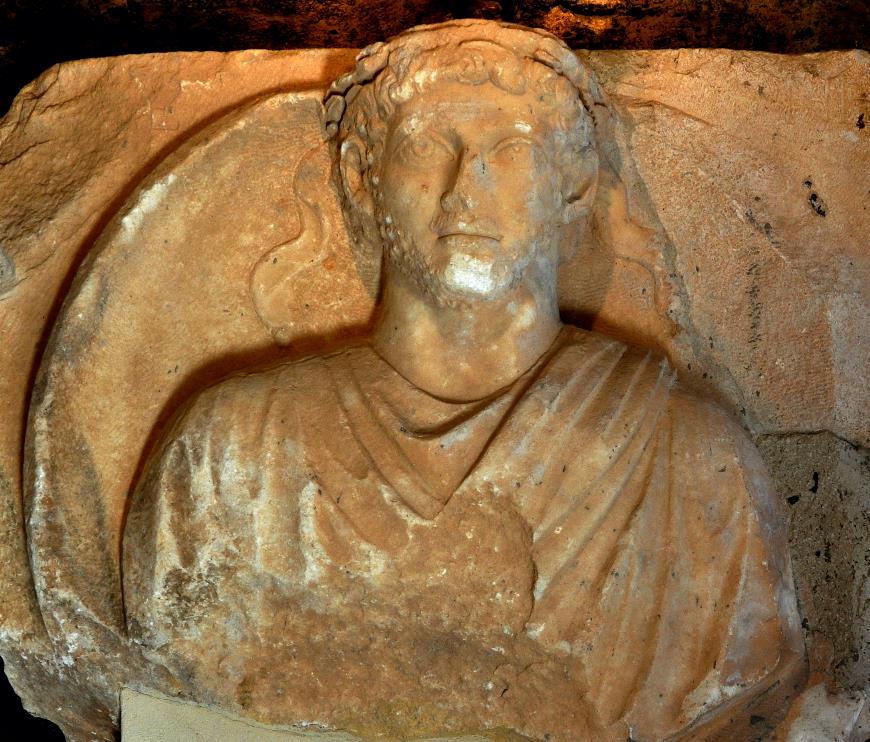
Eumenes, brother of Attalus II, was king of Pergamun 197-157 BC. He was the founder of the city of Hierapolis (Col. 4:13). It is fitting that there is a bust of Eumenes in the museum at Hierapolis.

King Eumenes II, brother to Attalus II Philadelphus. Photo ©Leon Mauldin.

King Eumenes II, brother to Attalus II Philadelphus. Photo ©Leon Mauldin.

Click image for larger view.


Travel in Bible Times–Tomb of Merchant Flavius Zeuxis

June 26, 2014

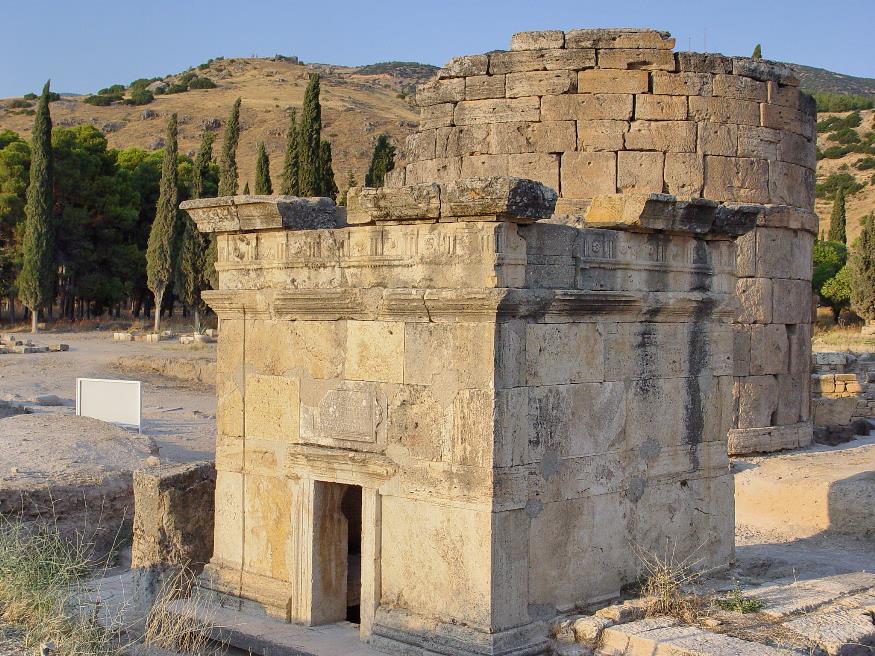
The necropolis of Hierapolis is one of  the largest ancient burial sites in Turkey. Tombs there date from 2nd century BC through 3rd century AD. One of the more interesting is that of T. Flavius Zeuxis and his sons (1st century AD).
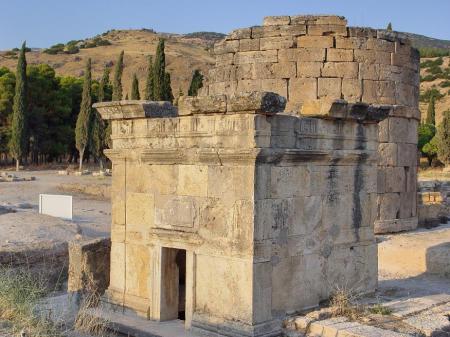
Tomb of Flavius Zeuxis, merchant of Hierapolis. Photo ©Leon Mauldin.

Tomb of Flavius Zeuxis, merchant of Hierapolis. Photo ©Leon Mauldin.

Dr. Carl Rasmussen observes: “Note the finely carved doorway with doorposts and lintel, the carved base, the slightly protruding stones of the corners (pilasters) of the tomb, the upper molding, and the Doric frieze composed of triglyphs and metopes filled with rosettes!” Click here.

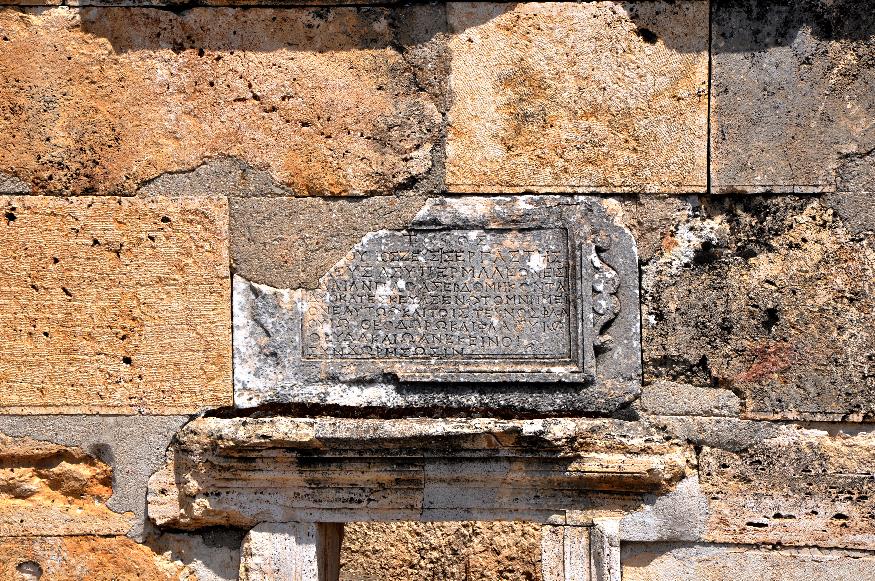
The inscription above the tomb entrance is translated, “Flavius Zeuxis, merchant, who sailed seventy-two trips around Cape Malea to Italy, built this.”
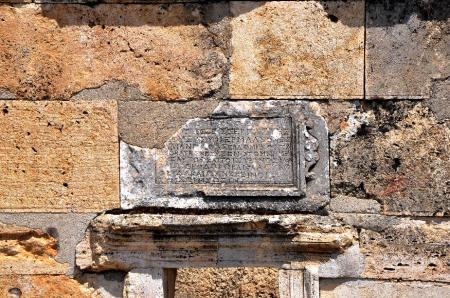
Tomb Inscription above door. Photo ©Leon Mauldin.

Tomb Inscription above door. Photo ©Leon Mauldin.

This inscription is helpful on several counts. Cape Malea is the southern tip of Greece’s Peloponnesus peninsula. It is famous for its treacherous weather and seas. William Barclay wrote:

It was a dangerous cape, and to round Cape Malea had in ancient days much the same sound and implications as to round Cape Horn had in later times. The Greeks had two sayings which showed what they thought of the voyage round Malea-“Let him who sails round Malea forget his home,” and, “Let him who sails round Malea first make his will.” (The Letters to the Corinthians, p.1).

Obviously it would have been considered quite an accomplishment to have made 72 trips around the Cape. This would mean a total of 36 round trips this merchant had made from Hierapolis of Asia Minor to Italy and back! Some have suggested that Zeuxis would have made two or three trips per year from Hierapolis to sell his goods in Italy.

This has implications for several biblical texts. For example, when Paul (as a prisoner under house arrest) was writing the NT letter of Colossians from Rome, Epaphras of Colossae was with him (Col. 1:7). Paul went on to referenced the tri-cities of Colossae, Hierapolis, and Laodicea as he spoke of Epaphras’ work among them:

Epaphras, who is one of you, a bondservant of Christ, greets you, always laboring fervently for you in prayers, that you may stand perfect and complete in all the will of God. For I bear him witness that he has a great zeal for you, and those who are in Laodicea, and those in Hierapolis. (Col. 2:12-13, NKJV).

The Zeuxis inscription shows it would not be unusual for residents of the Lycus River Valley, such as Epaphras, to make the voyage to Rome and back.

The travel of merchants such as Zeuxis also helps us relate to Paul’s journeys recorded in Acts, many of which were by sea. Further, it is not without significance that Paul mentioned the dangers he faced, including those on the sea:

 I have been on journeys many times, in dangers from rivers, in dangers from robbers, in dangers from my own countrymen, in dangers from Gentiles, in dangers in the city, in dangers in the wilderness, in dangers at sea, in dangers from false brothers (2 Cor. 11:26, NET).

But notwithstanding the potential dangers faced, travel by sea in the 1st century was common!

Also we might think of Rev. 18:11-13, with its extensive list of trade good that merchants (like our Flavius Zeuxis) from various locations in the Empire, brought to Rome. Contextually this passage speaks of the mourning that will come as a result of the fall of Rome:

And the merchants of the earth will weep and mourn over her, for no one buys their merchandise anymore: merchandise of gold and silver, precious stones and pearls, fine linen and purple, silk and scarlet, every kind of citron wood, every kind of object of ivory, every kind of object of most precious wood, bronze, iron, and marble; and cinnamon and incense, fragrant oil and frankincense, wine and oil, fine flour and wheat, cattle and sheep, horses and chariots, and bodies and souls of men.

Click on images for larger view.

Laodicea, a Wealthy City — a Poor Church

June 18, 2014

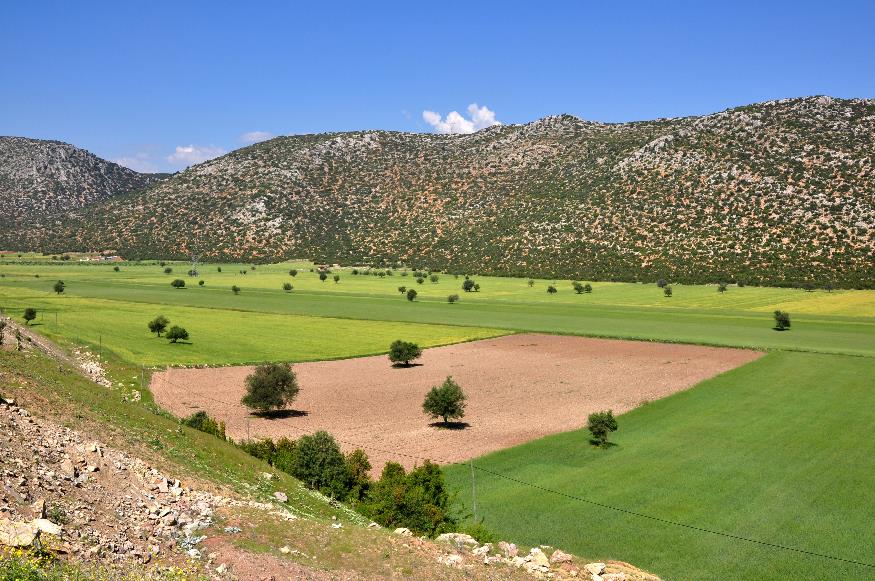
There is some beautiful scenery as you make the drive from the Mediterranean coast at Antalya (biblical Attalia) north and west to Laodicea.

En Route NW to Laodicea from Med. coast. Photo ©Leon Mauldin.

En Route NW to Laodicea from Med. coast. Photo ©Leon Mauldin.

Laodicea was known to be a wealthy city. It was a banking center, had a medical school specializing in ophthalmology, and manufactured clothing, especially known for its black wool market.

It is always a danger that God’s people become like the world around them. Jesus addressed the church at Laodicea (Revelation 3:14-21) and rebuked them for their self-satisfied, complacent attitude:

Because you say, “I am rich, and have become wealthy, and have need of nothing,” and you do not know that you are wretched and miserable and poor and blind and naked, I advise you to buy from Me gold refined by fire so that you may become rich, and white garments so that you may clothe yourself, and that the shame of your nakedness will not be revealed; and eye salve to anoint your eyes so that you may see (vv.16-18).

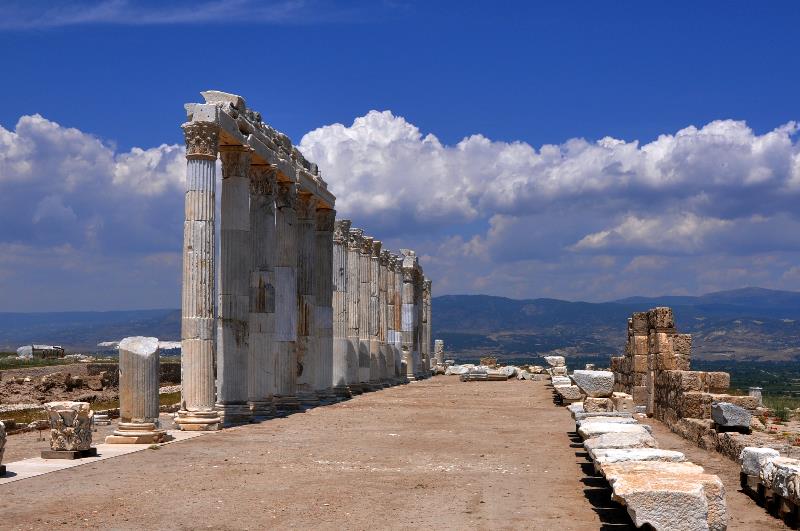
Excavations have shown numerous indications of Laodicea’s wealth.

Columns lining street in Laodicea. Photo ©Leon Mauldin.

Columns lining street in Laodicea. Photo ©Leon Mauldin.

W.M. Ramsay wrote:

It is characteristic of a city devoted to commercial interests and the material side of life, that the Church of Laodicea is entirely self-satisfied. It says, as the city said in A.D. 60, when it recovered its prosperity after the great earthquake without any of that help which the Imperial government was generally ready to bestow, and which the greatest cities of Asia had always been ready to accept, “I have grown rich, and have need of nothing.” It has never seen its real condition: it is poor and blind and naked (Letters to the Seven Churches, p.428).

Their complacency led to lukewarmness, and this nauseated the Lord (v.16). This is the only church of the seven addressed in Rev. 2-3 about which nothing good is said.

We have made several other posts on Laodicea. Use search box at upper right for more articles & photos.

Click on images for larger view.


Farewell to a Friend: Eliemelech (Elie) Ben Meir

June 10, 2014

Ferrell Jenkins (May 31) wrote a very fitting tribute to Eliemelech Ben Meira guide he has used in Israel for two decades. Elie died May 23, following a stroke.  Also Barry Britnell (who is currently leading a tour in Israel) made a nice post here.

I also wanted to share a few memories of Elie, whom I first met in 1999. I began taking groups to Israel in 2009. I never considered asking for any guide except Elie. He and driver Fawzi were close friends. Elie always wanted to be sure I put in a request for Fawzi to be our driver.

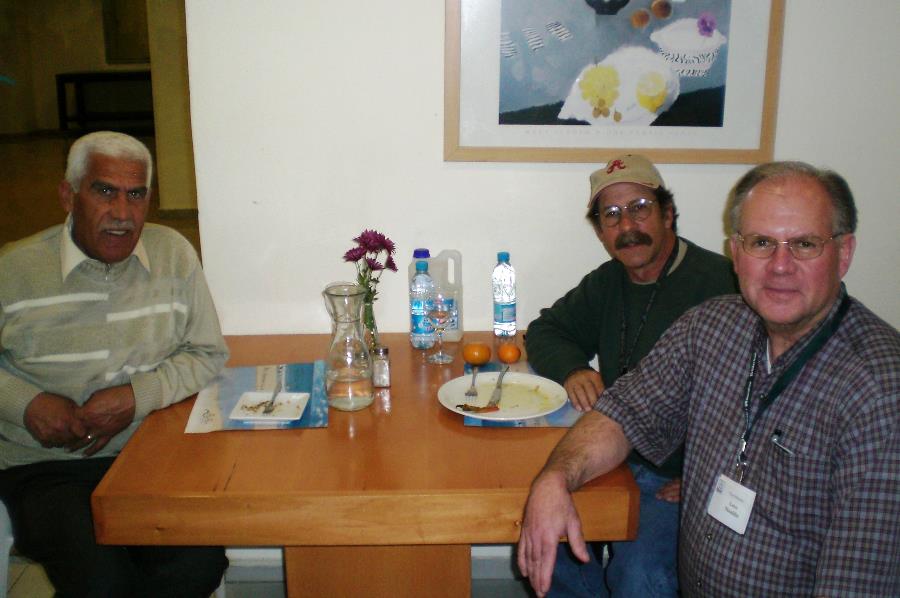
At Natana, Israel. Fawzi, driver at left, and Elie, center. Photo ©Leon Mauldin.

At Natanya, Israel. Fawzi, driver at left, and Elie, center. Photo ©Leon Mauldin.

I selected a few photos from this past Oct. 2013, that are from a variety of places.

At Dan, the northern most city in ancient Israel, and the site of Jeroboam’s shrine, which was condemned by faithful prophets.

Elie at Dan. Photo ©Leon Mauldin.

Elie at Dan. Photo ©Leon Mauldin.

In Jerusalem our group saw the “wailing wall.” At our approach to the site Elie was giving info and instructions.

Elie instructing our group as we neared Wailing Wall. Photo by Gary Kerr, ©Leon Mauldin.

Elie instructing our group as we neared Wailing Wall. Photo by Gary Kerr, ©Leon Mauldin.

At the Jordan River, at the traditional site of the Jesus baptism, there is a high water mark for Jan. 1, 2013. Though the Jordan does not flood as it did in biblical times (see here), it still gets well out of its banks at times as this photo shows. (click to enlarge photo; see info on board upper left).

Upper left shows high water mark reached Jan 2013. Elie is seated; tour member Keith Crews is at right. Photo ©Leon Mauldin.

Upper left shows high water mark reached Jan 2013. Elie is seated; tour member Keith Crews is at right. Photo ©Leon Mauldin.

Of course Masada has tremendous historical significance.

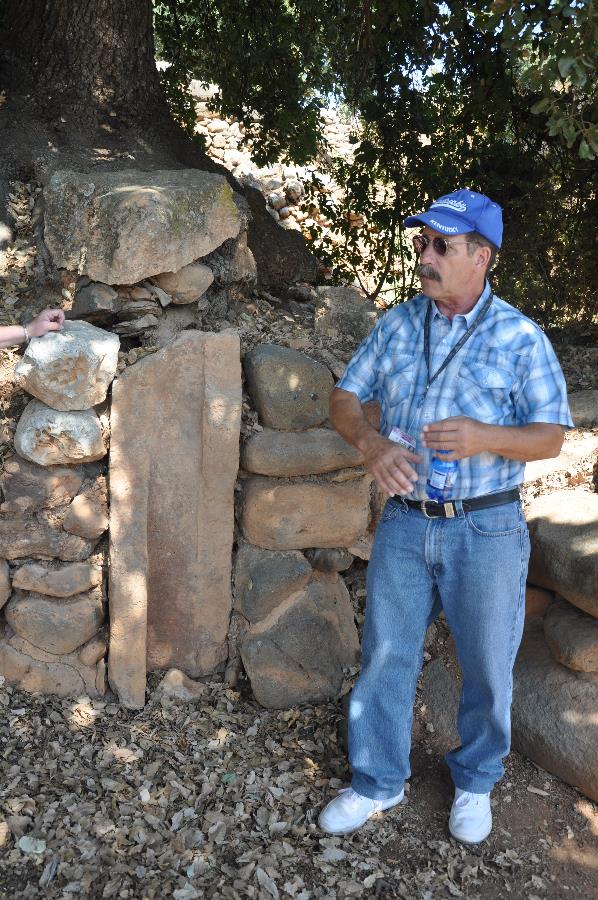
Elie instructing our group at Masada. Photo ©Leon Mauldin.

Elie instructing our group at Masada. Photo ©Leon Mauldin.

At Masada in particular Elie would remind everyone to bring their water.

This sampling also represents somewhat of the tremendous variety within the land of Israel itself. Elie was versatile and well equipped to help us very literally “from Dan to Beersheba.” I hate to say goodbye to old friends. He will be missed.


Decorations at Nicaea’s Eastern Gate

May 31, 2014

Recently we posted here on Nicaea. A remarkable portion of the Roman walls and gates can still be seen.

Some useful info on the decor of the gates at Nicaea and elsewhere can be found here:

Nicaea’s walls are well decorated with reliefs, with large heads, and also with column-shafts, both as horizontal wall-ties and as decoration: in the central one of the three square towers of the north wall, some 37 columns are used to decorate the upper stories and, at the same time, to act as floor-joists. The East Gate has reliefs, still visible, which impressed Kinnear, as did the reliefs and heads on the North (Constantinople) Gate. The south gate, for Bursa, has marble blocks and an inscription. The walls and towers on the north side are noticeably of creamy-white marble (in contrast with the much darker blocks used elsewhere: it is far from fanciful to perceive the desire to create an effect on the side of the city facing Constantinople, since we find exactly the same attention given to marble display in the more important parts of other citadels, such as Seljuk. Thus the antique monuments of Nicaea have been reused in the construction of the first set of mediaeval walls, in a direct echo of the marble prestige of the finest of Constantinople’s set pieces, the Porta Aurea itself.

Nicaea Head Decor at East Gate. Photo ©Leon Mauldin.

Nicaea Head Decor at East Gate. Photo ©Leon Mauldin.

See also Ferrell Jenkins’ earlier post here.


Pagan Temple at Laodicea

May 30, 2014

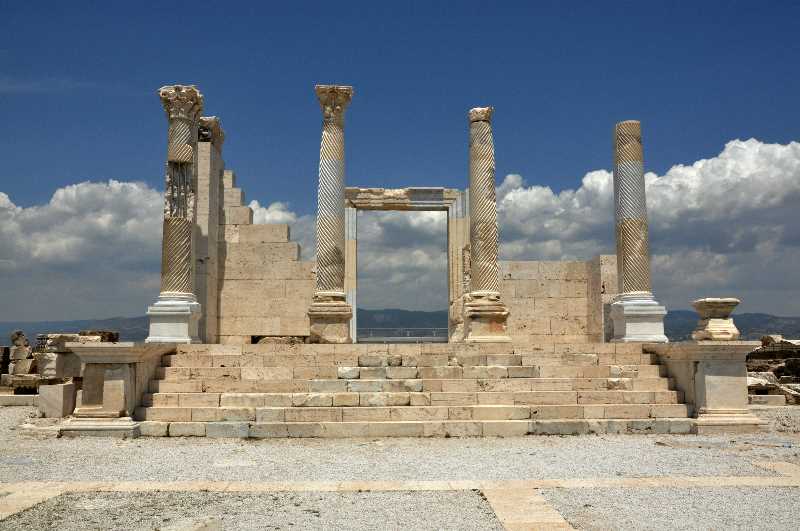
The last few years have seen an enormous amount of excavation in Laodicea. It is still ongoing, as Ferrell Jenkins and I saw several sectors of the very large tel that had teams of workers. One site of importance is the restoration of a pagan temple which reflects some of the wealth and splendor for which this city was famous. Remember God had His people here in Laodicea also, and they were the recipients of the 7th of the Seven Letters (Rev. 2-3).

Pagan Temple at Laodicea. Photo ©Leon Mauldin.

Pagan Temple at Laodicea. Photo ©Leon Mauldin.

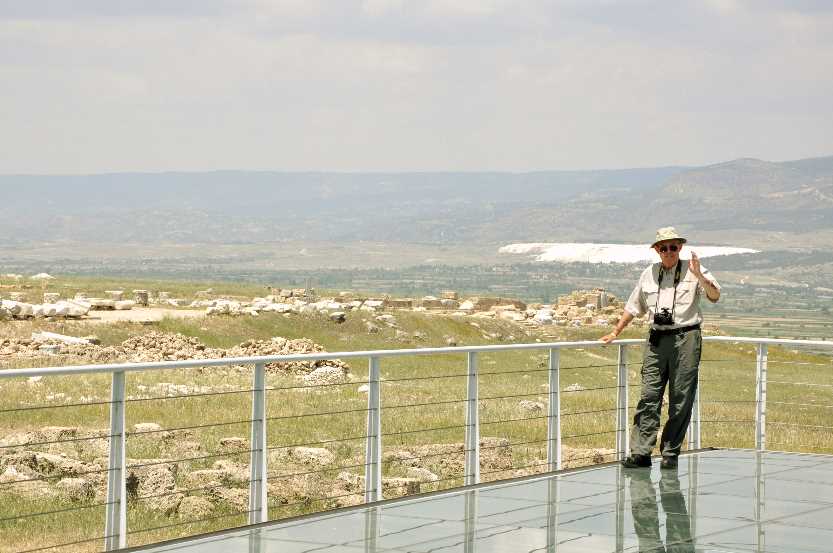
At the back of the temple there is a clear platform through which you can look down and see more excavation several meters below.

Ferrell Jenkins behind temple. The white spot 6 miles distance is Hierapolis. Photo ©Leon Mauldin.

Ferrell Jenkins behind temple. The white spot behind (6 miles distance across the Lycus Valley) is Hierapolis. Photo ©Leon Mauldin.

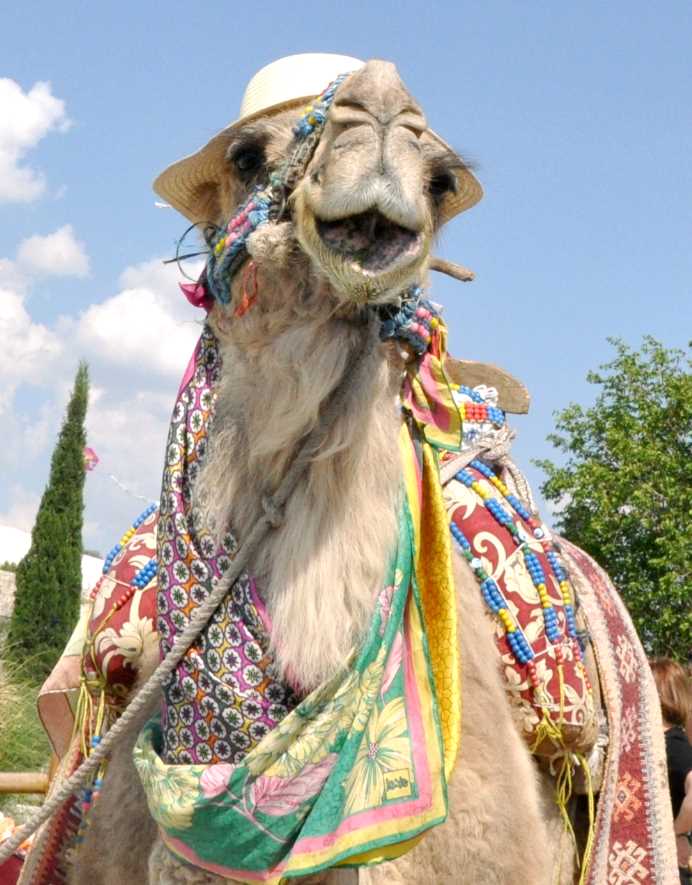
On the lighter side I present you with a camel photo.

Happy Camel at Hierapolis. Photo ©Leon Mauldin.

Happy Camel at Hierapolis. Photo ©Leon Mauldin.

May I say it’s good to be back in Sweet Home Alabama!