Horns of Consecration at Knossos, Crete

April 12, 2023

After the Apostle Paul left the younger evangelist Titus at Crete, he wrote, “For this reason I left you in Crete, that you should set in order the things that are lacking, and appoint elders in every city as I commanded you” (Titus 1:5). There were many cities (Greek polis) on the island of Crete, as can be seen from this map by bibleatlas.org:
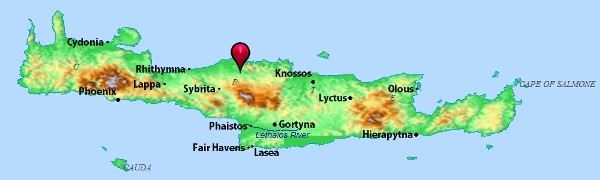
Cities on the Island of Crete. ©bibleatlas.org

In each of these cities where congregations of Christians were established, qualified men were to be appointed to serve as elders (bishops, pastors are biblically interchangeable terms). The list of qualifications was given as follows:

if a man is blameless, the husband of one wife, having faithful children not accused of dissipation or insubordination. For a bishop must be blameless, as a steward of God, not self-willed, not quick-tempered, not given to wine, not violent, not greedy for money, but hospitable, a lover of what is good, sober-minded, just, holy, self-controlled, holding fast the faithful word as he has been taught, that he may be able, by sound doctrine, both to exhort and convict those who contradict.

Titus 1:6-9

The archaeological excavations of Arthur Evans at Knossos got underway in 1900. He is credited with inventing the term “Minoan,” naming the civilization after King Minos, who ruled the island of Crete, according to legend.

A deity worshiped by the Minoans was the bull. In the Biblical Archaeology Society publication (2008), Island Jewels: Understanding Ancient Cyprus and Crete, we read:

Again, we rely on the evidence of frescoes and gems that show how the Minoans practiced an astonishing ritual that consisted of grasping a bull by its horns and leaping over its back. When we add this to the ubiquity of stylized bulls’ horns, so-called “horns of consecration,” as well as the bull’s head rhyta (drinking vessels; singular, rhyton) and vivid portraits of individual beasts, there can be no doubt that the Minoans treated the bull with deep reverence…The bull may well have represented the young male consort of the goddess of love, a pattern that recurs throughout the ancient near east from Tammuz and Ishtar to Venus and Adonis, although if this is the case we cannot even give names to the Cretan versions of the divine couple (pp. 49-59).

BAS

In keeping with this information, note our photo of the gigantic bull’s horns below:
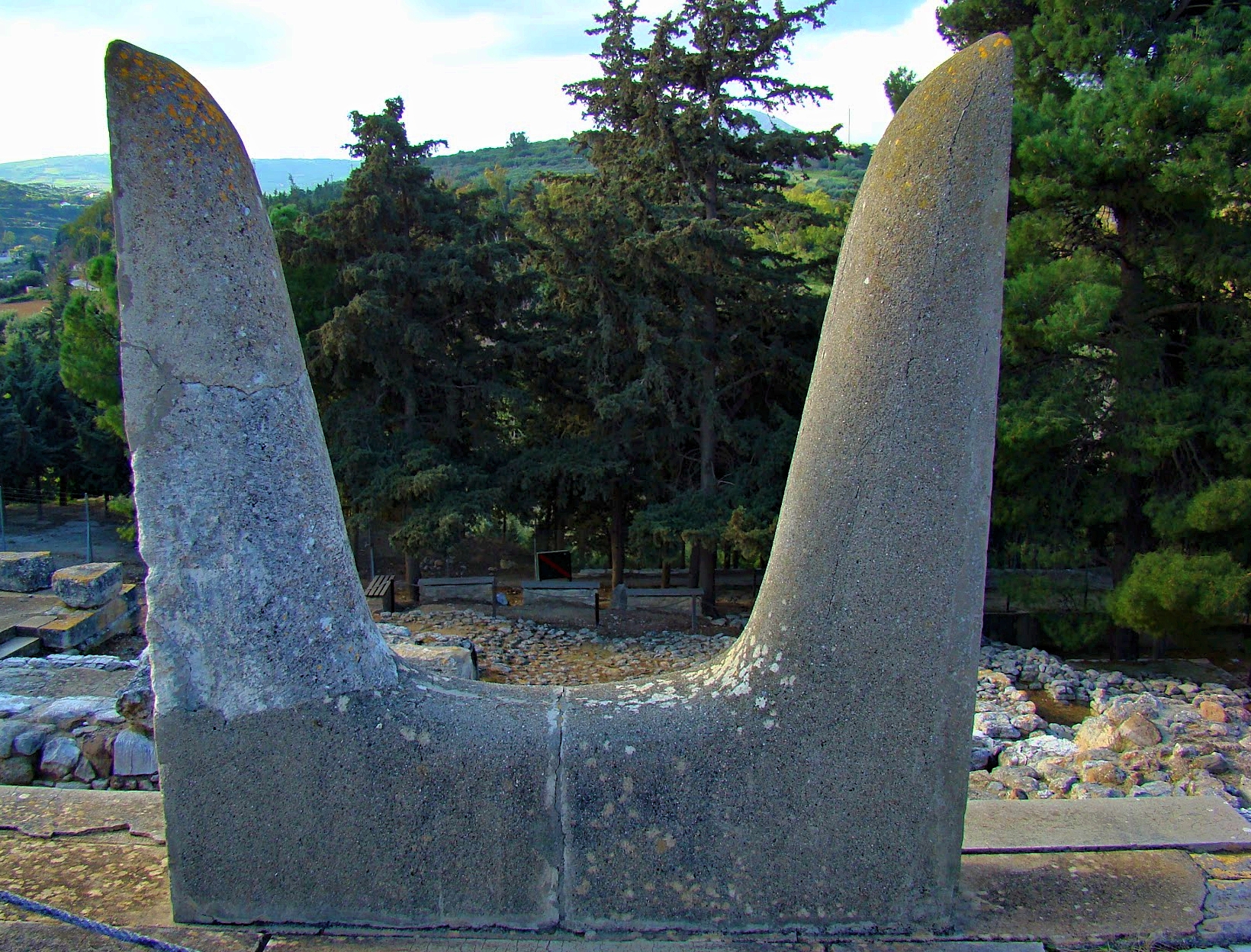
Bull’s horns at Knossos, Crete. Photo ©Leon Mauldin.

It is thought by many that these restored horns symbolized the sacred bull, and that they once adorned the top of the palace at Knossos, Crete.


The palace at Knossos was the largest of the Minoan palaces and served as the home of the legendary king Minos. This palace complex was named and excavated in 1900 by the Englishman Arthur Evans. Arthur Evans is also responsible for naming this sculpture-like object which resembles the horns of a bull, as “”horns of consecration.”” The horns in this slide, which are located outside the South Propylaea at the Knossos complex, are a 20th century reconstruction. Different depictions of horns of consecration can be found throughout Minoan culture, such as on Minoan sarcophagi. Overall, the bull was considered to be a sacred animal in ancient Crete, playing a large role in religious rituals. Since Evans, scholars and archaeologists have debated the true function and meaning of the horns of consecration. One scholar has suggested that these horns were used as seats of honor for nobility or gods. Other scholars have thought that the horns originally served as a pot-support in a hearth. Today, there is still a lack of consensus among scholars as to the function of these horns.
Professor William James Hamblin, https://contentdm.lib.byu.edu/digital/collection/CivilizationHamblin/id/1896/

Pharaoh Chephren/Khafra/Khafre

June 11, 2022

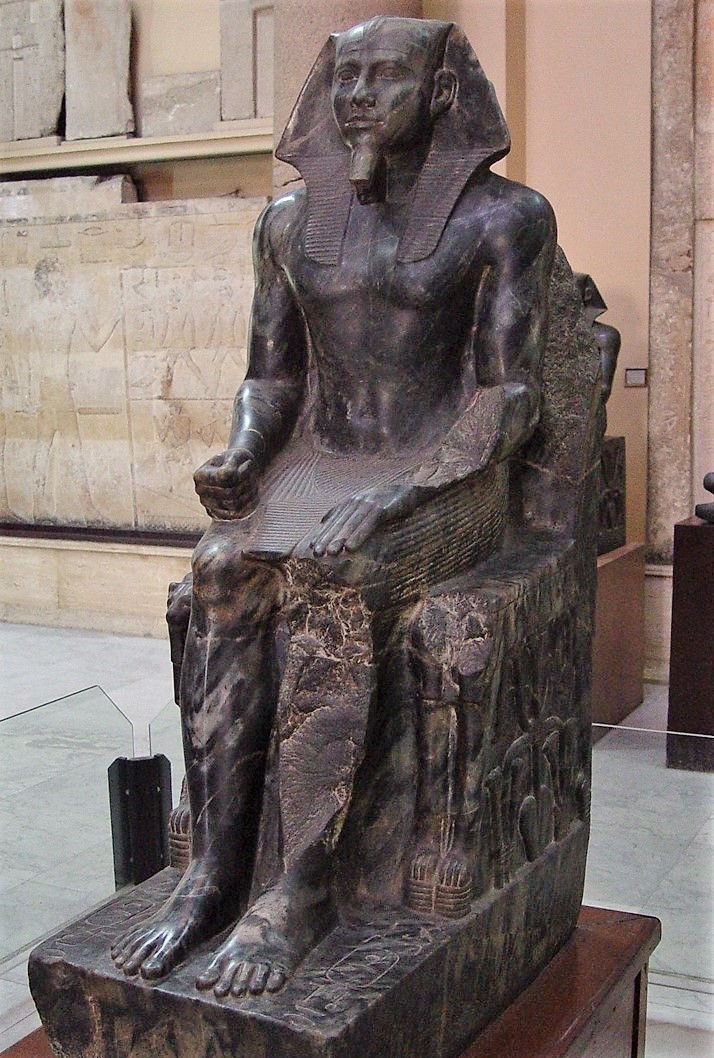
Chephren was pharaoh during Egypt’s 4th dynasty, reigning ca. 2520-2494 BC. He was the son of Cheops (builder of the Great Pyramid), and builder of the second pyramid at Giza. He is also the creator of the Great Sphinx.

This life-sized statue is housed in the Egyptian Museum in Cairo, having been discovered by Auguste Mariette in 1860, in Chephren’s valley temple at Giza. It is made of diorite, a high quality stone. On the stature throne are carved symbols of royalty, the lion paws on the front, and on the sides are displayed the symbol of the sema-tauy, representing the uniting of Upper and Lower Egypt.

Statue of Pharaoh Chephren, Egyptian Museum. Photo ©Leon Mauldin.

Chephren’s feet are bordered by his cartouche. On the back of the royal headdress is the falcon god Horus, god of dynastic divinity in Egyptian mythology. It was believed that Pharaoh was the representative of Horus on earth, while the god manifested himself in the person of the Pharaoh, the living Horus.

Chephren, sideview, shows Egyptian god Horus on his shoulder. Photo ©Leon Mauldin.

Click images for larger view.


The Basilica of Aquileia, Udine Province, Italy

June 10, 2019

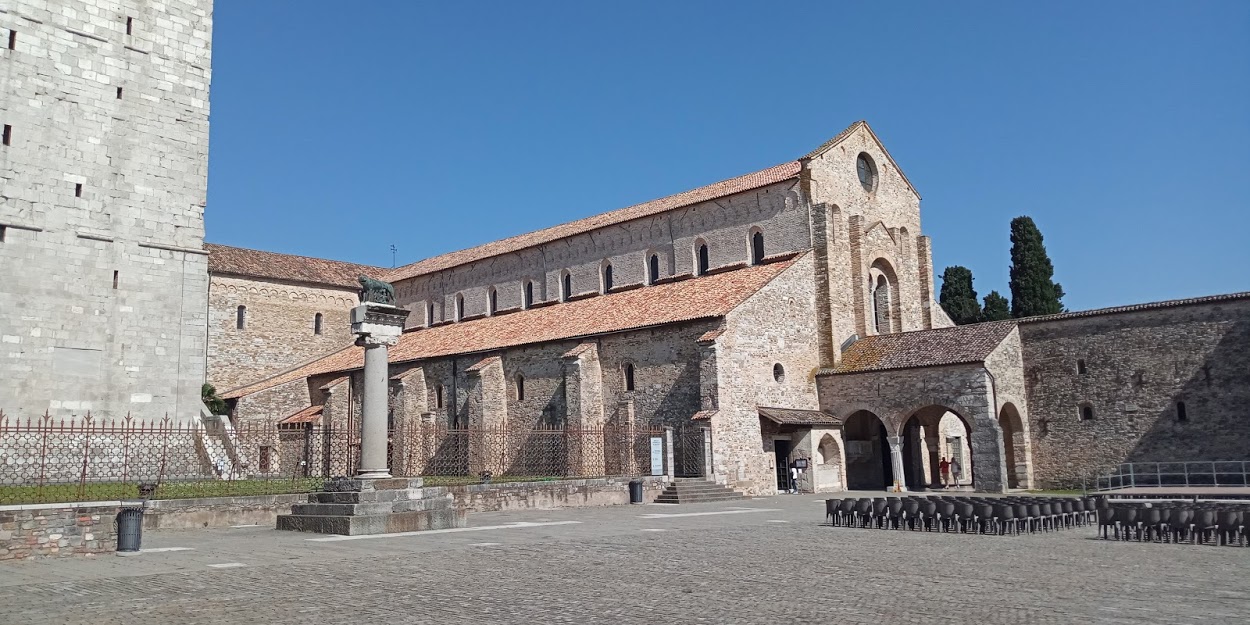
Aquileia is located in Friuli-Venezi-Giulia (Udine Province) Italy, and is listed as a UNESCO site. Construction of the Basilica began in the years following AD 313 and continued over the years through the 14-15th centuries.

Basilica of Aquileia. Photo by Leon Mauldin.

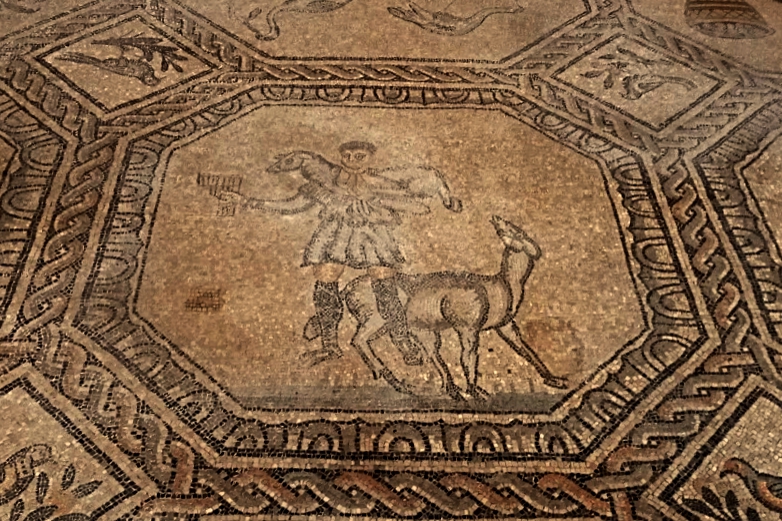
Inside are 760 square meters of mosaics of what is said to be “the largest Paleo-Christian mosaic of the western world.” These date to the late 4th century AD. The mosaic was covered by other flooring over the centuries, and was not uncovered until the years 1909-1912.

Of the many scenes depicted, I wanted to share this photo of the “Good Shepherd.” The on-site brochure states, “Christ is portrayed as a beardless young man bearing the lost lamb upon his shoulders. In one hand he holds the syrinx (the shepherds’ flute), symbol of the gentleness he takes care of his flock with.”

Christ the Good Shepherd. A scene from the mosaic floor. Photo by Leon Mauldin.

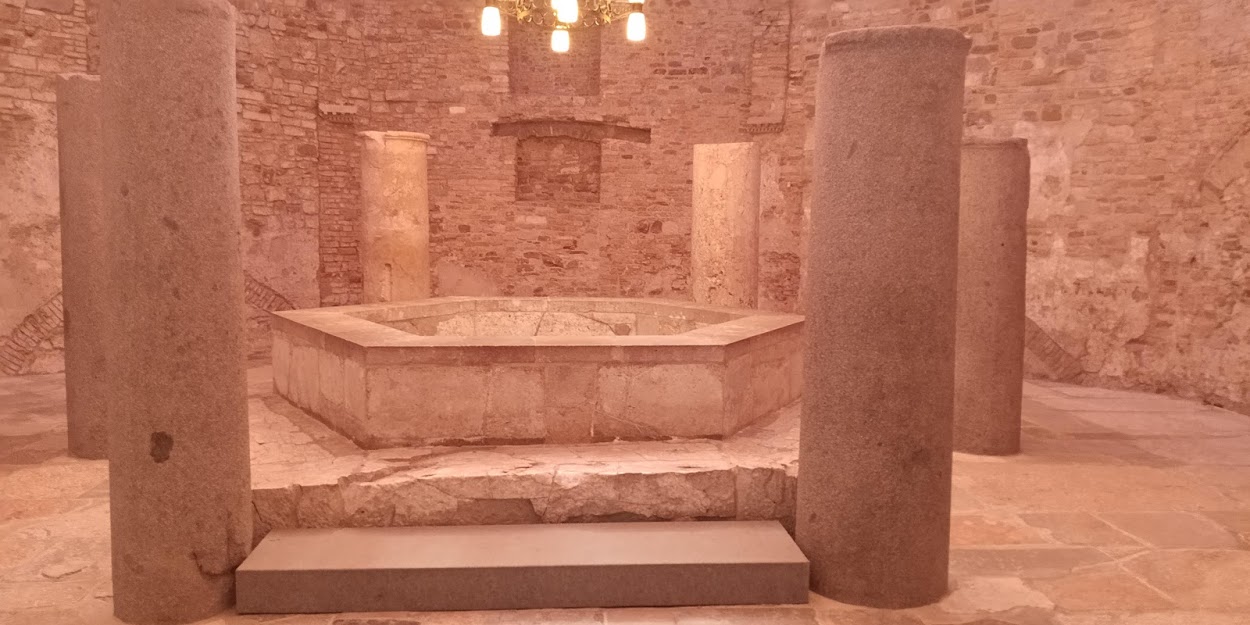
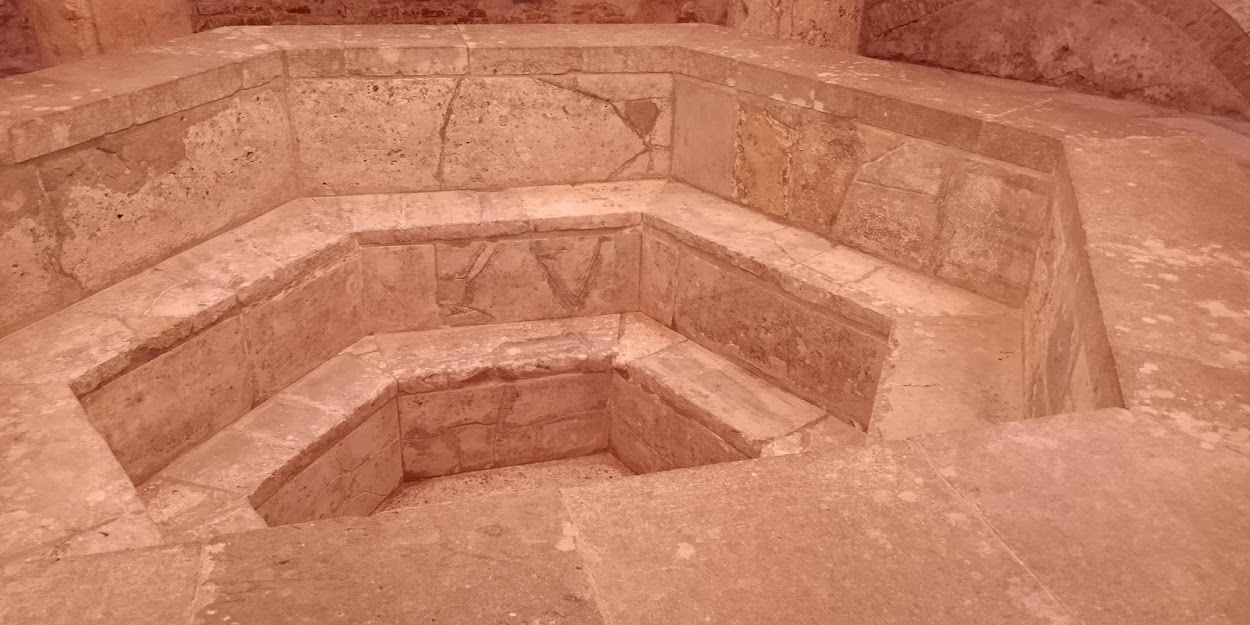
I was also impressed with the baptistery in which immersion took place.

Baptistery at the basilica of Aquileia. Photo by Leon Mauldin.

Here is a view inside the baptistery.

A view looking down inside the baptistery. Photo by Leon Mauldin.

I recently posted on the Good Shepherd motif here.

Click images for larger view.


The “Horns of Moses”

June 14, 2018

One of the innumerable attractions in Rome which we were able to see last week was that of Michelangelo’s Moses, housed (among other artistic works/artifacts) in the Church of San Pietro in Vincoli. The statue of Moses was sculpted by Italian High Renaissance artist Michelangelo Buonarroti, who created this work in the years 1513-1515. This sculpture was originally commissioned in 1505 by Pope Julius II for his tomb.

Michelangelo’s Moses, in Rome. Photo ©Leon Mauldin.

Moses is here depicted as seated, holding the two tablets of stone. Some suggest the intensity portrayed is meant to represent his holy anger when he cast down the stones upon being confronted with Israel’s idolatry.

But to the point of this post, Moses is seen here with two horns on his head. This is based on a rendering of Exodus 34:29 in the Vulgate, the Latin translation of the Bible in use during Michelangelo’s time. The English Standard Version renders the text, which speaks of Moses coming down from Mt. Sinai after talking with God, “When Moses came down from Mount Sinai, with the two tablets of the testimony in his hand as he came down from the mountain, Moses did not know that the skin of his face shone because he had been talking with God.” The Latin Vulgate renders the Hebrew word qaran, “to shine” as “horned.” Hence the horns on Michelangelo’s Moses.

The NET Bible contains this translator note:

The word qaran is derived from the noun qeren in the sense of a “ray of light” (see Hab. 3:4). Something of the divine glory remained with Moses. The Greek translation of Aquila and the Latin Vulgate convey the idea that he had horns, the primary meaning of the word from which this word is derived. Some have tried to defend this, saying that the glory appeared like horns or that Moses covered his face with a mask adorned with horns. But in the text the subject of the verb is the skin of Moses’ face.

The statue stands 8 feet, 4 inches and is made of solid marble.

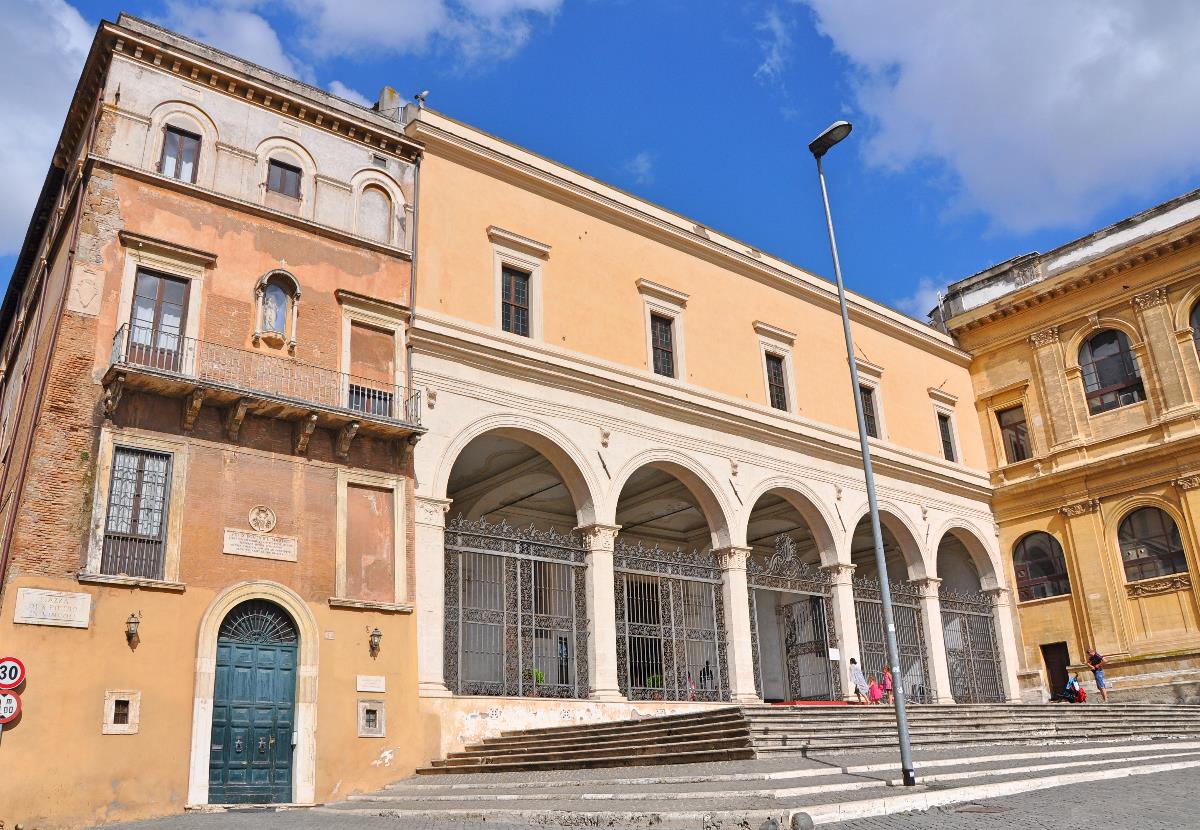
Church of San Pietro in Vincoli, Rome. Photo ©Leon Mauldin.

Click images for larger view.